Estrogen patch dose too high: symptoms to watch for
TL;DR: Signs your estrogen patch dose is too high include breast tenderness or swelling, bloating, nausea, headaches, mood swings, and spotting or heavy bleeding. Most show up in the first few weeks of a new or increased dose, and most ease with a step down. But unexplained bleeding needs evaluation no matter what the dose looks like.
What are the most common symptoms of too much estrogen from a patch?
The list is longer than most people expect, and half of it overlaps with the perimenopausal symptoms you started treating in the first place. That overlap is exactly why an overdose slips by.
The signs reported most often on a transdermal patch: breast tenderness or fullness, bloating and fluid retention, nausea (worst in the first one to two weeks after a dose bump), headaches or migraines, mood changes like irritability or anxiety, and vaginal spotting or irregular bleeding. The FDA-approved prescribing information for estradiol transdermal systems lists all of these as dose-related adverse effects [1].
Skin reactions at the patch site (redness, itching, blistering) show up more at higher doses and with longer patch contact. Those are local, not systemic, but they tell you the skin is being pushed to absorb more estrogen than it wants to.
Some women see a two to four pound gain in the first month that is mostly water, not fat. Others feel a heaviness in the pelvis or breasts that reads differently from ordinary premenstrual changes. A few get leg cramps or puffy hands and ankles.
Here is the trap. Low estrogen and high estrogen both cause headaches and both cause mood swings. Timing is the tiebreaker: if the symptom started or got worse after you raised your dose, excess estrogen is the better bet.
What are standard estradiol patch doses, and how do you know yours is high?
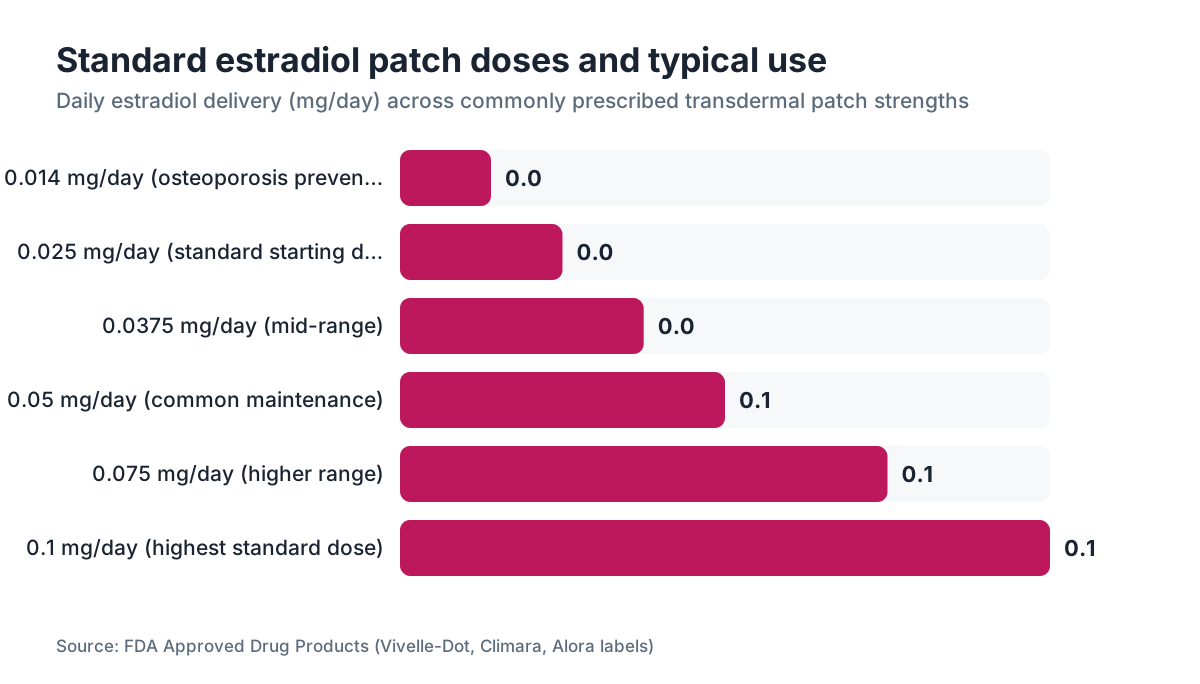
Estradiol patches run from 0.014 mg per day up to 0.1 mg per day, and where you sit on that scale changes everything.
US patch doses span 14 mcg/day (0.014 mg) to 100 mcg/day (0.1 mg). Starting doses for menopausal hormone therapy usually land between 0.025 and 0.05 mg/day [2]. The Endocrine Society's menopause guideline says to start at the lowest effective dose and move up only if symptoms are not controlled [3].
A practical reference:
| Dose (mg/day) | Common brand examples | Typical use | |---|---|---| | 0.014 | Menostar | Osteoporosis prevention only, not hot flash treatment | | 0.025 | Vivelle-Dot, Climara, generic | Standard starting dose | | 0.0375 | Climara, Vivelle-Dot | Mid-range, often used after titration | | 0.05 | Vivelle-Dot, Alora, generic | Common maintenance dose | | 0.075 | Vivelle-Dot, Climara | Higher range; consider symptom review | | 0.1 | Climara, Alora | Highest standard dose; excess symptoms more likely |
Blood levels help, but they are not the whole story. The Menopause Society (formerly NAMS) puts premenopausal follicular-phase estradiol at roughly 20 to 150 pg/mL, and hormone therapy usually aims for the lower end, around 40 to 100 pg/mL for most symptom relief [4]. Trough levels consistently above 150 to 200 pg/mL on a standard patch dose are a signal to reassess.
You do not need labs at every visit on a stable dose. You do want them when symptoms point either way. For more on how the menopause society frames hormone therapy guidelines, that piece walks through the current evidence.
Why does a transdermal patch cause high estrogen symptoms differently than a pill?
The pharmacology here changes both the symptom pattern and the risk profile, so it is worth getting right.
Oral estrogen goes through the gut and gets processed by the liver before it reaches the rest of your body. That first-pass step pumps out certain estrogen metabolites and raises sex hormone-binding globulin (SHBG), which mops up testosterone and can drag on mood and libido. A patch skips the liver. Estradiol moves straight from skin into blood.
So a patch gives a steadier, more predictable serum level without the liver traffic. The flip side: gram for gram, the estrogen reaching your tissues is more bioavailable than what an oral dose delivers. A 0.05 mg patch produces roughly the systemic exposure of 0.5 to 1 mg of oral estradiol, depending on how you absorb [1].
Absorption also shifts with placement, skin temperature, and whether the patch stays stuck. Women who exercise hard, use heating pads, or run warm skin (hot tubs, saunas) can pull in a lot more estrogen than the label promises, because heat opens up skin permeability. That is an underrecognized way to overshoot by accident.
Adhesion matters too. A patch that peels partway, then re-sticks after hours of loose contact, can dump a higher concentration in a shorter window. The daily dose reads the same on paper, but the delivery curve spikes, and spikes make symptoms.
Can too much estrogen from a patch cause breast tenderness and swelling?
Yes. Breast tenderness is one of the most reliable early warnings you have.
Breast tissue is exquisitely estrogen-sensitive. Excess estrogen drives ductal and stromal growth, which is the heaviness, tenderness, and visible swelling women recognize from the back half of their cycle. Same mechanism on a patch. If your breasts feel fuller in the week after a fresh patch goes on, then settle as the patch wears down, that up-and-down timing tells you the peak dose is too high for your tissue sensitivity.
A 2019 study in Menopause found breast tenderness in roughly 10 to 15 percent of women on standard transdermal estradiol, with the rate climbing at higher doses [5]. That is not a rare complaint.
Estrogen-excess breast pain is usually on both sides, diffuse rather than pinpoint, and cyclical if you still have any cycle. One-sided, fixed, or persistent breast pain that ignores your patch schedule needs a clinical breast exam, hormone status or not. The symptom overlap is the whole reason you cannot self-diagnose off breast changes alone.
Dropping one dose step, say 0.075 down to 0.05 mg/day, usually clears this within one to two weeks.
Does excess estrogen from a patch cause bleeding or spotting?
It can, and this is the symptom that earns a phone call to your provider fastest.
Estrogen builds the uterine lining. Without enough progestogen to hold it in check, that lining thickens and sheds on its own schedule, which shows up as breakthrough bleeding or spotting. If you had a hysterectomy and take estrogen alone, spotting is not on the table. If you have a uterus and take estrogen plus a progestogen, spotting in the first three to six months is fairly common while your body settles.
Spotting that starts or worsens after a dose increase, runs past six months, or comes in heavy is a different animal. The Endocrine Society guideline says any unscheduled bleeding on hormone therapy should be evaluated to rule out endometrial pathology, regardless of whether the dose looks high [3]. A transvaginal ultrasound to measure the endometrial stripe is usually step one.
If you are postmenopausal and have gone more than 12 months without a period, any bleeding at all gets evaluated. Hormones or not. The piece on whether bleeding after menopause is always cancer covers exactly this, worth reading before you panic and before you shrug it off.
Estrogen that runs too high without matching progestogen is one of the established risk factors for endometrial hyperplasia, which is why nailing the progestogen dose matters as much as nailing the estrogen dose [6].
Can high estrogen from a patch trigger migraines or make headaches worse?
Yes, and it blindsides a lot of women who started hormone therapy partly to get rid of headaches.
Estrogen and headaches are well documented. Falling estrogen sets them off in most women, the classic menstrual migraine. But rapidly rising or steadily high estrogen can provoke them too, especially in women with a history of migraine with aura. The International Headache Society points to estrogen fluctuation rather than the absolute level as the usual trigger, which is why steady transdermal delivery beats cyclical oral regimens for migraine-prone women [7].
On a twice-weekly patch, headaches that hit on days one to two after each change point to a peak-dose effect: estrogen spikes right after you apply and overshoots. Moving to a once-weekly patch with a flatter curve (like Climara) sometimes helps at the same nominal dose.
New, severe, or one-sided headaches with visual changes, numbness, or slurred speech are neurological red flags. Get care now, not later. High-dose estrogen in women with migraine with aura is tied to higher clot risk [3], so this is not a symptom to manage solo by fiddling with your patch.
What mood symptoms suggest your estrogen patch dose is too high?
Mood effects from excess estrogen are real, and they get pinned on anxiety disorders or life stress far too often.
Too much estrogen can bring irritability, emotional lability (crying easily, reacting hard for no clear reason), anxiety, and in some women a low-grade wired, restless feeling that is not their baseline. A common description: like too much caffeine, all day.
Here is the paradox. Estrogen at the right dose has well-documented mood-stabilizing, near-antidepressant effects. So the conversation with a provider often runs: her mood got worse on HRT, so she must need more estrogen. Sometimes that is right. But if she already has breast tenderness and bloating, and her mood dropped after a dose bump, excess estrogen deserves an equal look.
Progesterone side effects can mimic estrogen-excess mood symptoms, so on a combination patch or cyclic progestogen, figuring out which hormone is driving what takes some systematic work with your prescriber. For how perimenopausal hormone shifts shape mood before menopause even lands, that piece goes deeper.
In women with a personal or family history of hormone-sensitive mood disorders, any HRT dose change deserves a mood check-in within four to six weeks.
What should you actually do if you think your estrogen patch dose is too high?
Do more than rip off the patch and quit cold. That creates a new set of problems.
Sudden estrogen withdrawal can bring hot flashes, wrecked sleep, and mood instability within 24 to 48 hours. None of it is dangerous. All of it is miserable. Here is a saner approach.
First, track your symptoms against the timing of each patch change. Note which day you apply, and write down when symptoms peak and when they ease. Two to three weeks of this makes the provider conversation far more useful.
Second, call your prescriber before you change anything yourself. Most can review it fast and either confirm the dose is fine, drop you one step, or order a serum estradiol level for hard data.
Third, check your technique. Are you rotating sites? Applying heat (heating pad, hot yoga, jacuzzi) near the patch? Is it staying fully stuck? These are mechanical fixes that do not need a prescription change.
If you are with a telehealth menopause practice like WomenRx, a portal message with your symptom log usually triggers a prescriber review and dose adjustment within a day or two. You do not have to wait for your next appointment.
If your symptoms include chest pain, shortness of breath, sudden severe headache, vision changes, or calf swelling and pain, skip the portal and call 911 or go to the ER. Those can signal a venous thromboembolic event, a rare but real risk with estrogen therapy, higher at higher doses or with other risk factors [1].
How long does it take for high-estrogen symptoms to resolve after a dose reduction?
Most people feel clearly better within two to four weeks.
Transdermal estradiol has a serum half-life of about 36 hours after you pull the patch [1]. So within two to three days of switching to a lower dose, circulating estrogen drops toward the new equilibrium. Tissue effects (breast tenderness, endometrial stimulation) lag because cells need time to register the quieter signal.
Bloating and fluid retention usually clear in one to two weeks. Breast tenderness eases in two to three. Mood takes three to four, partly because mood always runs behind the physical stuff.
If you cut the dose and symptoms drag past six weeks, the original problem may not have been dose-related, or something else is feeding it. Thyroid dysfunction mimics several estrogen-excess symptoms, for one. If you have not had a thyroid panel lately, check. The thyroid hormone replacement therapy piece explains how thyroid and estrogen interact and which labs to ask for.
Some women who step down find the lower dose no longer holds their hot flashes or sleep. That is a genuine trade-off and a judgment call, not a failure.
Is there a blood test that confirms too much estrogen from your patch?
There is, though reading it takes some care.
A serum estradiol (E2) drawn the day before or the morning of a patch change (a trough) gives you the low point of your patch cycle. One drawn 12 to 24 hours after a fresh patch gives you something near the peak. Both are useful, for different reasons.
The Menopause Society puts the serum estradiol target for symptom relief in postmenopausal women at roughly 40 to 100 pg/mL, though individual response varies a lot [4]. A trough consistently above 150 to 200 pg/mL on a standard dose, or a peak above 300 pg/mL, says the patch is delivering more than the therapeutic goal needs.
Timing is everything. Estradiol drawn at random points in the cycle can mislead. Ask your provider when to draw it, or ask that it always be drawn at trough so you can compare over time.
Saliva and urine hormone tests get marketed as better options, but neither has strong evidence for guiding HRT dosing against serum testing. The Endocrine Society does not recommend salivary estradiol for monitoring transdermal therapy, because absorption into saliva is variable and does not track serum levels reliably [3].
Are some women more sensitive to estrogen and prone to symptoms at lower doses?
Yes, and it is one of the most underappreciated parts of managing HRT.
Estrogen receptor density, genetic variants in estrogen-metabolizing enzymes (CYP1A2, CYP3A4, COMT), body fat percentage, and baseline skin absorption all change how much biological effect a given patch dose produces. Two women in the same 0.05 mg/day patch can land at serum estradiol levels that differ two- or threefold.
Women with lower body weight absorb transdermally at about the same rate as heavier women but have less volume to distribute into, so serum levels can run higher. Women with higher skin blood flow from training may absorb more. Women with slower hepatic estrogen metabolism can accumulate more.
That is why starting low and titrating slowly (the rule from both NAMS and the Endocrine Society) is more than caution for caution's sake. The labeled dose is an average, not a promise of any particular serum level.
If you keep hitting excess symptoms at doses other women tolerate fine, ask about COMT or estrogen metabolism testing. It is not universally available or covered, but it can explain persistent sensitivity and guide dosing in a way symptom tracking alone cannot.
What happens if high estrogen from a patch goes untreated for months?
Short term, the cost is discomfort: breast tenderness, bloating, mood trouble, irregular bleeding. Long term, over-exposure to estrogen without enough progestogen to oppose it carries a documented risk of endometrial hyperplasia and, at sustained high levels, endometrial cancer [6].
The Women's Health Initiative, which studied conjugated equine estrogen plus medroxyprogesterone acetate (not transdermal estradiol, an important distinction), did not show increased endometrial cancer risk in women with intact uteri who took combined therapy correctly [8]. The operative word is opposed. Estrogen alone in a woman with a uterus, or combined therapy where the progestogen is underdosed against the estrogen, is a different story.
The NAMS hormone therapy position statement is blunt: "Adding a progestogen is required for all women with a uterus to prevent estrogen-stimulated endometrial hyperplasia and carcinoma" [4]. That is a direct quote, and it earns its weight.
Breast cancer risk is murkier. Observational data tie long-term combined HRT (five years or more) to a small absolute rise in breast cancer risk, but transdermal estradiol with progesterone (not synthetic progestins) looks lower-risk than oral combined therapy [9]. This is still active research, not settled science.
The practical read: persistent high-dose estrogen without monitoring and progestogen management is a real clinical problem, more than a matter of managing symptoms.
Frequently asked questions
How quickly do estrogen patch overdose symptoms appear?
Most develop within the first one to two weeks after a new or increased dose. Breast tenderness and bloating come earliest. Mood changes can take two to four weeks to show clearly. If symptoms hit within 24 to 48 hours of a new patch, a local skin reaction or a rapid absorption spike is more likely than a true systemic overdose.
Can I cut my estrogen patch to lower the dose?
For matrix-type patches, where estradiol sits throughout the adhesive layer, cutting is technically feasible and some providers do recommend it. Reservoir-type patches, where estradiol is in a central gel chamber, should never be cut, because that wrecks the rate-control membrane. Ask your pharmacist which type you have before you try, and only do it with your prescriber's explicit okay.
What is the difference between estrogen excess symptoms and estrogen deficiency symptoms?
Deficiency brings hot flashes, night sweats, vaginal dryness, poor sleep, and joint aches. Excess brings breast tenderness, bloating, nausea, headaches, mood changes, and spotting. Headaches and mood swings can turn up in both states, which is why timing against a dose change is the best diagnostic clue. A serum estradiol level helps when the picture is ambiguous.
Does nausea from an estrogen patch mean the dose is too high?
Nausea in the first one to two weeks of a new patch or dose bump is common and often settles on its own. Nausea that runs past two to three weeks, or that returns with each new patch, points more to excess. Nausea is less common from a patch than from oral estradiol because the liver is out of the loop, so when it happens transdermally, review the dose.
Can too much estrogen from a patch affect my sex drive?
Yes, and it is a paradox. Excess estrogen raises sex hormone-binding globulin (SHBG), which binds and inactivates testosterone. Lower free testosterone drops libido, genital sensitivity, and energy. If your sex drive fell after a dose increase, raise this mechanism with your provider and ask for a free testosterone or SHBG level.
How do I know if my patch is delivering more estrogen than the label says?
A serum estradiol drawn at trough (morning before a patch change) is the most practical check. Levels consistently above 150 to 200 pg/mL on a standard dose suggest over-absorption. Application site (abdomen vs buttock), skin temperature, exercise habits, and full adhesion all shift delivery. Heat near the patch site is a common culprit for unexpectedly high levels.
Is weight gain a sign of too much estrogen on a patch?
The weight gain tied to excess estrogen is fluid retention, not fat. You might see two to four pounds of water that tracks your patch cycle or a recent dose increase. Fat redistribution toward hips and thighs is more about normal hormonal change than excess specifically. Rapid or large weight gain needs evaluation beyond the estrogen dose.
Should I remove my estrogen patch immediately if I think the dose is too high?
Do not pull it without talking to your provider first. Sudden removal drops estrogen sharply, which can trigger rebound hot flashes, wrecked sleep, and mood instability within 24 to 48 hours. A planned step-down to the next lower dose is almost always safer and more comfortable. If you have symptoms of a serious event (chest pain, sudden severe headache, leg swelling), that changes everything, and you should seek emergency care.
Can high estrogen from a patch increase clot risk?
Transdermal estradiol carries substantially lower venous thromboembolism risk than oral estrogen, because it skips the liver's first-pass effect on clotting factors. But the risk is not zero, particularly at higher doses or in women with clotting disorders, obesity, or long immobility. The Endocrine Society recommends the transdermal route over oral in women with elevated baseline VTE risk, though dose still matters.
What should I tell my doctor if I think my patch dose is too high?
Bring a two to three week symptom diary with patch-change dates, symptom onset, and severity. Tell your doctor which dose you are on, how long you have been on it, and whether symptoms began at the start or after an increase. Mention any recent changes in exercise, hot tub or sauna use, or application technique. Ask for a serum estradiol level if you have not had one in three to six months.
Does the brand of estrogen patch affect how likely I am to get excess symptoms?
Different patch technologies release estradiol differently. Reservoir patches (older design) can release it less evenly than matrix patches. Larger patch surface areas generally deliver higher doses. Switching brands at the same labeled dose sometimes changes absorption enough to produce new symptoms. If yours started after a pharmacy swapped your brand, flag it.
Can high estrogen from a patch cause insomnia even though estrogen is supposed to improve sleep?
Yes. At the right level, estrogen improves sleep architecture and cuts night sweats. But excess can bring a restless, wired quality, especially in the first days after a patch goes on, that blocks sleep onset. Some women also report vivid dreams or early waking. If sleep got worse after a dose increase instead of better, put excess estrogen on the differential alongside progesterone dosing.
How does a doctor decide the right estrogen patch dose after symptoms of excess?
Usually by stepping down one level, rechecking symptoms at four to six weeks, and ordering a trough serum estradiol to confirm the new level is in range. If hot flashes and night sweats return at the lower dose, there may be a middle ground through adjusting progestogen, patch type, or application frequency rather than jumping back to the higher estrogen dose. It often takes two to three iterations to land in the right zone.
Sources
- FDA, Estradiol Transdermal System prescribing information (Vivelle-Dot label)
- FDA, Drug database: approved estradiol transdermal products
- Endocrine Society, Clinical Practice Guideline: Treatment of Menopause
- The Menopause Society (NAMS), Hormone Therapy Position Statement 2022
- Menopause journal, Pinkerton et al., 2019, breast tenderness rates with transdermal HRT
- NCI, Endometrial Cancer Risk Factors, estrogen without progestogen
- International Headache Society, Headache Classification and Hormonal Contraception/HRT guidance
- Women's Health Initiative, JAMA 2002 and 2004 publications, WHI HRT trials
- Fournier et al., Breast Cancer Research 2008, E3N cohort, transdermal estradiol and breast cancer risk
- Endocrine Society, Position on Laboratory Testing in Menopause Management