Estrogen patch cost: what you'll actually pay in 2025
TL;DR: Generic estradiol patches cost roughly $30 to $80 a month out of pocket, depending on dose and pharmacy. Brand options like Vivelle-Dot or Climara run $250 to $320 at retail without insurance. Most Medicare Part D and commercial plans cover at least one generic. GoodRx and similar coupons routinely cut the cash price 60 to 80 percent at major chains.
What do estrogen patches cost without insurance?
It depends on the brand, the dose, and the pharmacy. The range is wide enough that paying cash without checking coupons first is almost always a mistake.
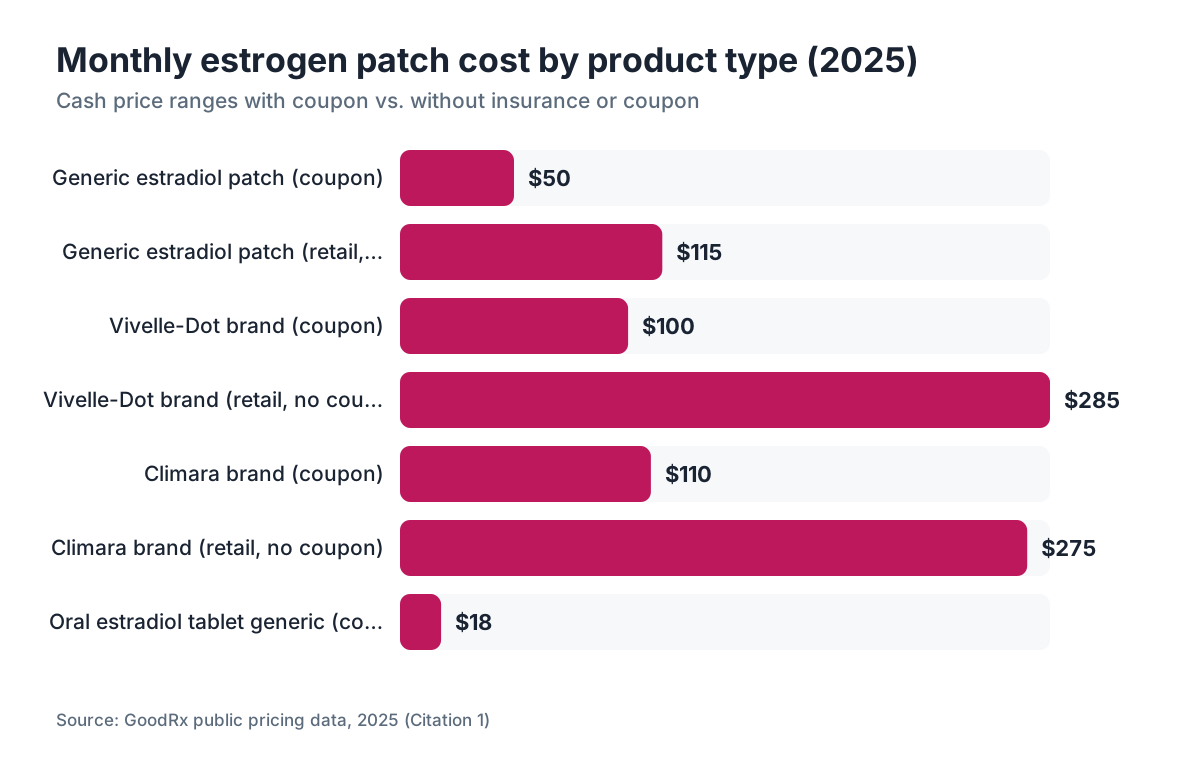
Generic estradiol transdermal patches, which are bioidentical to the 17-beta estradiol your body makes, are the cheapest choice. A one-month supply (usually 8 patches on the twice-weekly schedule, or 4 for weekly patches) runs roughly $30 to $80 at most major chains with a GoodRx or similar coupon [1]. Without a coupon, the retail cash price at those same pharmacies often lands between $80 and $150 for generics.
Brand-name patches are another world. Vivelle-Dot, Climara, and Minivelle carry much higher list prices. Vivelle-Dot 0.05 mg (twice-weekly, 8 patches) has a list price that can top $250 to $320 at retail without insurance or coupons [2]. Climara, a once-weekly patch, sits in a similar range. These brands are therapeutically equivalent to their generics for most women, and the FDA requires generic makers to show comparable bioavailability, so paying brand prices out of pocket is rarely medically necessary.
Compounded estradiol patches are a separate category. Compounding pharmacies can prepare custom-dose patches, but they are not FDA-approved, are rarely covered by insurance, and tend to cost $60 to $150 or more a month depending on the pharmacy and formulation. Unless you have a specific clinical reason, the FDA-approved generic is the better starting point.
One more thing. Dose barely moves the price. The 0.025 mg, 0.05 mg, 0.075 mg, and 0.1 mg strengths usually cost within a few dollars of each other at the same pharmacy, so don't let money push you into a dose that fails to control your symptoms.
How much do estrogen patches cost with insurance?
Most commercial plans and Medicare Part D cover at least one generic estradiol patch, often in Tier 1 or Tier 2. Tier 1 generics usually carry a copay of $0 to $15 a month. Tier 2 generics run $15 to $45 [3]. Before your deductible is met, you may pay the full negotiated rate, which can push your cost back toward $50 to $80 even with insurance.
Medicare Part D covers estradiol patches under the prescription drug benefit. Your exact copay depends on which Part D plan you picked and which tier the drug sits on. CMS data show the average Part D enrollee copay for a Tier 1 generic is around $1 to $5 in 2025, though that varies [3]. If a brand patch is on your formulary at all, expect Tier 3 or Tier 4 placement, with copays of $45 to $100 or more per fill.
Employer plans under the ACA must cover preventive services without cost-sharing when those services carry an A or B rating from the US Preventive Services Task Force. Hormone therapy for menopausal symptoms is not on the USPSTF A/B list, so it is not mandated to be free, and most plans apply normal cost-sharing [4]. Many plans still cover it generously.
Have a high-deductible health plan paired with an HSA? You can pay for patches with pre-tax dollars. That gives you an effective 22 to 37 percent discount depending on your marginal tax rate, which matters if you're paying mostly out of pocket.
The single most useful move before you fill: call your plan's pharmacy benefits number, ask for the formulary tier and expected copay for the exact NDC your prescriber wrote, then cross-check the GoodRx price. Sometimes the coupon beats your copay.
Brand vs. generic estrogen patch prices: a direct comparison
Here is a realistic price table based on commonly reported retail and coupon prices in 2025. Prices vary by region and change often, so treat these as ballpark figures and verify at your pharmacy.
| Product | Dose | Schedule | Patches/Rx | Retail cash price | GoodRx/coupon price | |---|---|---|---|---|---| | Estradiol patch (generic) | 0.05 mg | Twice-weekly | 8 | $80, $150 | $30, $60 | | Estradiol patch (generic) | 0.1 mg | Twice-weekly | 8 | $85, $155 | $35, $65 | | Vivelle-Dot (brand) | 0.05 mg | Twice-weekly | 8 | $250, $320 | $70, $130 | | Climara (brand) | 0.05 mg | Once-weekly | 4 | $240, $310 | $80, $140 | | Minivelle (brand) | 0.05 mg | Twice-weekly | 8 | $220, $290 | $65, $120 | | Alora (brand) | 0.05 mg | Twice-weekly | 8 | $210, $280 | $60, $115 |
Sources: GoodRx public price data [1] and FDA Orange Book for approved formulations [2].
The FDA Orange Book lists all approved estradiol transdermal products and their therapeutic equivalence ratings [2]. An "AB" rating means the FDA has determined the generic is therapeutically equivalent to the reference brand. Most generic estradiol patches carry this rating, which is why most clinicians (and most insurance formulary committees) treat them as interchangeable.
One practical note. Different generic makers use slightly different patch sizes and adhesives. Some women find one generic sticks better or irritates the skin less than another. If you have adhesion trouble with one, ask your pharmacist to dispense a different manufacturer's version at your next fill. It has nothing to do with cost, but it comes up constantly in real conversations.
How can I lower my estrogen patch cost right now?
A few concrete moves that work.
Check GoodRx, RxSaver, or the pharmacy's own savings program before every fill. At Costco, Walmart, and some independent pharmacies, generic estradiol patches sometimes run under $30 a month with a coupon. These prices are not advertised. You have to look them up [1].
Ask for a 90-day supply instead of 30 days. Most pharmacies charge a lower per-patch price at 90 days, and some plans allow 90-day mail-order fills at a lower copay tier.
Ask your prescriber to write it as generic estradiol transdermal, substitution permitted, at the lowest dose that controls your symptoms. A prescription written brand-name-only is one you may overpay for.
On Medicare, compare Part D plans every year during Open Enrollment (October 15 through December 7). The Medicare Plan Finder at Medicare.gov lets you enter your drugs and see which plan covers them at the lowest total cost [3]. Estradiol patch costs across plans can differ by $300 or more a year for the same drug.
If your physician has a clinical reason to prescribe a specific brand, look at manufacturer savings programs. Bayer (Climara), Noven (Minivelle), and others have historically offered savings cards for commercially insured patients, though not for Medicare or Medicaid enrollees. These programs change, so check the manufacturer's website directly.
One thing that does not work: buying from unregulated international online pharmacies to save money. The FDA has warned about counterfeit and subpotent hormone products bought this way [5]. The savings aren't worth the clinical risk when domestic generic prices are already low with a coupon.
Does Medicare cover estrogen patches, and what will I pay?
Yes. Medicare covers estrogen patches through Part D. They are not covered under Part A or Part B as a standard outpatient prescription [3].
Under the Inflation Reduction Act of 2022, Medicare Part D now caps out-of-pocket drug spending at $2,000 a year starting in 2025 [6]. For most women on estrogen patches, this cap won't come into play, because a generic patch usually runs well under $2,000 a year even at retail. If you take other expensive medications alongside estrogen, the cap matters a lot.
Medicare does not cover compounded estradiol patches, because compounded drugs lack FDA approval. If your only option at a given dose is a compounded formulation, you'll pay out of pocket.
Medicare Advantage (Part C) plans include drug coverage that mirrors Part D rules, but the specific formulary and tier placement can differ plan to plan. Verify coverage under your specific Advantage plan rather than assuming it matches standard Part D.
For women on Medicaid, coverage varies by state. Most state Medicaid programs cover at least one generic estradiol patch, but prior authorization rules and quantity limits differ. Your state's Medicaid drug formulary is where to check.
What is the monthly cost of estrogen patches compared to other hormone therapy forms?
Estrogen comes in several forms, each with its own price range. The patch is neither the cheapest nor the priciest.
Topical estradiol gel (EstroGel or generic estradiol gel 0.06%) runs roughly $40 to $100 a month with a coupon for the generic. Brand EstroGel costs substantially more. Vaginal estradiol cream treats genitourinary symptoms rather than systemic ones and costs $30 to $80 a month for generic.
Oral estradiol tablets are usually the least expensive form. Generic estradiol 1 mg or 2 mg tablets cost as little as $10 to $25 a month at many pharmacies with a coupon [1]. But oral estrogen goes through the liver first (first-pass metabolism), which shifts its safety profile compared to transdermal estradiol. The ESTHER study (Circulation, 2007) found transdermal estradiol was not associated with the elevated blood clot risk seen with oral estrogen [7]. That difference is why many clinicians now prefer the patch even though it costs more than a tablet.
Estradiol spray (Evamist) is similar to gel and sits in the $60 to $120 range with coupons.
Progesterone (if you have a uterus, you need it alongside estrogen) adds another $15 to $60 a month depending on whether you use oral micronized progesterone (generic Prometrium), a progestin tablet, or a progestin-releasing IUD. If you want to understand how estrogen and progesterone work together, the progesterone article covers it in detail.
| Form | Generic monthly cash price (coupon) | Liver first-pass? | |---|---|---| | Estradiol tablet | $10, $25 | Yes | | Estradiol patch | $30, $80 | No | | Estradiol gel | $40, $100 | No | | Estradiol spray | $60, $120 | No | | Brand patch (Vivelle-Dot, Climara) | $70, $140 | No |
The patch costs more than the pill. For most women who can use either form, the transdermal route carries a real safety edge, and the price gap is small enough that most clinicians consider it worth paying.
What factors determine which estrogen patch dose I need, and does that affect cost?
Your dose comes from your symptoms, your hormone levels (though symptom relief, not chasing a lab number, is the goal), and your prescriber's judgment. Twice-weekly patches typically come in 0.025, 0.0375, 0.05, 0.075, and 0.1 mg per day. Once-weekly patches like Climara range from 0.025 mg to 0.1 mg.
As the comparison table shows, cost barely moves across doses, usually a few dollars per fill for generics. Don't choose a dose by price. Undertreating symptoms to save money is a false economy when bone density, sleep, and cardiovascular risk factors all ride on adequate estrogen during menopause [8].
For the wider hormonal picture during this transition, the menopause and perimenopause age articles give good context. The hormone replacement therapy guide covers the evidence on benefits and risks in more depth.
Women starting therapy are often begun at 0.05 mg and adjusted after 8 to 12 weeks based on how their symptoms respond. The North American Menopause Society recommends the lowest effective dose for the shortest duration consistent with treatment goals and individual risk [8]. That guidance is about safety, not money, but it happens to be financially reasonable too.
Can I get estrogen patches through telehealth, and does that change the cost?
Yes. Telehealth prescribers can write for estrogen patches in most US states, and you fill them at any licensed pharmacy. The patch price at the pharmacy is the same whether the prescription came from a telehealth visit or an in-person clinic.
The visit cost is the variable. An in-person OB-GYN or primary care visit to discuss menopause symptoms typically costs $150 to $350 without insurance, or a specialist copay of $40 to $80 with insurance. Telehealth hormone visits tend to run $50 to $150 for the initial consult and less for follow-ups. For women in rural areas or without a nearby menopause-trained clinician, telehealth narrows both the access gap and, often, the cost gap.
Platforms like WomenRx offer telehealth consultations built for hormone therapy, with prescriptions sent to your preferred pharmacy. You still use insurance or a coupon at the pharmacy for the patch itself, so there's no markup on the medication.
Verify one thing with any telehealth service: confirm they prescribe FDA-approved estradiol patches filled at a licensed US pharmacy, not a compounding arrangement that bypasses standard oversight. Compounded hormones have legitimate uses in specific situations, but they should be the exception, not the default.
Are estrogen patches covered by FSA or HSA funds?
Yes. Estrogen patches are prescription medications and qualify as eligible medical expenses under both Flexible Spending Accounts and Health Savings Accounts [9]. You can pay for them with pre-tax FSA or HSA dollars at the pharmacy.
For HSA holders, the tax advantage stacks: contributions reduce your taxable income, growth is tax-free, and withdrawals for qualified medical expenses (including prescription estradiol patches) are tax-free. If you're in the 24 percent federal bracket and pay $70 a month for patches, using HSA funds is like paying about $53. Over a year, that's roughly $200 saved on the patch alone.
FSA funds work the same way but carry use-it-or-lose-it rules in most plans (with a small rollover allowance). If you have an FSA, account for your annual patch cost when you set your election amount.
You cannot use HSA or FSA funds for compounded medications unless they are prescribed and classified as prescription drugs. Some compounding pharmacies provide documentation for this. Others don't. Ask before you pay.
What are the hidden costs of estrogen patches most women don't think about?
The patch itself is usually the smallest line item once you add up what hormone therapy actually costs in practice.
Prescribing visits: in-person or telehealth, you'll pay for the initial consult and periodic follow-ups, at least annually. Budget $100 to $300 a year, depending on your coverage.
Progesterone: if you have a uterus, you need progestogen protection. Generic oral micronized progesterone (the bioidentical option) runs $15 to $50 a month. See the progesterone article for a full breakdown.
Lab work: some clinicians check estradiol and occasionally FSH levels when starting or adjusting therapy. Quest and LabCorp cash prices for estradiol run $30 to $80 per draw without insurance. With insurance, many are covered as part of a routine management visit.
Bone density monitoring: NAMS recommends considering a DXA scan in women with risk factors for osteoporosis, since estrogen loss speeds bone loss during menopause [8]. A DXA scan costs $150 to $300 without insurance. See the bone density test article for what's covered and when to get one.
Adhesion products: some women with sensitive skin or active lifestyles need medical-grade skin tape to keep patches in place. Not expensive, usually $10 to $20 a month, but not zero.
Adding it up: a realistic annual budget for patch therapy with generic medication, progesterone, one prescribing visit, and one lab draw is roughly $800 to $1,500 out of pocket for an uninsured or underinsured woman. With good insurance, the same regimen can run $200 to $400 a year.
What does the research say about cost-effectiveness of estrogen patches?
Cost-effectiveness research on hormone therapy measures cost per quality-adjusted life year gained, and the findings tend to favor estrogen therapy for symptomatic women, especially when started early in the transition.
Analyses published in Menopause, the journal of the Menopause Society, find that transdermal estradiol is cost-effective for menopausal symptom management and may produce downstream savings tied to reduced osteoporosis fracture risk in appropriately selected women [10]. The WHI re-analysis by Manson et al. (JAMA, 2017) showed the absolute risk-benefit balance for women who started HRT before age 60 or within 10 years of menopause onset was favorable for most, which feeds directly into cost-effectiveness math [11].
None of this makes estrogen patches right for every woman. NAMS is clear that therapy should be individualized by symptom burden, breast cancer risk, cardiovascular disease, blood clot history, and personal preference [8]. For symptomatic women without contraindications, the cost-effectiveness case is reasonably solid.
The NAMS 2022 Hormone Therapy Position Statement states that "for women aged younger than 60 years or who are within 10 years of menopause onset and have no contraindications, the benefit-risk ratio is favorable for treatment of bothersome vasomotor symptoms" [8]. That's a direct quote, and it's the clinical framing most US prescribers work within.
For context on what menopause does to the body and when it starts, the when does menopause start and menopause age articles are worth reading alongside this one.
How does the estrogen patch cost compare to treating menopause symptoms without hormones?
This comes up often, and the answer is genuinely complicated because non-hormonal alternatives span a wide price range and carry uneven evidence.
Veozah (fezolinetant), FDA-approved in 2023 for moderate-to-severe vasomotor symptoms, costs roughly $550 to $600 a month at retail without insurance [5]. Coverage is growing but inconsistent, and manufacturer savings programs help commercially insured patients. For a woman with contraindications to estrogen, fezolinetant is a real option. For a woman who can safely use estrogen, paying $550 versus $50 for equal or better symptom control is a hard case to make.
SSRIs and SNRIs (paroxetine, venlafaxine) get used off-label for hot flashes. Generic paroxetine is cheap, often under $10 a month, but its effect on hot flashes is modest next to estrogen, and side effects including sexual dysfunction matter for many women.
Paroxetine mesylate (Brisdelle) is the only FDA-approved non-hormonal treatment for hot flashes in its class. It costs far more than generic paroxetine without better efficacy data.
Gabapentin gets used off-label and is cheap as a generic, but the evidence for hot flash reduction is limited and it can cause sedation.
OTC supplements marketed for menopause (black cohosh, phytoestrogens, and similar products) have weak, inconsistent evidence, and their costs add up fast with zero insurance coverage [12].
For a symptomatic woman without medical contraindications to estrogen, the generic patch at $30 to $50 a month with a coupon is almost always more cost-effective than the non-hormonal alternatives on both price and symptom control. The comparison flips only if insurance covers a non-hormonal option generously while leaving estrogen uncovered, which is uncommon but does happen.
Frequently asked questions
How much does an estrogen patch cost per month at CVS, Walgreens, or Walmart?
With a GoodRx coupon, generic estradiol patches typically run $30 to $60 a month at CVS and Walgreens. Walmart often prices them at the low end of that range or below. Without a coupon or insurance, expect $80 to $150 for generics at major chains. Always run the coupon price through GoodRx or a similar tool before paying retail, because the difference can be substantial.
Is there a generic version of Vivelle-Dot or Climara, and is it cheaper?
Yes. Generic estradiol transdermal patches exist for both twice-weekly and once-weekly schedules. The FDA requires generic makers to show bioequivalence to brand patches and assigns an AB therapeutic equivalence rating to those that qualify. Generics typically cost $30 to $80 a month with a coupon versus $70 to $140 for brands. For most women, the generic works equally well.
Does insurance cover estrogen patches?
Most commercial plans and Medicare Part D cover at least one generic estradiol patch. Tier 1 generics usually carry copays of $0 to $15 a month. Brand patches may not be on formulary or may sit at a higher tier with larger copays. Always verify your specific plan's formulary, because coverage varies significantly. Compounded estradiol patches are almost never covered by insurance.
Can I use GoodRx for estrogen patches, and how much will I save?
Yes. GoodRx coupons for generic estradiol patches often cut the retail cash price 50 to 75 percent. On a $120 retail price, that can mean paying $35 to $55 at the right pharmacy. GoodRx is accepted at most major US pharmacies, and you don't need insurance to use it. Compare prices across nearby pharmacies in the app, since the same medication can differ by $20 or more by store.
Are estrogen patches covered by Medicare Part D?
Yes. Medicare Part D plans cover generic estradiol patches, typically at Tier 1 or Tier 2 with copays of $1 to $45 a month depending on the plan. Brand patches may sit at a higher tier. Starting in 2025, the Inflation Reduction Act caps Part D out-of-pocket drug spending at $2,000 a year. Compare plans annually at the Medicare.gov Plan Finder to find the lowest total cost for your drugs.
How much do estrogen patches cost without insurance?
Without insurance and without a coupon, generic estradiol patches run $80 to $150 a month at retail. With a GoodRx or similar coupon, that drops to $30 to $80 at most major pharmacies. Brand patches like Vivelle-Dot or Climara can cost $250 to $320 at retail with no insurance or coupon, though coupon prices are lower, around $70 to $140. Checking GoodRx before each fill is the single most effective way to lower your cost.
Can I pay for estrogen patches with my HSA or FSA?
Yes. Prescription estradiol patches are qualified medical expenses under both HSA and FSA rules. Using pre-tax funds cuts your real cost by your marginal tax rate, roughly 22 to 37 percent for many women. If you pay $70 a month, using HSA dollars brings the effective cost to about $45 to $55. Set your FSA election with your annual patch cost in mind so you don't leave tax savings behind.
Why are some estrogen patches so much more expensive than others?
Brand patches cost more mainly because of manufacturer pricing, not meaningful clinical differences. FDA-approved generics with an AB therapeutic equivalence rating deliver the same amount of estradiol to your bloodstream as the brand. Formulation differences like patch size or adhesive can matter for skin comfort but not for efficacy or safety. Most insurance formularies and most clinicians treat AB-rated generics as interchangeable with brands.
Are compounded estrogen patches cheaper than FDA-approved patches?
Compounded estradiol patches from specialty pharmacies typically cost $60 to $150 a month and are not covered by insurance. FDA-approved generics with a coupon often cost less and carry the significant advantage of FDA oversight of manufacturing quality and dose accuracy. Compounded patches have a role when someone needs a dose or formulation not sold commercially, but they shouldn't be the default based on cost or perceived superiority.
How does the cost of estrogen patches compare to estrogen pills?
Generic oral estradiol tablets are the cheapest estrogen form, often $10 to $25 a month with a coupon. Generic estradiol patches run $30 to $80 a month. The patch costs more but bypasses liver first-pass metabolism, which research including the ESTHER study links to lower blood clot risk than oral estrogen. For many women, the modest price difference is worth the safety profile, particularly those with cardiovascular risk factors.
Does the estrogen patch dose affect how much it costs?
Barely. Generic estradiol patches across the standard doses (0.025, 0.05, 0.075, and 0.1 mg) typically differ by only a few dollars per fill at most pharmacies. Dose should be set entirely by your symptoms and your prescriber's judgment, not by cost. Starting low to save money and then under-managing symptoms is a poor trade given the downstream effects of inadequately treated menopause on bone density and overall health.
Can telehealth prescribe estrogen patches, and does that save money on the overall cost?
Telehealth clinicians can prescribe estrogen patches in most US states, and you fill the prescription at any licensed pharmacy for the same price as any other. Telehealth hormone consultations typically run $50 to $150, less than many in-person specialist visits. The medication cost at the pharmacy doesn't change based on how the prescription was written. For women without a nearby menopause-trained clinician, telehealth can cut both access barriers and visit costs.
What is the annual out-of-pocket cost of estrogen patches for an uninsured woman?
A realistic annual estimate for an uninsured woman using generic estradiol patches with coupon pricing is $360 to $960 a year for the patch alone. Adding oral micronized progesterone (if needed), one annual prescribing visit, and periodic lab work brings the realistic total to roughly $800 to $1,500 a year. With insurance covering generics at Tier 1, the same regimen often runs $200 to $400 a year. HSA or FSA funds cut the effective cost further.
How do I know if I need an estrogen patch or some other form of estrogen?
The right delivery method depends on your symptoms, medical history, and preferences. Patches and other transdermal forms are generally preferred for women with cardiovascular risk factors or a history of migraines, because they avoid liver first-pass metabolism. Oral tablets are cheapest but carry a slightly higher blood clot risk. Gels and sprays offer similar benefits to patches with different routines. A clinician trained in menopause medicine can help you weigh the options.
Sources
- GoodRx, estradiol patch pricing page
- FDA Orange Book: Approved Drug Products with Therapeutic Equivalence Evaluations
- Medicare.gov, Drug coverage (Part D) and Plan Finder
- HealthCare.gov, Preventive care benefits for women
- US Food and Drug Administration (FDA)
- Centers for Medicare & Medicaid Services (CMS)
- Canonico M et al., ESTHER Study, Circulation 2007
- North American Menopause Society, 2022 Hormone Therapy Position Statement, Menopause
- IRS Publication 502, Medical and Dental Expenses
- Menopause: The Journal of the Menopause Society
- Manson JE et al., JAMA 2017, Menopausal Hormone Therapy and Long-term All-Cause and Cause-Specific Mortality
- NIH National Center for Complementary and Integrative Health, Menopausal Symptoms: In Depth