Eden semaglutide: what women need to know before prescribing
TL;DR: Eden Health is a telehealth platform that prescribes compounded semaglutide, a GLP-1 receptor agonist, for weight loss. Pricing starts near $199 to $299 per month depending on dose. Because it is compounded, not FDA-approved Ozempic or Wegovy, quality and oversight vary. Women in perimenopause and menopause face specific considerations most Eden intake forms skip.
What is Eden Health and how does its semaglutide program work?
Eden Health is a direct-to-consumer telehealth company that connects patients with licensed prescribers who can order compounded semaglutide. The model is simple. You fill out an online intake form, a prescriber reviews your health history asynchronously, and if you're approved, a compounding pharmacy ships semaglutide injections to your door. The intake usually takes 24 to 48 hours.
Eden does not make semaglutide itself. It works with 503B outsourcing facilities or 503A compounding pharmacies, depending on supply and state rules. That distinction matters. 503B facilities are registered with the FDA and must meet current good manufacturing practice (cGMP) standards, while 503A pharmacies compound for individual patient prescriptions and face less federal oversight [1].
The program is a subscription. Members pay monthly, receive pre-filled syringes or vials, and self-administer subcutaneous injections. Most protocols start at 0.25 mg weekly and titrate up over 16 to 20 weeks toward a maintenance dose of 1 mg to 2.4 mg weekly.
Eden also offers tirzepatide through a similar model. If you want to understand the clinical differences between those two drugs before deciding, the semaglutide vs tirzepatide comparison covers the head-to-head data in detail.
Is Eden semaglutide FDA-approved?
No. Read that twice before you order.
Brand-name semaglutide products, specifically Ozempic (approved for type 2 diabetes) and Wegovy (approved for chronic weight management), are FDA-approved [2]. Compounded semaglutide, which is what Eden dispenses, is not. The FDA has never approved any compounded version of semaglutide, and the agency states plainly that compounded drugs do not go through the same pre-market review for safety, effectiveness, or manufacturing quality.
Compounding is legal under specific conditions. During the semaglutide shortage that began in 2022, 503B outsourcing facilities could legally produce compounded semaglutide because the drug sat on the FDA's drug shortage list. The FDA declared the Wegovy shortage resolved in February 2025 and announced an enforcement phase for compounders [3]. As of mid-2025, most 503B facilities had to stop producing copies of brand-name semaglutide formulations unless they meet a narrow exemption (personalized dosing, documented patient allergy, or a clinically significant difference in the formulation).
Eden and similar platforms have worked around this by pairing semaglutide with added compounds such as B12 or niacinamide, arguing those combinations count as a distinct formulation. Whether that argument survives ongoing FDA enforcement is genuinely uncertain. The FDA issued warning letters to multiple telehealth compounders in early 2025 for continuing to produce and market compounded semaglutide after the shortage end date [3].
So here's what to do. If you order from Eden right now, confirm which pharmacy is filling your order, whether it is a 503A or 503B facility, and what the specific formulation contains. Ask for a certificate of analysis (COA). A legitimate compounder will hand one over without a fight.
How much does Eden semaglutide cost per month?
Eden has published pricing in the range of $199 to $349 per month depending on dose tier, though prices have moved as the rules around compounded semaglutide changed. The table below compares Eden's approximate pricing to brand-name alternatives.
| Option | Approx. monthly cost | Insurance coverage | |---|---|---| | Eden compounded semaglutide | $199 to $349 | No | | Wegovy (brand) without insurance | $1,300 to $1,650 | Varies; many plans exclude | | Wegovy with commercial insurance + savings card | $0 to $225 | Yes, select plans | | Ozempic (brand, off-label for weight loss) | $850 to $1,000 | Rarely for weight | | Other telehealth compounded semaglutide | $149 to $399 | No |
Prices above come from 2024 to 2025 reported ranges in pharmacy benefit data and manufacturer savings programs [4]. Your actual cost depends on dose, pharmacy, and whether you use Novo Nordisk's savings card for brand-name Wegovy.
The cost advantage of compounded semaglutide is real. A woman paying $250 a month for Eden versus $1,400 for brand-name Wegovy saves roughly $13,800 over a year. That is not trivial. The tradeoff is lack of FDA manufacturing oversight and the regulatory uncertainty above.
For a full breakdown of how compounded semaglutide differs from brand-name products, including what to ask a compounder before you buy, read our guide on compounded semaglutide.
Does Eden semaglutide actually work for weight loss?
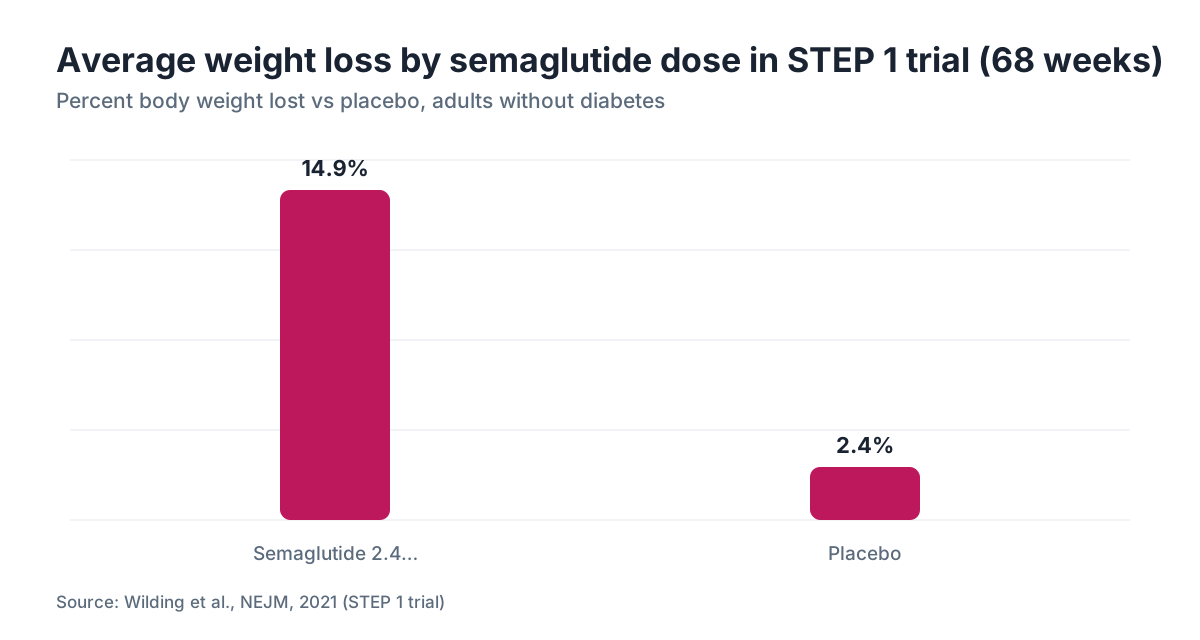
The clinical evidence for semaglutide as a weight loss drug is strong, and it comes from the STEP trial program, which studied brand-name semaglutide at 2.4 mg weekly (the Wegovy dose). STEP 1, published in the New England Journal of Medicine in 2021, found that adults without diabetes lost a mean of 14.9% of body weight over 68 weeks on semaglutide 2.4 mg versus 2.4% on placebo [5]. That is a large, well-run randomized controlled trial with roughly 2,000 participants.
No equivalent trial exists for compounded semaglutide. That does not mean compounded semaglutide fails to work. Semaglutide is a defined molecule. If a compounding pharmacy makes it correctly, it should behave the same way in the body. The catch is "if correctly," because without mandatory FDA quality testing there is no guarantee the dose in a vial matches the label, the active ingredient is pure, or sterility standards were met.
Independent testing by pharmacy researchers and journalists in 2023 and 2024 found concentration variability in some compounded semaglutide products. Some vials held more than the labeled dose, some less. Overdosing semaglutide sharply increases nausea, vomiting, pancreatitis risk, and other adverse effects [2].
For planning purposes, the STEP 5 trial (2-year extension) confirmed weight loss stayed durable as long as the drug continued, and weight came back fast after stopping [5]. This is not a short-term intervention.
More on the full evidence base is at semaglutide for weight loss.
What do women in perimenopause and menopause specifically need to know?
Midlife weight gain is about more than calories. Estrogen decline during perimenopause shifts fat from the hips and thighs toward the abdomen, raises insulin resistance, and disrupts sleep in ways that independently drive appetite [6]. GLP-1 drugs reduce hunger and slow gastric emptying, which helps, but they do nothing about the hormonal shift driving the weight gain in the first place.
Three things women in midlife should ask before starting any semaglutide program, Eden's included.
First, muscle loss. Semaglutide causes weight loss that runs roughly 25 to 40% lean mass, depending on the study and protein intake [7]. Women over 40 are already losing muscle at 1 to 2% per year from age-related sarcopenia. Stacking GLP-1-driven muscle loss on top of that without resistance training and enough protein (at least 1.2 g per kg of body weight daily) speeds up a problem that takes years to undo.
Second, bone density. Rapid weight loss from any cause, GLP-1 drugs included, is tied to reduced bone mineral density [7]. Perimenopausal and postmenopausal women already carry higher fracture risk from estrogen loss. Nobody has long-term fracture data on semaglutide in postmenopausal women specifically. If you have not had a baseline bone density test, get one before or shortly after starting.
Third, hormone therapy interactions. There are no known pharmacokinetic interactions between semaglutide and estrogen or progesterone. But semaglutide slows gastric emptying, which can affect absorption of oral medications including oral estrogen and oral progesterone. Transdermal estrogen (patches, gels, sprays) sidesteps this. If you take oral hormone therapy, talk to your prescriber about timing or switching delivery methods. For more on hormone replacement therapy options during this transition, that guide covers the full landscape.
Eden's intake form, as of early 2025, does not ask about menopausal status, hormone therapy use, or bone density history. That is a gap. A telehealth platform built around women's midlife health, like WomenRx, folds these questions into the GLP-1 evaluation because the clinical picture is different from a 35-year-old without those variables.
What are the side effects of semaglutide from Eden or any source?
Semaglutide's side effect profile is the same whether you get it from Eden, a brand-name prescription, or another telehealth platform. The molecule does not change.
The most common side effects hit the gut. In STEP 1, nausea affected 44% of participants on semaglutide versus 16% on placebo, vomiting 24% versus 6%, and diarrhea 30% versus 16% [5]. Most GI symptoms peak during dose titration (the first 12 to 20 weeks) and ease off once you reach a stable maintenance dose.
Serious but less common risks include:
- Pancreatitis (the FDA label carries a warning; stop semaglutide immediately if you have severe, persistent abdominal pain)
- Gallbladder disease, including gallstones; the STEP trials reported gallbladder events in about 2.6% of semaglutide users versus 1.2% on placebo [5]
- Thyroid C-cell tumors in rodent studies; the FDA label includes a black box warning for personal or family history of medullary thyroid carcinoma or Multiple Endocrine Neoplasia syndrome type 2 [2]
- Heart rate increase of 2 to 3 beats per minute on average (the SELECT cardiovascular safety trial, published 2023, showed a 20% reduction in major cardiovascular events in adults with overweight and established cardiovascular disease) [8]
Mental health: there were post-market reports of suicidal ideation with GLP-1 drugs. The FDA reviewed this signal in 2023 and concluded the data do not support a causal link, but monitoring continues [3].
For women already on an estrogen patch or other transdermal hormone therapy, GI side effects from semaglutide are unlikely to touch hormone absorption, because transdermal products bypass the gut entirely.
How does Eden compare to other telehealth semaglutide providers?
The compounded semaglutide telehealth space is crowded. Eden, Hims & Hers, Ro, Noom Med, LifeMD, and dozens of smaller platforms have offered similar models. They differ on price, turnaround time, pharmacy network, clinical rigor of intake, and how they responded to FDA enforcement.
| Platform | Approx. price/month | Prescriber type | Pharmacy type | Sync to lab work | |---|---|---|---|---| | Eden | $199 to $349 | Async MD/NP | 503A/503B mix | No (as of early 2025) | | Hims & Hers | $199 to $299 | Async MD/NP | 503B | No | | Ro | $145 to $299 | Async MD | 503B | Optional | | Noom Med | ~$149 (bundled) | Sync + async | 503A/503B | No | | WomenRx | Varies | Sync MD/NP | 503B preferred | Yes |
The table above is approximate. Prices and pharmacy relationships shift constantly in this market.
The differentiators that matter: (1) whether the prescriber does a synchronous review or purely asynchronous chart review, (2) whether the pharmacy is 503B (higher manufacturing standards) or 503A, and (3) whether the platform addresses conditions like menopause or thyroid disease in its clinical protocol.
Eden is not uniquely bad or uniquely good. It is a mid-tier platform in a market where quality signals are hard to verify from the outside. Before committing, confirm your fulfilling pharmacy, request a COA, and verify the prescriber's license in your state.
Who is not a good candidate for Eden semaglutide?
The FDA-approved prescribing criteria for Wegovy specify that semaglutide 2.4 mg is indicated for adults with a BMI of 30 or higher, or a BMI of 27 or higher with at least one weight-related comorbidity such as hypertension, type 2 diabetes, or high cholesterol [2]. Eden and most telehealth platforms use similar criteria.
Absolute contraindications include:
- Personal or family history of medullary thyroid carcinoma
- Multiple Endocrine Neoplasia syndrome type 2
- Prior serious hypersensitivity reaction to semaglutide or any component
- Pregnancy (semaglutide causes fetal harm in animal studies and should be stopped at least 2 months before attempting conception)
Strong cautions (these need a real prescriber conversation, more than async approval):
- History of pancreatitis
- Active gallbladder disease
- Diabetic gastroparesis
- Severe kidney impairment
- History of eating disorders, particularly restrictive ones, because GLP-1-driven appetite suppression can reinforce disordered patterns
For women in perimenopause or early menopause who already have significant bone loss, the combination of rapid weight loss and estrogen deficiency on bone deserves explicit attention. An async intake form cannot stand in for that conversation.
What questions should you ask Eden before starting?
If you decide to go ahead with Eden or any compounded semaglutide platform, here is the checklist that separates a careful patient from one flying blind.
- Which pharmacy will fill my prescription? Is it a 503A or 503B facility?
- Can I see a certificate of analysis (COA) for the specific batch I will receive? A COA shows potency, sterility, and the absence of endotoxins.
- What is the exact formulation? Pure semaglutide, semaglutide with B12, semaglutide with niacinamide? What are the concentrations?
- How does your prescriber respond if I have a side effect or need a dose adjustment? Is there a synchronous option?
- What is your refund or pause policy if I cannot tolerate the drug?
- Do you report adverse events to the FDA MedWatch system?
The FDA takes adverse event reports for compounded drugs through the MedWatch program [10]. Patients can report directly. If you have a serious reaction to compounded semaglutide, reporting it genuinely helps the agency's safety monitoring.
None of these questions are unreasonable. A platform that dodges them or cannot answer is a platform to skip.
What does the FDA's 2025 enforcement action mean for Eden semaglutide?
In February 2025, the FDA officially removed semaglutide from its drug shortage database, which triggered a wind-down period for compounders [3]. The agency set a compliance date for 503B outsourcing facilities and said it would take enforcement action against those still producing copies of brand-name semaglutide without a qualifying exemption.
The FDA's stated position, in its guidance on compounding semaglutide, is that it "generally does not intend to take action against compounders for compounding semaglutide" only while a shortage is in effect, and once resolved, compounded copies fall outside that allowance [3]. Translation: the legal cover for compounding this drug has narrowed sharply.
For Eden specifically, the ground under its compounding model has shifted. Platforms responded in a few ways: switching pharmacy partners, reformulating products with added compounds, pushing 503A single-patient compounding (which has a different legal pathway), or moving customers to brand-name Wegovy with Novo Nordisk's savings card.
As of mid-2025, patients with active Eden subscriptions report mixed experiences. Some got notices that their pharmacy was changing. Others received products with formulation changes they were not warned about. Some saw price increases. The market is in flux.
If you are currently on compounded semaglutide from any source, do not assume it keeps coming. Ask your prescriber what happens to your treatment if the compounding pathway closes in your state, and whether moving to brand-name Wegovy with insurance or a savings card is doable. More background on the general semaglutide landscape puts this in context.
Is Eden the right choice for women trying to manage midlife weight gain?
For women who have researched semaglutide thoroughly, understand the compounding landscape, don't have the contraindications listed above, and cannot afford brand-name Wegovy, Eden is one reasonable option in a crowded field. The drug works. The price is within reach. The convenience is real.
But Eden was not built for women in midlife. Its intake does not account for menopausal status, hormone therapy, bone density risk, or the hormonal drivers of midlife weight gain. A woman who is 52, in late perimenopause, on oral estrogen, losing muscle mass, and sleeping badly needs a fuller clinical picture than an async form gives her.
Platforms that treat GLP-1s and hormones as one connected question, instead of separate tracks, are better set up to give women in this phase useful care. If you want a prescriber who will look at your hormones and your metabolic health in the same conversation, WomenRx works that way, with synchronous visits and a protocol built around perimenopausal and menopausal women.
That said, the point is that you get care, not where you get it. If Eden is what's accessible to you right now, go in informed, ask the questions above, demand the COA, and pair it with resistance training and enough protein. Those basics matter as much as the drug source.
Frequently asked questions
Is Eden Health a legitimate company?
Eden Health is a real, operating telehealth company with licensed prescribers and pharmacy partnerships. Legitimate does not mean risk-free. The compounded semaglutide it dispenses is not FDA-approved, and the rules around compounding changed a lot in 2025. Verify your fulfilling pharmacy, request a certificate of analysis, and confirm your prescriber holds an active license in your state.
How long does Eden semaglutide take to work?
Most people notice appetite suppression within the first one to two weeks at low doses (0.25 mg). Meaningful weight loss, typically 5% of body weight or more, usually shows up by weeks 8 to 12. The maximum effect in trials came at 52 to 68 weeks at the 2.4 mg dose. Results at lower maintenance doses are proportionally smaller. Sticking to the titration schedule cuts down GI side effects a lot.
Can I use Eden semaglutide if I'm already on hormone replacement therapy?
There are no known pharmacokinetic interactions between semaglutide and estrogen or progesterone. The practical concern is that semaglutide slows gastric emptying, which can affect absorption of oral medications. If you take oral estradiol or oral progesterone, discuss timing with your prescriber or consider a transdermal option. Transdermal estrogen patches and gels are not affected by semaglutide's GI effects.
What is the difference between Eden semaglutide and Wegovy?
Wegovy is brand-name semaglutide at 2.4 mg weekly, FDA-approved for chronic weight management, made under strict pharmaceutical quality standards. Eden dispenses compounded semaglutide, which is not FDA-approved, costs far less (roughly $200 to $350 per month versus $1,300+ for Wegovy), and is produced by compounding pharmacies with less federal quality oversight. The active molecule is the same; the manufacturing assurance is not.
Does Eden semaglutide require a prior authorization or prescription?
You do need a valid prescription, which Eden's prescribers provide after reviewing your intake form. There is no insurance prior authorization because compounded semaglutide is not covered by insurance. The prescription is issued by a licensed prescriber in your state and filled by the partner pharmacy. Keep a copy in case you need to transfer to another pharmacy.
What happens to my weight when I stop Eden semaglutide?
The STEP extension trial showed participants regained roughly two-thirds of lost weight within one year of stopping semaglutide. This is not unique to Eden; it applies to semaglutide from any source at any price. The regain reflects the drug's mechanism: it suppresses appetite pharmacologically, and that effect ends when the drug does. Long-term treatment is the current clinical consensus for sustained results.
Is Eden semaglutide safe for women over 50?
The STEP trials included women over 50, and the safety profile was not dramatically different by age subgroup. The specific concerns for women over 50 are muscle mass loss, bone density loss during rapid weight loss, and the interaction with menopausal changes. These are manageable with resistance training, adequate protein, baseline bone density assessment, and, if appropriate, concurrent hormone therapy. None of these are reasons to avoid semaglutide; they are reasons to manage it carefully.
Can Eden semaglutide affect my thyroid?
The FDA label for Wegovy and Ozempic includes a black box warning for thyroid C-cell tumors, based on rodent studies. The clinical relevance in humans is unknown; no increase in medullary thyroid carcinoma has been detected in human trials to date. Anyone with a personal or family history of medullary thyroid carcinoma or MEN2 should not take semaglutide from any source. Routine thyroid function tests are not affected by semaglutide.
How does Eden semaglutide compare to tirzepatide?
Tirzepatide (the active ingredient in Zepbound and Mounjaro) targets both GLP-1 and GIP receptors, while semaglutide targets GLP-1 only. Head-to-head trial SURMOUNT-5 (2025) found tirzepatide produced about 47% more weight loss than semaglutide at comparable doses. Eden also offers compounded tirzepatide. The tradeoffs involve cost, side effect profile, and individual response. The full comparison is covered in the semaglutide vs tirzepatide article.
Does Eden ship to all 50 states?
Eden ships to most U.S. states, but compounding pharmacy regulations vary by state, and some states add restrictions on telehealth prescribing or compounded drug dispensing. Check Eden's current shipping map before enrolling. Patients in states with stricter compounding laws may find their prescription filled by a different pharmacy than expected, which changes the COA and quality assurance question.
What lab work should I get before starting Eden semaglutide?
Eden's async intake may not require lab work, but you should ideally have: a metabolic panel (kidney and liver function), HbA1c and fasting glucose (to rule out undiagnosed diabetes that changes dosing), a lipid panel, TSH (thyroid), and for women in midlife, FSH and estradiol to contextualize hormonal status. A bone density scan is reasonable if you are post-menopausal or have risk factors. Bring these results to your prescriber visit.
What should I eat while taking Eden semaglutide to protect muscle mass?
Aim for at least 1.2 grams of protein per kilogram of body weight daily, spread across meals. GLP-1 drugs cut overall intake, so getting enough protein while eating less takes deliberate planning. Resistance training two to three times weekly is the other non-negotiable. Studies of semaglutide-assisted weight loss show protein intake and exercise are the main variables predicting lean mass preservation during the weight-loss phase.
Sources
- FDA, Compounding and the FDA (503A vs 503B overview)
- FDA, Drugs@FDA database, Wegovy (semaglutide) prescribing information label
- FDA, Drugs section: semaglutide shortage resolution and compounding guidance
- NovoCare (Novo Nordisk), Wegovy savings and cost information
- Wilding JPH et al., STEP 1 trial, New England Journal of Medicine, 2021
- The Menopause Society, position statement on weight and menopause
- Systematic review of muscle and bone changes with GLP-1 receptor agonists, Obesity Reviews, 2024
- Lincoff AM et al., SELECT trial (semaglutide cardiovascular outcomes), New England Journal of Medicine, 2023
- Endocrine Society, Clinical Practice Guideline on Obesity in Adults, 2023
- FDA, MedWatch safety reporting program
- Jastreboff AM et al., SURMOUNT-5 trial, New England Journal of Medicine, 2025