Dotti estrogen patch: how it works, costs, and how it compares
TL;DR: Dotti is a transdermal 17β-estradiol patch approved by the FDA to treat moderate-to-severe vasomotor symptoms of menopause. It comes in five doses (0.025 mg to 0.1 mg/day), applied once or twice weekly depending on the formulation. Generic versions cost roughly $30-$80 per month. It delivers bioidentical estrogen through the skin, bypassing the liver, which may reduce clotting risk compared to oral estrogen.
What is the Dotti estrogen patch and what is it approved for?
Dotti is an FDA-approved transdermal estradiol patch made by Noven Pharmaceuticals. It delivers 17β-estradiol, the same estrogen the ovaries produce before menopause, directly through the skin into the bloodstream. The FDA approved Dotti specifically for the treatment of moderate-to-severe vasomotor symptoms associated with menopause [1].
The patch is applied to the lower abdomen, below the waistline, and is available in five delivery rates: 0.025, 0.0375, 0.05, 0.075, and 0.1 mg of estradiol per day [1]. Most formulations are changed twice weekly (every three to four days), which puts it in the same category as Vivelle-Dot, the patch it most closely resembles in design. Some lower-dose patches in this family are once-weekly.
What Dotti is not approved for: it is not indicated for the prevention of cardiovascular disease, dementia, or osteoporosis as a primary therapy, though estrogen does have bone-protective effects that some clinicians factor into their decisions [2]. The FDA label is explicit that the smallest effective dose for the shortest duration consistent with treatment goals and risks should be used [1].
If you are in the years before your last period, you may want to read about perimenopause age and when does menopause start to understand where you are in the transition. Dotti is indicated for women in menopause, meaning 12 consecutive months without a period, or for surgically menopausal women.
How does the Dotti patch work compared to estrogen pills?
Estrogen taken by mouth passes through the gut wall and then through the liver before it reaches circulation. That first-pass hepatic metabolism is not trivial. The liver responds by producing more clotting factors, more C-reactive protein, and more sex hormone-binding globulin, which can blunt how much free estradiol actually gets to your tissues [3].
Transdermal estradiol skips all of that. It absorbs through the skin, enters capillaries directly, and maintains steadier blood levels without the peaks and troughs that come with a daily pill. Women's Health Initiative observational data and multiple later analyses have consistently found that transdermal estradiol carries a lower venous thromboembolism (VTE) risk than oral estradiol. A 2010 case-control study published in Circulation found that oral estrogen users had roughly double the VTE risk of non-users, while transdermal users did not show a statistically significant increase [3].
Stroke risk follows the same pattern. The ESTHER study, a French case-control analysis, found that women using transdermal estradiol had no elevated stroke risk, while oral users had an odds ratio of about 1.5 for ischemic stroke [4].
None of this makes the patch risk-free. The absolute risk difference is small for most healthy women under 60 or within 10 years of menopause, the window the North American Menopause Society (NAMS) identifies as the period of favorable benefit-to-risk ratio for hormone replacement therapy [2]. But if you have a personal or family history of clots, the transdermal route is a real advantage.
The patch also skips the gut side effects some women get with pills: nausea, bloating, reflux. For women who have had bariatric surgery or who have absorption issues, transdermal delivery is often the clinically preferred choice.
What doses does the Dotti patch come in and how do you choose?
Dotti comes in 0.025, 0.0375, 0.05, 0.075, and 0.1 mg/day doses [1]. Clinicians almost always start at the lowest dose that controls symptoms, usually 0.025 or 0.05 mg/day, and titrate up if hot flashes, night sweats, or sleep disruption persist after 4 to 8 weeks.
The 0.025 mg dose is sometimes enough for women in early perimenopause or those with mild symptoms. Women who are further from their last period, or who had surgical menopause (oophorectomy), often need 0.05 to 0.1 mg to feel adequately treated. Surgical menopause is a sharper estrogen drop than natural menopause and frequently calls for higher doses.
There is no single "right" dose. Symptom response matters more than serum estradiol levels in most cases, though labs help rule out very low or unexpectedly high absorption. The NAMS 2022 Hormone Therapy Position Statement notes that "individualization of therapy is the cornerstone of treatment" and that dose should be the lowest that adequately controls symptoms [2].
One practical thing to know: the Dotti patch is small, about the size of a nickel or a little larger depending on dose. Some women count that as a real advantage over older systems like Climara, which is larger and changed only once weekly.
If progesterone is also prescribed (required for women with a uterus to protect the uterine lining), read about progesterone to understand how that piece fits. Estrogen alone in a woman who still has her uterus raises endometrial cancer risk. A progestogen added to the regimen removes that risk.
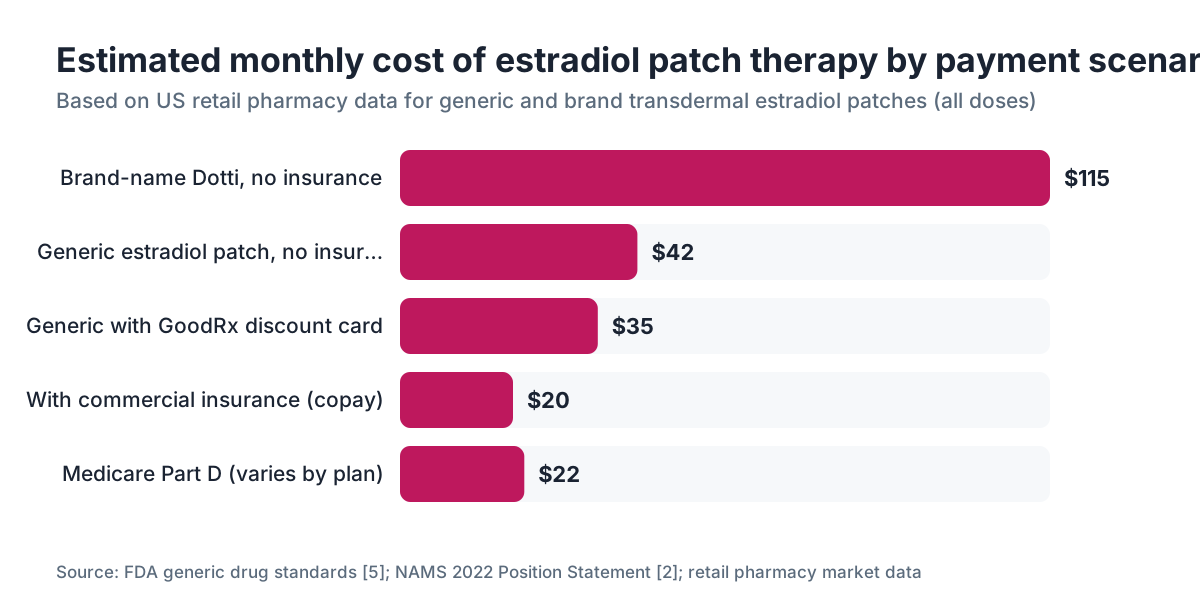
How much does the Dotti estrogen patch cost?
Dotti's price varies by pharmacy, insurance, and whether you use a manufacturer coupon or a third-party discount card. Here is a realistic range based on current market data:
| Scenario | Estimated monthly cost | |---|---| | Brand-name Dotti, no insurance | $80-$150 | | Generic estradiol patch (equivalent dose), no insurance | $25-$60 | | With GoodRx or similar discount card | $20-$55 | | With commercial insurance | $0-$40 copay | | Medicare Part D (varies by plan) | $0-$45 |
Generic transdermal estradiol patches that are bioequivalent to Dotti are widely available. The FDA requires generic patches to meet the same bioequivalence standards as the brand [5]. In practice, most pharmacists will substitute a generic unless the prescription is written "dispense as written." For most women, the generic performs identically.
Manufacturer savings programs exist for branded products, but eligibility typically excludes patients on government insurance (Medicare, Medicaid). The Dotti website has historically offered a savings card for commercially insured patients, but terms change, so verify directly.
Here is the math that matters at the counter: a 4-week supply of a twice-weekly patch takes 8 individual patches. A once-weekly patch takes 4. That difference shows up in the price when you compare products.
Total hormone therapy costs, including progesterone if you need it, typically run $50-$150 per month without insurance for generic products. That is a relevant budget number if you are also weighing a GLP-1 for weight management, which costs considerably more. If weight is part of your menopause picture, semaglutide for weight loss covers that conversation separately.
How do you apply the Dotti patch correctly?
Application technique matters more than most people expect. A poorly applied patch absorbs inconsistently and can fall off, leaving you under-dosed for days without realizing it.
The FDA label for Dotti specifies the lower abdomen as the application site, below the waistline and away from the waistband [1]. Avoid the breasts. Avoid skin that is red, irritated, oily, or has cuts. Rotate the site with each new patch so you are not repeatedly placing it on exactly the same spot. The inside of the upper arm is used for some transdermal patches, but Dotti's label specifies the abdomen.
Apply to clean, dry skin. Do not use lotion, oil, or powder on or near the site before applying. Press the patch firmly for about 10 seconds, running your finger around the edges. Then wash your hands.
For a twice-weekly patch, days 1 and 4 of the week is a common schedule: Monday morning and Thursday morning, for example. Consistency helps you remember.
If the patch falls off, reapply the same patch if it is still sticky. If it will not adhere, apply a new patch for the remainder of the scheduled wear time, then continue your normal schedule. Do not double up patches to make up for a missed dose without guidance from your clinician.
Skin irritation at the site is the most common side effect of transdermal patches, affecting roughly 10-20% of users in clinical studies [1]. It is usually mild redness or itching that resolves after removal. If you develop severe irritation, blistering, or persistent redness, contact your prescriber. Switching to a different patch formulation or a transdermal gel may solve the problem.
How does Dotti compare to other estrogen patches like Vivelle-Dot, Climara, and Minivelle?
Several transdermal estradiol patches are on the US market. They differ mainly in size, application frequency, and adhesive formulation, not in the active hormone itself. All deliver 17β-estradiol.
| Patch | Doses available | Change frequency | Relative size | |---|---|---|---| | Dotti | 0.025-0.1 mg/day | Twice weekly | Small | | Vivelle-Dot | 0.025-0.1 mg/day | Twice weekly | Small | | Minivelle | 0.025-0.1 mg/day | Twice weekly | Small | | Climara | 0.025-0.1 mg/day | Once weekly | Larger | | Alora | 0.025-0.1 mg/day | Twice weekly | Medium | | Menostar | 0.014 mg/day | Once weekly | Small |
Menostar is a special case: its 0.014 mg/day dose is approved only for osteoporosis prevention, not symptom relief [6].
Dotti and Vivelle-Dot are clinically interchangeable in most cases. Same doses, same change schedule, similar size. The practical differences come down to adhesive feel and, sometimes, whether your pharmacy stocks one or the other.
Climara is once-weekly, which sounds convenient, but some women find the larger patch more visible under clothing or more prone to edge lifting. Twice-weekly patches in the Dotti and Vivelle-Dot size tend to stay put better for active women.
Generic estradiol patches labeled as equivalent to any of these are substitutable by FDA bioequivalence standards. If cost is your main concern, ask your pharmacist which generic estradiol patch is cheapest at your pharmacy that day, rather than asking for a specific brand.
For a broader look at all transdermal options and how they fit into the full hormone therapy picture, see our article on estrogen patch.
Who should not use the Dotti estrogen patch?
The FDA label for Dotti lists several contraindications [1]. These are not suggestions. They are hard stops based on established risk data.
Absolute contraindications include: undiagnosed abnormal uterine bleeding, known or suspected estrogen-dependent cancers (breast cancer, endometrial cancer), active or recent arterial thromboembolic disease (stroke, myocardial infarction), active venous thromboembolism (DVT, pulmonary embolism), liver dysfunction or disease, and known hypersensitivity to estradiol or any patch component. Pregnancy is also a contraindication.
Women with a history of breast cancer are generally advised against systemic estrogen, though this is an area of ongoing research and individual clinical judgment. NAMS states that for women with prior breast cancer, the data are insufficient to say hormone therapy is safe, and non-hormonal options should be tried first [2].
Migraine with aura is a relative contraindication, not absolute, but worth discussing with your clinician because estrogen fluctuation can trigger migraine. Transdermal estrogen, because it keeps levels steadier, is often better tolerated by migraineurs than oral estrogen, but the clinical picture is individual.
Higher BMI does not disqualify someone from using estrogen patches, but absorption can be somewhat less predictable in women with more subcutaneous abdominal fat. Some clinicians check serum estradiol levels in this situation to confirm adequate delivery.
If you are unsure whether hormone therapy is right for you, an evidence-based starting point is a provider who specializes in menopausal medicine. Menopause is a useful overview of the whole clinical picture.
What are the real risks of estrogen patches that women should know about?
Honesty first: the Women's Health Initiative scared a generation of women and clinicians away from hormone therapy based on findings that applied mainly to older women using oral conjugated equine estrogens combined with medroxyprogesterone acetate, often started more than a decade after menopause [7]. That is not the same as a transdermal 17β-estradiol patch started in a healthy 50-year-old with significant hot flashes.
That said, risks exist and are real.
Breast cancer: The WHI found a small increased risk of breast cancer with combination estrogen-progestogen therapy (about 8 additional cases per 10,000 women per year after 5 years of use) [7]. Estrogen alone (in women without a uterus) did not increase breast cancer risk in the WHI and may have reduced it slightly. The type of progestogen matters. Micronized progesterone (bioidentical) appears to carry less breast risk than synthetic progestins like medroxyprogesterone acetate, based on the large French E3N cohort study, though this has not been confirmed in a randomized controlled trial [8].
Blood clots: Transdermal estrogen has a meaningfully lower VTE risk than oral estrogen, as noted above [3][4]. This is one of the strongest clinical arguments for the patch over a pill.
Endometrial cancer: This risk applies only to women with a uterus taking estrogen without a progestogen. With adequate progestogen added, the risk returns to baseline. That is why unopposed estrogen (estrogen without progesterone) is not appropriate for women who still have their uterus.
Cardiovascular disease: Estrogen started within 10 years of menopause or before age 60 appears to have a neutral or even protective cardiovascular effect in healthy women. Started later, after established atherosclerosis, it may not help and could cause harm. This is called the "timing hypothesis" or the "window of opportunity" [2].
Nobody has perfect data on long-term patch use beyond 5 to 7 years in randomized trials. Most of what we know past that comes from observational data. Be honest with yourself and your provider about your personal risk profile.
Do you need progesterone with the Dotti estrogen patch?
Yes, if you have a uterus.
Estrogen stimulates the uterine lining (endometrium). Without something to oppose that stimulation, the lining can overgrow, a condition called endometrial hyperplasia, which can progress to endometrial cancer [2]. A progestogen, meaning progesterone or a synthetic progestin, prevents this.
The standard of care is clear: any woman with an intact uterus who takes systemic estrogen therapy needs a progestogen [2]. The only exception is very low-dose vaginal estrogen for localized symptoms, which does not significantly stimulate the endometrium.
Options for the progestogen component include oral micronized progesterone (Prometrium), norethindrone acetate, and medroxyprogesterone acetate. Oral micronized progesterone is the most commonly preferred option now because its risk profile looks better than synthetic progestins, particularly for sleep, mood, and possibly breast cancer risk. Some women also use a levonorgestrel IUD (like Mirena) as the uterine-protective component, which keeps the progestogen local to the uterus while their systemic estrogen comes from the patch.
If you have had a hysterectomy, you do not need a progestogen. You can use the Dotti patch alone.
Read more in our progesterone article, which covers forms, doses, and the bioidentical vs. synthetic distinction in detail.
How do estrogen patches affect weight, metabolism, and body composition?
Nearly every perimenopausal and menopausal woman asks this, and the honest answer is more complicated than most articles admit.
Estrogen does not cause weight gain in a simple caloric sense. But the loss of estrogen at menopause changes where fat is stored. Women who were pear-shaped tend to become more apple-shaped, gaining visceral fat around the abdomen. Visceral fat is metabolically more active and more inflammatory than subcutaneous fat.
Hormone therapy does not reliably produce weight loss. A 2012 Cochrane review of trials found that postmenopausal women on hormone therapy did not lose weight compared to placebo. But the same review found that HRT reduced central fat redistribution, meaning women on estrogen gained less abdominal fat than those not on it [9].
Muscle loss speeds up at menopause. Estrogen has receptors in muscle and bone. Keeping estrogen levels steady during the transition helps preserve lean mass, which matters for metabolic rate.
Some women find that treating hot flashes and night sweats with estrogen improves sleep dramatically, and better sleep independently improves appetite regulation, cortisol patterns, and energy for exercise. That downstream benefit is real, even if the patch itself is not a weight-loss drug.
If weight management is a significant goal, estrogen therapy is supportive but not sufficient for most women. GLP-1 medications are a different tool for a different job. WomenRx treats both, and the two approaches are not mutually exclusive. A provider can help you think through whether they make sense together for your situation.
For women who are both menopausal and managing weight, treating estrogen deficiency and metabolic health together tends to produce better outcomes than treating either in isolation.
What are estrogen patches good for beyond hot flashes?
Vasomotor symptoms (hot flashes, night sweats) are the primary FDA-approved indication for Dotti, and they are the symptom category with the strongest evidence. But the benefits of estrogen therapy in menopause reach further.
Genitourinary symptoms: Estrogen, whether systemic or local, significantly improves vaginal dryness, painful intercourse (dyspareunia), urinary urgency, and recurrent UTIs. The 2022 NAMS position statement identifies genitourinary syndrome of menopause as a strong indication for estrogen [2].
Sleep: Hot flashes fracture sleep architecture. Treating vasomotor symptoms with a patch consistently improves subjective and objective sleep quality in trials [2].
Mood: Estrogen has documented effects on serotonin and dopamine systems. Perimenopausal depression responds to estrogen in some women, particularly when it is tied to hormonal fluctuation rather than a primary mood disorder. The data here are more limited than for vasomotor symptoms, but the association is plausible and well-supported by observational evidence.
Bone density: Estrogen is a potent inhibitor of bone resorption. Menopause is when bone loss accelerates most sharply. Estrogen therapy at adequate doses slows that loss significantly. A bone density test can establish your baseline before or during treatment. While estrogen is not a first-line osteoporosis treatment (bisphosphonates are), it is a meaningful secondary benefit of therapy started for symptoms.
Cognitive function: The timing hypothesis applies here too. Early estrogen therapy may protect cognitive aging; late initiation may not. The data are observational and inconsistent, so this should not be the primary reason to start therapy, but it should not be ignored either.
How do you get a Dotti patch prescription and what does the process look like?
Dotti requires a prescription. You cannot buy it over the counter.
The traditional route is through a primary care physician, OB-GYN, or menopause specialist. In-person visits allow a pelvic exam, blood pressure check, and a conversation about personal and family history. A current mammogram before starting is standard practice.
Telehealth has made prescribing much more accessible. A synchronous video visit with a clinician who is licensed in your state and specializes in menopause care can result in a prescription sent to a local or mail-order pharmacy. Platforms like WomenRx focus on this population, which means the clinicians already know the nuances of patch selection, dose titration, and the progesterone question without a lot of education needed on your part.
What to expect clinically: your provider will ask about your symptom pattern, last menstrual period, personal history (cancer, clots, liver disease, migraine), family history of breast cancer and cardiovascular disease, and your current medications. Blood pressure and BMI matter. Labs are not always required before starting in a low-risk woman, but many clinicians check a baseline FSH, estradiol, and sometimes thyroid function since hypothyroidism mimics some menopause symptoms.
After starting, a follow-up in 6 to 8 weeks lets you report whether symptoms improved and check for side effects. Dose adjustments at that visit are common.
For the broader framework of how hormone therapy is structured, hormone replacement therapy covers the clinical landscape in full.
Frequently asked questions
Is the Dotti patch the same as Vivelle-Dot?
Dotti and Vivelle-Dot are clinically very similar: both deliver 17β-estradiol, come in the same five doses (0.025 to 0.1 mg/day), and are applied twice weekly to the lower abdomen. They have different adhesive formulations and are made by different manufacturers. Most pharmacies treat them as interchangeable generics. If your pharmacy stocks only one, that one will work just as well in practice for most women.
Can I shower or swim with the Dotti patch on?
Yes. The Dotti patch is designed to stay on during bathing, showering, and swimming. Brief water exposure does not typically cause it to lift. Hot tubs, saunas, and long soaking can loosen the adhesive edges over time. If a corner lifts, press it back down firmly. If it fully detaches, apply a new patch and resume your regular change schedule rather than trying to stretch the wear period.
How long does it take for the Dotti patch to start working?
Most women notice some improvement in hot flashes and night sweats within 2 to 4 weeks of starting. Full effect takes closer to 4 to 8 weeks, which is why clinicians typically do not adjust the dose before that point. Sleep often improves before hot flashes fully resolve. If symptoms have not improved meaningfully at 8 weeks on a given dose, a titration upward is usually the next step.
What happens if I forget to change my Dotti patch on schedule?
Change it as soon as you remember. If it has been more than a day or two past your scheduled change, apply a new patch and restart your schedule from that day. Do not apply two patches to compensate. A short gap is unlikely to cause dramatic symptom return, but consistent timing matters for steady hormone levels. Setting a phone reminder for patch-change days is a practical fix most women find helpful.
Does the Dotti patch protect against osteoporosis?
Estrogen therapy at therapeutic doses slows bone resorption and preserves bone mineral density. This is a real benefit, particularly in the years right after menopause when bone loss is fastest. The FDA has not approved Dotti specifically for osteoporosis prevention; the primary indication is vasomotor symptoms. If bone protection is your main goal, a baseline bone density test is useful, and your clinician can factor that into treatment decisions alongside other bone-health strategies.
Can perimenopausal women use the Dotti patch, or is it only for postmenopause?
The FDA indication is for menopause, but transdermal estradiol is used clinically in perimenopause when symptoms are significant. Perimenopause involves erratic estrogen fluctuations rather than complete absence, so the approach may differ. Some clinicians use low-dose estrogen to stabilize those fluctuations; others prefer hormonal contraception in perimenopausal women who still need birth control. This is a conversation worth having with a provider who knows the perimenopause picture well.
What should I do if my skin gets irritated under the Dotti patch?
Mild redness or itching at the application site affects roughly 10-20% of patch users and usually resolves within a day or two of removal. Rotating sites with each application reduces cumulative irritation. If irritation is persistent or severe, try a different patch brand with a different adhesive formulation, or consider switching to a transdermal estradiol gel or spray, which eliminate the adhesive entirely. Contact your prescriber if you develop blistering or persistent skin reactions.
Is Dotti covered by insurance?
Many commercial insurance plans cover Dotti or its generic equivalents, often at the Tier 1 or Tier 2 copay level, meaning $10-$40 per month. Medicare Part D covers estradiol patches under most plans, with costs varying by plan formulary. Always ask your pharmacist to run a GoodRx or similar discount card comparison against your insurance copay. For some women, the discount card is cheaper than the insurance copay, especially for generics.
How is the Dotti patch different from estrogen gels, sprays, and creams?
All transdermal estrogen forms bypass the liver and deliver 17β-estradiol. The practical differences are in application method, dosing precision, and skin contact. Patches deliver a controlled rate throughout the wear period. Gels and sprays are applied daily and dry quickly but require care around transfer to partners or children until fully absorbed. Creams have more variable absorption. Patches are the easiest for consistent dosing; gels and sprays appeal to women who react to patch adhesives.
What are the best estrogen patches if cost is the main concern?
Generic estradiol transdermal patches are bioequivalent to all brand-name patches by FDA standards and typically cost $20-$55 per month with a GoodRx card. Ask your pharmacist which generic estradiol patch has the lowest cash price that day rather than requesting a specific brand. The active hormone is identical across all of them. If your pharmacy cannot get a good price, online pharmacies with verified accreditation can often source the same generics at lower cost.
Can I use the Dotti patch if I have had a blood clot in the past?
A history of venous thromboembolism (DVT or pulmonary embolism) is listed as a contraindication in the Dotti FDA label, regardless of route. That said, some hematologists and menopause specialists do use transdermal estrogen in women with prior clots who are on anticoagulation, given the meaningfully lower VTE risk of the transdermal route compared to oral estrogen. This requires specialist input and is not a decision to make without a thorough individual risk assessment.
How do I know what dose of Dotti patch is right for me?
Start low and titrate. Most clinicians begin at 0.025 or 0.05 mg/day and reassess symptoms at 4 to 8 weeks. If hot flashes and night sweats are not adequately controlled and you have no side effects, moving to the next dose up is standard. There is no universal target serum estradiol level; symptom control is the primary endpoint. Women who had surgical menopause often need higher doses (0.075-0.1 mg/day) to feel adequately treated.
Does the Dotti patch affect libido?
Estrogen alone has a modest positive effect on libido for some women by improving vaginal comfort and reducing pain with intercourse. But testosterone, not estrogen, is the primary driver of sexual desire. Many menopausal women with low libido need testosterone therapy in addition to estrogen to see meaningful improvement. If libido is your primary concern, a full hormone assessment including testosterone and DHEAS is a useful starting point alongside addressing estrogen deficiency.
What happens when you stop using the Dotti patch?
Vasomotor symptoms typically return after stopping estrogen therapy, sometimes within weeks. Gradual tapering (stepping down doses over several months) rather than abrupt discontinuation tends to reduce the severity of symptom rebound, though there is limited controlled trial data on the best tapering protocol. Bone density that was preserved during therapy will begin to decline again after stopping. Most women stop when they feel symptoms have naturally subsided enough to be tolerable, which varies widely.
Sources
- FDA, Dotti (estradiol transdermal system) prescribing information
- North American Menopause Society (NAMS), 2022 Hormone Therapy Position Statement
- Canonico M et al., Circulation 2010: Hormone therapy and venous thromboembolism among postmenopausal women
- Canonico M et al., ESTHER study, Stroke 2007: Postmenopausal hormone therapy and the risk of ischemic stroke
- FDA, Generic Drug Facts: Bioequivalence
- FDA, Menostar (estradiol transdermal system) prescribing information
- Rossouw JE et al., JAMA 2002: Risks and benefits of estrogen plus progestin in healthy postmenopausal women (WHI)
- Fournier A et al., Breast Cancer Research and Treatment 2008: E3N cohort study on breast cancer risk and hormone therapy type
- Marjoribanks J et al., Cochrane Database of Systematic Reviews 2012: Long-term hormone therapy for perimenopausal and postmenopausal women
- Endocrine Society, Clinical Practice Guideline: Menopause 2015