Does wild yam increase estrogen or progesterone? The real answer
TL;DR: Wild yam (Dioscorea villosa) contains diosgenin, a compound chemists can turn into progesterone in a lab. Your body cannot make that conversion. Human trials show wild yam creams and capsules do not measurably raise serum estrogen or progesterone. Wild yam is not a substitute for bioidentical or conventional hormone therapy.
What is wild yam and why do people think it raises hormones?
Wild yam is a climbing vine native to North America and parts of Asia. Its root and rhizome have been sold as a supplement for decades, marketed hard to women in perimenopause and menopause. The pitch sounds convincing. The plant contains a steroidal saponin called diosgenin, and chemists first used diosgenin in the 1940s to synthesize progesterone in the lab. Drug companies still run a similar process today to make much of the world's supply of hormonal steroids. So the plant-to-hormone link is real. It just stops at the factory door.
Here's the leap supplement marketing makes, and the one most women never hear corrected. It assumes your liver and gut can run the same multi-step synthesis that a factory does with reagents, heat, and industrial equipment. They can't. Diosgenin is a plant sterol, not a hormone precursor your body knows how to finish. The enzyme pathways needed to strip the sugar units and then hydroxylate the steroid nucleus don't exist in human tissue [1].
The confusion makes sense. Russell Marker's 1940s work synthesizing progesterone from Mexican wild yam was a real turning point in drug history. Before the chemistry was worked out in public, some practitioners guessed the body might do something similar. That guess has since been tested head-on. It didn't hold up.
Does wild yam actually raise estrogen or progesterone in your blood?
No. Wild yam does not raise serum estrogen or progesterone to any clinically meaningful level, and the human evidence here is unusually clean for supplement research.
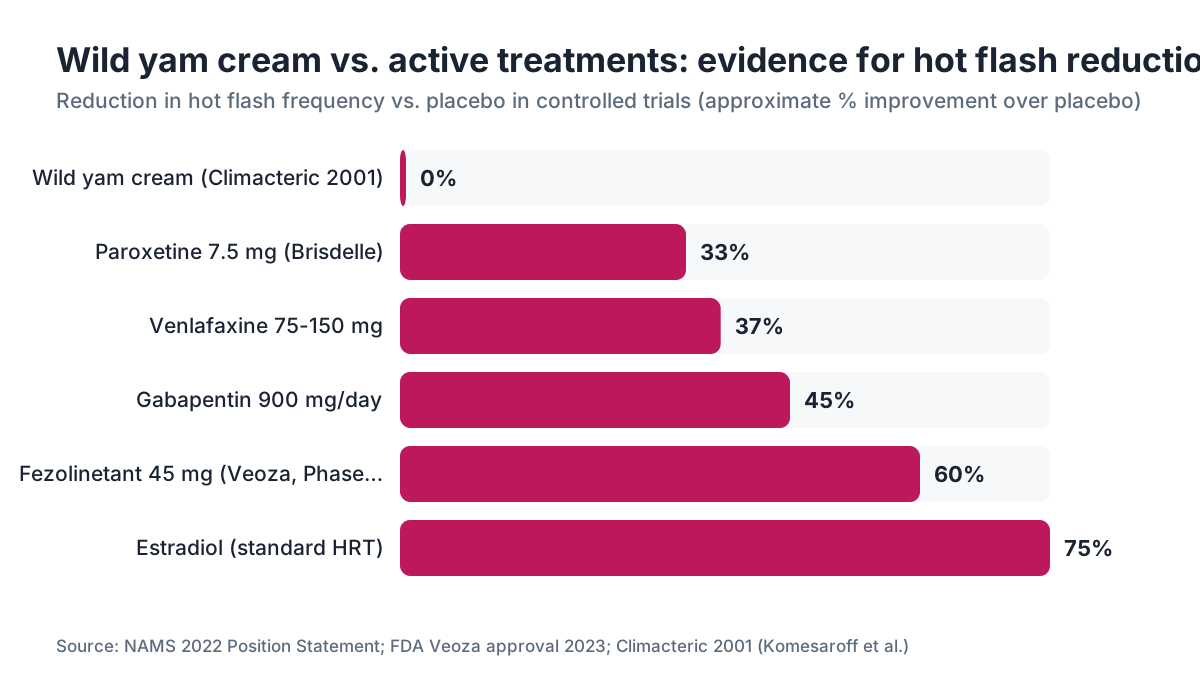
A randomized, double-blind crossover trial in Climacteric, the journal of the International Menopause Society, tested a wild yam cream in 23 healthy postmenopausal women over three months. Researchers measured serum estradiol, estrone, sex hormone-binding globulin, FSH, LH, progesterone, and salivary hormones. Nothing moved versus placebo [2]. Hot flashes and night sweats showed no statistically significant improvement either. The authors concluded that "short-term treatment with topical wild yam extract in healthy women appears to have little effect on menopausal symptoms," and they noted the cream caused no adverse effects, which is about the nicest thing you can say about it.
A separate question is whether diosgenin itself, even without becoming progesterone, might act weakly on estrogen receptors. Cell-culture and animal studies do show some estrogenic signaling from diosgenin at high concentrations [3]. Whether that means anything in a woman taking a supplement dose is unknown, and no clinical trial has shown a measurable estrogenic effect from oral or topical wild yam.
No well-designed human study has shown wild yam raises serum estrogen or progesterone to a level that matters.
Can your body convert diosgenin into progesterone on its own?
No. This is the core biochemical question, and the answer is settled.
Turning diosgenin into progesterone requires what chemists call the Marker degradation, a sequence that cleaves the spiroketal side chain of the sapogenin, then oxidizes and isomerizes what's left. None of those reactions have enzyme equivalents in human liver, intestine, or endocrine tissue. Human steroid production starts from cholesterol, not from plant-derived diosgenin [4].
When researchers feed radiolabeled diosgenin to animals and humans, it gets absorbed to a modest degree, circulates briefly, and leaves. No conversion to progesterone, DHEA, estrogen, or any other steroid hormone shows up [1].
This isn't a gap more research will close. Humans lack the machinery, full stop. What's still open is whether diosgenin does anything on its own, apart from hormone conversion, like affecting lipid metabolism or inflammation. A few rodent studies hint at cholesterol-lowering effects at very high doses [3]. That is not the same as raising your progesterone or estrogen, and nobody should read it that way.
What do wild yam creams actually contain, and are they safe?
Here the picture gets genuinely messy. Some products sold as "wild yam cream" or "natural progesterone cream" are exactly what they claim: wild yam extract, no hormonal activity. Others have been found to contain real pharmaceutical progesterone added during manufacturing, sometimes with no mention on the label [5].
The FDA has sent warning letters to makers of "natural progesterone" creams that contained USP progesterone without declaring it as a drug ingredient [5]. So if you buy an over-the-counter wild yam or "natural progesterone" cream and it seems to work, that's probably why. It may have real progesterone in it. Small amounts aren't inherently dangerous, but you have no idea what dose you're getting, and dose matters if you're trying to balance hormones or protect your uterine lining.
A woman with a uterus who takes estrogen needs a specific, documented dose of progestogen to protect that lining. An unregulated cream with unknown progesterone content gives you no such assurance, and underprotection can drive endometrial hyperplasia, which is serious [6].
Pure wild yam extract with no added hormones looks safe in the short term. The Climacteric trial found no adverse effects [2]. Safety data past three to six months is thin, mostly because almost no trials have run longer.
How does wild yam compare to actual hormone therapy?
It isn't a close comparison, and it's worth saying so flatly. Wild yam delivers no reliable hormone dose; FDA-approved hormone therapy delivers a measured one with decades of data behind it.
Progesterone and estrogen therapies that carry FDA approval, conventional or bioidentical, have defined doses, measured blood-level responses, and long safety and efficacy records. The North American Menopause Society (NAMS) position statement on hormone therapy says FDA-approved hormone therapies are the most effective treatments for vasomotor symptoms, and that compounded or over-the-counter alternatives have not shown equivalent safety or efficacy [6].
Wild yam competes on none of that. It doesn't reliably deliver a measurable dose of any hormone. It doesn't beat placebo for hot flashes in controlled trials. It doesn't protect the uterine lining. There's no monitoring around it.
Still, if someone wants a non-hormonal route because they can't or won't use hormone therapy, wild yam isn't dangerous. It just probably won't do much. Other non-hormonal options have real trial data for vasomotor symptoms, including certain SSRIs, SNRIs, gabapentin, and the neurokinin B antagonist fezolinetant [9]. The Endocrine Society's guidance points clinicians toward those evidence-based options rather than unregulated botanicals [9].
The comparison table below gives you a quick side-by-side.
If you want to understand FDA-approved bioidentical options, or where hormone replacement therapy fits your situation, that's a conversation for a clinician who can look at your actual hormone levels and history.
What about wild yam for perimenopause symptoms specifically?
Wild yam is a poor fit for perimenopause, and the irony is that it's marketed hardest for exactly the symptoms it can't touch.
Perimenopause is the stretch, often starting in the early-to-mid 40s, when ovarian hormone output starts swinging. Progesterone usually drops first, before estrogen, and that gap can cause irregular periods, broken sleep, anxiety, and mood shifts even when estrogen looks normal on paper [8].
Because progesterone deficiency tends to come first in perimenopause, reaching for a progesterone-sounding supplement feels logical. But wild yam supplies no progesterone. For the perimenopausal symptoms driven by falling progesterone, wild yam cream is unlikely to help at all.
There's also a cost to delay. Some symptoms women chalk up to hormones, like heavy or irregular bleeding, have other causes that need a workup. Treating those with wild yam while they drag on isn't a neutral choice.
If you want to know when menopause starts and what's happening hormonally in the years before it, a clinical picture including FSH, estradiol, and progesterone drawn at the right point in your cycle beats any supplement label.
Does wild yam have any real benefits for women?
Maybe, in a few narrow areas, but the evidence is weak and early. Here's the honest inventory.
Anti-inflammatory effects: Diosgenin shows anti-inflammatory activity in cell and animal studies, possibly through NF-kB pathway modulation [3]. Human trial data is close to nonexistent.
Cholesterol: A few small studies suggest diosgenin or wild yam extract may nudge lipid profiles, but the doses and populations vary so much that firm conclusions aren't possible.
Libido and sexual function: Wild yam gets marketed for low libido. There is no credible randomized trial supporting that use for wild yam specifically.
The Climacteric trial noted that women in the wild yam arm reported feeling somewhat better on certain subjective quality-of-life measures, though it didn't reach statistical significance [2]. Placebo response in menopause trials is real and can be large, sometimes 25 to 50 percent [11]. That's not a reason to wave off what women feel. It is a reason to read the data with care.
Wild yam isn't a scam in the sense of being acutely dangerous. It's better described as a product that does less than promised, costs money you could spend on things with evidence, and sometimes stands in for a real medical evaluation.
What should you actually use if you want to raise progesterone or estrogen?
If your symptoms or labs point to low progesterone or estrogen, real options exist with real evidence behind them.
For progesterone: FDA-approved oral micronized progesterone (Prometrium) is bioidentical, chemically identical to what your ovaries make, with well-established dosing for both uterine protection and sleep support. Compounded bioidentical progesterone is available through licensed pharmacies with a prescription, though it lacks the standardization of FDA-approved products [6].
For estrogen: Options run from oral estradiol to estrogen patches, gels, sprays, and vaginal formulations. Delivery method changes systemic absorption, clot risk, and symptom coverage. A clinician who works in hormone management can help you pick the form and dose.
Telehealth platforms built for women's hormones, including WomenRx, can review your symptoms and lab work and prescribe FDA-approved hormone therapy when it fits, without an in-person visit.
The practical takeaway for anyone eyeing wild yam: check your actual hormone levels first. A single estradiol and progesterone draw, timed to your cycle if you're still cycling, tells you far more than any supplement label ever will.
What does the FDA say about wild yam and hormone claims?
The FDA regulates wild yam root as a dietary supplement, not a drug, so manufacturers don't have to prove efficacy or safety before selling it. Under DSHEA, supplement makers can use structure/function claims without FDA approval, but they can't make disease claims or claim a product raises hormone levels, which would count as a drug claim [10].
The FDA has taken enforcement action against companies selling "natural progesterone" or "wild yam" products that made explicit hormone-raising claims or that contained undisclosed pharmaceutical-grade progesterone [5]. When a label says a product will "support hormonal balance" or "promote progesterone production," that language is carefully hedged to stay inside the structure/function rules [10].
The FTC has also gone after supplement marketers for deceptive advertising on menopause products. Neither agency has approved any wild yam product as a hormone therapy.
If a label says it contains USP progesterone, that's a different conversation. USP progesterone is a real drug, and there you'd want to know the dose and have medical oversight. But wild yam extract alone is neither a hormone nor a usable hormone precursor in any clinical sense.
Are there risks to taking wild yam supplements?
For most healthy women, pure wild yam extract looks low-risk in short-term use. The Climacteric trial found no significant adverse effects over three months in postmenopausal women [2].
The risks that matter are mostly indirect. First, opportunity cost. You spend time and money on something ineffective while symptoms that respond well to evidence-based treatment keep going. Second, the unknown-content problem. Some creams carry undisclosed progesterone, which matters if you take other hormones or have a condition where progesterone is contraindicated. Third, drug interactions. Diosgenin may affect the CYP450 enzymes that metabolize many medications, though human data is sparse.
Women with hormone-sensitive conditions, including estrogen-receptor-positive breast cancer, uterine cancer, or endometriosis, should be extra cautious with any product marketed around hormone activity, even theoretical activity. Talk to your oncologist or gynecologist before starting.
For most other women, wild yam isn't dangerous. It just probably won't do what you're hoping.
How to read supplement labels and spot misleading hormone claims
A few things to check on any wild yam or "natural hormone" product before you spend a cent.
Ingredient clarity: Does the label say exactly what's inside? If it lists "wild yam extract (Dioscorea villosa)" and nothing else hormonal, you're buying plant material. If it also lists progesterone USP or DHEA, those are actual hormones or hormone precursors, and you treat them differently.
Claim language: "Supports hormonal balance" and "promotes progesterone production" are structure/function claims the FDA does not verify [10]. They don't mean the product raises your progesterone.
Third-party testing: USP, NSF International, or ConsumerLab certification means the product was tested for identity, potency, and contaminants. It doesn't mean the product works. It means you're getting what the label says.
Dose transparency: A product that tells you how many milligrams of diosgenin it holds is more honest than one hiding behind "proprietary blend."
If you're weighing real hormone therapy, our overview of hormone replacement therapy walks through what's FDA-approved and what to ask your clinician.
Frequently asked questions
Does wild yam cream increase progesterone levels?
No. A randomized controlled trial in Climacteric tested wild yam cream in 23 postmenopausal women and found no significant change in serum progesterone or any other measured hormone versus placebo. The plant compound diosgenin cannot be converted to progesterone by human enzymes, so a cream containing only wild yam extract will not raise your progesterone.
Does wild yam cream increase estrogen?
No measurable rise in estradiol or estrone showed up in the best human trial of wild yam cream. Cell studies suggest diosgenin may weakly touch estrogen receptors at high concentrations, but that hasn't translated to a detectable hormonal effect in women using supplement doses. Wild yam is not a reliable source of estrogen activity.
Can wild yam replace progesterone cream or hormone therapy?
No. Wild yam delivers no progesterone. For women who need progestogen to protect the uterine lining while taking estrogen, or to address progesterone-related symptoms in perimenopause, there is no substitute for pharmaceutical-grade progesterone at a known dose. NAMS does not recommend over-the-counter wild yam products as hormone therapy alternatives.
What is diosgenin and does it work as a hormone in the body?
Diosgenin is a steroidal saponin found in wild yam root. Chemists can turn it into progesterone in a lab through a process called the Marker degradation. Human bodies can't run that conversion because the required enzyme pathways don't exist in human tissue. Diosgenin is absorbed and then excreted. It does not become a steroid hormone inside you.
Why do some wild yam creams seem to work?
Some products labeled as wild yam or natural progesterone cream actually contain pharmaceutical-grade progesterone USP that isn't clearly disclosed on the label. The FDA has cited manufacturers for exactly this. If a cream relieves menopausal symptoms, it may contain real progesterone, not because the wild yam is working. You have no reliable way to know the dose.
Is wild yam safe for women with hormone-sensitive breast cancer?
There isn't enough data to call it safe in that setting. Diosgenin has shown some estrogen receptor activity in cell studies, a real concern for women with estrogen-receptor-positive cancers. Until there's clinical evidence in that population, most oncologists and the available guidance would say to avoid it and discuss any botanical supplement with your oncologist first.
How does wild yam compare to bioidentical progesterone?
They are completely different things. Bioidentical progesterone (oral micronized progesterone, brand name Prometrium) is chemically identical to human progesterone, delivered in a known dose, with trial data for uterine protection and sleep. Wild yam extract delivers no measurable progesterone and has no equivalent evidence base. They shouldn't be compared as equal options.
Can wild yam help with hot flashes or night sweats?
The Climacteric randomized trial found no statistically significant drop in hot flashes or night sweats with wild yam cream versus placebo in postmenopausal women. For non-hormonal options with real trial evidence, SSRIs like paroxetine, SNRIs like venlafaxine, and the newer drug fezolinetant (Veoza) have shown efficacy in controlled trials.
What are the side effects of wild yam supplements?
In the three-month Climacteric trial, wild yam cream caused no significant adverse effects. Oral wild yam may cause nausea or headache at higher doses. The bigger risks are indirect: buying a product with undisclosed hormones, delaying evaluation of real symptoms, or assuming relief without a known cause. Long-term safety data beyond six months is essentially absent.
Does wild yam interact with hormone therapy or other medications?
Human interaction data is limited. Diosgenin may affect the CYP450 liver enzymes that metabolize many drugs, including some hormones, based on in vitro research. If you already take estrogen therapy, birth control pills, or other hormonal medications, tell your prescriber before adding any wild yam product. The unknown-content risk in some creams makes combined use unpredictable.
Is wild yam the same as Mexican yam or Chinese yam?
Different species, similar chemistry. Dioscorea villosa is North American wild yam. Dioscorea mexicana (Mexican yam) was the original source for Marker's pharmaceutical synthesis in the 1940s. Chinese yam (Dioscorea polystachya) is a different species used in traditional Chinese medicine. All contain diosgenin to varying degrees, and none of them convert to hormones in the human body.
Should I get my hormone levels tested before taking wild yam?
Yes, and testing is arguably more useful than the supplement itself. A timed serum estradiol and progesterone draw tells you whether you actually have a deficit and guides real treatment. Taking wild yam without knowing your levels means treating a guess. Testing matters most in perimenopause, when hormones swing widely from day to day.
Where can I find FDA-approved options instead of wild yam?
FDA-approved bioidentical estradiol and oral micronized progesterone are available by prescription from OB-GYNs, menopause specialists, and hormone-focused telehealth platforms. The NAMS provider finder at menopause.org helps you locate a menopause-certified clinician. Telehealth options have widened access considerably, including for women without a local specialist.
Sources
- Aradhana et al., 'Diosgenin,' Indian Journal of Pharmacology 1992 (widely cited biochemistry review)
- Komesaroff PA et al., 'Effects of wild yam extract on menopausal symptoms,' Climacteric 2001;4(2):144-150
- Raju J et al., 'Diosgenin, a steroid saponin of Trigonella foenum graecum,' Journal of Nutrition 2004;134(5):1122-1126
- Miller WL, Auchus RJ, 'The molecular biology, biochemistry, and physiology of human steroidogenesis,' Endocrine Reviews 2011
- U.S. Food and Drug Administration, Warning Letters and enforcement on 'natural progesterone' and wild yam creams
- North American Menopause Society (NAMS), 2022 Hormone Therapy Position Statement
- Prior JC, 'Progesterone for symptomatic perimenopause treatment,' Journal of Obstetrics and Gynaecology Canada 2011;33(12):1249-1258
- Endocrine Society Clinical Practice Guideline: Treatment of Menopause-Associated Vasomotor Symptoms
- Office of Dietary Supplements, NIH: Botanical Dietary Supplements Background Information
- Nachtigall LE, 'Isoflavones in the management of menopause,' Journal of the British Menopause Society 2001