Does semaglutide need to be refrigerated? Storage rules explained
TL;DR: Yes. Unopened semaglutide (Ozempic, Wegovy) must be refrigerated at 36 to 46°F (2 to 8°C). Once you use a pen for the first time, keep it at room temperature (up to 77°F/25°C) for up to 56 days, then discard it. Rybelsus tablets never go in the fridge. Compounded vials follow similar cold-chain rules, but the label your pharmacy prints is the one that governs.
What are the official semaglutide refrigeration requirements?
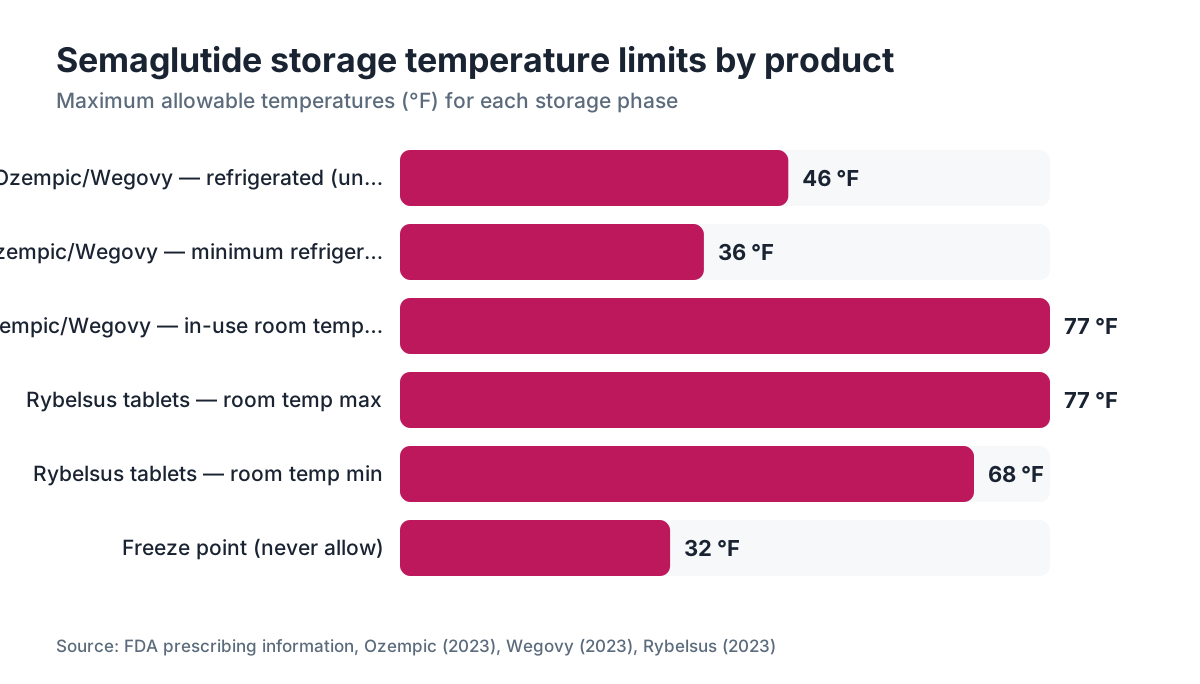
Store new, unused pens in the refrigerator at 36°F to 46°F (2°C to 8°C). That is the rule in the FDA-approved prescribing information for both Ozempic and Wegovy. Keep pens away from the freezer compartment and off the cooling element itself, because freezing destroys the drug. Light hurts it too, so leave each pen in its carton until you're ready to inject. [1]
The rules flip once you use a pen. That in-use pen can sit at room temperature, which Novo Nordisk defines as up to 77°F (25°C), for up to 56 days. After 56 days, throw it out even if medication remains. The window applies to Ozempic (0.25 mg, 0.5 mg, 1 mg, and 2 mg pens) and to Wegovy at every dose strength. [1][2]
Rybelsus, the oral tablet, breaks the pattern. You store Rybelsus at room temperature, 68°F to 77°F (20°C to 25°C), in its original bottle. You never refrigerate it. [3]
Here's the shorthand. Injectable semaglutide lives in the fridge until first use, then on the counter for up to 56 days. Rybelsus lives on the counter always.
What happens if semaglutide gets too warm or is left out of the fridge?
Heat degrades it, slowly. Semaglutide is a GLP-1 receptor agonist peptide, and like other peptide drugs its structure breaks down with heat over time. The FDA label gives no single "ruined at X degrees" number, because protein degradation depends on both temperature and how long the exposure lasts. [1]
What the data supports is the 56-day room-temperature window at up to 77°F, set through stability testing. Push past 77°F for a meaningful stretch and you're outside the validated range. A pen that spent a July afternoon in a parked car is done. Interior car temperatures can top 130°F within an hour, and no amount of cooling afterward reverses that. [4]
A new pen that sat at room temperature for less than 56 days total, in a home that never got hotter than 77°F, is still inside the labeled conditions. Use it. The 56-day clock starts at first injection, not the moment the pen left the fridge.
A frozen pen is trash. Ice crystals wreck the peptide and can jam the needle mechanism. Novo Nordisk says do not freeze, and a pen that frosted over should never be used. [1]
Heat and freezing both ruin the medication. When you're unsure, call your pharmacy. One lost pen costs far less than a month of blunted weight-loss results from a degraded dose.
Semaglutide storage temperature summary: a quick reference
| Product | Unopened storage | In-use storage | Max in-use duration | Freeze? | |---|---|---|---|---| | Ozempic pen (all strengths) | 36 to 46°F (2 to 8°C) refrigerated | Up to 77°F (25°C) room temp | 56 days | Never | | Wegovy pen (all strengths) | 36 to 46°F (2 to 8°C) refrigerated | Up to 77°F (25°C) room temp | 56 days | Never | | Rybelsus tablets | Room temp 68 to 77°F (20 to 25°C) | Same | No expiration change | Never | | Compounded semaglutide vials | Typically 36 to 46°F (2 to 8°C); verify label | Varies by formulation | Check pharmacy label | Never |
Sources: FDA prescribing information for Ozempic [1], Wegovy [2], Rybelsus [3]. Compounded product rules vary by pharmacy and formulation.
One caveat on that last row: compounded semaglutide is not FDA-approved, and its storage specs depend on what the pharmacy puts in the vial (base, salt form, diluent). If you're using compounded semaglutide, ask for written stability data specific to their product. [5]
How do you store semaglutide while traveling?
Travel is where most people slip up. A handful of rules keep it simple.
Carry injectable semaglutide in your carry-on, never in checked luggage. Cargo holds can freeze at altitude, and a delayed bag takes your medication with it. TSA lets injectable medications through security above the usual liquid limit as long as you declare them. The agency's guidance on medically necessary liquids allows these items "in reasonable quantities for your trip" when declared at the checkpoint. [6]
For a short trip, or any trip under 56 days with a pen you've already opened, you don't need refrigeration at all. Keep the pen out of direct sun and away from heat, and you're inside the labeled conditions. Most hotel rooms stay well under 77°F.
Unopened pens or trips past 56 days are different. You need a medical-grade travel cooler or insulated case with gel packs. Watch the packs, though: ones that are too cold will freeze the pen. Cool, not frozen. Frio-style evaporative wallets hold medications in roughly the 64 to 77°F range, which keeps an in-use pen fine but runs too warm for unopened pens. If you're carrying new pens, you need a refrigerated case or a hotel fridge each night.
International trips add a wrinkle. Book a room with a mini-fridge if you're carrying unopened pens. Many airlines will refrigerate medication on long-haul flights if you ask the crew, though nobody guarantees it.
Does compounded semaglutide need to be refrigerated?
Usually yes. Compounded semaglutide comes in vials rather than pre-filled pens, and formulations differ from one pharmacy to the next. The base is still a peptide, so cold storage is the safe default. Most compounding pharmacies recommend refrigeration at 36 to 46°F and assign a beyond-use date of 30 to 90 days from compounding, depending on the formulation and container. [5]
The FDA has said compounded semaglutide is not evaluated for stability, potency, or sterility the way approved drugs are. That matters for storage, because the 56-day room-temperature window came from testing Novo Nordisk's specific formulation. A different salt, base, or diluent can behave differently. [5][7]
Safest move: refrigerate compounded product until the beyond-use date on the label, unless your pharmacy gave you written guidance saying otherwise. If a vial sat at room temperature past that window, discard it. A replacement vial costs less than the risk of injecting a degraded peptide.
For more on what sets compounded products apart from the brand, the semaglutide overview covers the regulatory and clinical picture.
Can semaglutide be stored at room temperature permanently?
No. Only an in-use pen qualifies for room temperature, and only for up to 56 days. An unopened pen left on the counter is outside FDA-approved storage from day one. [1]
The 56-day rule feels generous, and that's where the confusion starts. If you inject Ozempic once a week, one pen lasts about 4 weeks (the 0.5 mg pen delivers roughly four 0.5 mg doses), so you'll finish it well before the room-temperature limit anyway. The 56 days matter most for someone who opens a new pen, then travels or forgets to put it back in the fridge.
Wegovy works differently. Each pen is a single-dose auto-injector: you open it, inject, and discard. In-use duration is almost beside the point because nothing's left inside. What matters for Wegovy is picking up your prescription on time and keeping the unopened pens cold.
So can you leave it on the counter forever? No. But an in-use pen on your bathroom shelf for up to 56 days in a climate-controlled home is exactly what the label allows.
What should you do if your semaglutide pen was left out overnight?
Don't toss it in a panic. Answer three questions first.
Is the pen already in use, or still sealed? An in-use pen that has spent fewer than 56 cumulative days at or below 77°F is still within label. Use it normally.
If it's brand new and sealed, and it sat out overnight (say 65 to 75°F) for 8 to 12 hours, you're in a gray zone. The 56-day allowance technically covers in-use pens; for unopened pens, the label says refrigerate. But stability isn't a cliff the drug falls off the second it leaves the fridge. Novo Nordisk's data supports 56 days at 77°F for in-use pens, which tells you the molecule tolerates that environment. One overnight at normal indoor temperature is unlikely to change the potency in any way you'd notice.
The honest version: nobody has published data on whether a single overnight at ambient temperature lowers the potency of an unopened pen. Want certainty? Call your pharmacy and report exactly what happened. Many will replace the pen or tell you it's fine to proceed. If you're mid-escalation and can't afford a missed week, using a pen that spent one night in a cool room is a defensible call. Loop in your prescriber too.
What not to do: inject a pen that froze, that baked in a hot car, or that looks cloudy or discolored. Semaglutide solution should be clear and colorless to very slightly yellow. Particles or cloudiness mean discard.
If you're running semaglutide alongside hormonal therapy, a telehealth provider like WomenRx can help you think through the logistics and the wider context of semaglutide for weight loss during the menopause transition.
How long does semaglutide last in the fridge before expiring?
The printed expiration date on the pen or carton is the number that governs, and it assumes continuous proper refrigeration. Novo Nordisk typically ships Ozempic and Wegovy with shelf lives of 2 to 3 years from manufacture, though what reaches your pharmacy has less time left.
The FDA requires manufacturers to prove stability through the labeled expiration date under the specified storage conditions. For semaglutide, that condition is 36 to 46°F until first use. Using a pen past its printed date is not recommended even if it looks perfect. You can't judge potency by looking.
In practice, a three-month supply kept in the fridge gets used long before expiration becomes an issue. The date matters if you stockpile, or if a supply gap forces you to work through older stock. Check the date at pickup and flag a tight window with your pharmacist.
The STEP trials don't tell you what happens to weight-loss outcomes when someone unknowingly uses degraded semaglutide, because that was never in scope. What STEP 1 does show is a mean weight loss of 14.9% of body weight at 68 weeks on properly dosed semaglutide 2.4 mg. [8] A compromised pen means you're not getting that dose, and subtherapeutic exposure is the likely result.
Does the storage method affect semaglutide's effectiveness for weight loss?
Yes, indirectly. The drug only works if you receive the intended dose at the intended concentration. Peptide degradation lowers the active drug concentration. Inject from a pen that was stored wrong and you may be getting less than the labeled dose with no way to tell.
This bites hardest during dose escalation. The standard Wegovy titration starts at 0.25 mg weekly and steps up every 4 weeks, reaching 2.4 mg by week 17. [2] A weak response during that stretch usually gets blamed on individual variation, but storage failure is a real and underappreciated cause of apparent non-response.
STEP 1, published in the New England Journal of Medicine in 2021, reported that participants on semaglutide 2.4 mg lost an average of 14.9% of body weight versus 2.4% on placebo. [8] That gap assumes correct storage and administration. Real-world results depend on an unbroken cold chain from manufacturer to pharmacy to your kitchen fridge.
For women in perimenopause or postmenopause, hormones add another layer. Estrogen shapes energy regulation, appetite signaling, and fat distribution, the same systems semaglutide acts on. If you want to see how the two overlap, the articles on menopause and hormone replacement therapy go deeper. The takeaway here: don't let a storage slip add noise to an already complicated picture.
Are there any special storage rules for semaglutide pens vs. vials?
Pens (Ozempic, Wegovy) are single-patient devices. They arrive pre-filled and sealed, with nothing to reconstitute, and a fresh needle attaches at each use. Because the pen is a closed system, contamination risk stays low, and the 56-day in-use window reflects the drug's stability inside that sealed cartridge.
Vials, common with compounded semaglutide, are multi-use containers you draw from with a separate syringe. Every needle stick into a multi-dose vial adds a small contamination risk, even with clean technique. Most compounding pharmacies use bacteriostatic water as the diluent for exactly that reason: it contains a preservative (benzyl alcohol) that limits microbial growth across repeated draws. [5]
Keep vials refrigerated between uses. Don't let a vial linger at room temperature the way an in-use pen can. Wipe the rubber stopper with an alcohol swab before each draw. Watch the beyond-use date on the label, typically 28 to 30 days once reconstituted for non-preserved formulations, or up to 90 days for bacteriostatic preparations, depending on the pharmacy. These numbers move around, and your pharmacy's label wins.
If you're comparing brand-name pens against compounded vials, the semaglutide vs tirzepatide piece touches on how delivery format changes the weekly injection experience.
How should you dispose of expired or heat-damaged semaglutide?
Don't pour liquid medication down the drain, and don't drop loose sharps in the trash. The FDA keeps a take-back locator on its Safe Disposal of Medicines pages, and the DEA runs National Prescription Drug Take-Back Day twice a year. [9]
No take-back nearby? The FDA's household disposal guidance for drugs not on the flush list says to mix the medication with something unappealing (used coffee grounds, dirt) in a sealed container, then put it in the household trash. For Ozempic and Wegovy, that's the recommended home method when take-back isn't an option. [9]
Needles and pens with needles attached are sharps. Use an FDA-cleared sharps container. Many pharmacies sell them for a few dollars and take full ones back. Never recap and toss loose needles in the garbage.
Frequently asked questions
Can I leave my Ozempic pen out of the fridge overnight?
If the pen is already in use and the room stayed below 77°F, that overnight counts toward your 56-day in-use allowance and the pen is fine. If it's a sealed, unused pen that sat out in a cool room, the risk of meaningful degradation from one night is low, but it's outside the labeled condition. Call your pharmacy if you want a definitive answer for your situation.
How long can Wegovy be out of the refrigerator?
Wegovy pens can stay at room temperature, up to 77°F (25°C), for up to 56 days after first use. Because each Wegovy pen is a single-dose injector (you use it once and discard), the 56-day limit matters mostly for unused pens you've pulled from the fridge. Put unused pens back in the refrigerator promptly if you aren't using them right away.
What if my semaglutide was delivered warm, not cold?
Contact the pharmacy that shipped it right away. Reputable mail-order pharmacies use validated cold-chain packaging, but failures happen. If the included temperature monitor shows an excursion above 77°F, document it and request a replacement. Do not inject medication you suspect was shipped improperly. File a complaint with the pharmacy and, if needed, report to the FDA's MedWatch program.
Does Rybelsus (oral semaglutide) need to be refrigerated?
No. Rybelsus tablets are stored at room temperature, 68 to 77°F (20 to 25°C), in the original bottle with its desiccant. Keep the bottle tightly closed and away from moisture. Never refrigerate Rybelsus. The tablet uses a completely different delivery mechanism than the injectable pens, which is why the storage rules differ.
Can semaglutide be frozen?
No. Freezing damages the peptide and can turn the solution cloudy or particulate. The FDA labels for Ozempic and Wegovy state do not freeze and advise discarding any pen that has frozen. Even brief freezing can alter the drug's physical properties in ways you can't reliably see by looking at it.
How do you travel with semaglutide on a plane?
Pack semaglutide in your carry-on. TSA exempts injectable medications from the liquid volume limit; just declare them at the checkpoint. For in-use pens at room temperature, no cooling is needed on trips under 56 days in cool settings. For unopened pens, use an insulated medical case with gel packs to hold the pen at 36 to 46°F, keeping it off direct ice contact so it doesn't freeze.
How do I know if my semaglutide has gone bad?
The solution should be clear and colorless to very slightly yellow. Discard the pen if it looks cloudy, shows visible particles, or has changed color. Those are signs of degradation or contamination. You can't confirm potency loss by eye, so proper storage is your real protection. After any known storage failure (freezing, extreme heat), discard regardless of how it looks.
Does compounded semaglutide have different refrigeration rules than Ozempic?
Yes, and they vary by pharmacy. Most compounding pharmacies recommend refrigeration at 36 to 46°F and give a beyond-use date of 28 to 90 days depending on formulation and whether bacteriostatic water was used. Unlike Ozempic, compounded semaglutide has no FDA-validated stability data. Follow your pharmacy's written instructions exactly, and ask for those instructions in writing when you get the prescription.
Can I store semaglutide in a bathroom medicine cabinet?
A bathroom cabinet is a poor spot for unopened pens because humidity and temperature swing near the shower. Use the refrigerator for unopened pens. For an in-use pen within the 56-day window, a bedroom dresser drawer or a cool, dry cabinet away from the bathroom beats above the sink. The criteria: below 77°F, out of direct sunlight, away from heat sources.
What is the temperature range for storing semaglutide?
Unopened pens must stay at 36 to 46°F (2 to 8°C), standard refrigerator temperature. In-use pens can be at room temperature up to 77°F (25°C) for up to 56 days. Don't exceed 77°F for any meaningful period, and never let a pen freeze (below 32°F / 0°C). Rybelsus tablets stay at 68 to 77°F (20 to 25°C) at all times.
How long does an Ozempic pen last in the refrigerator before it expires?
An unopened Ozempic pen kept continuously at 36 to 46°F is good through the expiration date printed on the carton, typically 2 to 3 years from manufacture. What you get at the pharmacy has a shorter remaining window depending on when it was made. Always check the date at pickup and tell your pharmacist if it seems close.
Does semaglutide storage matter differently for women in menopause?
The storage rules are identical regardless of menopausal status. What changes is the clinical context. Women in perimenopause or postmenopause often take semaglutide alongside hormone therapy, and both need proper storage. If you're juggling several prescriptions, build one consistent routine. Correct dosing matters even more during hormonal transitions, when appetite and weight regulation are already shifting.
What happens to semaglutide if it gets hot in a car?
Discard it. Interior car temperatures in summer routinely top 120 to 130°F within 30 to 60 minutes, far above the 77°F maximum. Heat speeds peptide degradation, and you have no way to gauge potency loss by looking at the solution. Never leave semaglutide in a parked car. Take it with you or keep it in a cooler with validated temperature control.
Can you put an in-use semaglutide pen back in the refrigerator?
Yes. You can move an in-use pen between fridge and room temperature freely, as long as total room-temperature time stays under 56 days and never exceeds 77°F. Some people prefer keeping the in-use pen in the fridge between injections. That's fine. Just don't freeze it. The 56-day clock counts cumulative time out of the refrigerator, not time since first use.
Sources
- FDA, Wegovy (semaglutide injection) prescribing information, Novo Nordisk
- FDA, Rybelsus (semaglutide) tablets prescribing information, Novo Nordisk
- National Institutes of Health, National Library of Medicine — heat exposure and medication degradation review
- FDA, Compounding and the FDA: Questions and Answers
- TSA, Traveling with Medications / special procedures
- Wilding JPH et al., STEP 1 Trial, New England Journal of Medicine, 2021
- FDA, Disposal of Unused Medicines: What You Should Know
- Novo Nordisk, Ozempic Storage and Handling, patient information