Does Medicare cover bone density tests? What women need to know
TL;DR: Medicare Part B covers a bone density test (DEXA scan) once every 24 months at no cost to you if you're enrolled in Part B and meet at least one qualifying condition, including being a woman whose doctor has determined you may be at risk for osteoporosis. You pay nothing when your provider accepts Medicare assignment.
What does Medicare actually cover for bone density tests?
Medicare Part B covers bone mass measurements, specifically dual-energy X-ray absorptiometry (DEXA) scans, under a benefit in place since 1998. Coverage applies to "qualified individuals" who meet specific clinical criteria. When you're eligible, the test is covered at 100 percent: no copay, no coinsurance, no deductible, as long as your provider accepts Medicare assignment. [1]
Medicare's own guidance is blunt about it. Medicare covers bone mass measurements for qualified beneficiaries at 100 percent of the Medicare-approved amount. Zero dollars out of your pocket, which almost never happens with Medicare. [1]
The test is a bone density test that measures bone mineral density at the hip and spine. It takes 10 to 30 minutes and uses very low radiation. Medicare does not cover peripheral DEXA (wrist, heel, finger) as a standalone screening test, though your doctor may use peripheral measurements in certain clinical situations. Central DEXA of the hip and lumbar spine is the standard this benefit is built around. [2]
Part A (hospital insurance) does not cover outpatient bone density tests. Part B is your coverage here. Medicare Advantage plans (Part C) have to cover at least the same benefits as Original Medicare, so an Advantage plan gives you the same bone density benefit, though the cost-sharing details can differ by plan.
Who qualifies for Medicare bone density test coverage?
Medicare uses the term "qualified individual" and lists five qualifying categories. You need to meet one. [1]
-
A woman determined by her physician or treating provider to be estrogen-deficient and at clinical risk for osteoporosis, based on her medical history and other findings.
-
A person with vertebral abnormalities shown on an X-ray that suggest osteoporosis, osteopenia, or vertebral fracture.
-
A person on long-term glucocorticoid (steroid) therapy, such as prednisone, at 7.5 mg per day or more for more than three months.
-
A person with primary hyperparathyroidism.
-
A person being monitored to assess the response to or efficacy of an FDA-approved osteoporosis drug therapy.
For most women reading this, category one is the one that matters. "Estrogen-deficient and at clinical risk" covers postmenopausal women and women who have had surgical menopause. It's broad enough that a physician examining a postmenopausal woman in her mid-50s would very likely determine she qualifies. You don't need a formal osteoporosis diagnosis first. [1]
Perimenopausal or approaching menopause and wondering if this applies yet? The honest answer is that it depends on whether your doctor documents estrogen deficiency and clinical risk. Many physicians will do that once you've had no period for 12 months, or when you're clearly in late perimenopause with low estrogen on labs. Ask directly. The documentation burden sits with your provider, and most are comfortable completing it for appropriate patients.
Age alone does not qualify you. Medicare is not built to cover this test for every woman the day she turns 65. You need the clinical determination. That said, the U.S. Preventive Services Task Force recommends screening for all women 65 and older with no known risk factors, and for younger postmenopausal women who do have risk factors, so most women in that age band meet the criteria with minimal documentation. [3]
How often does Medicare pay for a bone density scan?
Medicare pays for a bone density test once every 24 months (two years) for qualified individuals. If your test shows osteoporosis, or you're on a drug that needs closer monitoring, your physician can order testing sooner and Medicare can cover it with proper medical documentation. [1]
The 24-month interval is a hard rule for routine screening. If your doctor wants to test you more often without a specific clinical reason, Medicare will likely deny the claim and you'll owe the full cost. A DEXA scan at an outpatient imaging center runs $150 to $300 without insurance, though prices swing a lot by region and facility. [4]
Here's a detail people miss: the 24 months counts from the date of your last Medicare-covered bone density test, not from a calendar year. If your last covered test was March 2023, the next covered test is no earlier than March 2025.
Does Medicare cover bone density tests for men?
Yes. The bone density benefit applies to all qualified individuals, not only women. Men with any of the five qualifying conditions, most often vertebral fractures found by accident on imaging, long-term steroid use, or primary hyperparathyroidism, get the test covered at 100 percent under the same rules. [1]
The U.S. Preventive Services Task Force finds insufficient evidence to recommend routine osteoporosis screening in men, so category one (estrogen-deficient and at risk) is effectively a women's category. Men usually qualify through categories two through five. Asking on behalf of a husband or father? It's possible, but he needs a specific clinical reason beyond age. [3]
What does a Medicare-covered bone density test actually cost you?
When your provider accepts Medicare assignment and you meet the qualifying criteria, your cost is zero. No deductible, no copay, no coinsurance. Medicare pays 100 percent of the approved amount. [1]
Two situations can leave you paying. First, if your provider does not accept Medicare assignment, they can charge up to 15 percent above the Medicare-approved amount, and you'd owe that difference. Second, if your physician orders the test but the claim gets denied because the medical necessity documentation was incomplete, the cost falls to you. That happens more than it should, and it's usually a billing or documentation error rather than a change in policy. Before your appointment, confirm two things: the facility accepts Medicare assignment, and your physician has documented the qualifying condition in your chart.
The Medicare-approved payment rate for a bone density test (CPT code 77080 for axial DEXA) was roughly $134 in 2023 in a non-facility setting, though it varies by region. The allowed amount comes from the Medicare Physician Fee Schedule and updates every year. [5]
Here's what you pay across different coverage situations.
How does bone density test coverage compare across insurance types?
Trying to see where Medicare stands next to your other options? This table lays it out.
| Coverage Situation | Frequency Covered | Your Cost | |---|---|---| | Medicare Part B (qualified, assignment accepted) | Every 24 months | $0 | | Medicare Part B (qualified, non-participating provider) | Every 24 months | Up to 15% of approved rate | | Medicare Advantage (Part C) | At least every 24 months | Varies by plan | | Medicaid | Varies by state | Usually $0 to low copay | | Private insurance (ACA-compliant plan) | Varies; USPSTF A/B recommendations usually covered | Usually $0 (preventive) | | No insurance, self-pay | N/A | $150 to $300 typical range |
Most ACA-compliant private plans have to cover DEXA scans for women 65 and older with no cost sharing, because the USPSTF gives this a B recommendation. So if you're still on an employer plan at 65 before you switch to Medicare, you probably have coverage already. [3]
Medicaid coverage varies by state but generally includes bone density testing for postmenopausal women. Check your state's Medicaid program for the specifics.
Does Medicare cover bone density tests in perimenopause or before age 65?
Medicare usually isn't available until age 65 (with exceptions for disability or certain diagnoses). So this question really lands on women under 65 with private insurance, or those who enroll in Medicare early because of a disability.
For women who hit perimenopause or early menopause well before 65, private ACA-compliant insurance will typically cover a DEXA scan if you're postmenopausal with risk factors, in line with USPSTF guidance. The USPSTF recommends screening for postmenopausal women under 65 whose 10-year fracture risk equals or exceeds that of a 65-year-old white woman with no additional risk factors, which works out to roughly a 9.3 percent 10-year probability on the FRAX tool. [3]
If you're in perimenopause and worried about bone loss, ask your doctor to calculate your FRAX score and document whether you meet criteria. Plenty of women are surprised to find they qualify for a covered scan years before they expected.
The estrogen-bone connection is direct. Estrogen loss speeds up bone resorption, and hormone replacement therapy is one of the only interventions shown to actually prevent fractures in postmenopausal women. The North American Menopause Society states that menopausal hormone therapy is effective for preventing bone loss and reducing fracture risk in postmenopausal women. [6] Considering hormones and curious about your baseline bone health? A DEXA scan is the right place to start.
Does Medicare cover follow-up bone density tests if you're on osteoporosis medication?
Yes. Category five in the qualifying criteria covers people being monitored to assess the response to or efficacy of an FDA-approved osteoporosis drug. This matters because the standard of care for bisphosphonates like alendronate (Fosamax) or zoledronic acid (Reclast), or for biologics like denosumab (Prolia), includes repeat DEXA scanning to confirm the treatment is working. [1]
In practice, most physicians repeat the DEXA 1 to 2 years after starting treatment. Medicare covers that follow-up under category five even if the patient would otherwise only qualify for one scan every 24 months under category one. You still need the medical necessity documentation, but this is a separate pathway, and it matters when you're being actively treated.
On a selective estrogen receptor modulator like raloxifene (Evista) or a newer agent like romosozumab (Evenity)? Those are also FDA-approved for osteoporosis and qualify you under category five for monitoring scans.
How do you get a Medicare-covered bone density test, step by step?
The process is simple once you know what to ask for.
Step 1. At your next preventive or annual wellness visit, tell your doctor you'd like a bone density scan. If you're postmenopausal or have any of the five qualifying conditions, ask your physician to document that in your chart and on the order.
Step 2. Get an order from your doctor to a Medicare-participating imaging center or radiology practice. Don't assume a facility accepts Medicare assignment. Ask before you go.
Step 3. At check-in, confirm the test will be billed to Medicare under the bone mass measurement benefit and that the clinical indication (the qualifying condition) is on the order.
Step 4. The imaging center sends the claim to Medicare. If it's approved, you owe nothing. If it's denied, ask your doctor's office to review the documentation and file an appeal. Most first-submission denials come down to missing documentation, not actual ineligibility.
One thing worth knowing: your Medicare annual wellness visit (also free, no cost sharing) is a good moment to request the bone density order and have the qualifying documentation completed at the same appointment. No separate office visit needed.
What if Medicare denies your bone density test claim?
Denials happen, and most are fixable. The usual reasons: the qualifying condition wasn't documented on the order, the 24-month interval hasn't passed, or there's a coding error on the claim.
You have the right to appeal. Denials come with a Medicare Summary Notice that states the reason for the denial and your appeal rights. The first level is a redetermination request, which you file with the Medicare Administrative Contractor that processed the claim. You have 120 days from the date you get the denial notice to file. [7]
If redetermination is denied, you can escalate to a Qualified Independent Contractor (QIC) review, and beyond that to an Administrative Law Judge hearing. Most straightforward bone density denials resolve at the redetermination stage once the physician supplies the missing clinical documentation.
For free help with an appeal, the State Health Insurance Assistance Program (SHIP) in your state offers counseling. Find your local SHIP through the SHIP National Technical Assistance Center. [8]
Is there a connection between hormones, bone loss, and why this test matters after menopause?
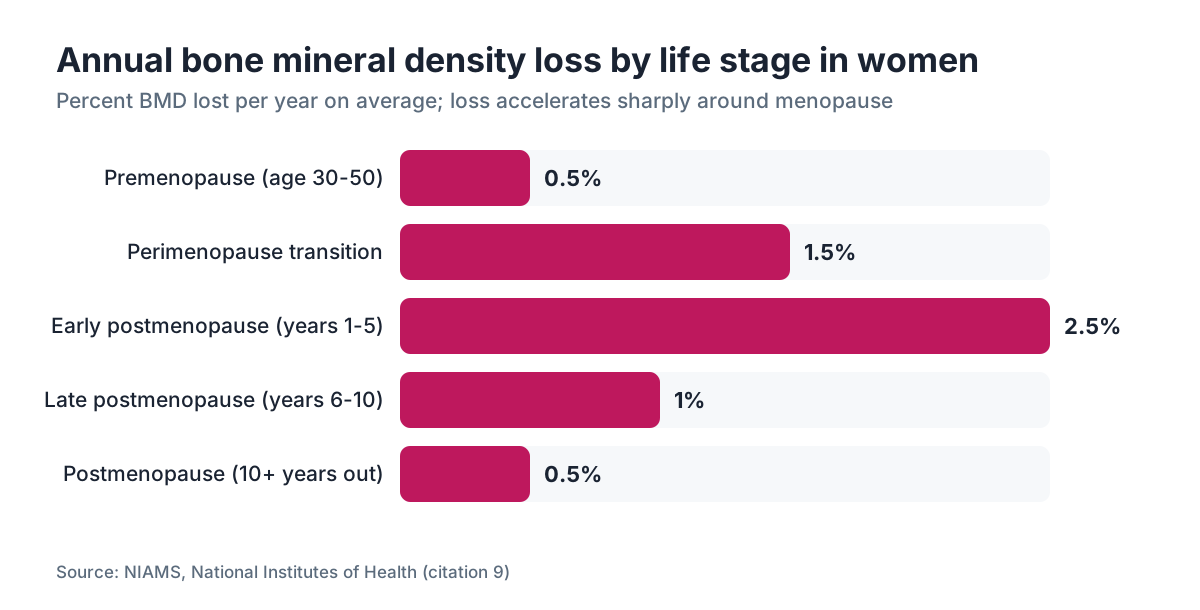
Bone loss doesn't creep down over decades. It drops off a cliff around menopause. Women can lose 1 to 3 percent of bone mineral density per year in the first 5 to 7 years after their last period, compared with roughly 0.5 to 1 percent per year before menopause. That cumulative loss is why hip and vertebral fractures hit women so much harder than men. [9]
Estrogen suppresses osteoclast activity, the cells that break down bone. When estrogen drops, osteoclasts run unchecked, and bone resorption outpaces formation. A DEXA scan at or just after menopause gives you a baseline, so you can track whether you're losing faster than expected.
For women eligible for and interested in hormone therapy, systemic estrogen (including an estrogen patch) has one of the strongest evidence bases for fracture prevention of any postmenopausal intervention. The Women's Health Initiative found that women on combined hormone therapy had fewer hip and vertebral fractures, with relative risk reductions of about 33 and 34 percent respectively. [10]
This is where a telehealth provider like WomenRx can help: reading your DEXA results alongside your hormone levels, your symptoms, and your fracture risk score gives a fuller picture than any single number. Considering HRT as part of a bone strategy? Getting a DEXA baseline before you start, then a repeat one to two years later, is good clinical practice.
None of this replaces a conversation with your doctor. But knowing the DEXA test is free through Medicare removes one barrier to getting the information you need. The test takes less time than a mammogram, it's painless, and the data it gives you is something you can act on.
What other bone health screenings does Medicare cover alongside a DEXA scan?
Medicare Part B covers several preventive services tied to bone and fall risk, and it's smart to know what else you can access at no extra cost.
Medicare covers lab tests for vitamin D levels when your physician orders them for a documented clinical indication (low vitamin D is a major modifiable risk factor for osteoporosis and fracture). This is billed as a diagnostic test, not preventive, so your Part B deductible applies unless it's bundled into your annual wellness visit bloodwork. [11]
Fall prevention counseling comes under the Medicare wellness visit. Tai chi, balance training, and strength training have evidence for lowering fall and secondary fracture risk, and some Medicare Advantage plans cover fitness programs like SilverSneakers that include them.
Calcium and vitamin D supplements are not covered by Medicare Part D unless prescribed for a specific deficiency or condition. Over-the-counter supplements generally aren't covered. That's a gap worth flagging, because the Bone Health and Osteoporosis Foundation recommends 1,200 mg of calcium per day (food and supplements combined) and 800 to 1,000 IU of vitamin D for women over 50. [12]
If you're already on progesterone or other hormonal therapies, some evidence suggests progesterone may have a mild positive effect on bone formation, though the data is far weaker than for estrogen. The DEXA scan is still the only way to know where you actually stand.
Frequently asked questions
Does Medicare pay for a bone density test every year?
No. Medicare Part B covers bone density tests once every 24 months (two years) for qualified individuals. More frequent tests may be covered if you're being monitored on an FDA-approved osteoporosis drug, but routine annual scanning is not. If your provider orders it more often without documented medical necessity, you'll likely owe the full cost, roughly $150 to $300.
Does Medicare cover a DEXA scan for a 65-year-old woman?
Yes, almost certainly, as long as her physician documents that she is estrogen-deficient and at clinical risk for osteoporosis. Most postmenopausal women at 65 meet this easily. The USPSTF also recommends routine screening for all women 65 and older. The test is covered at 100 percent with no cost sharing when the provider accepts Medicare assignment.
What is the Medicare CPT code for a bone density test?
The primary CPT code for a central DEXA scan is 77080 (axial skeleton, two or more sites). Code 77081 covers peripheral DEXA. For Medicare billing, the diagnosis code documenting the qualifying condition has to accompany the claim. Missing or incorrect diagnosis codes are the most common reason Medicare denies bone density claims.
Does Medicare Advantage cover bone density tests the same way?
Medicare Advantage (Part C) plans have to cover at least the same benefits as Original Medicare, including bone density testing every 24 months for qualified individuals. Cost-sharing, network restrictions, and prior authorization can differ by plan. Check your plan's Summary of Benefits or call member services to confirm your exact out-of-pocket cost.
Can my doctor order a bone density test without a referral under Medicare?
Medicare does not require a formal referral for bone density testing, but you do need a physician's order with the documented clinical indication (qualifying condition) to have the claim covered. Your primary care physician, gynecologist, or any treating provider can write the order. Specialist referrals aren't required unless your Medicare Advantage plan specifically requires them.
What happens if my bone density test shows osteoporosis? What does Medicare cover next?
If you're diagnosed with osteoporosis, Medicare Part B covers follow-up bone density tests to monitor treatment response (you now qualify under category five). Medicare Part D covers most FDA-approved osteoporosis medications, including bisphosphonates and denosumab, subject to your plan's formulary. Medicare also covers fall prevention counseling through the annual wellness visit.
Does Medicare cover bone density tests for women on hormone therapy?
Yes. Postmenopausal women on hormone therapy qualify under the estrogen-deficient-and-at-risk category, and women being monitored for osteoporosis prevention qualify under category five. There's no exclusion for women on HRT. Monitoring bone density before and after starting HRT is standard clinical practice.
Is a heel bone density scan (peripheral DEXA) covered by Medicare?
Generally no, not as a standalone screening test. Medicare's bone density benefit is built around central DEXA of the hip and lumbar spine. Peripheral devices measuring the heel, wrist, or finger aren't covered for routine screening under Part B. If a peripheral measurement is done as part of a clinical encounter, separate billing rules apply and coverage is limited.
Does Medicare cover bone density tests for women who have never had a fracture?
Yes. You do not need to have had a fracture to qualify. The most common category, estrogen-deficient women at clinical risk for osteoporosis, covers women who have never fractured anything. The point of the benefit is prevention: catching low bone density before a fracture. A prior fracture can make it easier to document medical necessity, but it's not required.
What if I'm on Medicaid, not Medicare? Is bone density testing covered?
Medicaid coverage of bone density tests varies by state, because states run Medicaid under federal guidelines with significant local discretion. Most state Medicaid programs do cover DEXA scans for postmenopausal women with appropriate clinical indications, often with no or minimal cost sharing. Contact your state's Medicaid office or your managed care plan for your state's rules.
Does Medicare cover bone density testing after a hip or vertebral fracture?
Yes. A vertebral abnormality shown on X-ray (including vertebral fracture) is one of the five qualifying categories for Medicare bone density coverage. A prior fragility fracture also signals high osteoporosis risk, which supports the estrogen-deficient-and-at-risk documentation. Post-fracture bone density testing is standard of care and Medicare covers it.
How do I find a Medicare-participating facility that does DEXA scans near me?
Use Medicare's Care Compare tool at medicare.gov to find participating providers and imaging facilities. You can also call the facility directly and ask whether they accept Medicare assignment for bone density testing. Hospital-based radiology departments, outpatient imaging centers, and some primary care offices with in-house DEXA equipment all perform this test.
Sources
- Centers for Medicare & Medicaid Services (Medicare.gov), Bone Mass Measurements coverage
- Bone Health and Osteoporosis Foundation, Clinician's Guide to Prevention and Treatment of Osteoporosis
- U.S. Preventive Services Task Force, Osteoporosis to Prevent Fractures: Screening (2018)
- Healthcare Bluebook, Fair Price for DEXA Bone Density Scan
- North American Menopause Society (The Menopause Society), 2022 Hormone Therapy Position Statement
- Centers for Medicare & Medicaid Services (Medicare.gov), Claims and Appeals
- SHIP National Technical Assistance Center (shiphelp.org)
- National Institute of Arthritis and Musculoskeletal and Skin Diseases (NIAMS), Osteoporosis Overview
- Women's Health Initiative, JAMA 2002, Risks and Benefits of Estrogen Plus Progestin in Healthy Postmenopausal Women
- Centers for Medicare & Medicaid Services (Medicare.gov), Clinical laboratory tests coverage
- Bone Health and Osteoporosis Foundation, Calcium and Vitamin D