Does HRT cause cancer? What the evidence actually shows
TL;DR: HRT raises breast cancer risk slightly with some formulations, but the absolute numbers are small and depend on which hormones you take, for how long, and when you start. Estrogen-only HRT may lower breast cancer risk. Endometrial risk is real but almost entirely preventable with progesterone. Most guidelines say benefits outweigh risks for healthy women under 60.
Does HRT cause cancer? The short, honest answer
It depends on the type of HRT, the type of cancer, and the woman taking it. That is not a dodge. The research genuinely splits depending on which hormones are involved.
Combined estrogen-plus-progestogen HRT is linked to a modest increase in breast cancer risk. Estrogen-only HRT, used by women who have had a hysterectomy, is linked to no increase and possibly a small decrease in breast cancer risk. Neither formulation meaningfully raises the risk of most other cancers, and both lower the risk of colorectal cancer and osteoporotic fractures [1].
The North American Menopause Society (NAMS) put it plainly in its 2022 position statement: "For women aged younger than 60 years or who are within 10 years of menopause onset and have no contraindications, the benefit-risk ratio is favorable for treatment of bothersome vasomotor symptoms and for those at elevated risk for bone loss or fracture" [1].
So the real question is not yes or no. It is which formulation, which cancer, how much risk, and for whom. The rest of this article answers each piece.
Does HRT cause breast cancer?
Combined HRT carries a real but small breast cancer signal. Estrogen alone does not. The fear that kept millions of women off hormones traces back to 2002, when the Women's Health Initiative (WHI) published results that sent prescriptions falling off a cliff. The WHI was a large randomized controlled trial of more than 16,000 women. Its combined-HRT arm was stopped early because of a signal of increased breast cancer [2].
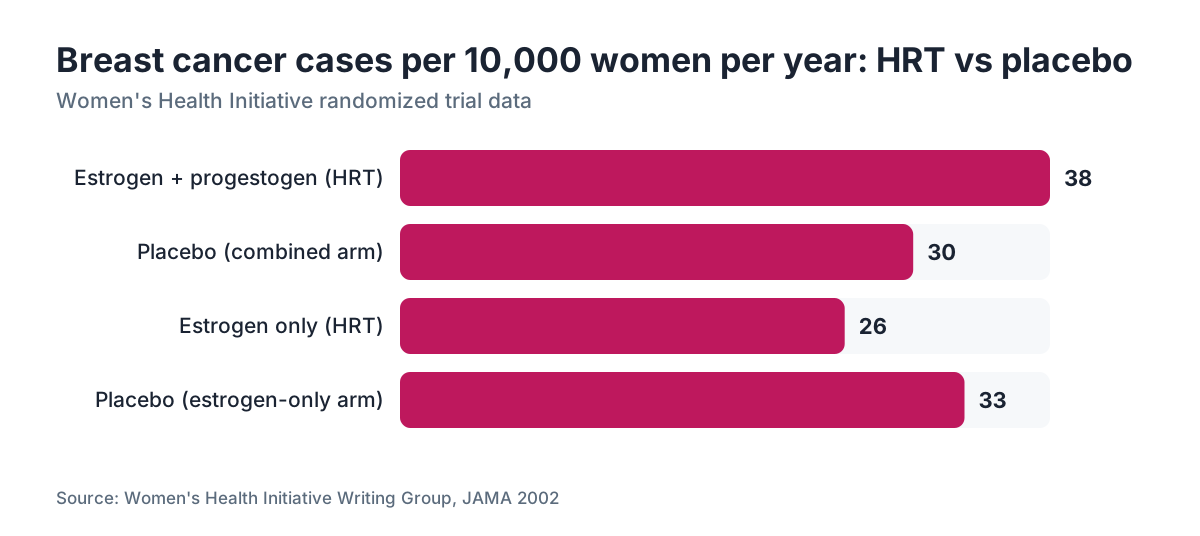
Here is what that signal looked like in absolute terms. Women on combined conjugated equine estrogen plus medroxyprogesterone acetate (MPA) had 38 breast cancer cases per 10,000 person-years, compared with 30 in the placebo group [2]. That is 8 extra cases per 10,000 women per year. Roughly the same bump you get from a glass or two of wine most nights.
The estrogen-only arm told a different story. Women taking conjugated equine estrogen alone had 26 breast cancer cases per 10,000 person-years versus 33 in placebo, which suggests estrogen alone may actually lower breast cancer incidence [2].
Newer data push the combined estimate higher. The 2019 Collaborative Group meta-analysis in The Lancet, pooling 58 studies and roughly 100,000 women with breast cancer, found risk climbing the longer treatment continued [3]. The relative risk for current users of combined HRT was about 2.30 after 10 or more years of use, versus 1.60 for 1 to 4 years. The absolute excess stayed modest: the analysis estimated around 1 extra breast cancer per 50 women using combined HRT for 5 years starting at age 50, compared with non-users over 20 years [3].
One detail from that Lancet analysis changes how many doctors prescribe now: the progestogen matters. Synthetic progestogens like MPA (the one used in the WHI) appear to carry more risk than micronized progesterone, which is body-identical. The micronized progesterone data are thinner, but several observational studies found lower breast cancer rates with estradiol plus micronized progesterone than with estradiol plus synthetic progestogens [4]. That is a big reason many menopause specialists now reach for body-identical formulations first. Our progesterone overview goes deeper on the distinction.
The bottom line on breast cancer. Combined HRT carries a real, small signal, concentrated in synthetic progestogens. Estrogen alone does not. Duration matters. The risk largely fades within a few years of stopping.
What did the Women's Health Initiative actually find, and how should you read it?
The WHI is the most-cited study in this debate and the most misread one. Three things about its design matter before you apply its numbers to yourself.
The average participant was 63 years old at enrollment, about 12 years past natural menopause [2]. That is not the typical HRT candidate today. NAMS and the Endocrine Society now lean on the "timing hypothesis": HRT started within 10 years of menopause onset has a different risk-benefit profile than HRT started after a long gap [1][5]. Start hormones early in the transition and there may even be a heart benefit. Start them late, after arteries have already stiffened, and that benefit disappears.
The formulation matters too. The WHI used oral conjugated equine estrogen plus MPA, which is not what most women get prescribed now. Transdermal estradiol and body-identical micronized progesterone were never part of the WHI at all. The observational data on those newer formulations look more favorable, though randomized trial data are limited [4].
So when a headline shouts "HRT doubles breast cancer risk," ask three questions. Which HRT? Which population? Absolute or relative risk? The WHI added 8 cases per 10,000 women per year in absolute terms. That is real. It is a long way from "HRT doubles your chance of getting breast cancer."
For a fuller tour of hormone replacement therapy options and formulation differences, that article walks through the whole landscape.
Does HRT cause endometrial cancer?
Estrogen alone, taken by a woman who still has a uterus, significantly raises endometrial cancer risk. This was known before the WHI and it is not in dispute. Unopposed estrogen thickens the uterine lining, which can lead to hyperplasia and eventually cancer.
The fix is simple. Add a progestogen. Combined HRT eliminates the excess endometrial risk and may push it below baseline [1]. That is exactly why estrogen-only HRT is only appropriate for women who have had a hysterectomy. If you have a uterus and your provider prescribes estrogen without progesterone, that is a red flag worth questioning.
Micronized progesterone and synthetic progestogens both protect the endometrium well. The breast cancer gap between them does not carry over here. For guarding the uterine lining, both do the job [4].
Does HRT cause ovarian cancer?
The ovarian signal is smaller and less consistent than the breast one, but it exists. A 2015 meta-analysis in The Lancet, pooling 52 epidemiological studies and over 21,000 women with ovarian cancer, found both estrogen-only and combined HRT linked to a small increase in ovarian cancer risk, about 1 extra case per 1,000 users over 5 years [6].
The absolute numbers here are even smaller than the breast cancer ones. The lifetime risk of ovarian cancer for an average woman is about 1.2% [7]. A small relative increase on a small baseline is a genuinely small absolute risk.
Longer use (more than 5 years) carries a higher signal, and the risk appears to shrink after stopping. For most healthy women starting HRT in their late 40s or 50s for symptom relief, ovarian cancer risk alone would rarely be the reason to skip HRT. It belongs in the informed-consent conversation, not at the top of the worry list.
Are there cancers where HRT actually lowers risk?
Yes. Colorectal cancer is the clearest one. The WHI found women on combined HRT had significantly fewer colorectal cancers: 10 cases per 10,000 person-years versus 15 in placebo [2]. That is a meaningful drop in a cancer that kills more women than ovarian cancer does.
Estrogen also protects against endometrial cancer once a progestogen is added, and observational data suggest lower rates of type 2 diabetes and metabolic syndrome in HRT users, though that last one is not a cancer finding.
HRT cuts fracture risk substantially too, which matters for both quality and length of life even though it is not a cancer question. If bone health is on your mind, the bone density test article explains when and how to get a baseline.
Add it up. The small breast and ovarian increases, set against the colorectal decrease, leave the net cancer picture roughly neutral for most women. The balance tips toward benefit once you fold in the effects on quality of life, bone, and (in the timing-appropriate window) the heart.
How does the type of HRT change the cancer risk?
Formulation changes the math more than most people expect. Here is what the evidence shows across the main HRT types:
| HRT type | Breast cancer | Endometrial cancer | Ovarian cancer | Colorectal cancer | |---|---|---|---|---| | Estrogen only (no uterus) | Decreased or neutral | N/A (no uterus) | Small increase | Decreased | | Estrogen + synthetic progestogen (oral) | Small increase | Neutral/decreased | Small increase | Decreased | | Estrogen + micronized progesterone | Possibly lower increase than synthetic | Neutral/decreased | Insufficient data | Possibly decreased | | Vaginal estrogen only (low-dose) | No signal | No signal | No signal | Unknown |
Vaginal estrogen (cream, ring, or tablet) delivers estrogen locally with minimal systemic absorption. Current evidence finds no increase in breast cancer risk with it, even among breast cancer survivors in some studies, though guidelines still recommend an oncologist conversation after a hormone receptor-positive diagnosis [1][8].
Route of delivery also shifts cardiovascular risk. Transdermal estrogen skips first-pass liver metabolism and appears safer for clotting. The cancer evidence on route is fuzzier.
At WomenRx, our clinicians study this formulation picture before recommending any protocol, because estrogen through an estrogen patch absorbs differently than oral estrogen, and that difference ripples through several downstream risks.
Who should be especially cautious about HRT and cancer risk?
HRT is not right for every woman. A few situations call for extra caution or outright avoidance.
Women with a personal history of breast cancer should work through HRT carefully with their oncologist. Most guidelines advise against systemic HRT after hormone receptor-positive breast cancer, though vaginal estrogen for severe genitourinary symptoms is increasingly discussed as a nuanced option [8]. Women with a BRCA1 or BRCA2 mutation carry a different baseline risk and need individualized counseling.
Women with a history of endometrial cancer, especially higher-grade tumors, should also be cautious, though low-grade early-stage disease is increasingly considered compatible with HRT in some cases.
Untreated abnormal uterine bleeding is a contraindication until its cause is known. Any undiagnosed vaginal bleeding needs evaluation before starting estrogen.
Active liver disease, a history of estrogen-sensitive clots, and active cardiovascular disease are separate contraindications. They have nothing to do with cancer but everything to do with the overall decision.
Age and time since menopause matter too. Starting HRT more than 10 years after menopause or after age 60 shifts the balance unfavorably, mostly for cardiovascular reasons. The cancer math itself does not change dramatically with timing [5].
What do major medical organizations actually recommend?
None of the major bodies tell all women to avoid HRT. All of them say the decision should be individualized. The clearest institutional positions come from NAMS, the Endocrine Society, and the FDA.
NAMS, in its 2022 position statement, concludes: "Hormone therapy remains the most effective treatment for vasomotor symptoms and the genitourinary syndrome of menopause and has been shown to prevent bone loss and fracture," and that for women under 60 or within 10 years of menopause, "the benefit-risk ratio is favorable" [1].
The Endocrine Society's 2015 clinical practice guideline on menopause echoes this, backing HRT for symptomatic menopausal women and pressing for individualized risk assessment over blanket avoidance [5].
The FDA requires breast cancer risk on HRT prescribing information, and that label language rests substantially on the WHI data [9]. FDA guidance does not prohibit HRT. It requires informed consent about risks.
The American Cancer Society issues no blanket recommendation against HRT. It advises women with risk factors to have a thorough conversation with their physician and to use the lowest effective dose for the shortest effective time [10].
Does stopping HRT reduce cancer risk back to baseline?
For breast cancer, the excess risk from combined HRT largely fades after you stop, though how fast depends on how long you used it. WHI follow-up showed the elevated breast cancer risk in the combined-HRT group was no longer statistically significant by about 2.4 years after stopping [2]. The 2019 Lancet meta-analysis found the risk lingered longer for women who used HRT for many years, but still declined after they stopped [3].
For endometrial cancer, stopping combined HRT does not raise risk, because the progestogen was protecting the lining the whole time. For women on estrogen-only HRT while still having a uterus (a clinical error), the elevated endometrial risk also declines after stopping, just slowly.
This is one reason the "lowest dose for the shortest necessary time" guidance makes sense for women who want to keep cancer exposure low. But women who stop HRT do not snap back to the risk profile of women who never took it. Think gradual slope, not cliff.
How do you weigh HRT cancer risks against the benefits?
Framing is everything here. Absolute risk beats relative risk for a personal decision.
If combined HRT adds roughly 8 extra breast cancer cases per 10,000 women per year [2], that is 0.08% a year, or about 0.8% over 10 years of use. For a 50-year-old woman with a baseline 10-year breast cancer risk near 2.5%, HRT might nudge that to roughly 3.3%. For a woman starting at 5% (family history or other factors), that same 0.8% lands differently.
Now the other side. Moderate to severe hot flashes and night sweats wreck sleep, mood, work, and relationships. Untreated menopause-related bone loss leaves roughly 50% of women over 50 with an osteoporosis-related fracture in their lifetime [11]. Urogenital symptoms, left alone, get worse over time and hit sexual health and bladder function.
Most practicing menopause specialists will tell you the absolute cancer risk from short-to-medium-term HRT is small enough that, for otherwise healthy symptomatic women, it rarely decides the question. What decides it: do you have a personal history of hormone-sensitive cancer, what is your baseline risk, how bad are your symptoms, and which formulation are you considering?
If you are in perimenopause and wondering whether your symptoms warrant treatment, reading up on when menopause starts and what to expect is worth doing before that appointment.
Frequently asked questions
Does HRT cause cancer?
Combined HRT (estrogen plus synthetic progestogen) is linked to a small increase in breast and ovarian cancer risk. Estrogen-only HRT, used by women without a uterus, may slightly lower breast cancer risk. HRT lowers colorectal cancer risk. The absolute numbers are small for most women, and major guidelines support HRT for healthy symptomatic women under 60.
Do HRT pills carry more cancer risk than patches or gels?
The cancer data comparing oral and transdermal estrogen are not definitive, but observational studies suggest transdermal estrogen carries lower cardiovascular clotting risk. For breast cancer specifically, the route of estrogen matters less than the type of progestogen paired with it. Body-identical micronized progesterone appears to carry less breast cancer risk than synthetic progestogens like MPA.
Does HRT cause breast cancer?
Combined HRT (estrogen plus synthetic progestogen) adds roughly 8 extra breast cancer cases per 10,000 women per year compared to placebo, based on the Women's Health Initiative. Estrogen-only HRT does not increase breast cancer risk and may lower it slightly. Risk declines within a few years of stopping. Duration of use and progestogen type both affect the size of the signal.
Can HRT cause cancer of the uterus (endometrial cancer)?
Estrogen alone, taken by a woman who has a uterus, significantly raises endometrial cancer risk. Adding a progestogen eliminates this excess risk. That is why estrogen-only HRT is only appropriate after a hysterectomy. Women who still have a uterus should always take combined HRT. If your provider prescribes estrogen alone and you have a uterus, ask about adding progesterone.
Can HRT cause ovarian cancer?
A 2015 Lancet meta-analysis of 52 studies found both estrogen-only and combined HRT linked to roughly 1 extra ovarian cancer case per 1,000 users over 5 years. That is a real signal but a very small absolute number given ovarian cancer's baseline lifetime risk of about 1.2%. Risk appears to decrease after stopping HRT.
Is HRT safe to take if I have a family history of breast cancer?
Family history raises your baseline risk, so any percentage increase from HRT adds onto a higher starting point. This does not make HRT automatically off-limits, but it makes individualized risk assessment more important. BRCA1 or BRCA2 carriers should discuss HRT with a genetic counselor or oncologist. Women with a first-degree relative with breast cancer should have that conversation clearly before starting.
Does low-dose vaginal estrogen raise cancer risk?
Current evidence finds no meaningful increase in breast or endometrial cancer risk with low-dose vaginal estrogen (cream, ring, or tablet). Systemic absorption is minimal at approved doses. NAMS considers vaginal estrogen safe for most women, including some breast cancer survivors, though women with a hormone receptor-positive breast cancer history should discuss it with their oncologist first.
How long can I safely take HRT?
There is no universal time limit. Major guidelines recommend the lowest effective dose for as long as it is needed, with annual reassessment of risks and benefits. Breast cancer risk from combined HRT rises with longer duration. Many women use HRT for 5 to 10 years without crossing into high-risk territory. Women with early menopause may use it until the natural age of menopause with low concern.
Does stopping HRT reduce my breast cancer risk back to normal?
Largely yes, over time. WHI follow-up data showed elevated breast cancer risk in combined-HRT users was no longer statistically significant about 2.4 years after stopping. Longer-term users may take longer to return to baseline. Stopping HRT does reduce risk, but not instantly. The decline is gradual over 1 to 5 years depending on how long you used it.
What is the timing hypothesis and does it affect cancer risk?
The timing hypothesis is the finding that HRT started within 10 years of menopause or before age 60 carries a more favorable risk-benefit profile than HRT started later. For cardiovascular health, the difference is significant. For cancer risk specifically, timing is less established as a modifier, but starting HRT earlier in the transition is generally considered the lower-risk window.
Is bioidentical HRT safer than conventional HRT for cancer risk?
Body-identical micronized progesterone does appear to carry less breast cancer risk than synthetic progestogens like medroxyprogesterone acetate, based on observational data. Estradiol (body-identical estrogen) is the main estrogen in most modern HRT regardless of whether the label says bioidentical. Custom-compounded bioidentical HRT has no randomized trial safety data, which is a genuine limitation.
Does HRT increase the risk of cervical cancer?
No meaningful association between HRT and cervical cancer has been established in the literature. Cervical cancer is caused by HPV infection, not by hormonal exposure. HRT does not appear to raise cervical cancer risk. Staying current on HPV vaccination and cervical screening remains the relevant prevention strategy regardless of HRT use.
What does the FDA say about HRT and cancer risk?
The FDA requires all combined estrogen-progestogen HRT products to carry label warnings about increased breast cancer risk, based substantially on WHI data. FDA does not prohibit HRT. It requires that prescribers and patients be informed about risks and that treatment use the lowest effective dose for the shortest time needed. Labels are updated periodically as evidence accumulates.
Can I take HRT if I have had breast cancer?
Most guidelines advise against systemic HRT after hormone receptor-positive breast cancer because estrogen can stimulate receptor-positive tumor cells. Some oncologists will discuss vaginal estrogen for severe genitourinary symptoms case by case. Women with hormone receptor-negative breast cancer face a different risk picture. Any HRT decision after breast cancer requires a direct conversation with your oncologist.
Sources
- North American Menopause Society (NAMS), 2022 Hormone Therapy Position Statement
- Writing Group for the Women's Health Initiative, JAMA 2002; 288(3):321-333
- Collaborative Group on Hormonal Factors in Breast Cancer, The Lancet 2019; 394(10204):1159-1168
- Fournier A et al., Breast Cancer Research and Treatment 2008; 107(1):103-111
- Endocrine Society Clinical Practice Guideline on Menopause, Journal of Clinical Endocrinology and Metabolism 2015; 100(11):3975-4011
- Collaborative Group on Epidemiological Studies of Ovarian Cancer, The Lancet 2015; 385(9980):1835-1842
- National Cancer Institute SEER Cancer Statistics, ovarian cancer
- NAMS Position Statement on Genitourinary Syndrome of Menopause, Menopause 2023
- FDA, Approved Drug Products: Hormone Therapy labeling information
- American Cancer Society, Menopausal Hormone Therapy and Cancer Risk
- Bone Health and Osteoporosis Foundation, Clinician's Guide to Prevention and Treatment of Osteoporosis