Do I need HRT? A quiz and honest guide to figuring it out
TL;DR: No lab value tells you to start HRT. The decision rests on your symptoms, how much they disrupt your life, your medical history, and your risk profile. This quiz walks you through the questions clinicians ask, then explains what your answers mean and what the research shows about benefit versus risk. Take it, then read on.
Do I need HRT? Take this 10-question symptom quiz first
Answer each question honestly. There are no trick questions. This quiz is not a diagnosis. It is a structured way to surface what your clinician needs and to help you see your own picture clearly.
Quiz: Rate each item from 0 (never / not a problem) to 3 (frequent / significantly affecting my life).
| # | Question | Your score (0-3) | |---|----------|------------------| | 1 | Hot flashes or night sweats that wake me up or interrupt my day | | | 2 | Vaginal dryness, discomfort during sex, or urinary urgency / recurrent UTIs | | | 3 | Sleep problems that are new or clearly worse in the past year | | | 4 | Mood changes (irritability, low mood, anxiety) that feel unlike my usual self | | | 5 | Brain fog, trouble finding words, or difficulty concentrating | | | 6 | Joint pain or muscle aches that have increased without a clear injury | | | 7 | Low libido that is new or significantly changed | | | 8 | My symptoms interfere with work, relationships, or quality of life | | | 9 | My last period was more than 12 months ago (score 1) or my cycles have become irregular in the past 1-3 years (score 1) | | | 10 | I have a personal history of early bone loss or osteopenia, or a family history of early cardiovascular disease | |
Scoring
Add up your numbers.
- 0-7: Symptoms are mild or absent. HRT may not be necessary right now. Follow up if things change.
- 8-14: Moderate symptom burden. A clinical conversation is worthwhile. Some options, like localized vaginal estrogen, carry very low systemic risk and could help specific symptoms even if full HRT is not the right fit.
- 15-22: Significant symptom burden. You are a strong candidate for a full hormone evaluation and a real shared-decision conversation about HRT.
- 23-30: Severe impact. Most major guidelines would support starting HRT if you have no specific contraindications. Get a clinical evaluation soon.
This scoring follows the structure of validated menopause symptom tools like the Menopause Rating Scale (MRS) and the Greene Climacteric Scale, both used in published research to define treatment populations. [2]
What is HRT and what does it actually do?
HRT (also called menopausal hormone therapy, or MHT) replaces the estrogen and often progesterone your ovaries stop making as you move through perimenopause and menopause. Some women add low-dose testosterone, though that is not FDA-approved for women and sits in a separate category.
Estrogen does most of the work. It controls hot flashes and night sweats, reverses the urogenital atrophy behind vaginal dryness and recurrent UTIs, protects bone density, and influences mood, sleep, and thinking. Progesterone (or a synthetic progestogen) gets added whenever a woman still has a uterus, because unopposed estrogen raises endometrial cancer risk. If you have had a hysterectomy, you may not need progesterone at all. [3]
For how the two hormones work together, see our guide to hormone replacement therapy.
The form matters too. Estrogen comes as patches, gels, sprays, pills, and vaginal rings. Pills pass through your liver first, which raises certain clotting proteins. Transdermal forms (the estrogen patch, gels, sprays) skip that first pass, and most current data show lower blood-clot and stroke risk than oral estrogen. [4] Progesterone varies as well. Body-identical micronized progesterone (Prometrium) appears to carry a friendlier breast-risk profile than older synthetic progestogens, based on the French E3N cohort and other observational data. [5]
Who actually benefits from HRT according to the evidence?
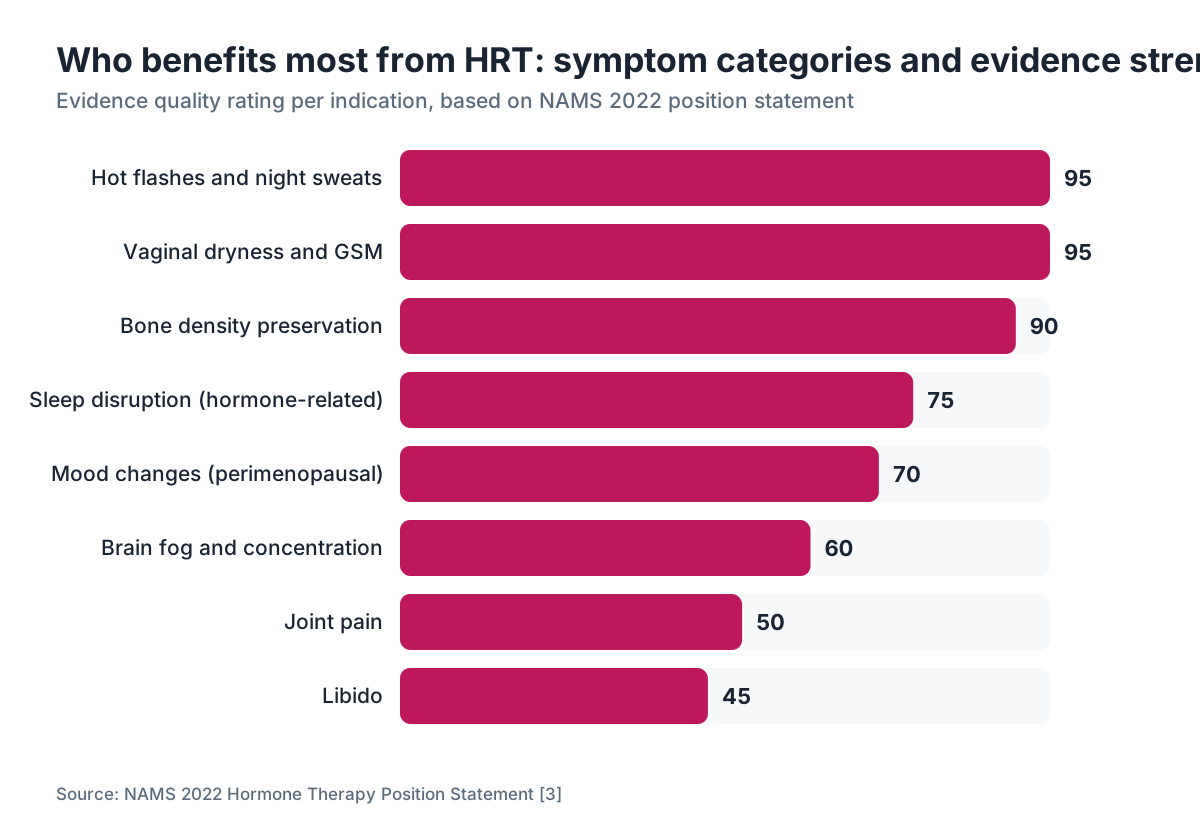
The clearest benefit is for hot flashes and night sweats in symptomatic women who start HRT within roughly 10 years of menopause or before age 60. The North American Menopause Society (NAMS) 2022 position statement puts it plainly: "For women aged younger than 60 years or within 10 years of menopause onset and without contraindications, the benefit-risk ratio is favorable for treatment of bothersome vasomotor symptoms." [3]
That 10-year window matters. It is sometimes called the timing hypothesis or the window of opportunity, and it reflects what happened in the Women's Health Initiative (WHI): women who started HRT in their 60s or more than a decade past menopause had higher rates of coronary events, while women who started near menopause had neutral or even favorable cardiovascular outcomes. [6]
Other well-established benefits:
- Genitourinary syndrome of menopause (GSM): Vaginal estrogen is the most effective treatment. Because it stays local, it is considered safe even for many women who cannot use systemic HRT. [3]
- Bone density: HRT prevents bone loss and cuts fracture risk. Women at elevated risk of osteoporosis, especially those with early menopause (before age 45), benefit most. [7] See our guide on bone density testing if you are unsure where you stand.
- Mood and sleep: Evidence is strongest in the early transition. HRT is not a primary treatment for major depression, but hormone-driven mood disruption often improves a lot. [3]
- Early menopause: Women who reach menopause before 45, naturally or surgically, carry higher lifetime risk of cardiovascular disease, osteoporosis, and cognitive decline. For them, HRT to at least age 51 (the average natural menopause age) is broadly recommended by NAMS, the British Menopause Society, and the Endocrine Society. [7][8]
What are the real risks of HRT, honestly?
Fear of HRT mostly traces back to the 2002 WHI publication, which reported more breast cancer, blood clots, stroke, and coronary disease. The full picture has more shading than the headlines gave it.
Breast cancer: The WHI found a small increased risk with combined estrogen-progestogen therapy after about 5 years of use. With estrogen alone (in women without a uterus), the WHI found a reduced breast cancer risk over 7 years. [6] More recent analyses and the French E3N data suggest body-identical micronized progesterone combined with transdermal estrogen may carry lower breast risk than older synthetic progestogens, though no randomized trial has settled it yet. [5]
Here is the absolute number in context. NAMS says any possible increase in breast cancer risk from combined HRT is less than one additional case per 1,000 women per year, on par with the risk from a daily glass of wine or from being overweight. [3]
Blood clots (VTE): Oral estrogen raises clotting risk. Transdermal estrogen does not appear to, based on multiple observational studies and the ESTHER study. [4] If you have a personal or strong family history of VTE, transdermal is the safer route.
Stroke: Oral estrogen, especially at higher doses, carries a small increased stroke risk. Transdermal estrogen at standard doses does not appear to. [4]
Real contraindications: Active or recent estrogen-receptor-positive breast cancer, unexplained vaginal bleeding, active blood clots, recent stroke or heart attack, and known estrogen-dependent cancers. These are situations where systemic HRT is generally off the table and where you need a specialist, not a quiz.
| Risk factor | Oral estrogen | Transdermal estrogen | |-------------|--------------|---------------------| | Blood clots (VTE) | Elevated | Not significantly elevated [4] | | Stroke | Small increase | Not significantly elevated [4] | | Breast cancer (E+P combined) | Small increase after ~5 yrs [6] | May be lower with micronized progesterone [5] | | Breast cancer (E alone) | Reduced in WHI [6] | Similar profile | | Bone protection | Yes [7] | Yes [7] | | Hot flash relief | Yes [3] | Yes [3] |
How do you know if your symptoms are from menopause or something else?
This is where it gets genuinely complicated, and where honest clinicians admit some uncertainty is baked in.
Hot flashes are fairly specific to estrogen withdrawal. If you are in your mid-40s or older and getting classic hot flashes (a wave of heat, sweating, sometimes chills, often worst at night), low estrogen is the likely cause. [8]
Sleep disruption, mood changes, and brain fog are far less specific. Thyroid disease causes all three. Iron-deficiency anemia causes fatigue and trouble concentrating. Depression and anxiety cause mood and sleep problems. Sleep apnea is badly underdiagnosed in midlife women and drives night sweats in some. Even perimenopause itself can be hard to separate from other conditions on symptoms alone.
A few labs are worth running before you start HRT: TSH (thyroid), CBC (anemia), fasting glucose and A1c, and a basic metabolic panel. FSH (follicle-stimulating hormone) can suggest menopause when it climbs above roughly 25-30 IU/L in the right clinical context, but it swings wildly during perimenopause, so one normal value rules out nothing. [8] The Endocrine Society notes that in women over 45 with classic symptoms, FSH testing may not change decisions much, and the diagnosis can often be made clinically. [8]
If you are under 40 with these symptoms, ruling out primary ovarian insufficiency (POI) is essential, because the management differs.
For timing, read our pieces on when does menopause start and perimenopause age.
What does a good HRT conversation with your doctor look like?
A good conversation covers five things: your symptoms and how much they affect your life, your personal history (especially breast cancer, blood clots, cardiovascular disease, and stroke), your family history of those same conditions, your preferences about how to take hormones, and your goals beyond symptom relief (bone protection, cardiovascular considerations, sexual health).
Bring your quiz results from section one. They are a structured way to say "here is what I am experiencing and here is how much it matters to me." That saves time and produces better conversations than trying to recall everything on the spot.
If your doctor waves off menopausal symptoms without a real discussion, or refuses to engage with current guidelines, that is a fair reason to get a second opinion. NAMS keeps a directory of certified menopause practitioners at menopause.org. [10] A provider who has studied this area knows the 2022 NAMS position statement substantially updated earlier, more cautious guidance, and will not reflexively withhold HRT from healthy symptomatic women in their 40s and 50s. [3]
WomenRx offers telehealth hormone evaluations for women who want a clinical assessment without hunting down a local specialist first. That is a real option if you live rural or your primary care provider is not comfortable here.
If you are also weighing weight management, know this: menopause-related hormonal shifts (falling estrogen, rising cortisol, insulin resistance) directly change body composition. Some women use GLP-1 medications alongside HRT. That is a separate conversation, but semaglutide for weight loss and semaglutide vs tirzepatide are here if that territory is relevant.
Are there women who should not take HRT at all?
Yes. Some contraindications are firm, and no quiz or clinician should talk you past them without careful specialist involvement.
Firm contraindications to systemic HRT: active or recent (within the past year) hormone-receptor-positive breast cancer, active unprovoked deep vein thrombosis or pulmonary embolism, recent arterial event (stroke, heart attack), unexplained uterine bleeding, and known or suspected estrogen-dependent cancers other than breast cancer. [3][8]
Relative contraindications, where risk-benefit needs individual analysis with a specialist: a more distant personal history of ER-positive breast cancer, inherited clotting disorders like Factor V Leiden, severe chronic liver disease, active gallbladder disease, and certain migraine with aura. Many of these are not automatic disqualifiers. They push the conversation toward transdermal routes, lower doses, or vaginal-only estrogen.
For genitourinary symptoms specifically, vaginal estrogen has such low systemic absorption that both NAMS and the American College of Obstetricians and Gynecologists say it can generally be used even by breast cancer survivors on aromatase inhibitors, when other options have failed and with oncology agreement. [11] That carve-out surprises a lot of women.
If you have a history of breast cancer or clotting disorders, please do not self-diagnose from this article. Get a specialist referral. The nuance matters enormously.
What if you want to try HRT but are nervous about the risks?
That is the most common spot women are actually in, and it is reasonable. A few practical thoughts.
Start with the lowest effective dose. Many of the risk signals from the WHI came from doses higher than what most prescribers use today. Standard modern practice is the smallest dose that controls symptoms. [3]
Choose transdermal estrogen if you have any concern about clot or stroke risk. The evidence consistently favors transdermal over oral for vascular safety, and symptom relief is equivalent. [4]
Use body-identical micronized progesterone if you need progesterone. The data are not as airtight as some advocates claim, but the observational evidence leans favorable, and it helps sleep in many women. [5]
Reassess every year. HRT is not a decision you make once and never revisit. Your symptom burden changes, your risk factors change, and the evidence keeps moving. An annual check-in to review dose, formulation, and ongoing need is standard care.
Get a bone density baseline if you are over 50 or have risk factors. Results sometimes change the math, because clear evidence of bone loss tips the benefit-risk calculation toward HRT. [7]
How long can you stay on HRT?
This is one of the most common questions and one of the most poorly answered by old guidance.
The old directive to use HRT "for the shortest time at the lowest dose" came from the first WHI data and has been substantially revised. NAMS now states there is no arbitrary duration limit for symptomatic women who are benefiting and have no contraindications. Stopping and restarting based on symptoms is acceptable. Continuing past 60 or 65 is a decision made by weighing individual benefit (ongoing symptom control, bone protection) against individual risk (the small absolute risk increases that accumulate over time). [3]
Roughly 10 to 15 percent of women have severe hot flashes that persist into their 60s and 70s. For them, stopping HRT can bring symptoms roaring back years after menopause. The decision to continue is individual, not formulaic. [3]
If your main reason for HRT is bone protection and you are well past menopause, other medications (bisphosphonates, denosumab, raloxifene) may become better primary bone treatments at some point. Worth discussing with your clinician when you hit your mid-60s.
What about bioidentical hormones from compounding pharmacies?
"Bioidentical" just means the hormone molecule is chemically identical to what your body made. Both FDA-approved products (like Estrace, Vivelle-Dot, Prometrium) and compounded versions can be bioidentical. The molecule is not the issue.
Quality control is. FDA-approved hormone products meet manufacturing standards (cGMP) that hold dose accuracy and sterility to account. Compounding pharmacies answer to state boards, not the FDA, and their products do not have to demonstrate bioequivalence. The FDA has warned that compounded hormones have shown potency inconsistencies ranging from essentially zero to many times the labeled dose. [9]
Here is the practical rule. If a commercial FDA-approved product exists in the dose and route you need, use it. Compounding makes sense when a patient genuinely cannot use a commercial formulation (an excipient allergy, a custom dose that does not exist commercially, or a route not sold commercially). It should not be the default on the basis of "more natural" claims, which have no evidence behind them.
For the compounding question in a different setting, see our piece on compounded semaglutide, where the same quality control concerns apply.
What are the signs you should see a doctor now rather than wait?
Some situations call for prompt evaluation rather than self-guided research.
See a clinician soon if you are under 40 with menopausal symptoms (POI needs to be ruled out and treated differently), if you have had any unexplained vaginal bleeding, if your symptoms are severe enough to hurt your function at work or in relationships, if you have broken a bone from a minor fall, or if you have new urinary symptoms (urgency, incontinence, recurrent infections).
These are not ER emergencies. They are call-this-week-and-get-seen situations. Delaying evaluation for early menopause in particular carries real long-term costs for bone and cardiovascular health that compound over the years. [7][8]
For typical timing, our article on menopause age covers the range of normal and what counts as early.
Frequently asked questions
Do I need HRT if my hot flashes are mild?
Mild hot flashes that do not disrupt sleep or daily function do not require HRT. Non-hormonal options like cognitive behavioral therapy for menopause, low-dose SSRIs (paroxetine is FDA-approved for this), or fezolinetant (Veozah) can help. HRT is the most effective option, but it is not mandatory for mild symptoms. The decision depends on your full symptom picture and preferences.
Can I do a do-I-need-HRT quiz online and then get a prescription?
A symptom quiz, including this one, measures your symptom burden and helps you structure a clinical conversation. It cannot replace an evaluation that reviews your medical history, contraindications, and current labs. Telehealth platforms can complete that evaluation efficiently, often in one visit, but some clinical review is genuinely required before prescribing. Quiz results are a starting point, not a prescription.
What blood tests do I need before starting HRT?
There is no single mandatory panel, but most clinicians check TSH (thyroid), CBC, fasting glucose or A1c, and a basic metabolic panel. FSH can be informative but is not required for diagnosis in women over 45 with typical symptoms. Lipid panel, blood pressure, and a review of your mammography and Pap status are also standard before starting systemic HRT.
Is HRT safe if I have a family history of breast cancer?
Family history of breast cancer is a relative, not absolute, contraindication. If you do not carry a BRCA mutation yourself and your screening is current, many clinicians and NAMS guidance support offering HRT after a careful discussion of your individual risk. Women with BRCA mutations face higher baseline risk, and that conversation needs a specialist with genetics expertise.
What is the difference between HRT and hormone therapy (HT)?
They mean the same thing in menopause care. "Hormone replacement therapy" or HRT is the older term. Many clinicians and organizations now prefer "menopausal hormone therapy" (MHT) or just "hormone therapy" (HT), partly because "replacement" implies you are returning to premenopausal levels, which is not quite accurate. The treatment and the evidence are the same regardless of the label.
Can HRT help with weight gain during menopause?
Menopause shifts fat distribution toward the abdomen, driven partly by falling estrogen and partly by aging-related metabolic change. HRT does not prevent all weight gain, but studies show it reduces visceral fat accumulation compared to no treatment. It is not a weight loss medication on its own, but it addresses one of the drivers of midlife body composition change.
Does HRT help with brain fog and memory problems?
Evidence is moderate. Women who start HRT near menopause report better verbal memory and concentration, and the critical window hypothesis suggests early initiation may protect cognitive health long term. HRT is not a treatment for established dementia. The best evidence is for symptomatic women in the early transition, not for women well past menopause when cognitive symptoms appear.
What if my doctor says I don't need HRT?
Ask specifically why, and whether the concern is your symptom level or your risk profile. If it is risk, ask which risks and whether a lower-dose transdermal option changes the picture. If your doctor is dismissing significant symptoms without real discussion, a second opinion from a NAMS-certified menopause practitioner is reasonable. Guidelines have shifted a lot since 2002 and not every provider is current.
At what age is it too late to start HRT?
There is no absolute upper cutoff, but the benefit-risk ratio shifts after age 60 or more than 10 years past menopause, especially for cardiovascular outcomes. Starting HRT for the first time at 65 or later in an asymptomatic woman is generally not recommended. For women still having significant symptoms after 60, a careful individual assessment can still support starting. Continuing HRT through the 60s in women who started earlier is a different and more commonly supported scenario.
How quickly does HRT work?
Hot flash improvement usually begins within 4 weeks of starting estrogen and peaks by about 8 to 12 weeks. Vaginal dryness takes longer, often 2 to 3 months of consistent local or systemic estrogen before full tissue effect. Mood and sleep often improve within the first 2 to 4 weeks in women whose symptoms are primarily hormonal. If you see nothing after 3 months at an adequate dose, the formulation or dose may need adjusting.
Is there an HRT quiz validated by doctors I can use?
Several validated menopause symptom scales exist in the medical literature. The Menopause Rating Scale (MRS) and the Greene Climacteric Scale are both widely used in research and practice to quantify symptom burden. The MRS is publicly available and has been validated across many countries and languages. The quiz in this article is modeled on the domains those tools cover, though it is not a direct reproduction of either.
Can I take HRT if I'm still getting periods?
Yes. Many women start HRT during perimenopause, when cycles are irregular but not fully stopped. In that setting the regimen is usually different: cyclical rather than continuous combined therapy, to align with your remaining hormonal fluctuation. It takes a clinical evaluation to determine which approach fits your current status. Starting HRT does not stop your periods; it manages symptoms on top of whatever your ovaries are still doing.
Does HRT protect against osteoporosis?
Yes, clearly. Estrogen is one of the most effective agents for preventing postmenopausal bone loss, and HRT reduces fracture risk when used consistently. The effect fades after stopping, so bone density does not stay permanently elevated. Women with osteopenia or osteoporosis who also have menopausal symptoms are strong candidates for HRT, since it treats both problems at once. Women with severe osteoporosis may need bone-specific medications too.
What is the difference between systemic HRT and local vaginal estrogen?
Systemic HRT (patches, gels, pills, sprays) delivers estrogen into the bloodstream and affects the whole body, relieving hot flashes, protecting bone, and improving mood and sleep. Local vaginal estrogen (cream, ring, suppository) stays in vaginal and bladder tissue, treating dryness and urinary symptoms without meaningful systemic absorption. Local therapy is considered safe even for many women who cannot use systemic HRT, and the two can be combined when needed.
Sources
- Greene JG, Maturitas 1998; Greene Climacteric Scale
- North American Menopause Society (NAMS), 2022 Hormone Therapy Position Statement
- Canonico M et al., ESTHER Study, Circulation 2007
- Fournier A et al., E3N French Cohort Study, Breast Cancer Research and Treatment 2008
- Rossouw JE et al., Women's Health Initiative Writing Group, JAMA 2002
- Endocrine Society Clinical Practice Guideline: Treatment of Symptoms of the Menopause, 2015
- Endocrine Society Clinical Practice Guideline: Menopause, 2015
- FDA, Compounded Bioidentical Hormone Therapy: Questions and Answers
- NAMS, Menopause Practitioner Directory, menopause.org
- The NAMS 2020 GSM Position Statement, Menopause journal
- National Institutes of Health, Office of Research on Women's Health: Women's Health Initiative overview