Compounded hormones vs pharmacy HRT: which is better for you?
TL;DR: FDA-approved HRT (brand or generic pharmacy products) has decades of safety and efficacy data behind it. Compounded hormones fill gaps when approved doses or delivery forms don't fit a patient, but they skip FDA review for potency, sterility, and consistency. For most women, start with approved products. Compounding is a reasonable second step when pharmacy options genuinely fall short.
What is the actual difference between compounded hormones and pharmacy HRT?
Pharmacy HRT means FDA-approved hormone products: Vivelle-Dot, Climara, Prometrium, Divigel, oral estradiol generics, and others you can fill at any chain pharmacy. Each passed the FDA's new drug application process, which reviewed manufacturing consistency, potency, and safety data before the product hit shelves. [1]
Compounded hormones are mixed by a compounding pharmacy to a prescriber's custom formula. The pharmacy may combine estradiol, estriol, progesterone, DHEA, or testosterone in a dose or delivery form that doesn't exist commercially. The FDA does not review or approve compounded preparations before they're dispensed, which means the agency has not independently verified that the batch you receive contains what the label says. [2]
That distinction matters more than most people realize. A 2017 study published in Menopause tested 28 compounded progesterone creams and found that 12 of them (43%) failed potency testing, delivering less than 90% of the labeled dose. [3] That's not a theoretical concern. It's a measured failure rate in a peer-reviewed journal.
There's a third category worth knowing. FDA-approved testosterone products (Androgel, Testim) are approved only for men, so nearly all testosterone therapy women receive is technically compounded or off-label. That's a genuinely different situation from compounding an estrogen product that already has approved alternatives.
Is FDA-approved HRT actually safer than compounded hormones?
The honest answer: we have far more data on approved products, and that asymmetry itself matters.
The Women's Health Initiative, the KEEPS study, and the large European observational data on transdermal estradiol plus micronized progesterone all used FDA-approved or identically characterized products. We know a great deal about their risk profiles for breast cancer, cardiovascular disease, stroke, and clot. For transdermal estradiol specifically, the evidence is reassuring: a 2019 Cochrane review found no increased VTE risk with transdermal routes compared to oral estrogen. [4] The North American Menopause Society's 2022 position statement says, "For women who are younger than 60 years or who are within 10 years of menopause onset and have no contraindications, the benefits of systemic HT outweigh the risks." [5]
Compounded hormones don't have equivalent safety trial data, full stop. That doesn't mean they're dangerous. It means we lack the long-term pharmacovigilance infrastructure to know. The FDA has warned specifically about compounded bioidentical hormone therapy (cBHT), stating in a 2021 consumer update that it lacks evidence of safety or efficacy compared to approved products. [2]
"Bioidentical" gets used to market compounded hormones as safer or more natural. It's a marketing term, not a regulatory category. Many FDA-approved products, including Estrace (estradiol) and Prometrium (micronized progesterone), are also bioidentical in the chemical sense. The compounding pharmacy version of the same molecule has the same structure. It just hasn't been independently verified for consistency.
When does compounded HRT actually make sense?
There are real clinical situations where compounding is the right answer, and it's worth being specific about them rather than dismissing all compounding.
First: testosterone for women. No FDA-approved testosterone product exists for female patients in the US. The Endocrine Society and NAMS both acknowledge that low-dose compounded testosterone is a reasonable option for hypoactive sexual desire disorder when other causes have been ruled out. [6] This is probably the clearest legitimate use case.
Second: doses or routes not commercially available. A woman who needs a very low-dose estradiol vaginal suppository that isn't sold commercially, or who reacts to an excipient in approved products, may have no other option. Compounding fills that real gap.
Third: vaginal DHEA. Intrarosa (prasterone) is now FDA-approved for dyspareunia, but compounded vaginal DHEA was used for years before that approval and some providers still prefer customized strengths.
Fourth: some women simply can't absorb transdermal patches well or can't tolerate the adhesive. A compounded estradiol gel or cream at a custom concentration can solve a real problem.
What's not a good reason to choose compounding: believing it's inherently safer, believing estriol-dominant "bi-est" or "tri-est" formulas protect against breast cancer (no clinical evidence supports that), or picking it because a provider runs a compounding pharmacy and profits from prescribing it. The last point sounds harsh, but financial conflicts in this space are real and worth asking about.
How do the costs compare between compounded and pharmacy HRT?
Cost is complicated, mostly because insurance coverage varies so widely.
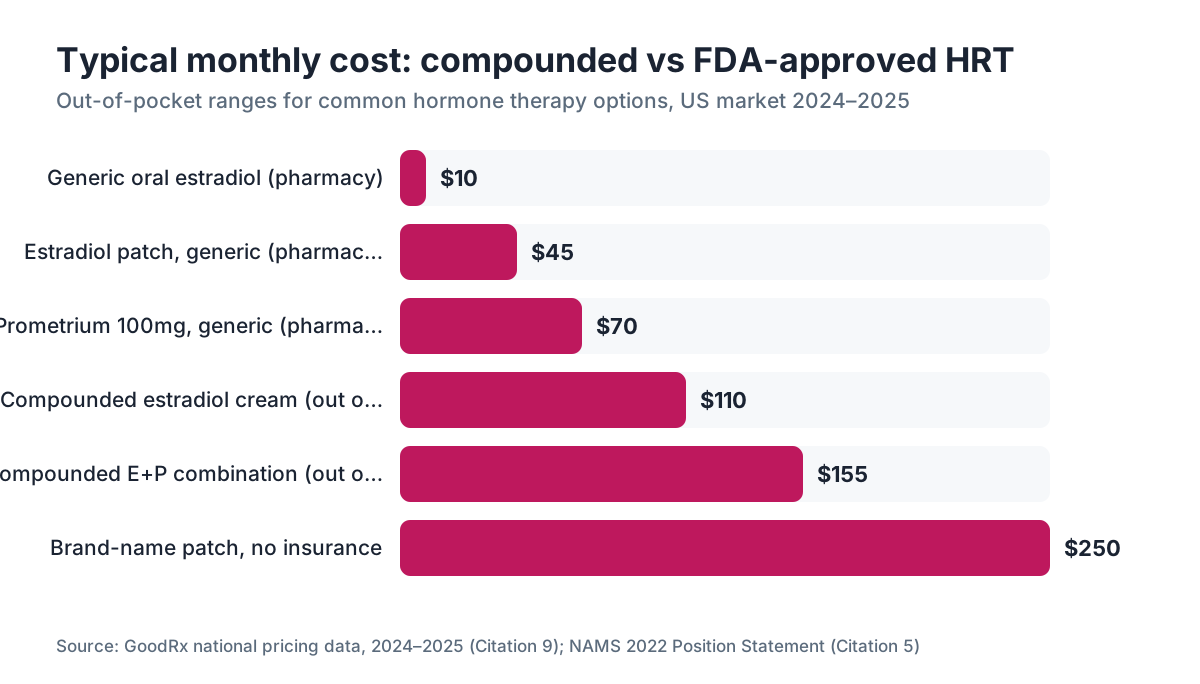
FDA-approved HRT runs roughly $20 to $90 per month with insurance or generic discounts. Generic oral estradiol is among the cheapest medications in existence, often under $10 per month with GoodRx. [9] Climara or Vivelle-Dot patches average $30 to $80 per month after insurance. Brand-name products without coverage can reach $200 to $300. Prometrium (micronized progesterone) typically costs $40 to $120 per month without insurance.
Compounded hormones are almost never covered by insurance. A custom cream or troche from a compounding pharmacy typically runs $50 to $200 per month depending on the formula and where you live. Specialty online compounding pharmacies often charge $80 to $180 per month for a standard estradiol-progesterone combination.
So the common assumption that compounding is cheaper is often wrong. A woman whose insurance covers her estradiol patch and Prometrium will likely pay less than she would for a compounded cream, and she gets a product with verified potency. The math shifts if she's uninsured or if she needs something genuinely not available commercially.
The comparison table below shows typical costs and key attributes side by side.
Compounded hormones vs pharmacy HRT: side-by-side comparison
| Feature | FDA-Approved Pharmacy HRT | Compounded Hormones | |---|---|---| | FDA pre-market review | Yes | No | | Potency verified | Yes (manufacturing standards) | Varies by pharmacy | | Insurance coverage | Often yes | Rarely | | Typical monthly cost | $10 to $120 with coverage | $50 to $200 out of pocket | | Testosterone option for women | Not FDA-approved (off-label) | Yes (most common route) | | Long-term safety data | Extensive (WHI, KEEPS, etc.) | Minimal | | Custom dosing | Limited to available strengths | Yes | | Estriol available | No (not FDA-approved alone) | Yes | | Bioidentical options | Yes (estradiol, progesterone) | Yes |
This table reflects general US market conditions as of mid-2025. Specific product availability and insurance formularies change frequently. [1][5]
What does the FDA actually say about compounded hormone therapy?
The FDA has grown more pointed about compounded bioidentical hormones over the past decade. Its 2021 consumer update warned that cBHT "has not been shown to be safe or effective" and that claims about estriol-based formulas are not supported by clinical evidence. [2]
The key regulatory distinction is between 503A compounding pharmacies (patient-specific prescriptions, small batches, state-regulated) and 503B outsourcing facilities (larger batches, more FDA oversight, used mostly for hospital settings). Most retail compounding pharmacies operate under 503A, which means the FDA's oversight is largely complaint-driven rather than proactive inspection.
The FDA does not ban compounded hormones and acknowledges their role when approved products are inadequate. But the agency has sent warning letters to compounding pharmacies making unsupported claims about hormone testing, personalization, or safety. [2]
If you use a compounding pharmacy, the safest path is one accredited by the Pharmacy Compounding Accreditation Board (PCAB), which requires independent potency testing. [8] That's not a guarantee, but it's a meaningful quality signal.
Does NAMS or the Endocrine Society recommend compounded hormones?
Neither organization recommends compounded hormones as a first-line choice.
The North American Menopause Society's 2022 hormone therapy position statement recommends FDA-approved products and says that compounded hormones "should be reserved for the rare woman who cannot use commercially available HT." [5] That's a pretty clear hierarchy.
The Endocrine Society's clinical practice guideline on menopause (2015, with updates) echoes the same logic: approved products first, compounding for specific unmet needs. [11] For testosterone specifically, the Endocrine Society acknowledges a legitimate role for low-dose compounded testosterone in women with hypoactive sexual desire disorder. [6]
Some providers at integrative or functional medicine practices present compounding as standard care, or even superior. That's out of step with the current consensus of both major specialty societies. The gap matters most for women who are new to hormone therapy and don't yet have a framework for evaluating competing claims.
If you're exploring your options, the menopause society is a useful starting point for understanding evidence-based guidance, and reading about what perimenopause actually looks like can help you ask better questions at your next appointment.
What about saliva testing and "personalized" hormone formulas?
Saliva hormone testing gets marketed heavily alongside compounded hormones as the foundation for personalized dosing. The idea sounds logical: test your levels, customize the formula. In practice, the evidence for saliva testing is weak.
Saliva estradiol and progesterone levels don't reliably reflect serum levels or tissue exposure, and they fluctuate a lot with hydration, time of day, and what you've eaten. The Endocrine Society does not recommend saliva testing as the basis for hormone dosing. [6] Serum testing has better reproducibility.
Where saliva testing gets done and then used to sell a proprietary compounded formula, there's an obvious financial incentive to find something to treat. That's not a conspiracy. It's just how fee-for-service economics work. Be skeptical of any provider whose testing always seems to end in a custom formula from the same pharmacy they're connected to.
Personalization itself is a legitimate goal. Your dose of estradiol should match your symptom response and serum estradiol levels, and that absolutely requires titration. The real question is whether it requires compounding or whether approved products in different strengths (patches come in 0.025, 0.0375, 0.05, 0.075, and 0.1 mg/day, for example) can get you there.
Are there women who should specifically avoid compounded hormones?
Yes, and it matters to say this plainly.
Women with a personal history of breast cancer, or with BRCA1/2 mutations, are already making high-stakes decisions about hormone therapy. Using a product with uncertain potency is a particularly bad idea in this context. If you're in this category, stick to FDA-approved products where the dose you're taking is the dose that went into the risk discussion with your oncologist or gynecologist.
Women who've had a hormone-sensitive blood clot also need predictable dosing. A cream that varies 30% batch to batch (within the failure rates found in that 2017 Menopause study) could matter clinically. [3]
Anyone relying on the peanut-oil-based Prometrium should know that a peanut allergy is a real contraindication to that specific product. This is actually one place where a compounding pharmacy solves a real problem: making progesterone in a different base.
One more thing. If you're paying out of pocket for compounded hormones because you believe they're safer or more effective than approved products, that belief isn't supported by current evidence. You may be paying more for less certainty. That's a choice worth making with full information rather than on the basis of marketing.
How should you talk to your doctor about this choice?
The best conversation starts with your symptoms and your specific medical history, not with a product category.
Ask your provider what FDA-approved options exist for what you need. If they jump straight to a compounded formula without explaining why an approved product won't work, that's worth a follow-up question. If they have a genuine clinical reason (testosterone therapy, excipient allergy, dose not commercially available), the compounding referral makes sense.
Ask whether the compounding pharmacy they use is PCAB-accredited. Ask whether it does independent potency testing on its batches. These are reasonable questions and a good pharmacy will have good answers.
At WomenRx, providers work through the FDA-approved options first and flag when compounding is genuinely the better clinical fit. That approach matches NAMS guidance and keeps the reasoning transparent to patients.
If you're also managing symptoms beyond classic hot flashes, such as frozen shoulder or postmenopausal bleeding (see our piece on bleeding after menopause and cancer risk), hormone therapy decisions get more layered fast. A provider who thinks through the full picture matters more than which pharmacy fills the prescription.
Worth reading if you want a broader frame: The New Menopause covers how evidence-based thinking about this transition has shifted in the past decade.
What is the bottom line on compounded vs pharmacy HRT?
For most women, FDA-approved HRT is the right starting place. It has verified potency, decades of safety data, and real insurance coverage that makes it affordable. The bioidentical versions (estradiol, micronized progesterone) that most integrative providers promote are already available as approved products.
Compounding fills genuine gaps, mainly testosterone for women (where no approved product exists), unusual dose needs, and excipient sensitivities. In those cases, use a PCAB-accredited pharmacy and stay skeptical of personalization claims that aren't backed by proper serum monitoring.
The marketing around compounded hormones often runs ahead of the evidence. "Natural," "bioidentical," and "personalized" are not synonyms for safe, effective, or better. They're descriptive terms strategically attached to an unregulated product category in ways that can mislead smart women into spending more for less certainty.
WomenRx providers handle exactly this question all the time. If you want a second opinion on your current regimen or you're starting from scratch, that's the clinical work that matters more than the compounding vs. pharmacy label.
For context on related therapies, including how thyroid hormone replacement fits into the picture for women with overlapping symptoms, see our dedicated coverage.
Frequently asked questions
Is compounded progesterone the same as Prometrium?
Both contain micronized progesterone, so the molecule is identical. But Prometrium is FDA-approved with verified potency and a peanut-oil base, while compounded progesterone has not been independently reviewed for consistency. A 2017 study in Menopause found 43% of tested compounded progesterone creams failed potency standards. If you can take Prometrium and it's covered, it's the more reliable option.
What is bi-est or tri-est hormone cream and is it safe?
Bi-est combines estradiol and estriol; tri-est adds estrone. These formulas are only available through compounding pharmacies because no FDA-approved product contains estriol alone or in combination. The claim that estriol protects against breast cancer is not supported by clinical trial data. The FDA explicitly warns that estriol-based compounded formulas lack evidence of safety or efficacy. Use them only if you have a specific clinical reason.
Can I get testosterone as an FDA-approved HRT product for women?
No FDA-approved testosterone product exists for women in the US as of mid-2025. Testosterone pellets, troches, creams, and injections used by women are all compounded or off-label. Both NAMS and the Endocrine Society acknowledge this gap and support low-dose compounded testosterone for women with hypoactive sexual desire disorder when other causes are excluded.
Does insurance cover compounded hormone therapy?
Almost never. Most insurance plans explicitly exclude compounded preparations. FDA-approved HRT, including generic oral estradiol (sometimes under $10/month with GoodRx) and Prometrium, is typically covered. This means compounded hormones often cost more out of pocket despite lacking the potency verification that comes with approved products.
Is saliva hormone testing reliable for dosing hormones?
No. The Endocrine Society does not recommend saliva testing for hormone dosing because saliva levels don't reliably correlate with serum levels or tissue exposure, and they vary with hydration and time of day. Serum testing is the standard. Providers using saliva testing to prescribe a proprietary compounded formula may have a financial interest in that arrangement worth asking about.
What is PCAB accreditation and why does it matter for compounding pharmacies?
The Pharmacy Compounding Accreditation Board (PCAB) is an independent body that certifies compounding pharmacies meeting stricter quality standards, including independent potency testing. A PCAB-accredited pharmacy is not FDA-regulated the same way a manufacturer is, but it provides a meaningful quality signal above the baseline state pharmacy board oversight. If you use a compounding pharmacy, ask whether it holds PCAB accreditation.
Are bioidentical hormones safer than synthetic hormones?
"Bioidentical" means the hormone molecule is chemically identical to what the human body produces. It does not mean safer. FDA-approved estradiol and micronized progesterone are bioidentical and have extensive safety data. The safety concern with compounded hormones is not the molecule; it's the lack of potency verification and the absence of long-term trial data on specific formulas.
How does the Women's Health Initiative apply to compounded hormone therapy?
It doesn't, directly. The WHI used oral conjugated equine estrogen and medroxyprogesterone acetate (not bioidentical). Its findings, including the small elevated breast cancer risk with combined therapy, have been refined significantly over time and largely don't apply to transdermal estradiol plus micronized progesterone. But critically, compounded hormones weren't studied at all in the WHI or in equivalent long-term trials.
Can a telehealth provider prescribe both FDA-approved HRT and compounded hormones?
Yes. Most telehealth providers licensed in your state can prescribe both. The clinical question is which is appropriate. A good telehealth provider starts with approved options, documents why compounding is needed when it's chosen, and directs you to an accredited compounding pharmacy rather than one they have a financial interest in.
What are the risks of getting the wrong dose from a compounded hormone preparation?
Under-dosing leaves symptoms uncontrolled, which is the most common real-world outcome given the potency failures documented in studies. Over-dosing with estrogen carries endometrial risk if progesterone is inadequate to balance it. Variable dosing batch-to-batch makes it harder to titrate by symptoms or serum levels. These risks are meaningful, especially for women with hormone-sensitive conditions.
Is there a difference between compounded hormone pellets and other compounded forms?
Pellets (implanted under the skin) are one of the riskier compounded delivery forms because the dose can't be adjusted once implanted and testosterone pellets in particular have been associated with supraphysiologic levels in some women. Neither NAMS nor the Endocrine Society endorses pellet therapy as a preferred delivery method. Creams, gels, and troches allow easier dose adjustment.
How do I know if my compounded hormone pharmacy is reputable?
Look for PCAB accreditation, independent potency testing on each batch (the pharmacy should provide a certificate of analysis on request), state pharmacy board licensure in your state, and no history of FDA warning letters. Avoid pharmacies that market directly to patients with claims about superior safety over FDA-approved products; that's a marketing red flag, not a clinical credential.
What FDA-approved HRT options are available as transdermal products?
Several. Estradiol patches include Climara (weekly), Vivelle-Dot (twice weekly), Alora, and Minivelle, in strengths from 0.025 to 0.1 mg/day. Estradiol gels include Divigel and Estrogel. Sprays include Evamist. All are FDA-approved with verified potency. Combined estradiol-levonorgestrel patches (CombiPatch) also exist. These cover most dose needs without requiring compounding.
Sources
- FDA, Drugs section (new drug application review)
- FDA, Consumer Updates: bioidentical hormone therapy (2021)
- Franke HR et al., Menopause, 2017, potency testing of compounded progesterone creams
- Cochrane Review: Hormone therapy for preventing cardiovascular disease in post-menopausal women, 2019
- North American Menopause Society, 2022 Hormone Therapy Position Statement
- Endocrine Society, Clinical Practice Guideline: Treatment of Menopause
- PCAB (Pharmacy Compounding Accreditation Board), Accreditation Standards
- GoodRx, Estradiol price data (national average, 2024-2025)
- Manson JE et al., NEJM, WHI Hormone Therapy Trial reanalysis 2013
- Stuenkel CA et al., Journal of Clinical Endocrinology & Metabolism, 2015 Menopause Management Guideline
- Santoro N et al., Menopause, 2019, testosterone in women review