Compound semaglutide: what it is, what it costs, and is it safe?
TL;DR: Compound semaglutide is a copy of the active ingredient in Ozempic and Wegovy, made by compounding pharmacies while the branded drugs sat on FDA's shortage list. It costs far less. But FDA never approved it, quality swings hard by pharmacy, and FDA declared the shortage over in February 2025, pushing compounded versions into a legal gray zone. Here's what every woman weighing it needs to know.
What is compound semaglutide and how is it different from Ozempic or Wegovy?
Semaglutide is a GLP-1 receptor agonist. It mimics the hormone GLP-1 to slow gastric emptying, quiet appetite, and lower blood sugar. Novo Nordisk sells it under two brand names: Ozempic (approved for type 2 diabetes) and Wegovy (approved for chronic weight management). Both are FDA-approved, made to strict pharmaceutical standards, and sold in pre-filled pens with validated dosing.
Compound semaglutide comes from a compounding pharmacy, a facility that mixes drug ingredients from bulk active pharmaceutical ingredient (API) instead of buying finished product from the original manufacturer. The result looks similar. It is not the same product. FDA has not reviewed or approved any compounded version for safety, effectiveness, or manufacturing quality [1].
Here's the wrinkle most people miss. A lot of compound semaglutide on the market is semaglutide sodium or semaglutide acetate, salt forms of the molecule rather than the base form used in Ozempic and Wegovy. FDA stated in 2024 that these salt forms are not the same active ingredient as the approved drugs and that using them in compounding raises added safety questions [2]. Some pharmacies later switched to base semaglutide, but sourcing is inconsistent and you often cannot verify which form you're getting.
For a broader look at how semaglutide works across all its forms, see semaglutide.
Why did compound semaglutide become so popular?
Demand for Ozempic and Wegovy exploded after 2021 clinical data and the 2023 FDA approval of Wegovy for cardiovascular risk reduction. Novo Nordisk's supply chain could not keep up. FDA placed semaglutide on its official drug shortage list in 2022, and it stayed there for more than two years [3]. During a shortage, federal law (21 U.S.C. § 503A and § 503B) lets licensed compounding pharmacies and outsourcing facilities prepare copies of shortage drugs without FDA pre-approval.
That legal window plus a price gap that could run $800 or more a month pulled in a wave of telehealth companies and medical spas offering compounded versions. For many women who couldn't get or afford brand-name Wegovy, it was the only practical way in.
Then FDA announced in February 2025 that the shortage was resolved [2]. That started a wind-down. FDA has stated that 503A pharmacies (patient-specific compounders) must stop making compound semaglutide once the shortage is officially delisted, and 503B outsourcing facilities had until May 22, 2025 to wind down. Litigation from compounding industry groups has muddied that timeline, so the legal picture is still moving as of mid-2025. Check FDA's current shortage database before you decide anything [3].
How much does compound semaglutide cost compared to brand-name?
This is the number that drives most of the decision. Brand-name Wegovy has a list price around $1,350 a month without insurance [4]. With insurance or a manufacturer savings card, some patients pay $0 to $25 a month, but coverage is patchy and many commercial plans still exclude it.
Compound semaglutide from telehealth platforms has been priced between $99 and $400 a month, depending on dose and provider. That spread matters. A low-volume, 0.25 mg starter dose costs less than a maintenance dose of 1.7 mg or 2.4 mg. Prices also shift based on whether a medical visit fee is baked in.
The table below lays out the common cost scenarios.
| Option | Typical monthly cost | FDA status | |---|---|---| | Wegovy (branded, no insurance) | ~$1,350 | Approved | | Wegovy (with GoodRx or coupon) | $650, $900 | Approved | | Ozempic (off-label for weight, no insurance) | ~$900, $1,000 | Approved (diabetes) | | Compound semaglutide (503A pharmacy) | $99, $250 | Not approved | | Compound semaglutide (503B outsourcer) | $150, $400 | Not approved |
One honest note. The cheapest compound options are not always the most carefully made. Pharmacy overhead, third-party testing, and sterile manufacturing all cost real money. A $99/month product that skips independent potency testing is a different deal than a $250/month product from an FDA-registered 503B outsourcing facility, even though both say semaglutide on the label.
See our full breakdown of semaglutide for weight loss for how costs interact with outcomes.
Is compound semaglutide legal to prescribe and use?
During a declared FDA drug shortage, yes. Sections 503A and 503B of the Federal Food, Drug, and Cosmetic Act created two categories of compounding. Section 503A covers traditional pharmacies compounding for specific patients with a valid prescription. Section 503B covers outsourcing facilities that can produce larger batches without patient-specific prescriptions but must register with FDA and follow current good manufacturing practice (CGMP) standards [5][12].
Once FDA pulls a drug off the shortage list, those exemptions stop applying. FDA's February 2025 shortage resolution started the enforcement clock. Court challenges from compounding trade groups delayed some deadlines, but FDA has said plainly it intends to enforce the law once the legal proceedings clear [2].
In plain terms: if you're starting compound semaglutide in mid-2025 or later, ask your prescriber directly whether the pharmacy they use has a current legal basis to make it. It's a fair question. A reputable provider will have a clear answer.
What are the side effects of compound semaglutide?
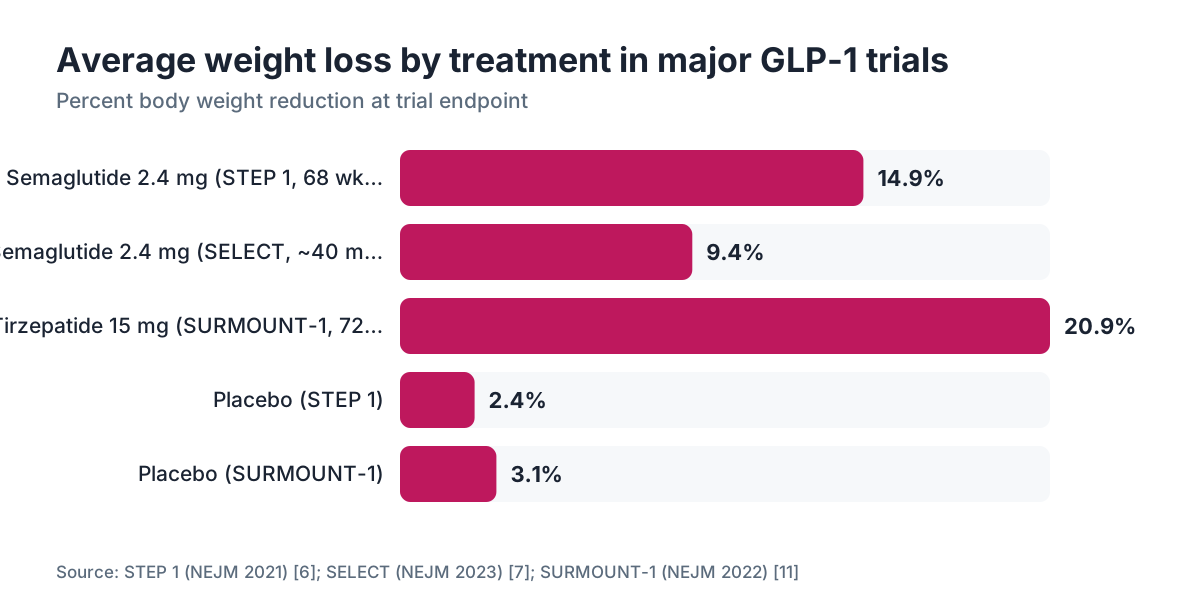
The side effect profile of semaglutide, the molecule itself, is well documented from large trials. The STEP 1 trial enrolled 1,961 adults and ran 68 weeks. It found that 74.2% of participants on semaglutide 2.4 mg reported gastrointestinal events, versus 47.9% on placebo [6]. The most common were nausea (44%), diarrhea (30%), vomiting (24%), and constipation (24%). Most GI effects were temporary, peaked during dose escalation, and faded over time.
More serious but less common risks include pancreatitis, gallbladder disease (STEP 1 found gallstones in 2.6% of semaglutide users versus 1.2% on placebo), and a small rise in resting heart rate. FDA labels for both Ozempic and Wegovy carry a boxed warning about thyroid C-cell tumors based on rodent studies, though that finding has not shown up in humans [4].
Compound semaglutide adds a layer of uncertainty on top of all that. An under-potent batch gives you less effect than expected. An over-potent batch from sloppy quality control makes side effects worse. FDA received adverse event reports in 2023 and 2024 describing hospitalizations tied to compounded semaglutide products, including cases of dosing errors and contamination [1]. The agency linked several to products using semaglutide salt forms or products with inaccurate dosing labels.
For women in perimenopause or menopause, GLP-1 side effects layer onto symptoms you may already have. Nausea overlaps with hot flash nausea. Constipation overlaps with progesterone-related gut slowing. If you're also on hormone replacement therapy, tell your prescriber, because the symptom picture gets tangled fast.
What are the long-term side effects of semaglutide women should know about?
The honest answer: the longest trials run about three to four years, so anything past that is a guess. The SELECT trial, published in the New England Journal of Medicine in 2023, followed 17,604 adults for a mean of 39.8 months and found semaglutide 2.4 mg cut major adverse cardiovascular events by 20% [7]. That's the best long-term data we have, and for cardiovascular risk it's genuinely good news.
Muscle loss is the real concern that's still being quantified. GLP-1 agonists strip weight from both fat and lean mass. Studies suggest roughly 25 to 40% of the weight lost on semaglutide is lean mass, which is a problem for women already shedding muscle through the menopause transition [8]. Resistance training and enough protein (most practitioners aim for 1.2 to 1.6 g per kilogram of body weight daily) seem to blunt it, but nobody has a clean long-term answer yet.
Bone density is another open question. Rapid weight loss from any cause pulls down bone mineral density, and early GLP-1 data show small decreases. Women already at risk for osteoporosis should get a bone density test before starting and again at 12 to 24 months. That's not alarmism. It's basic monitoring.
Mental health signals have been mixed. Some users report better mood and quieter food noise. FDA issued a communication in 2023 saying it was reviewing signals for suicidal ideation with GLP-1 and GIP/GLP-1 receptor agonists. The agency concluded in 2024 that the available evidence did not establish a causal link, but the question isn't fully closed [9].
Here's the uncomfortable part. The long-term picture for women over 50 is genuinely incomplete. Most trials enrolled younger, heavier people. Extrapolating to a 54-year-old in perimenopause is reasonable but not airtight.
For a direct comparison with tirzepatide, which has a somewhat different profile, see semaglutide vs tirzepatide.
How do you verify a compounding pharmacy is legitimate?
This is where women get tripped up. A pharmacy can have a slick website and still operate outside legal standards. Here's what to check.
First, ask whether the pharmacy is a 503B outsourcing facility registered with FDA. You can verify it on FDA's registered outsourcing facilities list, which is publicly searchable [5]. A 503B facility must follow CGMP standards and submit to FDA inspections. A 503A pharmacy answers to state boards of pharmacy, and that oversight varies a lot by state.
Second, ask for a certificate of analysis (COA) from a third-party lab confirming potency, sterility, and no endotoxins for the specific lot you're getting. A legitimate operation hands this over without flinching.
Third, check whether the pharmacy has any FDA warning letters. FDA publishes these online, and a quick search can surface a history of contamination findings or labeling violations.
If a telehealth company can't or won't tell you which pharmacy compounds their semaglutide, treat that as a red flag. WomenRx, for one, discloses its pharmacy partners and requires FDA-registered 503B sourcing. Knowing that chain of custody exists before you inject anything is reasonable due diligence.
Your prescriber should be able to answer four things: which pharmacy, what form of semaglutide, what concentration, and whether each lot gets third-party testing. Four questions. Clear answers expected.
Can you get compound semaglutide in a pill or sublingual form instead of an injection?
The branded drugs come as subcutaneous injection only. Rybelsus is an FDA-approved oral semaglutide for type 2 diabetes at 3, 7, and 14 mg, but that is not the dose range used for weight loss.
Some compounders have started making oral and sublingual compound semaglutide. The science here is thin. Semaglutide absorbs poorly by mouth without the SNAC (sodium N-[8-(2-hydroxybenzoyl)amino]caprylate) enhancer that Novo Nordisk builds into Rybelsus. Compounders making sublingual troches or oral capsules without that technology are selling a product that may absorb poorly or unpredictably. There's no published bioavailability data on compounded sublingual semaglutide at all.
That doesn't stop the market from offering it. It does mean a compounded oral or sublingual version at a weight-loss dose sits on the far edge of what any evidence supports. Subcutaneous injection is less convenient, but it's the only delivery route with actual clinical trial backing.
How does compound semaglutide fit into perimenopause and menopause weight management?
Weight gain during the menopause transition is not a simple calories-in-calories-out story. Estrogen decline shifts fat toward the visceral (abdominal) area, slows resting metabolic rate, and changes insulin sensitivity. Women typically gain 5 to 8 pounds in the years around their final period, and plenty gain more [10].
GLP-1 agonists work on the appetite and insulin side of that equation. They do not replace estrogen. Some practitioners, including those at telehealth platforms built for women, now pair semaglutide with hormone therapy. The theory: estrogen supports muscle and metabolic health while the GLP-1 handles appetite and weight trajectory. Small observational studies hint the combination may protect lean mass better than either alone, but there's no prospective trial data yet.
If you're managing menopause symptoms with an estrogen patch or oral progesterone, the interactions aren't dangerous, but they do call for coordinated care. GLP-1 slows gastric motility, which can shift absorption timing for oral medications. Taking oral progesterone at a consistent time relative to meals matters more when your gut is moving slower.
For women just noticing hormonal shifts and wondering about timing, see perimenopause age for a realistic picture of when these changes tend to start.
What should you ask a provider before starting compound semaglutide?
Walk in with specific questions instead of waiting to be told. Here's a practical list.
Which pharmacy makes this, and is it a 503B registered outsourcing facility? Can you send me their FDA registration number? What form of semaglutide is it (base, sodium salt, acetate salt)? What's the concentration per mL, and how do I draw my dose? Is there a current COA with potency and sterility testing for the lot I'm receiving?
On the clinical side: What's the dose escalation schedule? How do we monitor for muscle loss? Should I get a DEXA scan before starting? What do I do if I have severe nausea or vomiting and can't keep anything down?
And for women in the menopause transition specifically: How does this interact with any hormone therapy I'm on? Have you managed both at the same time before?
A provider who gets vague or irritated when you ask these is the wrong provider. You're injecting a peptide drug with real metabolic effects. Detailed questions are the point.
WomenRx is built around the overlap of hormonal health and GLP-1 therapy for women, with providers who can hold both conversations at once. That integrated care matters when your biology doesn't sort itself into one tidy box.
What does the FDA actually say about compounded semaglutide right now?
FDA has been unusually blunt on this. In 2024, FDA clarified that semaglutide sodium and semaglutide acetate are not the same active ingredient as semaglutide base, and therefore could not be compounded under the shortage exemption even while the shortage still existed [2]. That was a signal the agency planned to use its existing authority aggressively.
In February 2025, FDA announced the shortage resolution for both Wegovy and Ozempic, starting the wind-down clocks for compounders. FDA stated: "FDA has determined that Wegovy (semaglutide) injection, 2.4 mg is not currently in shortage," and set enforcement discretion timelines for pharmacies to transition [2].
As of mid-2025, enforcement sits in a complicated spot because of court orders from industry litigants. FDA's stated position is that once the legal barriers clear, it will pursue enforcement. For a patient, the practical takeaway is simple: the regulatory ground under compound semaglutide has narrowed sharply from where it stood in 2023.
FDA does not regulate the practice of medicine, so a physician can still prescribe what they judge appropriate. But the pharmacy filling that prescription needs legal standing to compound the drug. That's the weak link right now, and it's why working with a telehealth provider who tracks the legal landscape in real time matters far more than it did two years ago.
Frequently asked questions
Is compound semaglutide the same as Ozempic or Wegovy?
No. Ozempic and Wegovy contain FDA-approved semaglutide made by Novo Nordisk to pharmaceutical standards. Compound semaglutide is made by a compounding pharmacy from bulk active ingredient. FDA has not reviewed or approved any compounded version. Many compounds on the market used semaglutide salt forms that FDA explicitly stated are not the same active ingredient as the approved drugs.
Is compound semaglutide still legal in 2025?
The legal picture shifted hard in 2025. FDA removed Wegovy and Ozempic from its shortage list in February 2025, ending the exemption that let compounding pharmacies legally make copies. Court challenges from compounding trade groups delayed some enforcement deadlines, but the legal window has narrowed considerably. Ask your prescriber about current compliance status before starting or continuing.
What are the most common compound semaglutide side effects?
The profile mirrors branded semaglutide from clinical trial data. Nausea (up to 44%), diarrhea (30%), vomiting (24%), and constipation (24%) top the list, per the STEP 1 trial. Compounded versions carry an added risk of dosing errors or contamination that FDA has documented in adverse event reports. These can intensify GI effects or, in contamination cases, cause unrelated reactions.
Can compound semaglutide cause muscle loss?
Yes. Studies suggest 25 to 40% of the weight lost on semaglutide is lean mass rather than fat. It's a concern for everyone but especially for women in perimenopause and menopause who are already losing muscle from estrogen decline. Resistance training at least twice weekly plus protein intake of 1.2 to 1.6 g per kg of body weight daily are the main evidence-based ways to blunt it.
How do I know if a compounding pharmacy is FDA-registered?
Check FDA's public list of registered outsourcing facilities (503B), searchable at fda.gov. A 503B facility follows current good manufacturing practice standards and gets FDA inspections. Ask your telehealth provider for the pharmacy's registration number and verify it yourself. Also request a certificate of analysis confirming potency and sterility for your specific lot.
What is semaglutide sodium, and is it safe?
Semaglutide sodium is a salt form of semaglutide used by some compounding pharmacies. FDA stated in 2024 that it is not the same active ingredient as the semaglutide in Ozempic or Wegovy and questioned whether it could be compounded under the shortage exemption. Its safety has not been separately studied in clinical trials. Most reputable 503B pharmacies have shifted to semaglutide base to match FDA guidance.
Does compound semaglutide work as well as branded Wegovy?
There are no head-to-head randomized trials comparing compound semaglutide to Wegovy. If a compounded product delivers the same molecule at the same dose with accurate potency, it should behave similarly. The uncertainty sits on the quality side: if potency is off, so is the effect. Third-party testing and FDA-registered 503B sourcing are the closest proxies for confidence that the vial matches the label.
Is compound semaglutide safe to use during perimenopause?
No large trial has studied semaglutide specifically in perimenopausal women. The general safety profile from STEP and SELECT applies, but perimenopause adds considerations: GLP-1-related muscle and bone loss stacks onto menopause-related losses, oral hormone medications may absorb differently with slowed gastric motility, and nausea overlaps with hormonal symptoms. Coordinated care from a provider handling both hormones and GLP-1 matters more here than in younger women.
What are the long-term risks of semaglutide for women over 50?
The longest data set is the SELECT trial at roughly 3.3 years, showing a 20% cut in major cardiovascular events. Longer term, the concerns for women over 50 are muscle loss (stacking onto age-related sarcopenia), reduced bone mineral density with rapid weight loss, and unknown effects past 3 to 4 years. Anyone on semaglutide past 12 months should get a DEXA scan and muscle mass assessment as routine monitoring.
Can I get compound semaglutide as a pill or sublingual drop instead of an injection?
Some compounders offer oral or sublingual semaglutide. No published bioavailability data supports that compounded oral or sublingual semaglutide absorbs reliably at weight-loss doses without the specialized SNAC absorption enhancer Novo Nordisk uses in its FDA-approved oral version, Rybelsus. Subcutaneous injection remains the only delivery route with clinical trial evidence at the weight-management dose range.
How much does compound semaglutide cost per month?
Prices have ranged from roughly $99 to $400 a month depending on dose, pharmacy, and whether a telehealth visit fee is bundled in. Compare that to a list price around $1,350 a month for branded Wegovy without insurance. The gap is real, but weigh it against pharmacy quality, legal status, and whether third-party potency testing is part of what you're paying for.
Will my insurance cover compound semaglutide?
No. Compounded drugs are not FDA-approved and are almost never covered by commercial health insurance. Some FSA and HSA accounts may cover it as a prescribed medication, but rules vary. Brand-name Wegovy is covered by a growing number of commercial plans, and Novo Nordisk offers a savings card that can cut cost significantly for commercially insured patients who qualify.
What happens when I stop taking compound semaglutide?
STEP 4 trial data shows participants who stopped semaglutide regained about two-thirds of their lost weight within a year. It's the same for branded and compounded versions, because it reflects the underlying pharmacology, not the manufacturer. GLP-1 therapy appears to need indefinite use for lasting weight management, which has cost and access implications worth weighing before you start.
Should I choose compound semaglutide or tirzepatide?
Tirzepatide (Zepbound for weight loss) hits both GLP-1 and GIP receptors and produced greater average weight loss in SURMOUNT-1 (20.9% of body weight) than semaglutide did in STEP 1 (14.9%). It also had a shortage period that allowed compounding. For women where a bigger weight-loss effect matters, compounded tirzepatide was a popular option. See our direct comparison at semaglutide vs tirzepatide.
Sources
- FDA, Medications Containing Semaglutide Safety Communication
- FDA, Human Drug Compounding and semaglutide shortage resolution statements
- FDA, Drug Shortages Database current listing
- FDA, Wegovy (semaglutide) Prescribing Information
- FDA, Registered Outsourcing Facilities List (503B)
- Wilding JPH et al., STEP 1 trial, New England Journal of Medicine, 2021
- Lincoff AM et al., SELECT trial, New England Journal of Medicine, 2023
- Bikou A et al., review of lean mass changes with GLP-1 agonists, Metabolism, 2024
- FDA, GLP-1 receptor agonist suicidal ideation review communication, 2024
- Greendale GA et al., menopause transition weight changes, JAMA Internal Medicine, 2019
- Jastreboff AM et al., SURMOUNT-1 trial (tirzepatide), New England Journal of Medicine, 2022
- 21 U.S.C. § 503A and § 503B, Federal Food Drug and Cosmetic Act