How to find cheap semaglutide: every real option in 2025
TL;DR: Branded semaglutide (Ozempic, Wegovy) lists at $935 to $1,349 per month without insurance. Lower-cost paths that are real: manufacturer savings cards ($25/month for insured diabetics), NovoCare patient assistance (free for low income), and compounded semaglutide from accredited pharmacies. Each route carries genuine trade-offs on quality, legality, and long-term access.
Why does semaglutide cost so much in the first place?
The sticker price is real, and it is genuinely high. Novo Nordisk's Wegovy (semaglutide 2.4 mg for weight loss) lists at roughly $1,349 per month as of 2025, and Ozempic (semaglutide for type 2 diabetes) lists at around $935 per month for the 1 mg pen. [1] Those are pre-discount, pre-insurance numbers. Most women paying out of pocket see something in that range.
The reason is patent protection. Novo Nordisk holds composition-of-matter patents on semaglutide that run through the late 2020s and beyond in the United States, so no FDA-approved generic exists yet. [2] European prices for the same molecule run 60 to 80% lower because governments negotiate directly with the manufacturer. Here, they don't.
Insurance coverage is inconsistent and often cruel. Most commercial plans cover Ozempic for diagnosed type 2 diabetes. Many specifically exclude Wegovy for weight loss. The Affordable Care Act does not require obesity drug coverage. [3] Medicare Part D was barred from covering weight-loss drugs for decades, and the Treat and Reduce Obesity Act has been introduced repeatedly without passing as of mid-2025.
The math comes down to your diagnosis. Diabetes plus commercial insurance can mean $25 to $50 a month with a savings card. Weight management on a plan that excludes it means the full list price, and the full list price is brutal.
What does compounded semaglutide actually cost, and is it legal?
Compounded semaglutide was the dominant low-cost route from 2023 through 2024, and the legal mechanism is specific: FDA-regulated 503A and 503B compounding pharmacies can legally prepare copies of a drug while that drug sits on the FDA's official shortage list. [4] Wegovy and Ozempic were on that list from 2022 through most of 2024. That opened the door. The FDA removed Ozempic from the shortage list in October 2024 and Wegovy in February 2025. Those dates changed the law.
Once a drug leaves the shortage list, 503A pharmacies (the ones that fill individual prescriptions) lose their legal basis to compound it, and the FDA has begun sending warning letters. 503B outsourcing facilities had a separate compliance deadline. Read this in mid-2025 or later and the window for straightforwardly legal compounded semaglutide has narrowed hard. [5] Some pharmacies still compound it. Whether they should is a live legal question, not a settled one.
When it was widely available, most telehealth programs priced compounded semaglutide at $199 to $399 per month, bundled with a clinical visit. A few direct-to-consumer programs went as low as $150 per month for starting doses. The catch: compounded products are not FDA-approved, they are not tested for bioequivalence against the brand, and potency can vary between batches.
For a fuller breakdown of what compounded semaglutide is, how it differs from Wegovy, and the current regulatory status, see our article on compounded semaglutide.
Here is the test that protects you. If a pharmacy quotes you compounded semaglutide for $100 to $300 per month today, ask them directly which regulatory pathway they use. A legitimate 503A pharmacy can answer that. If they can't, walk away.
How much does semaglutide cost with insurance?
With good commercial insurance and an Ozempic prescription for type 2 diabetes, copays often land between $25 and $100 per month. [1] Novo Nordisk's Ozempic savings card can bring that to $25 per month for commercially insured patients who meet eligibility rules. The savings card does not work for Medicare or Medicaid patients.
Wegovy for weight loss is covered by roughly 25 to 30% of commercial plans, according to KFF (formerly the Kaiser Family Foundation). [3] When it is covered, copays typically run $50 to $150 per month. When it is not, prior authorization fights are common and exhausting.
Medicaid coverage varies by state. As of 2025, fewer than half of state Medicaid programs cover GLP-1s for obesity. [3] Some state employee benefit programs have started covering Wegovy, so check your specific plan documents.
A practical move: if you have been diagnosed with type 2 diabetes or prediabetes, ask your prescriber whether Ozempic fits your situation. The indication difference between Ozempic and Wegovy is real (diabetes versus weight management), but plenty of women carry both conditions, and a diabetes diagnosis changes the insurance math entirely.
Do manufacturer savings programs actually work?
Yes. For commercially insured patients, Novo Nordisk's programs are real and meaningful.
The Ozempic $25 savings card lets commercially insured patients pay as little as $25 per month for up to 24 months. You enroll at the Novo Nordisk website. The card does not stack with federal programs, so Medicare and Medicaid patients are excluded by law. [1]
Wegovy's savings program has a similar structure, capping out-of-pocket cost at $0 to $25 per month for eligible commercially insured patients. Income limits and insurance exclusions apply. Novo Nordisk also runs a patient assistance program (NovoCare) for uninsured patients who meet income thresholds, which can provide the drug at no cost. [1]
These programs are not permanent. Novo Nordisk has adjusted terms before, and it can change eligibility criteria or sunset the cards. If your budget depends on a $25 copay, keep a backup scenario ready.
GoodRx and similar discount aggregators can also cut the cost of a cash-pay Ozempic prescription. GoodRx prices for a 4-pen box of Ozempic (1 mg) have ranged from $800 to $950 depending on pharmacy, lower than list but still steep. They do not work alongside insurance.
What does semaglutide cost through telehealth versus a traditional doctor?
The drug cost is the drug cost. A traditional endocrinology or primary care visit plus a pharmacy fill is not inherently cheaper than telehealth. Where telehealth saves money is bundling: the visit fee, the prescription, and sometimes the compounded medication itself land in one monthly charge.
Across 2023 and 2024, bundled telehealth programs offering compounded semaglutide averaged $199 to $399 per month. [6] Some charge a higher upfront fee for the first month and lower recurring fees after. Programs offering branded Wegovy or Ozempic through telehealth are usually just facilitating the prescription. You still pay the pharmacy, and pricing tracks the open market.
WomenRx offers telehealth-based GLP-1 programs for women, with clinical assessment included. Compare programs like this on what is actually bundled. Is the cost just the visit, or does it include the medication? Is a physician or only a nurse practitioner reviewing your chart? What happens when you need a dose adjustment?
The honest comparison: if your insurance covers Wegovy, a traditional provider relationship is probably better for long-term management. If you are paying cash, a telehealth program with bundled compounded semaglutide was cheaper through 2024. The 2025 regulatory shift makes that comparison messier now.
Is buying semaglutide from overseas or online pharmacies safe?
No, not reliably. FDA import rules allow personal importation of a 90-day supply in narrow circumstances, but the agency has said clearly that unapproved foreign versions of semaglutide do not qualify for enforcement discretion. [7] An unreviewed product means you cannot verify purity, dose accuracy, or sterility.
Counterfeit semaglutide is a documented and growing problem. The FDA warned in June 2023 about counterfeit Ozempic pens entering the supply chain through unauthorized distributors. Some counterfeits contained insulin instead of semaglutide, which can cause life-threatening hypoglycemia. [7]
Online pharmacies with .com addresses, aggressive pricing, and no requirement for a valid US prescription are almost certainly operating illegally. The National Association of Boards of Pharmacy (NABP) publishes a "Not Recommended" list of online pharmacies, and you can verify any pharmacy at their site before ordering. [8]
Canadian and Mexican prices for semaglutide are genuinely lower. Importing is legally gray, and the authenticity risk is real. If cost is the driver, compounding (while it was legal) or the manufacturer assistance program are both safer bets than the international gray market.
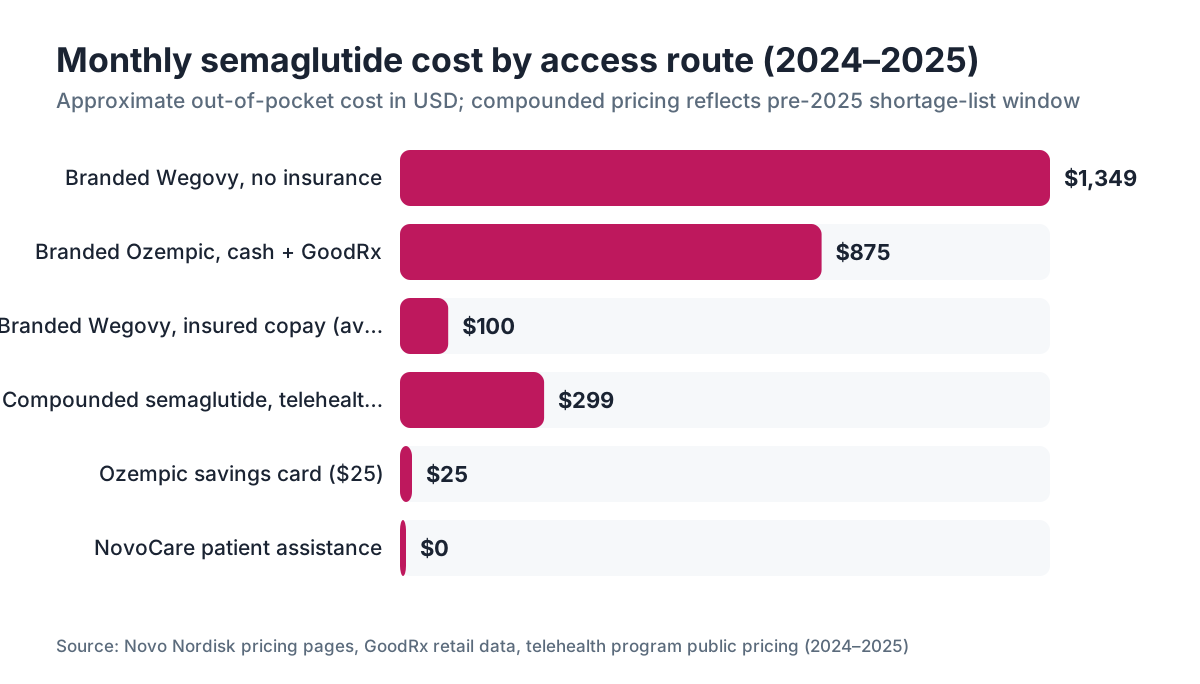
How does semaglutide pricing compare across your real options?
This table sums up what women have actually paid across the main access routes, drawn from publicly available pricing data from 2024 to mid-2025. Compounded pricing assumes the FDA shortage-list window was open, and that window has substantially closed as of 2025.
| Access route | Approximate monthly cost | Requires insurance? | FDA-approved product? | |---|---|---|---| | Branded Wegovy, no insurance | $1,200, $1,349 | No | Yes | | Branded Wegovy, covered insurance | $0, $150 copay | Yes | Yes | | Branded Ozempic, diabetes + savings card | $25 | Yes (commercial) | Yes | | Branded Ozempic, cash pay + GoodRx | $800, $950 | No | Yes | | Compounded semaglutide, telehealth bundle | $199, $399 | No | No | | Compounded semaglutide, direct pharmacy | $150, $300 | No | No | | Manufacturer patient assistance (NovoCare) | $0 | No (low income) | Yes |
Sources: Novo Nordisk pricing pages, GoodRx retail data, telehealth program public pricing circa 2024. [1][6]
These numbers shift. Novo Nordisk has been under congressional and public pressure on pricing, and Wegovy's list price dropped slightly in late 2024. The Inflation Reduction Act gives Medicare new negotiating power over some drugs, but semaglutide is not yet in the negotiated group.
Does semaglutide work for weight loss in women specifically?
Yes, and the evidence is strong. The STEP 1 trial, published in the New England Journal of Medicine in 2021, found that once-weekly semaglutide 2.4 mg produced an average weight loss of 14.9% of body weight over 68 weeks, versus 2.4% for placebo, in adults with obesity or overweight plus at least one weight-related complication. [9] About 74% of participants were women, so the data is reasonably female-representative.
For women in perimenopause and menopause, the picture sharpens. Estrogen decline drives fat toward the abdomen (visceral fat), and visceral fat is exactly what GLP-1s target most effectively. No large randomized trial has studied semaglutide specifically in perimenopausal women, but smaller observational data and the underlying mechanism both point to the drug working at least as well in this group. The STEP trials did not break out results by menopausal status, which is a real gap.
See our deeper article on semaglutide for weight loss for dose titration, side effects, and what to expect in the first 12 weeks.
One thing worth saying flat out: a GLP-1 does not replace treating estrogen loss. Hormone therapy handles sleep, hot flashes, bone density, and mood in ways semaglutide simply does not. Chase only the scale in perimenopause and you may be solving the wrong problem first. Read more about perimenopause age and what is actually driving those changes.
What are the risks of choosing cheap semaglutide over the branded version?
The risks split into three buckets: product quality, regulatory, and clinical.
Product quality. Compounded semaglutide is not tested for bioequivalence against Wegovy, so the dose you inject may not deliver the same amount of active drug. Some compounders have used semaglutide salts (like semaglutide acetate) rather than the free base in Wegovy. The FDA has stated that semaglutide sodium and semaglutide acetate are not the same as the approved drug, and products using those forms are considered adulterated. [5] Potency swings between lots at unregulated compounders are also real.
Regulatory. Getting compounded semaglutide from a pharmacy that no longer has a legal basis to compound it (because the shortage exemption expired) means you are part of a technically illegal transaction. The pharmacy carries the primary legal risk, not you as the patient. The bigger practical danger is that your supply gets cut off abruptly and you face a treatment gap.
Clinical. Nausea, vomiting, and gastroparesis are real adverse effects of semaglutide regardless of source. The difference with a branded product is that you get a manufacturer hotline, an FDA-regulated label, and a pharmacist who can call the maker. With a compounded product, quality control sits entirely with the compounding pharmacy. To vet one, check PCAB accreditation (the Pharmacy Compounding Accreditation Board) or use the NABP verification tool. [8]
For women also using hormone replacement therapy, semaglutide slows gastric emptying, which can in theory affect absorption of oral estrogen and oral progesterone. This is not well-studied. On oral HRT and starting semaglutide? Tell your prescriber.
Will semaglutide get cheaper soon? What's coming for generic semaglutide?
Probably, but not soon. Novo Nordisk's key US composition-of-matter patent on semaglutide runs to around 2032 for some formulations, and the company holds multiple overlapping patents that complicate the picture. [2] Generic injectable GLP-1s are not arriving in the next two to three years.
What could move faster: the Inflation Reduction Act requires Medicare to negotiate prices for certain high-cost drugs. Ozempic and Wegovy are strong candidates for a future negotiation list by the late 2020s. [10] Negotiation touches Medicare Part D patients directly and could pressure commercial pricing downstream.
Foreign generics are coming abroad. Several Indian companies (Sun Pharma, Cipla) have announced semaglutide generics for their home markets, but these are not approved for US use and cannot legally be imported in most circumstances. [2]
Oral semaglutide is not the loophole people hope for. Novo Nordisk's Rybelsus (oral semaglutide, 14 mg max dose) lists around $800 to $900 per month, about the same as Ozempic. It is approved for type 2 diabetes, not weight management, and its weight loss data trails the injectable 2.4 mg dose. It is not a cheaper substitute for Wegovy.
Compared with tirzepatide (Mounjaro/Zepbound), semaglutide pricing is similar. See semaglutide vs tirzepatide for a full efficacy and cost comparison. Both stay expensive without insurance.
How do I actually access cheap semaglutide right now, step by step?
Step 1: Check your insurance. Call the member services number on your card and ask specifically whether your plan covers semaglutide (Wegovy) for weight management, and what the formulary tier and prior authorization requirements are. Ask the same for Ozempic if you have a diabetes or prediabetes diagnosis. The call takes 20 minutes and could save you $1,200 a month.
Step 2: If you have commercial insurance and a diabetes diagnosis, enroll in Novo Nordisk's $25 Ozempic savings card immediately. It is free, instant, and legitimate. [1]
Step 3: If you have no coverage for weight management, check NovoCare patient assistance eligibility. Novo Nordisk covers the drug at no cost for patients below certain income thresholds. [1]
Step 4: If you do not qualify for assistance and are paying cash, compare GoodRx pricing at pharmacies near you for branded Ozempic. Prices vary by $100 to $200 between pharmacies in the same zip code.
Step 5: If you are considering compounded semaglutide, verify the pharmacy is PCAB-accredited or listed in NABP's verified pharmacy program before purchasing. Ask them outright which category they operate under (503A or 503B) and whether they can legally compound semaglutide given the current shortage-list status. [8]
Step 6: Consider whether telehealth management fits your situation. WomenRx, for example, offers GLP-1 programs for women that include clinical assessment and can help match you to the most cost-effective appropriate option for your health history.
Step 7: If none of these routes work and cost is the wall, ask whether tirzepatide (Zepbound) has better coverage under your plan. Some plans that exclude Wegovy cover Zepbound. It is worth a separate call.
Frequently asked questions
What is the cheapest legal way to get semaglutide right now?
For commercially insured patients with type 2 diabetes, Novo Nordisk's $25 Ozempic savings card is the cheapest legitimate route. For uninsured, low-income patients, the NovoCare patient assistance program can provide Wegovy or Ozempic free. For cash-paying patients, compounded semaglutide through a PCAB-accredited pharmacy ran $150 to $399 per month, but the legal window for compounding has narrowed sharply since early 2025.
Is compounded semaglutide still legal in 2025?
The FDA removed Wegovy from its drug shortage list in February 2025, which eliminated the primary legal basis for 503A compounding pharmacies to make semaglutide. 503B outsourcing facilities had a separate compliance deadline. Pharmacies that keep compounding semaglutide without a current legal basis are operating against FDA policy. The situation is evolving, so ask any pharmacy you use to state its regulatory pathway explicitly.
Does insurance cover semaglutide for weight loss?
About 25 to 30% of commercial plans cover Wegovy for weight management, according to KFF analysis. Most require prior authorization and a documented BMI of 30 or above, or 27 with a weight-related comorbidity. Medicare Part D traditionally excluded weight loss drugs, and coverage rules have been in legislative flux as of 2025. Always call your insurer directly and ask about the specific drug name and NDC code.
Can I get semaglutide for $25 a month?
Yes, if you are commercially insured and have a type 2 diabetes diagnosis that supports an Ozempic prescription. Novo Nordisk's savings card caps your copay at $25 per month for up to 24 months. It does not work with Medicare, Medicaid, or if your plan does not cover Ozempic. For Wegovy, the manufacturer's savings program offers a similar $0 to $25 copay cap for eligible commercially insured patients.
Is semaglutide from overseas pharmacies safe?
No, not reliably. The FDA documented counterfeit Ozempic pens in the US supply chain in 2023, and some contained insulin rather than semaglutide, posing a hypoglycemia risk. Foreign online pharmacies that do not require a valid US prescription are almost certainly operating illegally. The National Association of Boards of Pharmacy publishes a verified pharmacy list you can use to check any pharmacy before purchasing.
How does GoodRx affect the price of semaglutide?
GoodRx can lower the cash price of branded Ozempic by 5 to 15% versus list, putting it roughly in the $800 to $950 range per month depending on pharmacy. It cannot be used alongside insurance. It does not make semaglutide cheap, but it is legitimate, free to use, and worth checking. For Wegovy, GoodRx discounts are similar in structure, but the higher list price means you still pay over $1,000 in most cases.
What is semaglutide acetate and why does the FDA object to it?
Semaglutide acetate and semaglutide sodium are salt forms of semaglutide used by some compounding pharmacies because the free-base form is harder to source. The FDA stated in 2024 guidance that these salt forms are not the same active ingredient as the approved drug, making products that contain them adulterated under the Federal Food, Drug, and Cosmetic Act. If a compounding pharmacy cannot tell you the exact salt form they use, that is a red flag.
Will there be a generic semaglutide, and when?
Novo Nordisk holds US patents on semaglutide that extend roughly to 2032 for key formulations. No FDA-approved generic injectable semaglutide is expected in the near term. Several Indian manufacturers have launched generics in their home markets, but US approval would require separate FDA review. Oral semaglutide (Rybelsus) similarly has patent protection and does not yet face generic competition in the US.
Does semaglutide work for menopausal weight gain?
Yes, based on STEP 1 trial data and the underlying mechanism. About 74% of STEP 1 participants were women, and average weight loss was 14.9% over 68 weeks at the 2.4 mg dose. Menopausal estrogen decline shifts fat to the abdomen, exactly where GLP-1 therapy works best. No large trial has stratified results specifically by menopausal status, though. Semaglutide does not address hot flashes, sleep disruption, or bone density, which estrogen does.
Can I take semaglutide with hormone replacement therapy?
There is no known dangerous interaction between semaglutide and standard HRT. The main practical concern is that semaglutide slows gastric emptying, which could in theory reduce absorption of oral estrogen or oral progesterone. This has not been well-studied. If you take oral HRT and start semaglutide, mention it to your prescriber. Transdermal estrogen (patches, gels) bypasses the issue entirely.
What questions should I ask a compounding pharmacy before buying semaglutide?
Ask: Are you a 503A or 503B pharmacy? What is your regulatory basis for compounding semaglutide given the current shortage-list status? What salt form of semaglutide do you use? Are you PCAB-accredited? Can you provide a certificate of analysis for your current batch? A reputable pharmacy answers all of these clearly. If they deflect or cannot answer, do not purchase from them.
Is tirzepatide cheaper than semaglutide?
List prices are close: Zepbound (tirzepatide for weight loss) lists around $1,059 per month, below Wegovy's $1,349. Eli Lilly has a self-pay program that can reduce Zepbound to roughly $550 per month for cash-pay patients. Mounjaro (tirzepatide for diabetes) has savings card programs similar to Ozempic. Some insurance plans that exclude Wegovy cover Zepbound, so it is worth checking both for your specific plan.
Does losing weight with semaglutide cause bone loss in women?
Rapid weight loss from any cause, including GLP-1 therapy, can reduce bone mineral density, particularly in older women. The STEP trials did not show dramatic bone loss signals, but they were not designed to detect it and ran only 68 weeks. Postmenopausal women on semaglutide who are already at risk for osteoporosis should get a baseline bone density test and discuss weight-bearing exercise with their provider. Estrogen therapy protects bone in ways semaglutide does not.
What happens when I stop taking semaglutide?
Weight regain is the dominant pattern after stopping. The STEP 4 trial found that participants who stopped semaglutide after 20 weeks regained about two-thirds of their lost weight within one year. GLP-1 medications work while you take them, not by permanently resetting your set point. That makes cost a recurring calculation, not a one-time expense, which matters when you choose a semaglutide source.
Sources
- Novo Nordisk US – Ozempic and Wegovy savings and patient assistance programs
- FDA – Orange Book: Approved Drug Products with Therapeutic Equivalence Evaluations
- KFF (Kaiser Family Foundation) – Coverage of Anti-Obesity Medications
- JAMA Internal Medicine – Telehealth prescribing of GLP-1 medications (published analysis)
- FDA – FDA warns consumers not to use counterfeit Ozempic (semaglutide) found in US drug supply (June 2023)
- National Association of Boards of Pharmacy (NABP) – Verified Pharmacy Program
- Wilding JPH et al. – Once-Weekly Semaglutide in Adults with Overweight or Obesity (STEP 1 trial), New England Journal of Medicine, 2021
- CMS – Medicare Drug Price Negotiation Program
- Rubino DM et al. – Effect of Continued Weekly Subcutaneous Semaglutide vs Placebo on Weight Loss Maintenance (STEP 4 trial), JAMA, 2021