Can you get pregnant in menopause? What the biology actually says
TL;DR: Once you've had 12 consecutive months with no period, you've reached menopause, and natural pregnancy is not possible. Perimenopause is a different animal. That transition can last 4 to 10 years, and ovulation still happens during it, unpredictably. So yes, pregnancy is genuinely possible before that 12-month mark, and contraception still matters until it's confirmed.
What actually happens to fertility at menopause?
Menopause is a single point in time, not a phase. By clinical definition, it's the moment 12 consecutive months have passed since your last menstrual period, with no other obvious cause like illness or medication. [1] After that 12-month mark, your ovaries have stopped releasing eggs reliably, estrogen and progesterone have dropped hard, and natural conception is not physiologically possible.
The confusion most women run into is mixing up menopause with perimenopause, the years-long transition leading up to it. Those two things are biologically very different. During perimenopause, your cycles get irregular, but your ovaries are still occasionally releasing eggs. That window matters enormously for pregnancy risk.
The average age of menopause in the United States is 51, though the normal range runs from about 45 to 55. [12] Anything before 40 is called premature ovarian insufficiency (POI) and carries its own clinical considerations. A small number of women hit menopause earlier because of surgery, chemotherapy, or genetics.
So here's the clean answer. True menopause, confirmed by 12 months without a period, means natural pregnancy is not going to happen. The complicated answer involves everything that comes before that line.
Can you get pregnant during perimenopause?
Yes, and this surprises a lot of women. Perimenopause can start as early as the mid-30s, though the 40s are more typical. [2] During this phase, ovulation becomes erratic rather than absent. Some months your ovaries release an egg, some months they don't, and nothing about how you feel or how irregular your cycle has become tells you which is which.
A cycle that's been skipping for three months might be followed by a surprise ovulation. That unpredictability is exactly what makes the perimenopause window risky if pregnancy isn't the goal.
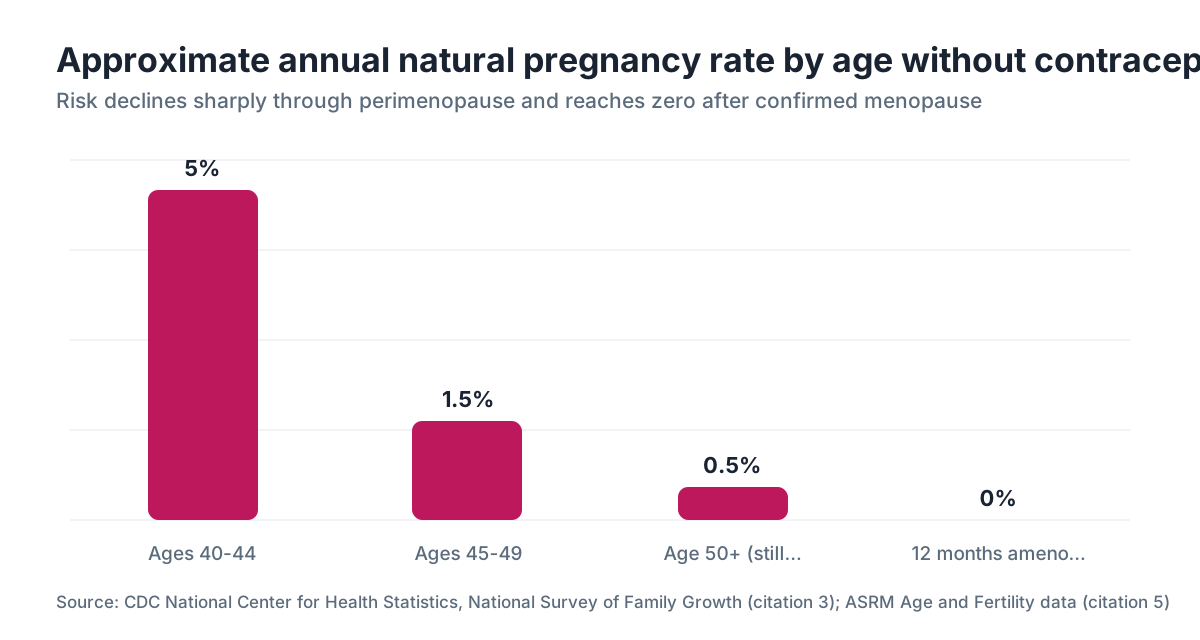
Studies tracking women in their late 40s find pregnancy rates low but not zero. Data from the National Survey of Family Growth, analyzed by the CDC, puts the odds at roughly 5 percent per year for women ages 40 to 44 without contraception, and those rates keep falling through the late 40s. They don't reach zero until periods stop entirely. [3]
FSH (follicle-stimulating hormone) rises during perimenopause as the pituitary works harder to stimulate the ovaries, and a single high FSH reading gets misread as proof of infertility all the time. It isn't. FSH swings from cycle to cycle, and no single measurement reliably rules out ovulation. [1] The North American Menopause Society (NAMS) specifically warns that FSH levels alone cannot be used to confirm infertility in perimenopausal women. [1]
If you're in perimenopause and absolutely do not want to conceive, you need contraception. That's not a theoretical recommendation.
How long does perimenopause last, and when is pregnancy risk finally gone?
Perimenopause averages about 4 to 8 years, though some women move through it in 2 years and others take closer to 10. [2] You're technically in perimenopause from the first sign of hormonal irregularity (changing cycle length, hot flashes, sleep disruption) until the 12-month no-period mark that defines menopause.
For understanding pregnancy risk, the window that matters is everything before that 12-month mark. Once you hit month 13 without a period, the biology has shifted and natural conception is not happening. Before month 12? Still possible.
Contraception guidelines from the major medical bodies reflect this. NAMS recommends continuing contraception until 12 months of amenorrhea in women over 50, and 24 months in women under 50, because younger perimenopausal women have more residual ovarian activity. [1] The American College of Obstetricians and Gynecologists (ACOG) recommends the same general approach. [4]
One practical complexity: if you start hormone replacement therapy during perimenopause, the progestin or progesterone component can cause withdrawal bleeding, which makes counting those 12 uninterrupted months trickier. Your prescriber needs to help you read the bleeding pattern rather than restart the clock every time.
For more on where you might fall in the timeline, see perimenopause age and when does menopause start.
What are the odds of getting pregnant in your late 40s vs. early 50s?
The probability of natural conception drops sharply with age and ovarian reserve. Here's a rough picture based on published population data:
| Age range | Approximate annual pregnancy rate (without contraception) | Notes | |---|---|---| | 40-44 | ~5% per year | Ovulation still frequent, egg quality declining [3] | | 45-49 | ~1-2% per year | Cycles increasingly irregular, ovulation erratic [3] | | 50+ (still cycling) | <1% per year | Very low but not zero until amenorrhea confirmed | | 12 months amenorrhea confirmed | Essentially 0% | Natural conception physiologically not possible [1] |
These are population-level estimates. For any individual woman, the number is either zero (she doesn't ovulate that month) or it isn't, so average rates tell you about risk management, not your specific biology.
Egg quality falls off alongside frequency. Chromosomal abnormalities in eggs climb steeply through the 40s, which is why miscarriage rates for natural conceptions in this age group run 40 to 50 percent in women over 40, far higher than in younger women. [5] That doesn't mean pregnancy is safe to pursue carelessly. It means the pregnancies that do occur carry real medical weight.
Assisted reproduction using IVF with donor eggs sidesteps this somewhat, because a younger donor's eggs are used, but that's a separate clinical conversation from spontaneous conception in perimenopause.
What birth control options work well during perimenopause?
Most contraceptive methods work well during perimenopause, but the choice matters because you're also managing irregular bleeding, hot flashes, and mood changes at the same time. A method that handles both pregnancy prevention and symptom relief can make life a lot simpler.
The hormonal IUD (like Mirena) is a favorite during perimenopause for a few reasons. It delivers progestin locally, keeps uterine bleeding very light or absent, and lasts 5 to 8 years. It won't touch hot flashes or bone density because it doesn't raise systemic estrogen, but it pairs cleanly with a separate estrogen prescription if you need one.
Low-dose combined oral contraceptives (estrogen plus progestin) are another option for healthy, non-smoking perimenopausal women. They suppress ovulation reliably and can calm hot flashes and cycle chaos. The FDA labels for combined hormonal contraceptives note higher VTE risk with age and smoking, so this isn't right for everyone. [6] Women over 35 who smoke are generally steered away from estrogen-containing contraceptives.
Progestin-only pills, implants, and injections are your options when estrogen is off the table. The copper IUD is effective and hormone-free but tends to make heavy or irregular bleeding worse, which is already a common perimenopausal complaint.
Barrier methods are safe and hormone-free but demand consistent use and don't forgive irregular timing, which is fine if that fits your life.
One thing to be clear about: hormone replacement therapy (MHT/HRT) is not contraception. Standard HRT doses sit far below what's needed to suppress ovulation. If you're using HRT during perimenopause, you still need a separate contraceptive method.
Does hormone therapy during menopause ever cause pregnancy?
No. Menopausal hormone therapy (MHT) does not cause pregnancy and cannot restore fertility. The estrogen and progesterone doses in MHT run much lower than those in hormonal contraceptives, and the point is symptom management, not ovulation suppression.
Some women on MHT during perimenopause see menstrual-type bleeding return, especially on cyclic regimens. That's a withdrawal bleed from the progestogen phase of therapy, not evidence of ovulation or fertility coming back. [7] It can be confusing, but bleeding on HRT doesn't mean the ovaries have restarted.
If you're weighing HRT and want to understand your options for the transition, the estrogen patch and progesterone articles cover the delivery methods and doses in more detail.
The one place this gets more nuanced is premature ovarian insufficiency (POI). Women with POI before 40 occasionally have spontaneous ovarian activity despite apparent ovarian failure, and rare pregnancies have been documented even in women with confirmed POI. [8] It's uncommon, but it means women with POI who don't want to conceive still need contraception, and those who do want to conceive should work with a reproductive endocrinologist rather than assuming it's impossible.
What does pregnancy in your late 40s or early 50s actually look like medically?
If a perimenopausal woman does conceive naturally, most obstetric standards call that pregnancy high-risk. Miscarriage rates run high (roughly 40 to 50 percent in women over 40, versus around 10 to 15 percent for women in their 20s). [5] The risk of chromosomal conditions like trisomy 21 climbs with maternal age. Gestational hypertension, gestational diabetes, and placental complications also show up more often.
None of this means a late-40s pregnancy can't be carried successfully. It means closer monitoring, earlier prenatal care, and an obstetric team that's comfortable with older maternal age.
For women actively pursuing pregnancy in their 40s, the conversation is almost always about assisted reproduction rather than waiting for a natural conception. IVF with donor eggs does far better in older women because egg quality is the limiting factor, not uterine capacity. A uterus at 48 can usually support a pregnancy given the right hormonal environment. The eggs produced by 48-year-old ovaries often cannot.
This is a genuinely complex clinical area, and it deserves a direct conversation with a reproductive endocrinologist rather than generalizations.
Does weight change during perimenopause affect fertility or pregnancy risk?
Body weight moves reproductive hormones in real ways. Adipose tissue converts androgens to estrogen, so women with higher body fat percentages often carry somewhat higher circulating estrogen. That doesn't reliably translate into more ovulation, but it does muddy the hormonal picture during perimenopause.
Obesity is also tied to anovulatory cycles (cycles where no egg is released), irregular periods, and higher rates of PCOS features, any of which make the perimenopause transition harder to read.
GLP-1 receptor agonists like semaglutide are now widely used for weight management in midlife women. The STEP 1 trial showed semaglutide 2.4 mg weekly producing about 15 percent mean body weight reduction in adults with obesity. [9] Weight loss at that scale can restart ovulatory cycles in women who had stopped ovulating from obesity-related hormonal disruption. There are documented cases of women in their 40s who'd been told they were perimenopausal or infertile conceiving after big GLP-1-driven weight loss.
The FDA prescribing information for semaglutide advises stopping it at least 2 months before a planned pregnancy because animal studies showed fetal harm. [10] Women on GLP-1 agonists who are perimenopausal and not reliably post-menopausal should use contraception. WomenRx clinicians raise this during GLP-1 consultations, because the weight-fertility connection gets overlooked.
See also: semaglutide for weight loss and semaglutide vs tirzepatide for how these medications compare on efficacy and safety.
When should you stop worrying about contraception entirely?
The conservative, evidence-based answer: 12 months of confirmed amenorrhea in women over 50, and 24 months in women under 50. [1] That's the NAMS standard, and it's cautious on purpose, because the downside of an unexpected pregnancy at 49 is significant.
In practice, once you've crossed that 12-month threshold at 50 or older with no other cause for the absent periods, you don't need contraception anymore. FSH above 30 IU/L on two tests taken at least 4 to 6 weeks apart, combined with amenorrhea, is sometimes used as backup confirmation, but again, FSH alone isn't enough. [1]
For women on hormonal contraception, stopping to check menstrual status is one option. Another reasonable one is staying on the method until post-menopausal status is highly probable given your age and symptom history, then switching to MHT if symptoms call for it.
The one group that has to stay vigilant longer: women with POI, who can have intermittent ovarian activity even with confirmed very low ovarian reserve. They should talk this through with their gynecologist specifically.
For a fuller picture of the menopause transition and menopause age data, those articles cover the epidemiology in detail.
What tests can tell you where you are in the menopause transition?
There's no single blood test that tells you definitively whether you can still get pregnant or whether you've finished the menopause transition. That's genuinely frustrating, but it's the biological reality.
Tests that help paint the picture:
FSH: Elevated levels (generally above 25 to 30 IU/L in most lab references) suggest declining ovarian function, but because FSH fluctuates, a single reading isn't conclusive. [1] Serial measurements tell you more.
Estradiol: Low estradiol (below about 30 pg/mL in most labs) supports a perimenopausal or postmenopausal pattern. Again, one number on one day is not definitive.
AMH (anti-Mullerian hormone): AMH reflects ovarian reserve more stably than FSH because it doesn't swing much across the cycle. Very low or undetectable AMH (under about 0.1 ng/mL) suggests minimal remaining follicular activity. But using AMH to confirm infertility or menopause isn't standardized clinically the way it is in fertility treatment. [2]
DXA bone density scan: Not a pregnancy test, but relevant for perimenopausal women because estrogen loss speeds up bone loss, and knowing your baseline matters. See bone density test for when and why to get one.
The most reliable test remains what it's always been: 12 consecutive months without a period.
What if you want to get pregnant during perimenopause?
If you're in perimenopause and pregnancy is the goal, the conversation gets specialized quickly. Natural conception is possible but increasingly difficult, and outcomes hang on egg quality rather than uterine function.
For women trying to conceive in their mid-to-late 40s, a reproductive endocrinologist is the right starting point. A fertility workup will include AMH, antral follicle count via ultrasound, and often a uterine evaluation. Those results shape whether natural attempts, intrauterine insemination (IUI), or IVF with your own eggs or donor eggs is the most realistic path.
IVF success rates with your own eggs at 43 to 44 run around 5 to 7 percent per transfer in national SART data. [11] With donor eggs from a woman under 35, success rates per transfer rise to 40 to 50 percent regardless of the recipient's age, which is why donor egg IVF is often the clinically recommended path for women in their late 40s.
Perimenopausal women who do conceive need early prenatal care, chromosomal screening (cell-free DNA testing or CVS/amniocentesis), and close monitoring for hypertensive disorders and gestational diabetes. A maternal-fetal medicine (MFM) specialist is often involved alongside the OB.
This is one of those topics where the biology is clear and the emotional weight is enormous. There's no clean universal answer about when to try, when to stop, or what level of intervention is worth it. Those are conversations with your medical team and your own values.
Frequently asked questions
Can you get pregnant in menopause naturally?
No. True menopause is defined as 12 consecutive months without a period, and after that point natural conception is not physiologically possible because ovulation has ceased. In the years before that 12-month mark, during perimenopause, ovulation still occurs unpredictably and pregnancy is genuinely possible. Contraception stays necessary until the 12-month threshold is confirmed.
What is the oldest age at which a woman can get pregnant naturally?
There's no precise upper age limit for natural conception because it depends on individual ovarian function, but natural pregnancies beyond age 50 without assisted reproduction are extremely rare. Most women who conceive naturally in their late 40s do so early in the perimenopausal transition. By 52 to 55, most women have crossed the menopause threshold and natural pregnancy is no longer possible.
Can perimenopause symptoms be confused with early pregnancy?
Yes, often. Missed or irregular periods, nausea, breast tenderness, mood changes, and fatigue show up in both early pregnancy and perimenopause. The only reliable way to tell them apart is a pregnancy test. If you've had unprotected sex and your period is late during perimenopause, test before assuming it's a hormonal shift. Progesterone levels and ultrasound can clarify things further if the test is ambiguous.
Does a high FSH level mean you can't get pregnant?
Not definitively. A single elevated FSH reading suggests reduced ovarian reserve, but FSH fluctuates significantly between cycles. The North American Menopause Society states that FSH levels alone cannot confirm infertility in perimenopausal women. Women with elevated FSH have conceived naturally and through IVF. FSH is one data point in a larger picture, not a pass-fail fertility verdict on its own.
If you get your period back after months of none, does that reset the menopause clock?
Yes. The 12-month count starts over from the last period. Any bleeding, even light spotting, restarts the clock. This is one reason women on cyclic hormone therapy find it hard to confirm menopause, since the progestogen phase can trigger withdrawal bleeding. Continuous combined HRT regimens avoid this problem for most women after the first few months of use.
Can semaglutide or GLP-1 drugs cause pregnancy in perimenopausal women?
Indirectly, yes. Significant weight loss can restart ovulatory cycles in women who had stopped ovulating due to obesity. If a perimenopausal woman resumes ovulation after losing weight on a GLP-1 agonist and isn't using contraception, she could conceive. FDA guidance on semaglutide advises against use in pregnancy due to potential fetal harm, which makes contraception important for perimenopausal women on these medications who aren't confirmed post-menopausal.
Do you still need birth control on hormone replacement therapy?
Yes, if you haven't confirmed menopause yet. Standard HRT doses do not suppress ovulation. If you're using HRT during perimenopause, you need a separate contraceptive method. The hormonal IUD is popular because it provides both uterine protection (required with systemic estrogen) and contraception. Once you've confirmed 12 months of amenorrhea, the contraception is no longer needed, but the timing has to be confirmed carefully.
What is premature menopause and does it affect pregnancy differently?
Premature ovarian insufficiency (POI) refers to ovarian function loss before age 40. Unlike typical menopause, POI can be intermittent: ovaries occasionally reactivate, and spontaneous pregnancies have occurred in women with confirmed POI. Women with POI who don't want to conceive still need contraception. Those who do want to conceive should work with a reproductive endocrinologist; donor egg IVF is often the recommended path.
How do doctors confirm menopause has actually happened?
The clinical standard is 12 consecutive months of amenorrhea with no other explanation. Blood tests showing elevated FSH (above 30 IU/L on two tests) and low estradiol support the diagnosis but aren't sufficient alone. AMH testing reflects ovarian reserve but isn't standardized for confirming menopause. In practice, the 12-month rule is the most reliable marker available.
Is pregnancy after menopause possible with IVF?
Yes, through donor egg IVF. The post-menopausal uterus can sustain a pregnancy when given adequate estrogen and progesterone support. Success rates per transfer using donor eggs from young donors run around 40 to 50 percent regardless of recipient age. These pregnancies are high-risk and need close obstetric monitoring, but they're established medical practice in specialized centers. They are not natural conception and require deliberate clinical intervention.
What are the risks of getting pregnant in your late 40s?
Miscarriage risk is roughly 40 to 50 percent in women over 40, compared to about 10 to 15 percent in women in their 20s. Chromosomal abnormalities rise with egg age. Gestational hypertension, gestational diabetes, and placental problems are more frequent. These are real risks requiring close prenatal monitoring and often a maternal-fetal medicine specialist, not reasons that a late-40s pregnancy is impossible to carry successfully.
Can you use an at-home hormone test to know if you're in menopause?
At-home FSH urine tests can detect elevated FSH, which may suggest perimenopause, but the same caveat applies as with lab tests: FSH fluctuates, and a single result isn't conclusive. These tests are not approved to confirm infertility or replace clinical evaluation. They're reasonable for prompting a conversation with your provider, not for making contraception or treatment decisions on their own.
Does breastfeeding affect menopause timing or pregnancy risk?
Breastfeeding suppresses ovulation through elevated prolactin, providing some natural fertility reduction, but it's unreliable as contraception, especially beyond six months postpartum or when feeding frequency drops. Breastfeeding doesn't change the overall timing of menopause. If a woman in her mid-40s is still nursing and her periods have returned irregularly, she should treat herself as perimenopausal for contraception purposes.
How does perimenopause affect bone density, and should that change how I manage this transition?
Estrogen protects bone. During perimenopause, falling estrogen speeds up bone loss, and the first few years after menopause are when density drops fastest. Women who've been perimenopausal for several years, especially those now confirmed post-menopausal, should discuss baseline bone density screening with their provider. Early detection of low density gives time for lifestyle and medical interventions before fracture risk becomes clinically significant.
Sources
- North American Menopause Society (NAMS), Menopause Practice: A Clinician's Guide
- The Endocrine Society, Menopause and Perimenopause clinical practice resources
- CDC National Center for Health Statistics, National Survey of Family Growth
- American College of Obstetricians and Gynecologists (ACOG), Committee Opinion on Contraception in Midlife Women
- American Society for Reproductive Medicine (ASRM), Age and Fertility Patient Fact Sheet
- FDA, Combined Hormonal Contraceptives: Approved Labeling and Prescribing Information
- NAMS, Hormone Therapy Position Statement 2022
- National Institutes of Health, National Institute of Child Health and Human Development, Premature Ovarian Insufficiency
- Wilding JPH et al., STEP 1 Trial, New England Journal of Medicine, 2021
- FDA, Ozempic and Wegovy Prescribing Information (Semaglutide)
- Society for Assisted Reproductive Technology (SART), National Summary Report 2021
- NIH National Institute on Aging, Menopause: Overview