How to prepare for a bone density test: what actually matters
TL;DR: Stop calcium supplements 24 hours before your scan. Skip the appointment if you had contrast dye or a nuclear medicine procedure in the last week. Wear loose, metal-free clothing. The DXA scan takes 10 to 20 minutes, hurts nothing, and uses less radiation than a chest X-ray. No fasting needed. That covers about 90% of real preparation.
What is a bone density test and why do women get one?
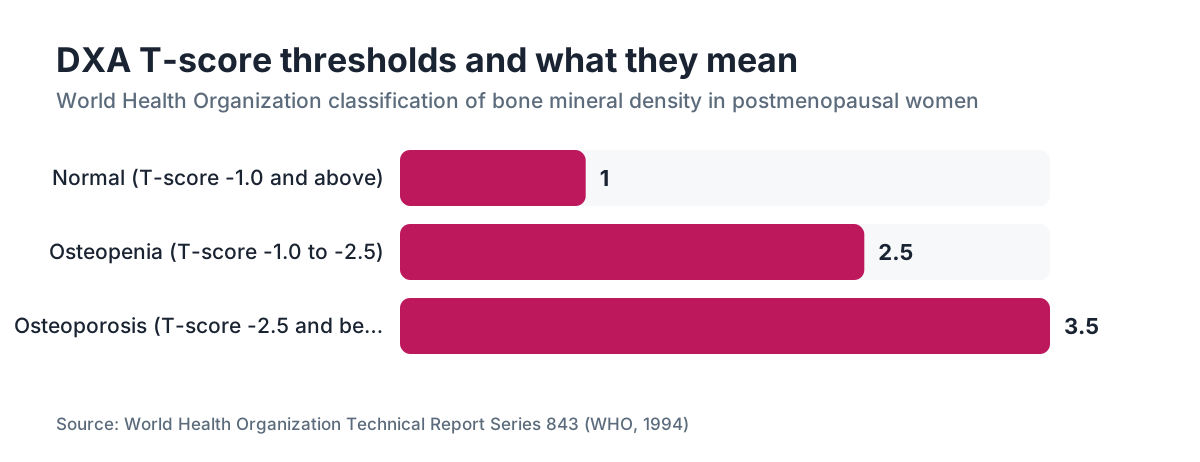
A bone density test, almost always done by dual-energy X-ray absorptiometry (DXA), measures the mineral content in your bones. The result comes back as a T-score: the number of standard deviations your bone mineral density sits above or below the average young adult [1]. A T-score at or above -1.0 is normal. Between -1.0 and -2.5 is osteopenia. At -2.5 or below, the diagnosis is osteoporosis [1].
For women, the test matters most around menopause. Estrogen is one of the main brakes on bone resorption. When estrogen drops sharply in perimenopause and early menopause, bone loss speeds up. The Bone Health and Osteoporosis Foundation estimates women can lose up to 20% of their bone density in the five to seven years after menopause [2]. That window is exactly when catching a problem early changes what happens next.
The U.S. Preventive Services Task Force recommends DXA screening for all women 65 and older, and for younger postmenopausal women whose 10-year fracture risk equals or exceeds that of a 65-year-old with no added risk factors [3]. Your doctor calculates that risk using the FRAX tool, which weighs body weight, smoking history, family fracture history, and whether you take corticosteroids [12].
If you are still in perimenopause and wondering whether this applies to you yet, the honest answer is: maybe. Early screening makes sense if you have low body weight, a history of eating disorders, or long-term steroid use. Talk to a clinician who knows your hormone picture, more than your age.
How far in advance should you start preparing for a bone density test?
Most preparation happens in the 24 to 48 hours before the scan, not weeks ahead. The single most common mistake is taking a calcium supplement the morning of the test. Calcium tablets, especially calcium carbonate, can leave residue that artificially raises the scan reading. Stop all calcium supplements, including calcium-containing antacids like Tums, at least 24 hours before your appointment [4][10].
If you have had any imaging study with contrast dye, barium, or a nuclear medicine injection in the past 7 to 10 days, tell your ordering clinician before you schedule the DXA. Leftover contrast material scatters the X-ray beams and can distort results enough to force a reschedule [4].
That is the full timeline for most women. No fasting. No medication holds beyond calcium. No special diet the week before. Preparation is simpler than people expect, which is good news.
What should you wear to a bone density test?
Wear loose, comfortable clothing without metal. This is not a vague suggestion. Metal in or near the scan field, including underwire bras, jeans with rivets, belts with metal buckles, and some sports bra clasps, can block or scatter the X-ray beam and the technologist will ask you to remove it anyway [4].
The safest bet: yoga pants or soft leggings, a loose cotton shirt, and a bra without underwire. Leave the jewelry at home. You will likely be scanned lying flat on a padded table, fully clothed, so there is no gown at most facilities unless your clothing has metal the technologist spots.
Avoiding metal also speeds the appointment. Hunting for a replacement garment or waiting while you change adds time to a scan that should take minutes. If your only pants that day have a metal zipper, ask the facility ahead of time whether they keep wraps or shorts on hand.
Do you need to fast or avoid food before a DXA scan?
No fasting is required for a standard DXA bone density test [4]. You can eat normally, drink water, have your coffee, and take most of your regular medications on the day of the scan.
The one food-related rule that applies is the calcium supplement restriction described above. Food sources of calcium (dairy, leafy greens, fortified foods) are fine and do not interfere with DXA results [10]. Only supplemental calcium in tablet, capsule, or chewable form needs to be paused.
If you take a prescription bisphosphonate like alendronate (Fosamax) or risedronate (Actonel), do not stop it without asking your doctor. Bisphosphonates are the reason you are being tested in many cases, and skipping a dose does not change your DXA result the way calcium residue does.
Which medications and supplements should you pause before the test?
The short list of what to actually pause:
- Calcium supplements: stop 24 hours before [4]
- Calcium-containing antacids (Tums, Rolaids, certain generics): stop 24 hours before [4]
- Vitamins that contain calcium (many women's multivitamins do): check the label and stop 24 hours before if calcium is listed [10]
Everything else stays on schedule: vitamin D, magnesium, prescription osteoporosis drugs, hormone therapy, thyroid medication, blood pressure medication. Do not change any medication around a DXA without talking to your prescriber first.
One thing worth knowing: if you are on hormone replacement therapy or an estrogen patch, that does not interfere with the scan itself. But the reading radiologist needs it to interpret your results in context, so make sure it lands on your intake paperwork.
Same goes for GLP-1 receptor agonists like semaglutide. Research interest in how GLP-1s affect bone metabolism is growing, and while the drugs do not distort the DXA scan, your prescriber should know you are on one when reviewing results [9]. If you are weighing GLP-1 options and also tracking bone health, a platform like WomenRx that manages both hormone therapy and semaglutide for weight loss in one place can help your care team see the whole picture.
What happens during the DXA scan itself?
You lie flat on a padded table, fully clothed. A mechanical arm passes slowly over your body, emitting two low-energy X-ray beams. The scanner measures how much of each beam passes through bone versus soft tissue, then calculates bone mineral density in grams per square centimeter [1].
The sites measured most often are the lumbar spine (usually L1 through L4) and the proximal femur (hip), because those fractures carry the highest clinical consequences. Some facilities also scan the non-dominant forearm, particularly if your hip or spine is hard to read due to prior hardware, severe arthritis, or obesity [1].
Total time on the table is usually 10 to 20 minutes. No tunnel. No noise beyond a soft hum. No injection. Radiation exposure runs about 1 to 10 microsieverts depending on the machine and sites scanned, which sits far below the roughly 100 microsieverts from a standard chest X-ray and orders of magnitude below a CT scan [5].
You will not get results in the room. The technologist acquires the images, a radiologist or trained DXA reader interprets them (usually within a few days), and the report goes to your ordering provider.
What factors can affect bone density test accuracy?
Several things can make a DXA result misleading, and knowing them helps you get a number your doctor can actually use.
Things that can falsely raise the reading (look denser than you are):
- Calcium supplement residue in the GI tract
- Osteophytes (bone spurs) from spinal arthritis, common after 60 and a known source of overestimation at the lumbar spine
- Prior vertebral compression fractures
- Aortic calcification overlying the spine
- Contrast dye or barium from recent imaging [4]
Things that can falsely lower the reading:
- Positioning errors during the scan
- Hardware artifacts (spinal rods, hip replacements) in the scan field
- Very low body weight, because lean tissue changes beam attenuation differently
If your spine result and hip result diverge sharply, or if your result jumped between scans with no clinical explanation, ask whether any of these factors apply. It is a fair question, not a challenge to the technologist.
For tracking change over time, consistency matters as much as accuracy. Use the same DXA machine, the same facility, and ideally the same technologist year over year. The Least Significant Change (LSC), the smallest real change a DXA can detect, is typically 2 to 4% at the spine and 3 to 6% at the hip for a well-run facility [6]. Changes smaller than that are within measurement error.
What T-score results mean and what comes next
T-scores are the main output, and the World Health Organization thresholds are the standard reference [1]:
| T-score | Classification | Typical next step | |---|---|---| | -1.0 and above | Normal | Rescreen per guidelines (every 2 years for high-risk, less often if normal) | | -1.0 to -2.5 | Osteopenia | Lifestyle interventions, FRAX risk recalculation, possible HRT discussion | | -2.5 and below | Osteoporosis | Pharmacological treatment usually recommended | | -2.5 or below + fracture | Severe osteoporosis | Immediate treatment, fall-prevention workup |
The Z-score is a second number on the report. It compares you to women your own age rather than to a young adult reference. A Z-score below -2.0 means your bone density is lower than expected even for your age, which sometimes points to a secondary cause (thyroid disease, malabsorption, certain medications) worth investigating.
One honest word about treatment: the decision to start a bisphosphonate, denosumab, or other prescription therapy is not made by the T-score alone. Your FRAX 10-year fracture probability goes into it too [12]. A woman with a T-score of -2.3 but very low fracture risk per FRAX may reasonably wait. A woman with a T-score of -1.8 but several risk factors may start treatment. This is a conversation, not an algorithm.
If bone loss tracks the estrogen drop around menopause, hormone therapy is one evidence-supported option. The Endocrine Society guideline states that menopausal hormone therapy is effective for preventing bone loss in postmenopausal women and may be considered for fracture prevention in women at elevated risk who are also appropriate candidates for HRT [7][11].
How often should women get a bone density test?
Screening frequency depends on your baseline result and risk profile. The general guidance from the USPSTF and major bone health groups [3]:
- Normal T-score in a low-risk woman: rescreening every 10 to 15 years is reasonable
- Mild osteopenia (T-score around -1.0 to -1.5): rescreen in 3 to 5 years
- Moderate to advanced osteopenia (T-score -1.5 to -2.4): rescreen in 1 to 2 years
- On pharmacological treatment for osteoporosis: typically every 1 to 2 years to check response
If you just started hormone replacement therapy after a low baseline scan, most clinicians recheck at 1 to 2 years to see whether the therapy is holding bone mineral density steady. That monitoring scan uses all the same preparation rules.
Medicare covers DXA every 24 months for eligible beneficiaries, and more often when medically necessary, under the Bone Mass Measurement Act [8]. Most private insurance follows similar logic, but check your specific plan, because some require prior authorization if you are younger than 65.
Does body weight or recent weight loss affect bone density test results?
Yes, and more women need to hear this, given how many are now losing significant weight on GLP-1 medications.
Body weight itself changes bone loading. Higher body weight (fat mass and muscle mass together) mechanically stimulates bone formation, while rapid weight loss can tip the balance toward resorption. Multiple studies have documented bone density decreases with intentional weight loss, including trials of bariatric surgery and, more recently, GLP-1 receptor agonist trials [9].
The STEP trials of semaglutide showed meaningful body weight reductions but also raised questions about whether the bone mineral density changes were clinically significant or within the range of DXA measurement error. The data are genuinely mixed. Nobody has definitive long-term fracture-outcome data from GLP-1 trials yet. The closest findings suggest the bone effects may be modest compared to bariatric surgery, but monitoring is still reasonable [9].
If you have lost 10% or more of your body weight in the past year, from a GLP-1, dietary changes, or surgery, mention that to your ordering clinician when you schedule a DXA. It gives context for reading the result and may change how often you get rescreened. For women combining GLP-1 therapy with perimenopause or early menopause, when estrogen-driven bone loss is already underway, serial DXA monitoring is worth the conversation with your provider. Our full breakdown of the bone density test itself covers that monitoring picture in more detail.
At WomenRx, clinicians handle this intersection routinely. If you want a care team that thinks about bone health alongside hormones and weight, that integrated approach is the point.
Special situations: implants, recent imaging, pregnancy, and prior fractures
A few scenarios call for extra planning.
Recent contrast imaging. If you had a CT scan with intravenous contrast, an MRI with gadolinium, or any nuclear medicine scan in the past 7 days, notify your ordering provider. Most radiologists recommend waiting 7 to 10 days after intravenous contrast and at least 4 days after oral barium before DXA [4].
Pregnancy. DXA is not done during pregnancy. Radiation exposure is very low, but no clinical scenario makes the information urgent enough to outweigh even minimal fetal risk. If you are pregnant or think you might be, reschedule.
Spinal hardware, hip replacements, or vertebral fractures. Metal hardware in the lumbar spine or hip artifacts out that region. The technologist may shift the scan to the opposite hip or the forearm. Tell the scheduling team ahead of time so they can plan the protocol. Prior vertebral compression fractures can falsely raise lumbar spine T-scores, so the radiologist reading your scan needs your fracture history.
High BMI. DXA table weight limits run 300 to 450 pounds depending on the machine. If this applies to you, ask the facility about their specific equipment limit before the appointment to avoid a wasted trip. Some facilities have bariatric-capable DXA machines.
Breastfeeding. Not a contraindication. Low radiation dose, no contrast, no issue.
Questions to ask your doctor before and after the scan
Before the scan, ask:
- Which sites will be scanned, and why those given my history?
- Should I bring my prior DXA report for comparison, or will the facility pull it directly?
- Are there conditions in my chart (arthritis, prior fractures, recent imaging) that might limit how well the results can be read?
- What is my FRAX score now, before we even do the scan?
After the scan, ask:
- What are my T-scores and Z-scores at each site, and what do they mean for me specifically?
- How does this compare to my last scan? Is the change outside the Least Significant Change threshold?
- Given my hormone status (on HRT, in perimenopause, or postmenopausal), what do you recommend?
- If I need treatment, what are the options and their trade-offs?
- When should I retest, and on the same machine?
These are not hard questions, and any clinician ordering a DXA should answer all of them. If you are getting your first scan at menopause age or because perimenopause has started, bring that context into the conversation directly.
Frequently asked questions
Can I take vitamin D the morning of a bone density test?
Yes. Vitamin D supplements do not interfere with DXA scan results and should stay on your normal schedule. The only supplement to pause is calcium (including calcium-containing multivitamins and antacids) for 24 hours before the scan. Stopping vitamin D makes no clinical sense and would only disrupt your routine for nothing.
How long does a bone density test take?
The scan itself takes 10 to 20 minutes for standard hip and spine imaging. Arriving early for paperwork and positioning adds another 10 to 15 minutes. Plan for a 30 to 45 minute appointment block total. The actual time on the table is short, and the machine makes very little noise.
Is a bone density test safe for women who are breastfeeding?
Yes. DXA uses very low radiation (roughly 1 to 10 microsieverts) and involves no contrast or injection. There is no reason to delay or avoid the test while breastfeeding. The radiation dose is so low it is not measurably different from the background environmental radiation you absorb over a normal day.
Can I exercise before a bone density test?
Exercise is fine before a DXA scan. Unlike some cardiac or metabolic tests, bone density measurement needs no physical rest beforehand. Wear workout clothes if that is what you have, but check that they carry no metal zippers or underwire before you go in.
What does it mean if my spine T-score and hip T-score are very different?
Moderate variation between spine and hip scores is normal. Large gaps (more than 1 to 1.5 points between sites) can signal a technical artifact at one site, such as spinal osteophytes falsely raising the lumbar reading, or a real asymmetry. Ask your radiologist or clinician which result is most reliable for your age and anatomy.
Do I need a bone density test if I'm on hormone replacement therapy?
HRT helps preserve bone, but it does not guarantee a normal T-score, especially if you started years after menopause or had low bone mass before starting. A baseline DXA before or shortly after starting HRT is useful, so you can track whether bone density is stable, improving, or still declining despite therapy.
Will losing weight on a GLP-1 medication like semaglutide affect my bone density?
Possibly. Significant weight loss reduces mechanical loading on bones, and some GLP-1 trial data suggest modest bone mineral density changes. The evidence is not settled for long-term fracture risk, but women losing 10% or more of body weight on a GLP-1 drug should discuss DXA monitoring with their provider, especially if they are perimenopausal or postmenopausal.
How much does a bone density test cost without insurance?
Out-of-pocket cost for a DXA scan runs roughly $150 to $400 at most outpatient radiology facilities, though hospital-based rates can go higher. Medicare covers DXA every 24 months for qualifying beneficiaries under the Bone Mass Measurement Act. Many private insurers cover it annually or every two years for women 65 and older and for younger women with documented risk factors.
What is the difference between a T-score and a Z-score on a bone density report?
A T-score compares your bone mineral density to a healthy young adult reference population (peak bone mass). A Z-score compares you to people of your same age and sex. Osteoporosis is diagnosed using T-scores. Z-scores are used in premenopausal women and to flag whether bone loss is greater than expected for your age, which might point to a secondary cause.
Should I get a bone density test before starting menopause hormone therapy?
Many clinicians recommend a baseline DXA around the time of menopause, especially if you have risk factors. It gives you a starting point for future scans. HRT started to address menopausal symptoms also helps bone, so if your baseline is already low, knowing that before you start can shape the type and dose of therapy your provider recommends.
Can arthritis affect my bone density test results?
Yes. Degenerative arthritis, especially lumbar spondylosis with osteophytes (bone spurs), can falsely raise the lumbar spine T-score because the extra bone mass registers as higher density. This is one reason bone density results should always be read by a clinician who knows your imaging and clinical history, not interpreted in isolation.
Is there anything I should eat or drink more of before a bone density test to improve my results?
No. Your diet in the 24 to 48 hours before the test does not change your bone mineral density reading. Bone density reflects months to years of metabolic activity, not what you ate yesterday. Focus on long-term calcium and vitamin D intake, weight-bearing exercise, and managing estrogen levels, not pre-test dietary tweaks.
What age should women start getting bone density tests?
The USPSTF recommends screening for all women 65 and older. Younger postmenopausal women with equivalent fracture risk per FRAX qualify earlier. Women with specific risk factors (long-term steroid use, eating disorder history, early menopause, rheumatoid arthritis) may warrant screening before 65. Ask your clinician to calculate your FRAX score if you are unsure.
Sources
- World Health Organization, Assessment of Fracture Risk and its Application to Screening for Postmenopausal Osteoporosis (Technical Report Series 843)
- Bone Health and Osteoporosis Foundation (formerly National Osteoporosis Foundation), Clinician's Guide to Prevention and Treatment of Osteoporosis
- U.S. Preventive Services Task Force, Osteoporosis to Prevent Fractures: Screening (2018 Recommendation Statement)
- International Society for Clinical Densitometry (ISCD), Official Positions and DXA Patient Preparation Guidelines
- FDA, Radiation-Emitting Products: Bone Density Scans
- ISCD, Official Positions on Precision and Least Significant Change in DXA
- Endocrine Society Clinical Practice Guideline, Pharmacological Management of Osteoporosis in Postmenopausal Women (2019)
- Centers for Medicare & Medicaid Services, Bone Mass Measurement Coverage
- New England Journal of Medicine, STEP 1 Trial: Once-Weekly Semaglutide in Adults with Overweight or Obesity (Wilding et al., 2021)
- National Institutes of Health, Office of Dietary Supplements: Calcium Fact Sheet for Health Professionals
- North American Menopause Society (NAMS), Menopause Practice: A Clinician's Guide, Bone Health Chapter
- FRAX WHO Fracture Risk Assessment Tool, University of Sheffield