Bone density test cost: what you'll actually pay in 2025
TL;DR: A bone density test (DEXA scan) costs $50, $150 with insurance and $100, $400 without it. Medicare covers one test every 24 months for qualifying women at no cost. Your out-of-pocket price depends on whether you have insurance, where the scan is done, and your age. Most women over 65 pay nothing.
What does a bone density test actually cost?
Expect $50 to $150 with health insurance and $100 to $400 paying cash. The range is wide because setting drives most of it. A hospital radiology department charges more than a standalone imaging center or the machine in your OB-GYN's office.
For cash-pay patients, GoodRx and similar discount programs often bring a DEXA scan down to $80 to $150 at participating imaging centers in most U.S. cities. [1] The scan takes 10 to 30 minutes and uses very low-dose X-ray, so there's no premium for the radiation safety equipment a CT scan requires.
Insurance coverage is the biggest variable. If your plan calls the scan preventive care for a qualifying patient (woman 65+, or younger with risk factors), your cost-sharing may be zero. If your plan treats it as a diagnostic test ordered after a fracture or fall, you'll likely pay your standard specialist copay or a percentage of the allowed amount. Call your insurer before the appointment and ask whether the ordering ICD-10 code triggers preventive or diagnostic billing. That one question can be the difference between $0 and $150.
Does insurance cover bone density tests?
Most private plans cover DEXA scans for women 65 and older, and many cover them earlier when a physician documents risk factors like early menopause, long-term corticosteroid use, low body weight, or a prior fragility fracture. Rules vary by plan, so treat the patterns below as general, not a guarantee for your policy.
Medicare Part B is the clearest case. It covers a bone density measurement test once every 24 months, at 80% of the Medicare-approved amount, for beneficiaries who meet at least one of several criteria: estrogen-deficient women at clinical risk for osteoporosis, patients with vertebral abnormalities on imaging, patients on or starting long-term glucocorticoid therapy, patients with primary hyperparathyroidism, and patients being monitored for osteoporosis treatment response. [2] If you carry a Medigap supplement, your 20% coinsurance is covered too, so your out-of-pocket cost drops to zero.
Medicaid coverage differs by state. Most states cover DEXA for women meeting age or clinical thresholds, but reimbursement rates run low enough that some imaging centers won't accept Medicaid for this service. Call ahead.
The ACA requires non-grandfathered private plans to cover preventive services rated A or B by the U.S. Preventive Services Task Force with no cost-sharing. The USPSTF gives bone density screening a B rating for women 65 and older and a B rating for postmenopausal women under 65 at increased risk. [3] That B rating means most ACA-compliant private plans must cover the scan with no copay for those women. The 2025 Supreme Court ruling in Braidwood v. Becerra left some legal uncertainty about whether employers with self-insured plans must follow USPSTF mandates, but most major insurers have said they intend to keep the coverage regardless.
How is a bone density test performed?
The standard test is dual-energy X-ray absorptiometry, almost always called a DEXA scan (sometimes spelled DXA). You lie fully clothed on a padded table while a mechanical arm passes over your body emitting two very low-energy X-ray beams. The machine measures how much of each beam bone absorbs versus soft tissue. [4] A central scan of the hip and lumbar spine, the two clinically important sites, takes about 10 to 20 minutes.
No injection. No contrast dye. No enclosed tube. The radiation dose runs roughly 1 to 10 microsieverts, far below a chest X-ray (about 100 microsieverts) and negligible next to daily background radiation. [4]
Results come back as a T-score and a Z-score. Your T-score compares your bone density to a healthy 30-year-old woman. At or above -1.0 is normal. Between -1.0 and -2.5 is low bone mass (osteopenia). Minus 2.5 or below is osteoporosis, by the World Health Organization definition. [5] Your Z-score compares you to a woman your own age, which matters more if you're premenopausal or your doctor is trying to figure out whether your bone loss is faster than expected.
Some clinics offer peripheral DEXA, scanning the wrist, heel, or finger. That equipment is smaller and cheaper to run, so cash prices drop to $30 to $50, but peripheral scans are screening tools only. They can't diagnose osteoporosis and aren't what Medicare reimburses for treatment monitoring. [2] If a peripheral scan flags a problem, you'll need a central DEXA anyway.
What drives the price difference between locations?
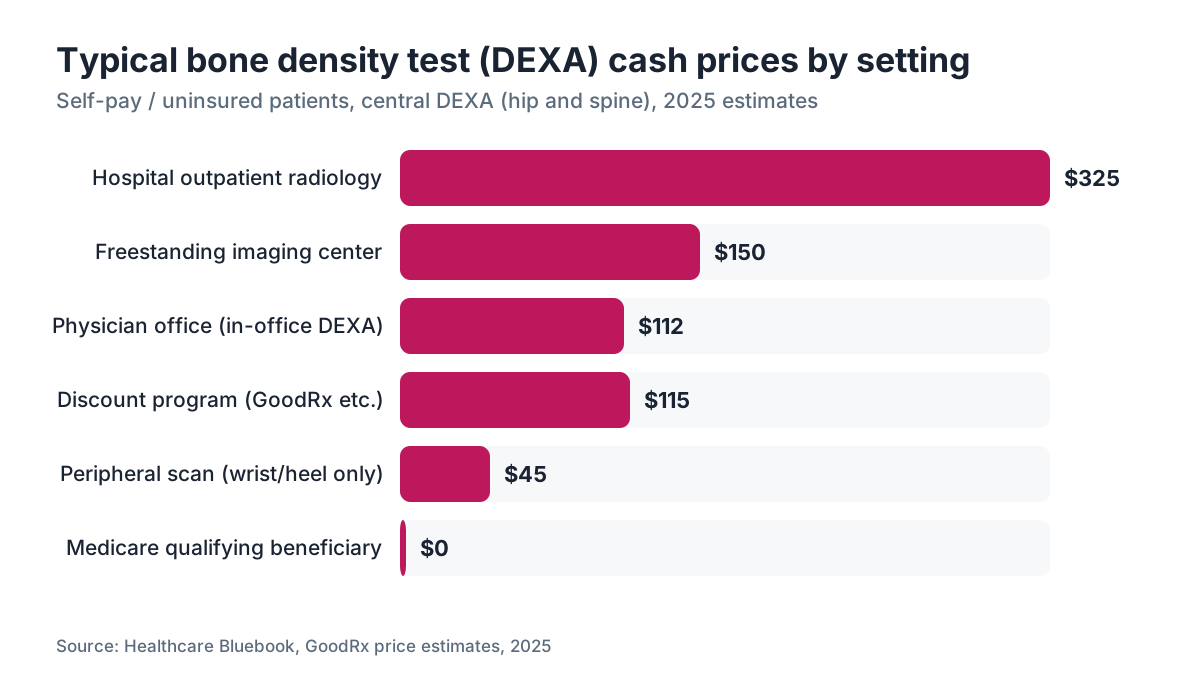
Hospital outpatient radiology is the priciest setting, often billing $250 to $400 for a self-pay DEXA because hospital facility fees stack on top of the professional fee. The same scan at a freestanding imaging center runs $100 to $200 cash. In-office machines at OB-GYN, internal medicine, or rheumatology practices often post the best cash rates, sometimes $75 to $150, because the practice owns the equipment outright and carries low overhead per scan. [1]
Geography matters too. Urban imaging centers in major metros tend to charge more than rural facilities, though heavy competition in big cities can push prices back down. A price-comparison tool like Healthcare Bluebook or the NewChoiceHealth cost estimator can reveal a two- or three-times price gap between facilities in the same zip code.
For insured patients, the number that matters is the negotiated rate and your cost-sharing tier, not the billed charge. A hospital billing $350 might have a negotiated rate of $140 with your insurer, leaving you a $28 copay. An imaging center billing $120 cash might be out-of-network for your plan, so you pay the full $120. The math is genuinely unpredictable until you call your insurer.
| Setting | Typical cash price | Notes | |---|---|---| | Hospital outpatient radiology | $250, $400 | Facility fee adds cost | | Freestanding imaging center | $100, $200 | Most common setting | | Physician office (in-office DEXA) | $75, $150 | Best cash rates | | Peripheral scan (wrist/heel) | $30, $60 | Screening only, not for diagnosis | | Medicare beneficiary (qualifying) | $0 copay | 80% covered by Part B + supplement | | Discount program (GoodRx etc.) | $80, $150 | Varies by city and facility |
When should women get a bone density test?
The USPSTF recommends routine screening for all women 65 and older, and for postmenopausal women under 65 whose 10-year fracture risk equals or exceeds that of a 65-year-old white woman with no additional risk factors, which works out to roughly a 9.3% 10-year risk on the FRAX calculator. [3]
The Bone Health and Osteoporosis Foundation (formerly the National Osteoporosis Foundation) recommends testing earlier for women who reach menopause before 45, women who have taken corticosteroids for more than three months, women with rheumatoid arthritis, and women whose parent had a hip fracture. [6]
Perimenopause deserves a mention. Bone density can drop 1 to 2% per year in the two to three years around the final menstrual period, faster than most decades of adult life. If you're in perimenopause and carry even one additional risk factor, ask your doctor whether an early baseline DEXA makes sense rather than waiting until 65. If you want to understand where you sit hormonally before that conversation, hormone replacement therapy shapes bone density outcomes and is worth reviewing alongside your DEXA results.
Women already diagnosed and treated for osteoporosis usually get a follow-up scan every one to two years to check treatment response. Medicare's 24-month rule reflects that standard. [2]
How does menopause affect bone density, and why does that change what you should test for?
Estrogen is the main regulator of bone remodeling in women. When estrogen drops at menopause, osteoclasts (the cells that break bone down) get more active relative to osteoblasts (the cells that build it). The result is net bone loss that can be steep: women can lose 10 to 20% of bone density in the decade around the menopause transition. [7]
That's why testing timing is more urgent for women who hit menopause early. A woman who reaches menopause at 40 faces potentially two extra decades of estrogen-deficient bone remodeling before she reaches the USPSTF's screening age of 65. That's a real gap, and most endocrinologists would order a baseline DEXA far earlier for her.
Hormone replacement therapy does preserve bone density. Evidence including data from the Women's Health Initiative shows estrogen therapy reduces the risk of hip and vertebral fractures. [7] The North American Menopause Society states that HRT is an approved option for fracture prevention in postmenopausal women at elevated risk. [8] That matters for cost: if your DEXA shows low bone mass in early menopause and you and your doctor choose HRT partly for bone protection, you may sidestep the later cost of bone-specific drugs (bisphosphonates run $25 to $200 a month depending on form and insurance).
If you're trying to read your hormone levels in perimenopause or early menopause alongside a DEXA result, perimenopause age covers the timeline of when bone loss typically speeds up.
Can you get a bone density test covered without a doctor's referral?
In most states, a DEXA scan is a prescription service, meaning a physician, nurse practitioner, or PA has to order it before an imaging center will run it. A handful of states allow direct-access imaging where you can self-refer. Even in those states, insurance won't reimburse without a valid order.
Some telehealth platforms can order a DEXA for a qualifying patient. WomenRx, for example, sees many perimenopausal and menopausal women already discussing hormone levels with a clinician, and ordering a baseline bone density test fits that clinical picture. The order goes to a local imaging center of your choice.
Direct-to-consumer screening companies such as LabCorp OnDemand, along with some concierge wellness services, offer DEXA scans without a physician referral in select states, usually at cash prices of $99 to $199. The result still needs a clinician who knows your full history to interpret it.
So don't skip the ordering clinician to save time. The real value of a DEXA is what happens next: someone who can read your T-score alongside your fracture risk, medication history, and menopausal status, then turn the number into a plan.
How do you find the cheapest bone density test near you?
Start with your insurer's cost estimator tool, which most major carriers now run through their member portal. Enter 'DEXA scan' or CPT code 77080 (axial skeleton, two or more sites) and your zip code. [1] That gives you the facility-specific estimated cost-sharing under your plan.
If you're uninsured or your plan has a high deductible, work through these in order.
First, check GoodRx's imaging search. It pulls prices from participating imaging centers and lets you book online. Prices in the $80 to $130 range are realistic in most mid-size cities.
Second, call freestanding imaging centers directly and ask for their self-pay rate. Many hold a standard discount, often 30 to 50% off list price, that they don't advertise.
Third, look at federally qualified health centers (FQHCs). They use sliding-scale fees and can sometimes arrange DEXA referrals at reduced cost for low-income patients.
Fourth, check whether nearby hospital systems run charity care programs that apply to outpatient imaging. If you're at or below 200 to 400% of the federal poverty level, you may qualify for a steep discount or even a free scan.
The CPT code you want is 77080 for the full central DEXA (hip and spine). For peripheral sites only, it's 77081. Make sure the facility bills the right one if you want insurance reimbursement for a therapeutic-quality scan. [1]
What happens after the test? Understanding your results and next steps
Your DEXA report gives a T-score for each site scanned and a summary diagnosis: normal, low bone mass (osteopenia), or osteoporosis. Most reports also include a FRAX score, your 10-year probability of a major osteoporotic fracture, calculated from bone density, age, sex, weight, height, and clinical risk factors. [5]
If your T-score falls between -1.0 and -2.5 (osteopenia), the first-line moves are lifestyle: weight-bearing exercise, adequate calcium (1,000 mg a day for women under 50, 1,200 mg for women 50 and up), vitamin D (800 to 1,000 IU a day for most adults, more if you're deficient), and quitting smoking. [6] Drug treatment usually waits unless your FRAX score crosses a threshold (roughly 3% for hip fracture or 20% for major osteoporotic fracture under U.S. guidelines) or you have other accelerating factors.
If your T-score is -2.5 or below, treatment is recommended. Bisphosphonates (alendronate, risedronate, zoledronic acid) are the most common first-line drugs. They run from $4 to $10 a month for generic alendronate to a once-yearly IV zoledronic acid infusion that can cost $200 to $1,000 depending on setting and insurance. [9] Newer agents like denosumab, romosozumab, and teriparatide are held for more severe or treatment-resistant cases and cost substantially more.
HRT is a legitimate option for fracture prevention in women who are also symptomatic from menopause. [8] If you're already on or considering an estrogen patch for hot flashes and sleep, that medication does double duty. That's a real cost efficiency worth raising with your prescriber.
A repeat DEXA in one to two years is standard after starting any treatment, to confirm a response before you continue or switch.
Is a bone density test the same as a bone scan?
No, and this mix-up trips up a lot of patients. A DEXA scan measures bone mineral density and screens for osteoporosis. It uses very low-dose X-ray and takes 10 to 20 minutes.
A bone scan (bone scintigraphy) is a nuclear medicine test. It involves an injection of a radioactive tracer, then a 2 to 4 hour wait while the tracer circulates, then imaging. It detects fractures, bone infections, bone tumors, and metastatic disease. It does not measure bone density and can't diagnose osteoporosis. [4]
The two get confused because both involve bones and both produce images. Cost is very different. A nuclear medicine bone scan typically runs $500 to $1,500 depending on setting, versus $100 to $400 for a DEXA. If your doctor ordered a 'bone density test,' she means a DEXA. If she ordered a 'bone scan' without the word density, she means something else entirely.
QCT (quantitative CT) is a third option: a CT-based measure of volumetric bone density that some researchers argue reads more accurately for certain populations. It costs more than DEXA (often $300 to $600 cash) and delivers more radiation. It isn't routine for screening and generally isn't covered by insurance for that purpose.
What about GLP-1 medications and bone density?
This is emerging territory, and it's worth flagging for women taking semaglutide or tirzepatide for weight loss. Rapid weight loss of any kind, whether from bariatric surgery, very low-calorie diets, or GLP-1 receptor agonists, is linked to some bone density loss, though the size and clinical meaning of that loss with GLP-1 drugs specifically is still being studied. [10]
The STEP trials of semaglutide (which led to its FDA approval for weight management as Wegovy) did not show statistically significant bone mineral density loss at 68 weeks compared with placebo, though the studies weren't powered for fracture outcomes. [10] The picture with tirzepatide looks similar: early trial data didn't flag serious bone loss, but long-term data are thin.
For perimenopausal women already at risk from falling estrogen who are also using a GLP-1 for weight loss, a baseline DEXA before starting and periodic monitoring afterward makes practical sense. Raise it with your prescriber.
For more on how semaglutide for weight loss intersects with other parts of women's health, that background applies here. The short version: GLP-1s are powerful, but they work best when you're also watching bone health, lean muscle mass, and nutrition.
Key numbers to know about bone density testing
A few facts worth having in your pocket before you talk to your doctor or call your insurer.
The Medicare reimbursement rate for CPT 77080 in 2024 ran roughly $130 to $145 for the facility fee plus professional component combined, depending on geographic locality. [2] That's the government's allowed amount, a rough floor for what cash prices should look like at negotiated rates.
About 10 million Americans have osteoporosis and another 44 million have low bone mass, per Bone Health and Osteoporosis Foundation estimates drawn from National Health and Nutrition Examination Survey data. [6]
Women make up roughly 80% of osteoporosis cases in the United States. [6]
The U.S. Preventive Services Task Force reaffirmed its B-grade recommendation for bone density screening in women 65+ in 2018, with an updated review in progress as of 2025. [3]
A T-score of -2.5 or below defines osteoporosis, a threshold the World Health Organization set in 1994 that remains the clinical standard. [5]
About half of women over 50 will have an osteoporosis-related fracture in their lifetime, per the Bone Health and Osteoporosis Foundation. [6] Keep that in mind when your insurer makes coverage feel complicated: a hip fracture averages $30,000 to $50,000 in direct medical costs, which dwarfs the cost of any scan.
Frequently asked questions
How much does a bone density test cost without insurance?
Without insurance, a central DEXA scan (hip and spine) typically costs $100 to $400, with the low end at freestanding imaging centers and the high end at hospital outpatient departments. Discount programs like GoodRx often bring cash prices to $80 to $150 at participating facilities. A peripheral scan of the wrist or heel is cheaper, $30 to $60, but it can't diagnose osteoporosis and isn't a substitute for the full central scan.
Does Medicare pay for a bone density test?
Yes. Medicare Part B covers bone density measurement tests once every 24 months for qualifying beneficiaries, including estrogen-deficient women at clinical risk for osteoporosis. Medicare pays 80% of the approved amount. If you have a Medigap supplement covering the 20% coinsurance, your out-of-pocket cost is zero. The CPT code is 77080. You still need a physician or qualified provider to order the test.
At what age should a woman get her first bone density test?
The USPSTF recommends routine screening starting at 65 for all women, and earlier for postmenopausal women under 65 whose 10-year fracture risk equals or exceeds that of a 65-year-old white woman with no additional risk factors. Women with early menopause (before 45), long-term corticosteroid use, low body weight, or a family history of hip fracture should discuss earlier baseline testing with their doctor.
How long does a bone density test take?
The scan itself takes 10 to 20 minutes for a standard central DEXA of the hip and lumbar spine. You stay fully clothed and lie on a padded table. There's no injection, no fasting, and no recovery time. Total appointment time including check-in and positioning is usually 30 to 45 minutes. Results are typically available within a few days, interpreted and sent to the ordering provider.
Is a bone density test painful?
No. A DEXA scan is painless. You lie still on a padded table while a mechanical arm passes over you. There's no injection, no compression, and no confined space. The radiation dose is very low, roughly equivalent to a few hours of normal background radiation. People with severe back pain sometimes find it uncomfortable to lie flat for the 10 to 20 minutes required.
What is a normal bone density T-score for a woman?
A T-score at or above -1.0 is normal. Between -1.0 and -2.5 indicates low bone mass, also called osteopenia. At or below -2.5 meets the WHO diagnostic criteria for osteoporosis. These thresholds apply to postmenopausal women and men over 50. Premenopausal women are assessed by Z-score, which compares to age-matched peers rather than peak bone mass.
Can I get a bone density test covered by insurance before age 65?
Yes, under two conditions. First, ACA-compliant plans must cover USPSTF B-rated preventive services, so postmenopausal women under 65 with elevated fracture risk qualify for no-cost coverage. Second, regardless of age, most plans cover DEXA as a diagnostic test when a physician documents clinical indications like early menopause, steroid use, or prior fragility fracture. Call your insurer with CPT code 77080 to confirm before scheduling.
How often should bone density be tested?
For routine screening, every two years is the standard interval, which is also what Medicare reimburses. Women with normal bone density and low fracture risk may need retesting less often, and some guidelines suggest every 5 to 10 years. Women on treatment for osteoporosis usually retest every one to two years to confirm a response. Your doctor sets the interval based on your T-score, fracture risk, and whether you're on bone-active medication.
What is the difference between a DEXA scan and a bone scan?
A DEXA scan measures bone mineral density using low-dose X-ray and screens for osteoporosis. It takes 10 to 20 minutes and involves no injections. A bone scan (scintigraphy) is a nuclear medicine test using a radioactive tracer that detects fractures, tumors, and infections in bone. It doesn't measure density and can't diagnose osteoporosis. Costs differ sharply: DEXA runs $100 to $400 cash versus $500 to $1,500 for a bone scan.
Does losing weight with GLP-1 drugs affect bone density?
Rapid weight loss can reduce bone density to some degree, regardless of cause. Early data from the STEP trials of semaglutide did not show statistically significant bone mineral density loss at 68 weeks, but the studies weren't designed to detect fracture outcomes. Perimenopausal women using GLP-1 medications who already face estrogen-related bone loss should discuss a baseline DEXA with their prescriber and keep calcium and vitamin D intake adequate.
What should I avoid before a bone density test?
Avoid calcium supplements for 24 hours before the scan, since high-dose calcium in the gut can interfere with imaging. Wear comfortable clothing without metal (no underwire bras, zippers over the scan area, or belt buckles). You don't need to fast. Tell the technologist if you've had a recent barium study or nuclear medicine test, because residual contrast or tracer can affect results. No other special preparation is required.
Can I use an HSA or FSA to pay for a bone density test?
Yes. A DEXA scan ordered by a licensed healthcare provider is a qualified medical expense under IRS rules for both Health Savings Accounts and Flexible Spending Accounts. You can pay directly with your HSA or FSA debit card at the imaging center, or pay out of pocket and submit for reimbursement. Keep the itemized receipt and the Explanation of Benefits if insurance paid a portion.
Do telehealth providers order bone density tests?
Some do. Telehealth platforms focused on women's hormones and menopause care, including WomenRx, can order a DEXA through a clinician visit if you meet clinical criteria. The order goes to a local imaging facility of your choice. This helps if your primary care provider has dismissed your request or if you're already managing hormone therapy through a telehealth practice and want bone health monitoring built in.
How does hormone replacement therapy affect bone density test results?
HRT preserves bone density. Women taking estrogen therapy consistently show slower bone loss and higher T-scores over time than untreated postmenopausal women. If you start HRT after an osteopenia diagnosis, a follow-up DEXA one to two years later should show stable or improved density. This is one reason HRT is considered an evidence-based option for fracture prevention in postmenopausal women at elevated risk, per the North American Menopause Society.
Sources
- Healthcare Bluebook, Fair Price estimates for CPT 77080
- Medicare.gov, Bone Mass Measurements coverage
- U.S. Preventive Services Task Force, Osteoporosis to Prevent Fractures Recommendation (2018)
- RadiologyInfo.org (Radiological Society of North America), Bone Densitometry (DXA)
- World Health Organization, Assessment of Fracture Risk and Its Application to Screening for Postmenopausal Osteoporosis (WHO Technical Report Series 843)
- Bone Health and Osteoporosis Foundation, Osteoporosis Fast Facts
- National Heart, Lung, and Blood Institute (NIH), Women's Health Initiative
- North American Menopause Society (NAMS), 2022 Hormone Therapy Position Statement
- GoodRx, Alendronate Price and Savings
- Wilding JPH et al., STEP 1 Trial: Once-Weekly Semaglutide in Adults with Overweight or Obesity, New England Journal of Medicine 2021
- IRS Publication 502, Medical and Dental Expenses (HSA/FSA qualified expenses)
- FRAX WHO Fracture Risk Assessment Tool (University of Sheffield)