Bone density screening ICD-10 codes: the complete guide for women
TL;DR: The main ICD-10 code for bone density screening is Z13.820 (encounter for screening for osteoporosis). Supporting codes like Z87.310 (personal history of osteoporosis) and M81.0 (age-related osteoporosis without fracture) apply once screening turns into diagnosis. Medicare covers a DXA every 24 months for women 65 and older and high-risk younger women.
What is the correct ICD-10 code for bone density screening?
Z13.820 is the code you want. Its full descriptor in ICD-10-CM is "Encounter for screening for osteoporosis," and it sits inside the Z13 chapter for encounters for screening examinations. Use it when a patient has no known bone disease and is coming in specifically to find out whether she does. That single distinction, screening versus diagnostic, drives the entire claim.
The ICD-10-CM system is maintained jointly by the Centers for Disease Control and Prevention and the Centers for Medicare and Medicaid Services, and it updates every October 1. Z13.820 has held that slot since the U.S. adopted ICD-10-CM in 2015, so nearly every payer recognizes it without any special paperwork. [1]
Reading an Explanation of Benefits? Checking a claim? Z13.820 is almost always the first-listed code on a preventive DXA encounter. The scan itself is billed separately, usually under CPT 77080 (axial DXA, two or more sites) or CPT 77081 (peripheral DXA, one site).
Here is the part billing offices miss. Some payers, Medicare included, want the reason a patient qualifies for screening listed as a secondary code right next to Z13.820. That justifier might be Z78.0 (asymptomatic menopausal state) or a code tied to her specific risk factors. The primary code stays Z13.820. The secondary code is often the line between a paid claim and a denial.
What other ICD-10 codes come up in bone health billing?
Once a woman has a DXA result, the coding shifts under your feet. A T-score between -1.0 and -2.5 means low bone mass (the old term was osteopenia), and the right code is M85.80 (other specified disorders of bone density and structure, unspecified site) or a site-specific variant under M85.8. Watch out for M85.00 through M85.09, which are fibrous dysplasia codes and wrong for plain low bone mass. What the ordering provider documents decides the choice.
Osteoporosis without a pathological fracture gets M81.0 (age-related osteoporosis without current pathological fracture). M81.6 covers localized osteoporosis. Both are diagnostic codes, appropriate only after a test confirms the disease.
Z87.310 covers a personal history of osteoporosis. It matters when a patient has been treated, her density has improved, and she comes back for follow-up imaging. When an insurer asks why you are repeating a DXA at 12 months instead of 24, Z87.310 paired with documentation of active treatment (a bisphosphonate, say) answers the question.
Here is a quick reference for the codes that show up most in a women's bone health practice:
| Scenario | ICD-10 Code | Descriptor | |---|---|---| | Screening, no known disease | Z13.820 | Encounter for screening for osteoporosis | | Asymptomatic menopause (secondary) | Z78.0 | Asymptomatic menopausal state | | Low bone mass / osteopenia | M85.80 | Other specified disorders of bone density, unspecified site | | Age-related osteoporosis, no fracture | M81.0 | Age-related osteoporosis without current pathological fracture | | Osteoporosis with current pathological fracture | M80.00XA-S | Age-related osteoporosis with current path. fracture, various sites | | Personal history of osteoporosis | Z87.310 | Personal history of osteoporosis | | Estrogen-deficiency osteoporosis | M81.0 (+ E28.319 secondary) | Pair with ovarian failure code if relevant | | Glucocorticoid-induced osteoporosis | M81.8 | Other osteoporosis without current pathological fracture |
Glucocorticoid-induced osteoporosis turns up often in women on long-term prednisone for autoimmune disease. It carries its own code because the mechanism and the treatment differ from age-related or estrogen-deficiency bone loss. [2]
Who qualifies for Medicare-covered bone density screening?
Medicare Part B covers bone mass measurement under the Medicare Benefit Policy Manual, Chapter 15, Section 80.5. Five groups qualify: estrogen-deficient women at clinical risk for osteoporosis, people with vertebral abnormalities seen on X-ray, patients on (or expected to start) long-term glucocorticoid therapy, patients with primary hyperparathyroidism, and anyone being monitored for response to osteoporosis treatment. [3]
Medicare pays for one DXA every 24 months. A shorter interval needs documentation of a clinical condition that makes the earlier test medically necessary. Medicare uses procedure code 77078 for axial CT bone density; for the far more common DXA, providers bill CPT 77080 or 77081, processed under the same benefit framework.
For women under 65 on commercial insurance, the Affordable Care Act requires plans to cover preventive screening with no cost-sharing when it carries a U.S. Preventive Services Task Force (USPSTF) grade of B or higher. The USPSTF gives bone density screening a B recommendation for women 65 and older, and for postmenopausal women under 65 whose 10-year fracture risk equals or exceeds that of a 65-year-old white woman with no extra risk factors (roughly a FRAX score at or above 9.3 percent for major osteoporotic fracture). [4]
That FRAX threshold is what opens coverage early. It is not an age cutoff. It is a risk calculation. Take a 58-year-old with early menopause, low body weight, a parent who fractured a hip, and a current smoking habit. Her FRAX will almost certainly clear the threshold. Document the FRAX in the note, and Z13.820 carries the claim.
The bone density test article on this site walks through how DXA scans are performed and what T-scores mean, if you want the clinical side of the test itself.
How does menopause affect bone density screening eligibility and coding?
Estrogen restrains osteoclasts, the cells that break bone down. When estrogen falls at menopause, bone turnover speeds up. Women lose 1 to 3 percent of bone mineral density a year in the first several years after their final period, with the steepest drop in years one through three. [5]
That is exactly why both coding guidelines and Medicare policy name estrogen-deficient women as a qualifying group. For billing, the secondary code documenting that deficiency can be Z78.0 (asymptomatic menopausal state), N95.1 (menopausal and female climacteric states), or, for surgical menopause, E89.40 (asymptomatic postprocedural ovarian failure).
When to start screening younger women with early menopause is genuinely unsettled. The North American Menopause Society (now the Menopause Society) recommends DXA at the time of diagnosis for women with premature ovarian insufficiency (menopause before age 40) and for women with early menopause (before 45), regardless of FRAX score. That is clinically sound, but it goes past the USPSTF B recommendation, so coverage rides entirely on the payer. Document these encounters as medically necessary rather than preventive, and use Z13.820 with supporting diagnosis codes. [11]
For perimenopausal women worried about their bones, a baseline DXA makes clinical sense, but coverage gets spotty. A 50-year-old still menstruating occasionally with two major risk factors might get covered. She might not. The honest move is to run her FRAX, write the number down, and let the math argue for you. The perimenopause age article covers the hormonal changes happening before menopause.
Hormone replacement therapy does preserve bone. Randomized trials, the Women's Health Initiative among them, showed estrogen reduces vertebral and hip fracture risk. Coding-wise: women on HRT being monitored for bone response can be coded under Z13.820 for true screening, or under the active osteoporosis or low bone mass codes if a deficit already exists, with documentation of therapeutic monitoring. The hormone replacement therapy article covers how HRT is prescribed and tracked.
What is the difference between a screening code and a diagnostic code for bone density?
This trips up billing offices constantly. A screening encounter means the patient has no known condition and comes in to find out if she has one. A diagnostic encounter means she already has a known condition, a symptom pointing at one, or an abnormal result being followed up.
A 66-year-old with no prior DXA and no symptoms comes in for her first scan. That is screening. Z13.820 goes first.
She returns two years later, and her earlier scan showed low bone mass at a T-score of -1.8. The repeat DXA is now a diagnostic and monitoring encounter. M85.80 (or the site-specific variant) becomes the primary code, and Z13.820 no longer belongs in the primary slot. Some payers will still process a Z13.820 here, but technically the encounter is diagnostic.
The difference is clinical, not only administrative. A screening test on a low-probability patient carries a different pretest probability than a follow-up scan on someone already known to have osteoporosis. The USPSTF, the CDC, and the American College of Obstetricians and Gynecologists all separate screening from diagnosis in their recommendations, and the ICD-10-CM chapter guidelines carry the same logic into billing. [6]
The working rule: if the patient has a known diagnosis on her problem list that the DXA is addressing, the diagnosis code is primary. If she is asymptomatic with no prior bone diagnosis, use Z13.820.
Does bone density screening ICD-10 coding differ for GLP-1 users?
The code does not change. The clinical justification does. GLP-1 receptor agonists like semaglutide and tirzepatide produce large weight loss, and low body weight is an independent risk factor for reduced bone mineral density. Observational studies and at least one randomized trial have flagged modest density reductions in GLP-1 users, particularly at the hip, though whether those changes raise fracture rates is still being studied. [7]
For coding, a GLP-1 user getting a baseline or follow-up DXA is coded like anyone else: Z13.820 for true screening, or the appropriate diagnosis code if bone loss is already documented. The GLP-1 use itself does not touch the ICD-10 code. What it changes is why you are ordering the test, and that reasoning belongs in the note to support medical necessity when the patient is under 65 or does not otherwise clearly qualify under the USPSTF recommendation.
Practices that manage both hormone therapy and GLP-1 prescribing for women are starting to treat bone density as part of the baseline workup before starting GLP-1 therapy in perimenopausal and postmenopausal patients. That pattern will likely push the coding community toward clearer guidance in the next few years. For now: document the risk factors and let Z13.820 carry the screening encounter.
The semaglutide for weight loss article covers the broader metabolic picture, including how semaglutide affects women's physiology.
How do you bill for bone density screening if insurance denies Z13.820?
Denials usually trace to one of three problems: the patient does not appear to meet the payer's criteria, the documentation does not support the code, or a billing error slipped through (wrong NPI, wrong place of service, duplicate claim).
If the denial is criteria-based, the appeal has to show at least one of these: her age qualifies her (65 and older for Medicare), her FRAX meets the USPSTF threshold, she has documented estrogen deficiency, or she is on long-term glucocorticoid therapy. The USPSTF B recommendation gives a strong legal footing for appeals under ACA-compliant plans, which are required to cover B-rated preventive services without cost-sharing. Cite 42 U.S.C. 300gg-13, the ACA preventive services mandate, in the appeal letter. [8]
If the denial is documentation-based, the appeal needs the actual FRAX score printed in the visit note. Not a mention that risk was assessed. The number. Payers want to see it.
Some commercial payers set their own criteria stricter than USPSTF. Aetna, for one, publishes a clinical policy bulletin for bone density testing with additional conditions. Read the payer's policy before you order the test, document that the patient meets the stated criteria, and most denials never happen.
For Medicare, the Local Coverage Determination from the applicable Medicare Administrative Contractor governs coverage in that region. LCDs for bone density imaging vary by MAC, so check Novitas, CGS, or whichever contractor covers your area at cms.gov.
What ICD-10 codes apply after a DXA finds osteoporosis or low bone mass?
The coding story changes with the result.
T-score at or below -2.5 (osteoporosis): use M81.0 for age-related osteoporosis without a current fracture. If a fragility fracture is present or documented historically, move to the M80 category with site-specific codes (M80.00XA for an initial encounter at an unspecified site, through M80.879S for a sequela at a specific site). Osteoporosis with a fracture is a higher-severity code and usually changes treatment decisions.
T-score between -1.0 and -2.5 (low bone mass): M85.80, or site-specific M85.8x variants. Some providers use M85.89 (multiple sites) when both spine and hip show low density.
T-score above -1.0 (normal): if the encounter was purely screening and the result is normal, ICD-10 guidelines say to code Z13.820 and add a negative-screening result code if the payer requires one. Z03.89 (encounter for observation for other suspected diseases and conditions, ruled out) can work, though many practices just let Z13.820 stand alone for a normal result.
For treatment monitoring, patients already on bisphosphonates, denosumab, or HRT who come back for a repeat DXA get the bone condition code as primary (M81.0 or M85.80), with the therapy noted in the medication list. That monitoring encounter is diagnostic, not screening.
How often should women get bone density screening, and how does frequency affect coding?
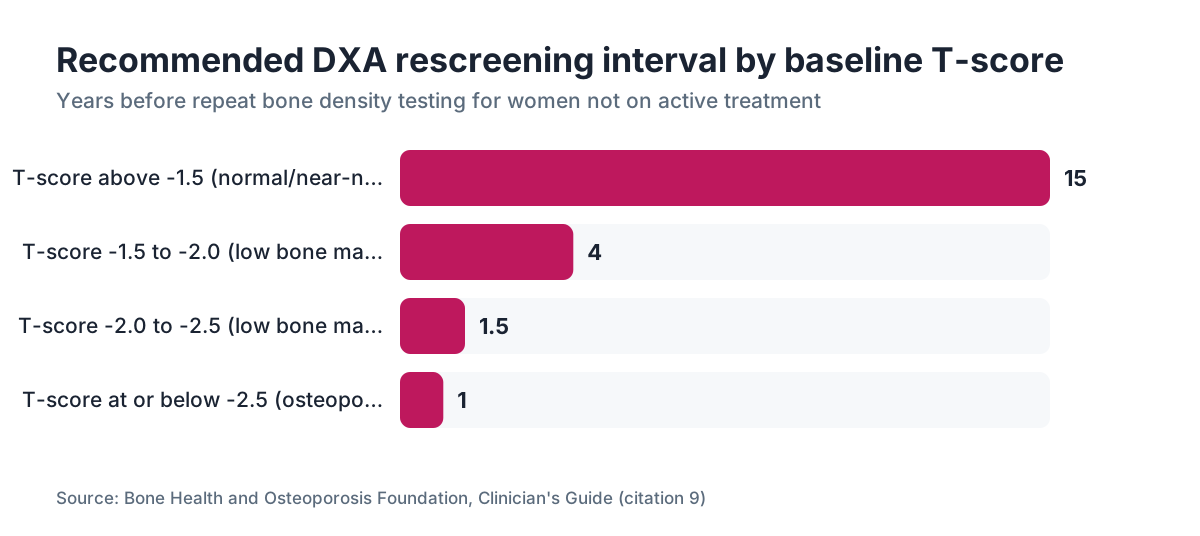
The USPSTF does not set a rescreening interval for women with normal bone density; its 2018 recommendation addressed when to start, not how often to repeat. The Bone Health and Osteoporosis Foundation (formerly the National Osteoporosis Foundation) suggests women with normal or near-normal density who are not on treatment can wait up to 15 years before rescreening if their initial T-score is above -1.5. Women with a T-score between -1.5 and -2.0 are typically rescreened every 3 to 5 years. Those between -2.0 and -2.5 may be rescreened every 1 to 2 years. [9]
Medicare's 24-month rule is an administrative limit, not a clinical one. A woman on a bisphosphonate or denosumab who needs a DXA at 12 months to check treatment response can get one, but expect prior authorization and documentation of medical necessity. The code there is not Z13.820, because that is a screening code. It is the condition being treated, M81.0 or M85.80, with a note that the test monitors response to therapy.
A frequency pitfall worth naming: a patient had a DXA somewhere else, the records are not in your system, you order what you think is a first scan, and Medicare has one on file from 18 months ago. The claim denies. Check the patient's Medicare claim history or ask her directly before ordering.
Are there ICD-10 codes specific to bone density screening in younger women or those with secondary causes?
Yes. Secondary osteoporosis has its own coding pathway because the cause drives the treatment.
Estrogen deficiency from surgical menopause or premature ovarian insufficiency: E89.40 (asymptomatic postprocedural ovarian failure) or E28.310 (symptomatic premature menopause). Pair with M81.0 if osteoporosis is confirmed, or Z13.820 if you are screening.
Long-term glucocorticoid use: T38.0X5A (adverse effect of glucocorticoids, initial encounter) paired with M81.8 for the bone condition. The adverse effect code documents why she has drug-induced osteoporosis.
Malabsorption (celiac disease, Crohn's, bariatric surgery): K90.0 (celiac disease), K50.x or K51.x (Crohn's or ulcerative colitis), Z98.84 (bariatric surgery status). Pair with the bone density code that matches the finding.
Hyperthyroidism or hyperparathyroidism: E05.x or E21.x paired with the bone code. These endocrine conditions speed bone loss through mechanisms separate from estrogen, and the cause code matters for care coordination.
For younger women in the 35 to 50 range worried about their bones, knowing where they stand hormonally is the starting point. The when does menopause start article gives context on estrogen levels in the years before the final period, which is when bone loss begins for many women.
How does ICD-10 coding connect to FRAX and clinical risk assessment?
The FRAX tool, built by the World Health Organization Collaborating Centre for Metabolic Bone Diseases at the University of Sheffield, calculates a 10-year probability of major osteoporotic fracture and of hip fracture from clinical risk factors, with or without bone mineral density. [10]
FRAX is a justification tool, not a code. But its output decides which code fits. A woman with a 10-year major fracture probability at or above 20 percent, or a hip fracture probability at or above 3 percent, meets the BHOF treatment threshold regardless of T-score. A woman below those thresholds with a T-score of -2.3 is a judgment call.
On the billing side, a documented FRAX supports medical necessity for early screening in women under 65. Write the actual number in the note: "Patient's FRAX 10-year major osteoporotic fracture risk is 12.4%, exceeding the 9.3% USPSTF threshold for this age group." That sentence, verbatim, is the difference between a paid claim and a denial letter.
The USPSTF states in its 2018 recommendation: "The USPSTF recommends screening for osteoporosis with bone measurement testing to prevent osteoporotic fractures in women 65 years or older and in postmenopausal women younger than 65 years who are at increased risk of osteoporosis, as determined by a formal clinical risk assessment tool." [4] That language gives payers the clinical standard they need to approve the claim.
Some payers have written FRAX thresholds straight into their prior authorization criteria. Knowing the threshold before you order saves everyone the round trip.
What should a compliant bone density screening order and note include?
Documentation is where billing lives or dies. A compliant note for a preventive bone density screening encounter needs a few things.
The indication: why this patient needs the test today. Age, menopausal status, FRAX score if you calculated it, specific risk factors (low body weight, smoking, family history, medication history). If you are using Z13.820, the note has to make clear this is a screening encounter, not follow-up of a known condition.
The specific test ordered: axial DXA of spine and hip (CPT 77080) versus peripheral DXA of one site (CPT 77081). Most guidelines favor axial DXA because it measures the sites most tied to fracture risk.
The interpretation: if you are the ordering provider reading the results, record the T-score at each site, the reference population, and your impression. "T-score -1.8 at the left femoral neck. This represents low bone mass. Patient counseled on calcium and vitamin D intake, weight-bearing exercise, and fall prevention. Will recheck in 2 years." That note supports the initial Z13.820 claim and the future monitoring encounter both.
Build a bone density template into the EHR that captures FRAX, menopausal status, current medications, and fracture history. It takes about 20 minutes to set up and saves dozens of hours of appeals work over a year.
For how estrogen levels and menopause management intersect with bone health in practice, the menopause and estrogen patch articles have clinical context.
Frequently asked questions
What is ICD-10 code Z13.820?
Z13.820 is the ICD-10-CM code for "encounter for screening for osteoporosis." Use it when a patient has no known bone disease and is coming in for a preventive DXA scan. It is the first-listed code on most bone density screening claims. Once a diagnosis is established, switch to the appropriate M-category code such as M81.0 for osteoporosis or M85.80 for low bone mass.
Does Medicare cover bone density screening and which ICD-10 code do I need?
Yes. Medicare Part B covers bone mass measurement every 24 months for qualifying women, including those with estrogen deficiency, vertebral abnormalities, long-term glucocorticoid use, primary hyperparathyroidism, or a need for treatment monitoring. The billing code is Z13.820 for screening. Medicare's benefit applies to procedure codes 77078, 77080, and 77081. A secondary diagnosis code documenting the qualifying condition strengthens the claim.
What is the ICD-10 code for osteoporosis without fracture?
M81.0 is age-related osteoporosis without current pathological fracture. M81.8 covers other osteoporosis without current pathological fracture, used for drug-induced or secondary cases. These are diagnostic codes used after a DXA confirms a T-score at or below -2.5. They are not interchangeable with Z13.820, which is only for screening encounters before a diagnosis exists.
What ICD-10 code covers low bone mass or osteopenia?
M85.80 (other specified disorders of bone density and structure, unspecified site) is the most common code for low bone mass. Site-specific variants run M85.811 through M85.819 for shoulder, M85.821 through M85.829 for upper arm, and so on. Some practices use M85.89 when both spine and hip show low density. Do not use an osteoporosis code (M81.x) unless the T-score is at or below -2.5.
Can a woman under 65 get bone density screening covered by insurance?
Yes, if her 10-year fracture risk on FRAX meets or exceeds the risk of a 65-year-old white woman with no additional risk factors (roughly 9.3% for major osteoporotic fracture). The USPSTF gives this a B recommendation, so ACA-compliant plans must cover it with no cost-sharing. Document the actual FRAX score in the note. Code it Z13.820 with secondary diagnosis codes documenting the risk factors.
What is the ICD-10 code for a personal history of osteoporosis?
Z87.310. Use it when a patient has had osteoporosis, has been treated, and is returning for monitoring. It is a history code, not an active diagnosis code. Pair it with an active bone density code (M81.0 or M85.80) if she still has measurable bone disease, or use it alone if her bone density has normalized and she is being followed.
How does being on a GLP-1 like semaglutide affect bone density screening coding?
GLP-1 use does not change the ICD-10 code for bone density screening. Z13.820 still applies for a screening encounter. But GLP-1-associated weight loss is an independent bone density risk factor, and that risk belongs in the clinical note to support medical necessity. Preliminary research shows modest hip bone density reductions in GLP-1 users, which makes baseline and follow-up DXA reasonable for perimenopausal women on these medications.
What is the difference between CPT 77080 and 77081 for DXA?
CPT 77080 is axial DXA measuring two or more skeletal sites, usually lumbar spine and hip. CPT 77081 is peripheral DXA measuring one site, often the wrist or heel. Most guidelines favor 77080 because spine and hip T-scores predict fracture risk more accurately. Medicare and most commercial insurers cover 77080 for qualifying indications. CPT 77082 covers vertebral fracture assessment done at the same session as a DXA.
Why would a bone density screening claim be denied even with Z13.820?
Common reasons: the patient had a DXA within the past 24 months (Medicare's limit), the documentation does not establish she meets the payer's eligibility criteria, the ordering provider did not record a FRAX score for a woman under 65, or a billing error like wrong place of service or NPI. Appeal with the FRAX calculation, the USPSTF B-recommendation citation, and 42 U.S.C. 300gg-13 for ACA-compliant plans if cost-sharing was applied incorrectly.
What ICD-10 code applies to bone density screening in women with premature ovarian insufficiency?
Use Z13.820 as the primary screening code, with E28.319 (unspecified primary ovarian failure) or E28.310 (symptomatic premature menopause) as the secondary code documenting why screening is indicated. The Menopause Society recommends DXA at diagnosis for women with premature ovarian insufficiency (menopause before 40) regardless of FRAX score. Coverage depends on the payer, so document medically necessary rather than preventive if she is under the standard age threshold.
Does hormone replacement therapy affect which ICD-10 code I use for a DXA?
HRT does not change the primary screening or diagnostic code. If a woman on HRT gets a DXA specifically to monitor bone response to therapy, the encounter is diagnostic, not screening, so use M81.0 or M85.80 as the primary code rather than Z13.820. Document in the note that the DXA monitors response to estrogen therapy. This distinction matters for claim processing and for showing the clinical rationale.
How long does it take for insurers to process a bone density screening claim with Z13.820?
Most commercial insurers process clean claims within 14 to 30 days under ACA and state prompt-payment laws. Medicare's target is 14 days for electronic claims. Denials that need appeals can take 60 to 120 days to resolve depending on the payer and appeal level. Submitting complete documentation of eligibility criteria upfront, rather than relying on appeals, is consistently faster.
Is there a separate ICD-10 code for glucocorticoid-induced osteoporosis?
Glucocorticoid-induced osteoporosis is coded M81.8 (other osteoporosis without current pathological fracture) paired with an adverse effect code like T38.0X5A to document steroid use as the cause. This matters because treatment differs from age-related osteoporosis, bisphosphonate thresholds are lower, and payers may need the cause code to authorize treatment. If a fracture is present, use M80.8x with the appropriate site code.
What does the ICD-10 code Z78.0 mean in bone density billing?
Z78.0 is the code for asymptomatic menopausal state. In bone density billing, it shows up as a secondary code alongside Z13.820 to document that the patient is postmenopausal and therefore at raised risk for osteoporosis. Payers who want a clinical reason for screening in a woman between 60 and 65 with no other flagged risk factors often accept Z13.820 plus Z78.0 together. It signals estrogen-deficient status without asserting a disease diagnosis.
Sources
- CDC, ICD-10-CM Official Guidelines for Coding and Reporting
- USPSTF, Osteoporosis to Prevent Fractures: Screening (2018)
- NIH National Institute of Arthritis and Musculoskeletal and Skin Diseases, Osteoporosis
- ACOG, Clinical Practice Bulletins
- NEJM, Once-Weekly Semaglutide in Adults with Overweight or Obesity (STEP 1, Wilding et al., 2021)
- U.S. Code, 42 U.S.C. 300gg-13, ACA Preventive Services Mandate
- Bone Health and Osteoporosis Foundation, Clinician's Guide to Prevention and Treatment of Osteoporosis
- WHO Collaborating Centre for Metabolic Bone Diseases, FRAX Tool (University of Sheffield)
- The Menopause Society, Clinical Practice Materials
- HHS Office of Disease Prevention and Health Promotion, Healthy People 2030