Biote hormone replacement therapy: what women need to know
TL;DR: Biote is a franchise network of providers who implant small testosterone and estradiol pellets under the skin every 3 to 5 months. Pellets dissolve slowly and aim for steady hormone levels. Cost runs roughly $300, $500 per insertion session. Evidence on pellets is thinner than for FDA-approved patches and gels, but many women find them convenient. Here is what the research and the fine print actually say.
What is Biote hormone replacement therapy?
Biote (formerly BioTE Medical) is a company based in Irving, Texas that trains and certifies physicians, nurse practitioners, and other providers to implant hormone pellets into patients. It is not a pharmaceutical manufacturer in the traditional sense. It is a clinical education and practice-building franchise. The actual pellets are compounded by third-party pharmacies that Biote has vetted and contracts with.
The pellets themselves are tiny cylinders, roughly the size of a grain of rice, made from fused crystalline testosterone or estradiol. A provider numbs the hip or upper buttock, makes a small incision with a trocar, places one or more pellets into the subcutaneous fat, and closes the site with a steri-strip. The whole procedure takes about ten minutes in an office setting. Over the next three to five months, the pellets dissolve and release hormones directly into the bloodstream, bypassing the digestive system entirely.
Biote's model is to license its protocols, training, and software to independent practices. As of 2024, the company claims more than 7,000 certified providers across the United States [1]. That broad reach is part of why women searching for "hormone replacement therapy Houston" or in dozens of other cities often find a Biote-affiliated clinic near them.
The hormones in Biote pellets are bioidentical, meaning their molecular structure is identical to the estradiol and testosterone your ovaries once produced. That word gets used a lot in marketing, so let me be precise: FDA-approved patches, gels, and rings also contain bioidentical estradiol. "Bioidentical" does not automatically mean safer or better absorbed. It refers to molecular structure, not regulatory status.
Biote pellets are compounded products, not FDA-approved drugs. That distinction matters, and we will cover it in detail below.
How do Biote pellets work compared to patches, pills, and gels?
All hormone replacement therapy delivers the same active molecules. The differences are in how those molecules enter your body, how steadily they arrive, and how much you can adjust the dose once it is in.
| Delivery method | Frequency | Adjustable mid-course | FDA-approved product | Typical estradiol dose range | |---|---|---|---|---| | Pellet (Biote) | Every 3 to 5 months | No | No (compounded) | Varies by compounding Rx | | Transdermal patch | Twice weekly or weekly | Yes, anytime | Yes (Vivelle-Dot, Climara, others) | 0.025 to 0.1 mg/day | | Transdermal gel | Daily | Yes, anytime | Yes (Estrogel, Divigel) | 0.25 to 1.5 g/day | | Oral estradiol | Daily | Yes, anytime | Yes (Estrace, generic) | 0.5 to 2 mg/day | | Vaginal ring | Every 90 days | No mid-cycle | Yes (Femring, Estring) | 0.05 to 0.1 mg/day systemic |
The main argument for pellets is consistency. Patches can fall off, gels require careful application to avoid transferring hormone to a partner or child, and oral estradiol undergoes first-pass liver metabolism that changes how your body processes it. A pellet theoretically delivers a flat, steady serum level without any of those variables.
The main argument against pellets is the loss of flexibility. If your provider overshoots your dose, which does happen, you cannot peel off the pellet the way you peel off a patch. You wait for it to dissolve. That can mean weeks or months of elevated testosterone, which can cause acne, hair thinning at the temples, clitoral enlargement, or voice changes. Some of those effects are reversible. Some are not.
A 2021 review published in Menopause, the journal of the North American Menopause Society (NAMS), noted that pellet therapy carries a higher risk of supraphysiologic testosterone levels in women than other delivery methods [2]. NAMS does not include pellets in its list of FDA-approved HRT options and specifically flags the compounded pellet category as lacking the safety data that comes with the FDA drug-approval process.
For an overview of how hormone replacement therapy options compare more broadly, that article covers the full landscape.
What does Biote hormone replacement therapy cost?
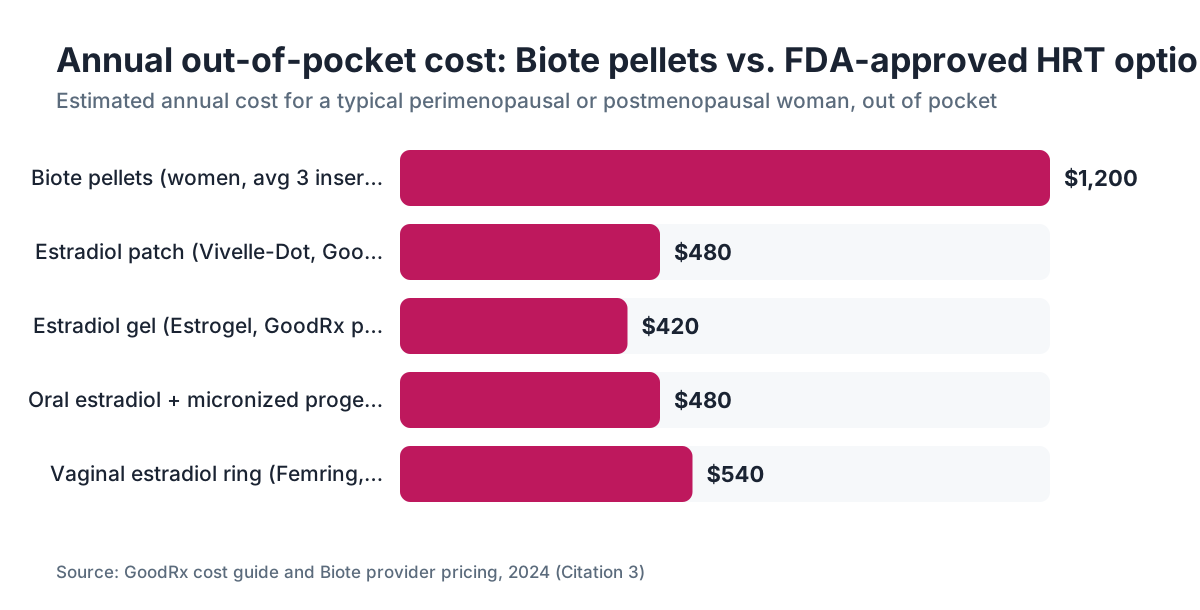
Biote costs run roughly $300 to $500 per insertion for women, plus consultation and lab fees, which pushes the typical annual out-of-pocket total to $800 to $1,600. Insurance almost never covers it. That is the honest breakdown, and here is where every dollar goes.
Most Biote-affiliated practices charge separately for the initial consultation ($100, $300), the lab work ($100, $400 depending on the panel), and the pellet insertion itself. The insertion fee typically runs $300, $500 for women and $600, $900 for men, because men receive higher doses and more pellets per session [3]. Some practices bundle labs and consultation into a package that runs $450, $800 for the first visit all-in.
Because pellets are compounded products, insurance almost never covers them. Major commercial insurers classify compounded bioidentical pellets as experimental or unproven, and Medicare follows the same logic. You are paying out of pocket every three to five months, so the annual cost often lands between $800 and $1,600 for women.
Compare that to a Biote alternative: a twice-weekly estradiol patch like Vivelle-Dot runs roughly $30, $80 per month at most pharmacies with a GoodRx coupon, and generic oral progesterone (micronized progesterone 100 mg) runs about $20, $40 per month. A full year of patch-plus-progesterone can cost under $1,000 and is often partially covered by insurance.
Some Biote clinics in markets like Houston have become concierge-style practices that also offer pellet insertion for testosterone in perimenopausal women who have low libido or fatigue, which is a legitimate but off-label use since no testosterone product is FDA-approved specifically for women in the United States.
If cost is a real constraint and you want bioidentical estradiol with good evidence behind it, FDA-approved transdermal estradiol is that product. The molecules are identical. The regulatory scrutiny is not.
Is Biote FDA approved?
No. Biote pellets are not FDA-approved drugs.
The FDA approves specific drug products, which means it has reviewed clinical trial data on safety, efficacy, manufacturing standards, and labeling for that exact formulation. Compounded hormone pellets have not gone through that process. The compounding pharmacies that make Biote pellets operate under Section 503A or 503B of the Federal Food, Drug, and Cosmetic Act, which allows pharmacies to prepare customized medications for individual patients but exempts them from the full new-drug approval pathway [4].
The FDA has been explicit about its concerns. In a 2020 statement, the agency said it has "received reports of serious adverse events associated with the use of compounded hormone therapy" and that compounded hormones "are not FDA-approved and have not been evaluated for safety or effectiveness" [5]. That is not a fringe position. It is the agency's published guidance.
This does not mean compounded pellets are dangerous for every woman, or that Biote-trained providers are negligent. Thousands of women report feeling better on pellet therapy than they did on pills or patches. The honest answer is that we have good long-term safety data on FDA-approved estradiol (from the Women's Health Initiative and later trials) and we do not have that same quality of data on compounded pellets as a category.
NAMS states directly: "Hormone therapy that is approved by the FDA has undergone rigorous testing for efficacy, safety, and consistency of dose. Compounded hormone preparations have not." [2]
What hormones does Biote actually put in the pellets?
Biote pellets can contain testosterone, estradiol, or both, depending on your bloodwork and symptoms. The compounding pharmacy presses the hormone into a fused crystalline pellet with a binder, typically stearic acid.
Most women who come to Biote with classic menopause symptoms like hot flashes, night sweats, and vaginal dryness will receive estradiol pellets. Women with low libido, fatigue, or brain fog, symptoms that often have a testosterone component, may receive testosterone pellets alone or in combination.
The dosing is supposed to be individualized based on a panel of blood tests drawn before insertion. A typical panel includes total testosterone, free testosterone, estradiol, SHBG (sex hormone-binding globulin), FSH, and sometimes DHEA-S and thyroid markers. The provider uses Biote's proprietary dosing algorithm to calculate how many milligrams of each hormone to order in the pellet.
Here is where individualization gets complicated: the algorithm is proprietary, which means you cannot independently verify how it weighs your labs against your symptoms. Some providers customize it well. Others follow the defaults closely. The quality of your experience at a Biote clinic depends heavily on the individual provider, more than the Biote system.
Progesterone is almost never delivered via pellet, and that matters. Women who have a uterus still need progesterone or a progestin to protect the uterine lining from estradiol-driven endometrial hyperplasia. Biote providers typically prescribe oral micronized progesterone (Prometrium) or a compounded progesterone cream as a separate prescription. Make sure your provider addresses this if you have a uterus. Estrogen without progestogen protection is not appropriate for most women. Our progesterone article explains the options in detail.
What are the side effects and risks of Biote pellet therapy?
The risks of Biote HRT fall into two buckets: risks shared with all hormone therapy, and risks specific to the pellet delivery method.
Risks shared with all systemic estrogen therapy include increased risk of venous thromboembolism (though this risk is substantially lower with transdermal than oral estrogen), endometrial cancer if estrogen is used without progesterone in women with a uterus, breast cancer risk with longer-term use (the absolute risk increase is small but real, particularly after five or more years of combined estrogen-progestogen therapy in postmenopausal women), and gallbladder disease. These risks exist at different magnitudes with patches, pills, and pellets.
Risks more specific to pellets include the following.
Supraphysiologic hormone levels. A 2019 study in Maturitas found that a significant percentage of women on pellet therapy had testosterone levels above the normal female range [6]. This can cause acne, increased body hair, clitoral enlargement, and hair thinning at the temples. Voice deepening from excessive testosterone can be permanent.
No mid-cycle dose adjustment. If you have a bad reaction, you wait. This is genuinely different from patches or gels, where stopping or reducing dose is immediate.
Insertion site complications. Rare but documented: infection, pellet extrusion (the pellet works its way out through the skin), and fibrosis at the insertion site after repeated procedures.
Women who are considering Biote and have a personal or family history of breast cancer, blood clots, stroke, or liver disease should have an especially detailed conversation with a provider about whether pellets or any systemic HRT is appropriate for them. The perimenopause age article has more on how timing of HRT initiation affects the risk-benefit picture.
Does the evidence support Biote pellets for menopause symptoms?
Honestly, the evidence is thinner than you might expect for something so widely used.
There are small observational studies and case series suggesting pellets improve hot flashes, libido, mood, and sleep. A 2019 review in Therapeutic Advances in Endocrinology and Metabolism looked at testosterone pellet use in women and found improvements in libido, satisfaction, and some quality-of-life measures, but the authors explicitly noted the studies were small and not randomized controlled trials [7].
For estradiol specifically, the strongest evidence base (including the Women's Health Initiative reanalysis and the KEEPS trial, which looked at transdermal estradiol) is built on FDA-approved patch and oral formulations, not pellets. We extrapolate that pellet-delivered estradiol likely has similar effects because the molecule is the same, but that extrapolation is an assumption, not a proven fact.
NAMS's 2022 position statement on hormone therapy says that hormone therapy remains the most effective treatment for vasomotor symptoms (hot flashes and night sweats) and the benefits generally outweigh the risks for healthy women under 60 or within ten years of menopause onset [2]. That endorsement applies to FDA-approved formulations. NAMS does not endorse compounded pellets specifically.
The Endocrine Society takes a similar position. It recommends against the routine use of compounded hormones in preference to FDA-approved products unless there is a specific documented medical need for a customized dose or formulation [8].
None of this means pellets do not work for any individual woman. It means the standard of evidence is lower, and you are making a different kind of decision than when you choose a therapy with a 20-year safety database.
How do I find a Biote-certified provider near me?
Biote maintains a provider locator at biote.com where you can search by zip code or city. Most providers work in suburban medical practices, OB/GYN offices, family medicine clinics, and medspa-style integrative wellness centers.
For women searching specifically for hormone replacement therapy Houston, the Houston metro has dozens of Biote-certified providers. Prices and clinical quality vary. The Biote certification means the provider completed Biote's training program, not that they passed an independent specialty board exam in hormone medicine. Ask how many pellet insertions the provider performs per month and what they do if your labs come back showing supraphysiologic levels after insertion.
Questions worth asking at any Biote consultation:
- What specific labs will you run before and after insertion, and what are your target ranges for my age?
- If my testosterone comes back too high after insertion, what is the management plan?
- Do you include progesterone in the protocol if I have a uterus?
- What is your insertion complication rate at this practice?
- Is the insertion fee separate from labs and the consult?
A good provider answers these without defensiveness. If they pivot to testimonials or wave off your questions about FDA approval with "the FDA is behind the times," that is a signal to keep looking.
WomenRx offers telehealth-based hormone evaluation for women who want a second opinion or a thorough lab review before committing to a pellet protocol.
How does Biote compare to other bioidentical HRT approaches?
The word "bioidentical" gets used in two distinct contexts, and they get conflated constantly.
FDA-approved bioidentical hormones include estradiol patches (Vivelle-Dot, Climara, Minivelle), estradiol gels (Estrogel, Divigel), estradiol sprays (Evamist), and micronized progesterone capsules (Prometrium). These are structurally identical to your own hormones AND have been through clinical trials for safety and efficacy.
Compounded bioidentical hormones include Biote pellets, custom-compounded creams, troches (dissolving tablets), and sublingual drops. These are also structurally identical to your own hormones but have not gone through the FDA approval process for the specific formulation being sold.
A third category is synthetic hormones: medroxyprogesterone acetate (MPA) and conjugated equine estrogens (from mare urine). These are NOT structurally identical to human hormones and are the ones used in the original Women's Health Initiative. Much of the fear around HRT comes from the WHI data on these specific synthetic formulations, not from bioidentical estradiol.
So if you are trying to decide between Biote pellets and an estrogen patch like Vivelle-Dot, you are comparing two bioidentical products. The patch has more safety data. The pellet has more convenience if it is dosed correctly the first time.
The Menopause Society's 2022 statement is worth quoting directly: "FDA-approved hormone therapies are available in multiple doses and routes of administration and can be tailored to meet individual patient needs." [2] That flexibility is often underestimated by women who feel like pills and patches are the only non-pellet options.
Can Biote HRT help with weight, energy, and brain fog?
These are the symptoms that often drive women to Biote in the first place, and the honest answer is: it depends on what is causing those symptoms.
If low estradiol is driving night sweats that destroy your sleep, and poor sleep is causing your fatigue and brain fog, then restoring estradiol, whether by pellet or patch, can genuinely help. If your testosterone is in the basement and has been for years, addressing that deficit can improve libido, muscle tone, and energy. These are real physiological effects, not placebo.
Weight is more complicated. Estrogen affects fat distribution, insulin sensitivity, and metabolic rate. Women in perimenopause and menopause often gain visceral fat even without changing their diet or exercise, partly because declining estrogen shifts fat storage from the hips and thighs to the abdomen. Restoring estradiol can blunt some of that shift. A 2023 Cochrane review found that HRT modestly reduces body fat percentage in postmenopausal women compared to placebo [9].
But HRT, including Biote pellets, is not a weight-loss treatment. If significant weight loss is a goal alongside hormone optimization, many women in the menopausal transition are also asking about GLP-1 receptor agonists like semaglutide, which work by a completely different mechanism (appetite and satiety signaling). You can read more about how GLP-1s work for women in our semaglutide for weight loss article.
The combination of HRT and GLP-1 therapy is something more integrative practices are exploring, though there is not yet a large trial that has studied the two together formally in menopausal women. WomenRx does evaluate both treatment paths and can help you figure out which one (or which combination) fits your labs and history.
What should I ask my doctor before starting Biote?
Before any hormone therapy, a responsible provider should do a baseline health assessment. For Biote specifically, here is what that should include.
A hormone panel with estradiol, total and free testosterone, SHBG, FSH, and LH. If you are still cycling or recently stopped, the timing of the draw relative to your cycle matters.
A complete metabolic panel, lipid panel, and thyroid-stimulating hormone test. Thyroid dysfunction mimics many hormone symptoms and should be ruled out before attributing everything to estrogen or testosterone.
A bone density conversation. Menopause speeds bone loss, and one of the strongest, best-documented benefits of estrogen therapy is bone protection. If you are over 50 and have not had a baseline DXA scan, it is worth discussing. Our bone density test article covers what the numbers mean.
A personal and family history review focused on breast cancer, blood clots, cardiovascular disease, and uterine conditions. These are not disqualifiers for HRT in most cases, but they change the risk calculation and sometimes the choice of delivery method.
A discussion of uterine status. If you have a uterus and your provider is offering you estrogen without a clear plan for progesterone or progestin coverage, that is a problem. Walk away.
And post-insertion labs. Any Biote provider should recheck your hormone levels about four to six weeks after your first insertion to make sure your dose is in range. If they do not offer this automatically, ask for it. This is how you catch supraphysiologic levels before symptoms become severe or, in the case of testosterone virilization, potentially irreversible.
For women who want to understand where they fall in the hormonal transition before starting treatment, the when does menopause start article explains the perimenopause-to-menopause continuum and what your FSH and estradiol levels actually tell you.
Frequently asked questions
How long does a Biote pellet insertion take?
The in-office procedure itself takes about ten minutes. You come in, the provider numbs the hip or upper buttock with a local anesthetic, makes a small incision with a trocar, places the pellet, and closes the site with a steri-strip or surgical tape. Most women drive themselves to and from the appointment. There is usually mild soreness at the insertion site for a few days.
How often do you need Biote pellet insertions?
Most women need reinsertion every three to five months. The wide range exists because how fast a pellet dissolves depends on your body size, activity level, and the starting dose. More active women and those with higher muscle mass tend to metabolize pellets faster. Your provider should recheck labs before each insertion to fine-tune the next dose.
Does insurance cover Biote pellet therapy?
Almost never. Major commercial insurers and Medicare classify compounded hormone pellets as experimental. You pay out of pocket for the consultation, lab work, and insertion at each visit. Annual cost for women typically runs $800 to $1,600. By comparison, FDA-approved estradiol patches with a GoodRx coupon can cost under $50 a month and are often partially covered by insurance.
Is Biote hormone therapy safe for women with a family history of breast cancer?
This is a nuanced question that requires a real conversation with a provider who knows your full history, including which relative was affected, at what age, and whether genetic testing has been done. A family history of breast cancer does not automatically rule out HRT for everyone, but it raises the stakes of the risk-benefit calculation. The Menopause Society recommends individualized counseling in this situation rather than a blanket rule.
What is the difference between Biote and traditional hormone replacement therapy?
Traditional HRT typically refers to FDA-approved pills, patches, gels, or rings containing estradiol and sometimes progesterone or progestin. Biote delivers those same hormones via compounded subcutaneous pellets. The molecules are often identical, but the delivery method, regulatory status, and evidence base are different. FDA-approved products have more safety data. Pellets offer longer intervals between doses.
Can Biote pellets cause testosterone to go too high in women?
Yes, and this is a documented risk. A 2019 study in Maturitas found that a meaningful percentage of women on pellet therapy had post-insertion testosterone levels above the normal female range. Symptoms of excess testosterone include acne, hair thinning at the temples, increased facial hair, clitoral enlargement, and, with prolonged exposure, voice changes that can be permanent. Post-insertion labs four to six weeks after placement help catch this early.
Do I need progesterone if I am on Biote estradiol pellets?
Yes, if you have a uterus. Estradiol without progestogen protection stimulates the uterine lining and raises the risk of endometrial hyperplasia and endometrial cancer. Biote pellets do not deliver progesterone. Your provider should prescribe oral micronized progesterone (Prometrium) or a compounded progesterone cream separately. Women who have had a hysterectomy can use estrogen alone.
How long before Biote pellets start working?
Most women notice some improvement in energy, sleep, and hot flash frequency within two to four weeks of their first insertion. Libido and cognitive symptoms often take four to eight weeks to improve noticeably. Full effect is usually reached by six to eight weeks, which is also when your provider should recheck labs to confirm your levels are in an appropriate range.
Can you exercise after a Biote pellet insertion?
Most providers recommend avoiding lower-body exercise, swimming, and hot tubs for five to seven days after insertion to reduce the risk of the pellet extruding before it is properly encapsulated in tissue. Light upper-body activity is usually fine after 24 to 48 hours. Your specific provider will give you their protocol. Follow it, because extrusion rates increase with early vigorous activity.
What is the Biote method, specifically?
The Biote method refers to the company's proprietary protocol: a specific set of labs, a dosing algorithm built into their software, a standardized insertion technique taught in their certification course, and recommended supplement products the company also sells under the Nutraceuticals line. The core clinical approach is lab-based pellet dosing, but the surrounding protocol and software are Biote's commercial product.
Are there alternatives to Biote pellets for women who want bioidentical hormones?
Yes. FDA-approved bioidentical options include estradiol patches (Vivelle-Dot, Climara), estradiol gels (Estrogel, Divigel), estradiol sprays (Evamist), and micronized progesterone (Prometrium). These contain the same molecules as Biote pellets and have extensive clinical trial safety data. Telehealth platforms can prescribe these without an in-person visit in most states, making access easier.
Is testosterone in Biote pellets approved for women?
No. There is no FDA-approved testosterone product specifically for women in the United States. Using testosterone pellets in women is an off-label application. The Endocrine Society and NAMS both acknowledge that testosterone can benefit certain women with hypoactive sexual desire disorder, but they recommend using the lowest effective dose with regular monitoring precisely because the risk of supraphysiologic levels is real.
How does Biote hormone therapy compare to pellet therapy from other companies?
Several other companies offer pellet training and protocols, including EvexiPEL and SottoPelle. They operate on a similar franchise model. The core product, compounded hormone pellets, is the same category. Differences lie in the dosing algorithms, training rigor, compounding pharmacy relationships, and the individual provider's skill. Biote has the largest provider network in the U.S. as of 2024, which gives it greater name recognition but does not inherently mean better outcomes.
Can perimenopausal women use Biote, or is it only for postmenopausal women?
Biote providers treat both perimenopausal and postmenopausal women. Perimenopause, the transition phase that can start in the late 30s or 40s, often involves fluctuating hormones that cause irregular periods, sleep disruption, mood changes, and hot flashes even before the final menstrual period. Lab-guided hormone therapy during perimenopause is more complex because your ovaries are still producing hormones inconsistently, which makes dosing harder to calibrate.
Sources
- Biote Medical, Provider Network page
- The Menopause Society (NAMS), 2022 Hormone Therapy Position Statement
- GoodRx, Hormone Pellet Therapy Cost Guide
- U.S. Food and Drug Administration, Compounding and the FDA (Human Drug Compounding)
- U.S. Food and Drug Administration, statement on compounded bioidentical hormone therapy (cBHT)
- Maturitas (Elsevier), 2019 study on testosterone pellet therapy in women
- Therapeutic Advances in Endocrinology and Metabolism, 2019 review of testosterone therapy in women
- Endocrine Society, Clinical Practice Guideline on Menopausal Hormone Therapy
- Cochrane Database of Systematic Reviews, 2023 review of HRT and body composition in postmenopausal women
- National Institutes of Health (NHLBI), Women's Health Initiative study summary
- U.S. Food and Drug Administration, Approved Drug Products (Orange Book)