Bioidentical hormones cost: what you'll actually pay in 2025
TL;DR: Bioidentical hormones cost anywhere from $30 to over $500 a month. FDA-approved products (estradiol patches, oral progesterone) run $30 to $150 monthly and are often covered by insurance. Custom-compounded formulas cost $80 to $400+ monthly and are almost never covered. Your biggest cost lever is one choice: FDA-approved or compounded.
What are bioidentical hormones, exactly?
Bioidentical hormones are hormones chemically identical to the ones your body makes. The estradiol in a bioidentical product has the same molecular structure as the estradiol your ovaries produce. Same goes for progesterone and testosterone.
That's different from the older synthetic progestins (like medroxyprogesterone acetate) used in the original Women's Health Initiative trial, which are not molecularly identical to human progesterone [10]. Whether that molecular difference matters clinically is a real scientific debate. But it's the core distinction.
Here's where people get confused. Bioidentical does NOT automatically mean compounded, natural, or safer. Some bioidentical hormones are FDA-approved brand-name drugs you can get at any pharmacy. Others are custom-mixed at compounding pharmacies. The word itself says nothing about where the product comes from or how it's regulated.
The FDA has approved several bioidentical hormone products. Estrace (oral estradiol), the Vivelle-Dot patch, Prometrium (oral micronized progesterone), and Divigel (estradiol gel) are all bioidentical and FDA-approved [1]. If your doctor prescribes Prometrium, you are getting a bioidentical hormone. No compounding required.
For a broader look at hormone replacement therapy options, including the non-bioidentical ones, that article covers the full landscape.
What is the average monthly cost of bioidentical hormones?
There is no single average, because "bioidentical" covers two product categories with wildly different price tags. Anyone quoting you one number is hiding half the picture.
FDA-approved bioidentical products, with insurance, often cost $10 to $50 per month for the common formulations. Without insurance, retail prices run from about $30 for a generic estradiol patch to $150 to $200 for brand-name Prometrium [2]. These prices are real and verifiable at GoodRx or your pharmacy counter.
Custom-compounded bioidentical hormones, which is what most people mean when they say "BHRT," cost $80 to $400 per month at most compounding pharmacies. Some specialty clinics charge $250 to $500 monthly once you add the provider consultation fee to the compound itself.
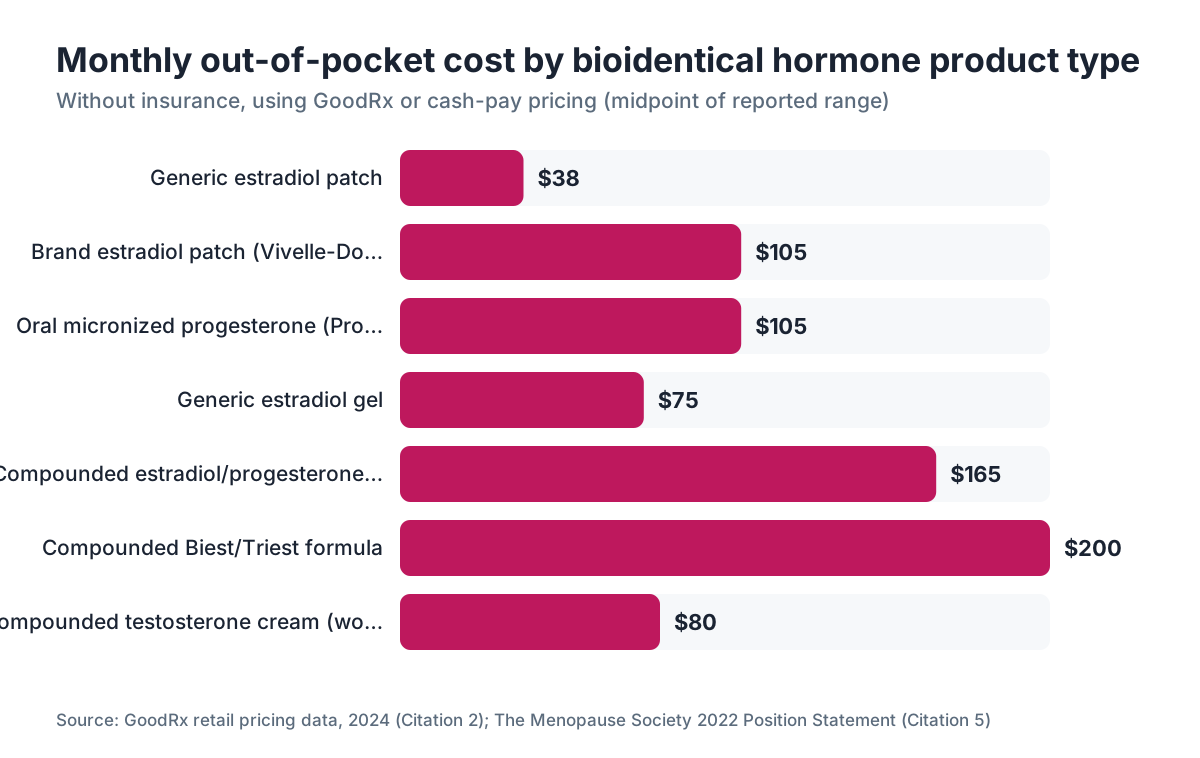
Here's a realistic cost table across the main product types:
| Product type | Example | Monthly cost (no insurance) | Monthly cost (with insurance) | |---|---|---|---| | Generic estradiol patch | Estradiol 0.05 mg/day | $25 to $50 | $0 to $20 | | Brand estradiol patch | Vivelle-Dot | $80 to $130 | $10 to $40 | | Oral micronized progesterone | Prometrium 100 mg | $60 to $150 | $10 to $30 | | Generic estradiol gel | Estradiol 0.06% | $50 to $100 | $10 to $30 | | Compounded estradiol/progesterone cream | Custom | $80 to $250 | Rarely covered | | Compounded tri-estrogen (Biest/Triest) | Custom | $100 to $300 | Rarely covered | | Compounded testosterone for women | Custom | $40 to $120 | Rarely covered |
Those compounded ranges come from reported patient costs and compounding pharmacy price lists. Individual pharmacies vary a lot, so treat the upper ends as realistic rather than worst-case.
Does insurance cover bioidentical hormones?
FDA-approved bioidentical hormones get covered by most insurance plans the same way any other prescription drug does. Estradiol patches, estradiol gel, and oral micronized progesterone (Prometrium) sit on the formularies of most major insurers and Medicare Part D plans. On a standard plan, your copay might be $10 to $30 monthly.
Custom-compounded hormones are a different story. Because compounded drugs are not FDA-approved finished products, most plans exclude them. Medicare Part D generally does not cover compounded drugs unless the active ingredient is an approved drug covered under the plan and specific conditions are met [3]. In practice, most women paying for compounded BHRT pay out of pocket.
HSA and FSA dollars can cover compounded hormones when a licensed practitioner prescribes them [11]. That doesn't lower the sticker price, but it cuts the after-tax cost by your marginal rate, often 22 to 32% for women in the income range most likely to use these services.
If cost is a real constraint, do this: ask your prescriber whether an FDA-approved bioidentical product would work for you before going the compounding route. For many women in perimenopause and menopause, the answer is yes.
How much do compounded bioidentical hormones cost vs. FDA-approved options?
This is the cost comparison that matters most, and the gap is large. A generic FDA-approved regimen can cost one-tenth of a compounded specialty program for the same hormone types.
A woman using a generic estradiol patch plus generic Prometrium from a regular pharmacy might pay $40 to $70 per month without insurance, or as little as $10 to $30 with it. The same hormone types, custom-compounded with a saliva-testing protocol and a specialty clinic consultation, can run $300 to $600 per month all in.
The compounded version is not necessarily better. The FDA has stated that "compounded drugs are not FDA-approved" and that they "have not undergone FDA premarket review for safety, effectiveness, or quality," and it points to FDA-approved hormone therapy as a safe and effective option for most patients [4]. The Menopause Society (formerly NAMS), in its 2022 Hormone Therapy Position Statement, holds that custom-compounded bioidentical hormones have not been proven safer or more effective than FDA-approved hormone therapy [5].
That doesn't mean compounded hormones have no place. There are legitimate reasons to compound: allergies to excipients in commercial products, the need for doses not commercially available, or testosterone prescribing for women (no FDA-approved product is marketed for women in the US). But if you're paying a $250-a-month premium over an FDA-approved option because you heard compounded is more "natural," you're buying a marketing concept, not a clinical benefit.
For more on the specific hormones involved, the progesterone article and the estrogen patch article go deeper on each.
What drives the cost difference between BHRT clinics?
Four things set the price: the consultation model, the compounding pharmacy used, the specific hormones prescribed, and whether testing is bundled in. Get clear on all four before you commit.
Consultation fees vary enormously. Some telehealth platforms charge $99 to $150 for an initial visit and $50 to $75 for follow-ups. Specialty functional medicine or anti-aging clinics can charge $300 to $600 for an initial visit alone. That's before a single hormone is dispensed.
Hormone testing is another line item. A standard FSH, estradiol, and progesterone panel at LabCorp or Quest runs $50 to $150 without insurance. Saliva hormone panels, heavily marketed by some BHRT practices, cost $150 to $400 and are not considered reliable by mainstream endocrinology guidelines [6]. If a clinic requires saliva testing, that's money spent on a test mainstream medicine doesn't validate.
The compounding pharmacy markup matters too. Some clinics have an in-house or preferred pharmacy and earn a referral arrangement. Nothing is inherently wrong with that, but it means you may not be getting the lowest price. Call independent compounding pharmacies directly and compare.
The hormone mix itself changes cost. A simple estradiol cream is cheaper to compound than a tri-estrogen formula (Biest or Triest, combining estriol, estradiol, and sometimes estrone). Estriol has no FDA-approved commercial product in the US, so a Biest or Triest formula must be compounded by definition, which adds cost and complexity.
For context, WomenRx uses a telehealth model that prescribes FDA-approved hormones alongside compounded options where clinically indicated, which keeps most prescriptions insurance-eligible.
What is the cost of bioidentical testosterone for women?
Testosterone is interesting on cost because there is no FDA-approved testosterone product for women in the United States. Every testosterone prescription for a woman is either off-label use of a male product or a compounded preparation.
Off-label male testosterone products (AndroGel, Testim, or generic testosterone gel) used at a fraction of the male dose can cost $30 to $80 monthly with a GoodRx coupon, though the very low doses women need require careful dosing instructions or dilution.
Compounded testosterone cream or gel made to female-appropriate doses (typically 0.5 to 2 mg/day versus the roughly 50 mg/day male dose) runs $40 to $120 per month at most compounding pharmacies. That's one of the more affordable compounded options.
The real cost issue is the monitoring. You'll likely need a testosterone level drawn before starting and periodically after, adding $30 to $80 per lab draw. Some providers also check SHBG and free testosterone, which adds to lab costs.
The Menopause Society recognizes testosterone therapy for women with hypoactive sexual desire disorder as having reasonable evidence behind it, while also noting the lack of long-term safety data in women [5].
Do bioidentical hormones cost more at specialty clinics than regular gynecologists?
Almost always yes, and by a wide margin. A routine gynecology follow-up plus a covered prescription can cost your copay alone. A specialty program can run several hundred dollars a month.
A standard OB/GYN or primary care doctor can prescribe FDA-approved estradiol and progesterone. Your insurance covers the visit, and your pharmacy fills the prescription at a normal copay. Total out-of-pocket for a routine follow-up and refill might be $20 to $60 depending on your plan.
A specialty BHRT or anti-aging clinic, especially one advertising "personalized" or "customized" hormone therapy, typically operates outside standard insurance billing. Visits are often cash-pay. The compounded prescriptions they favor aren't covered. The proprietary testing panels they run aren't covered. All-in costs of $300 to $700 per month for the full program are common.
That doesn't mean specialty clinics offer nothing. Some practitioners in that space have deep menopause expertise a busy generalist may not have time to match. But you're paying for time and attention, not for a scientifically superior product.
If you're somewhere in the years leading up to menopause, a certified menopause practitioner credentialed by the Menopause Society can give you expert hormone management and still prescribe FDA-approved products through your regular pharmacy. That combination often costs far less than a cash-pay specialty clinic.
How do bioidentical hormone costs change over time?
The first year is usually the most expensive. It includes baseline labs, the initial consultation, and often a stretch of dose adjustment with extra follow-up visits.
A realistic first-year budget for FDA-approved bioidentical HRT with a new provider:
- Initial consultation: $150 to $300 (or a copay if covered)
- Baseline labs (estradiol, FSH, progesterone, metabolic panel): $100 to $200
- Monthly prescription cost: $30 to $150 x 12 months
- One or two follow-up visits: $50 to $200 total
Total first year: roughly $700 to $2,500 depending on insurance coverage.
For compounded BHRT at a specialty clinic, first-year costs can run $2,500 to $6,000 or more.
After year one, costs typically drop. You're in a stable regimen, follow-ups are less frequent, and you're not repeating baseline testing. Many women on FDA-approved HRT settle into an ongoing cost of $300 to $600 per year, including one annual visit and their prescriptions.
One more thing worth counting. Untreated menopause symptoms carry their own costs: lost productivity, sleep aids, OTC lubricants, and mental health care all add up. That's harder to quantify, but it belongs in any honest cost-benefit thinking. For a sense of the timeline, see when does menopause start.
Are there ways to lower the cost of bioidentical hormone therapy?
Yes, several, and some are big. Start with the generic switch and work down the list.
Generic substitution is the single biggest lever. Generic estradiol patches are chemically identical to Vivelle-Dot and cost a fraction of the brand. Generic estradiol gel is available too. Ask your prescriber to allow generic substitution rather than writing "dispense as written" for the brand.
GoodRx, RxSaver, and similar discount cards can cut out-of-pocket costs on FDA-approved bioidenticals by 40 to 80% at retail pharmacies. A 30-day supply of generic estradiol patch that retails for $80 might cost $25 to $35 with a GoodRx coupon [2]. These discounts can't be combined with insurance, so compare both before you pay.
Mark Cuban's Cost Plus Drugs (costplusdrugs.com) carries some generic hormone formulations at transparently low prices. Oral estradiol tablets run a few dollars per month there as of 2024, though patch and gel forms have more limited availability.
For testosterone specifically, asking your provider to prescribe an off-label male generic testosterone gel at a pharmacy (with instructions to use a small fraction of the packet) can beat a custom compound on price.
Telehealth has genuinely lowered consultation costs for hormone prescribing. A telehealth visit for HRT management might cost $75 to $150 versus $200 to $350 for an in-office specialist visit, with no travel.
If you have a bone density concern alongside your hormone symptoms, a bone density test before starting HRT can sometimes be covered by insurance as a preventive service, sparing you an out-of-pocket charge.
What should I expect to pay at a telehealth BHRT provider?
Telehealth has made bioidentical hormone prescribing more accessible and, in most cases, cheaper than a cash-pay specialty clinic in person. Your total depends almost entirely on whether they prescribe FDA-approved products or compounded ones.
A typical telehealth BHRT consultation runs $99 to $199 for the initial visit. Some platforms include lab orders in that fee. Others charge separately, which at a direct-pay lab might add $75 to $150. Monthly prescription costs then hinge on the product: FDA-approved (cheapest, often insurance-eligible) or compounded (more expensive, usually not covered).
Platforms that mostly prescribe FDA-approved bioidentical hormones and bill insurance for visits can get total ongoing cost down to $20 to $60 monthly for many women. Platforms that lean on compounded formulas and cash-pay visits run $200 to $500 monthly.
Ask any telehealth provider these before you sign up: Do you prescribe FDA-approved hormones or primarily compounded? Do you accept insurance for consultations? What compounding pharmacy do you use, and can I compare prices? What labs do you require, and can I use my own insurance for them?
WomenRx operates as a telehealth platform prescribing both FDA-approved and compounded options depending on clinical need. Check current pricing directly at womenrx.com.
How does the cost of bioidentical HRT compare to GLP-1 medications for women?
This comes up a lot, because many women in perimenopause and menopause are weighing both, especially given evidence that estrogen loss contributes to weight gain and metabolic shifts during the transition. The short version: HRT is cheap next to GLP-1s.
GLP-1 medications like semaglutide (Ozempic, Wegovy) cost $900 to $1,400 per month at retail without insurance. Compounded semaglutide, sold by licensed compounding pharmacies during the FDA shortage period, ran $200 to $500 per month. Brand-name tirzepatide (Zepbound, Mounjaro) prices similarly to Wegovy.
By comparison, even the expensive end of FDA-approved bioidentical HRT ($150 a month without insurance) is far cheaper than GLP-1 therapy at retail.
For women managing both menopause symptoms and weight, the combination approach shows up more and more in the medical literature. The STEP trials for semaglutide and the SURMOUNT trials for tirzepatide both enrolled women, though neither was designed to isolate menopausal status as a variable [7][8]. Some practitioners now coordinate both therapies, which means pricing each one separately.
On the weight loss side, the semaglutide for weight loss article has current cost data, and semaglutide vs tirzepatide covers the efficacy and price tradeoffs.
Are bioidentical hormones regulated differently, and does that affect cost?
Yes, and this regulatory split is the root cause of most of the cost and coverage variation you'll run into.
FDA-approved bioidentical hormone products (estradiol patches, gels, oral tablets, vaginal products, Prometrium) went through the full FDA approval process: clinical trials for safety and efficacy, standardized manufacturing, consistent dosing, and post-market surveillance. Because they're approved drugs, they sit on insurance formularies and are subject to price negotiation between insurers and manufacturers.
Custom-compounded hormones are regulated differently. The FDA oversees compounding pharmacies under the Federal Food, Drug, and Cosmetic Act, but compounded drugs do not require FDA approval before they're dispensed [4]. Quality can vary between pharmacies. Dosing consistency in creams and gels is harder to verify. Because compounded drugs aren't approved products, insurers exclude them, so you bear the full cost.
The FDA's guidance on compounded bioidentical hormones notes it has received reports of adverse events tied to compounded hormone products [4]. That doesn't make compounded hormones inherently dangerous. It means quality control is less standardized than for approved drugs.
Some compounding pharmacies are accredited by PCAB (the Pharmacy Compounding Accreditation Board), which offers a quality assurance standard above minimum state licensure [9]. If you're using compounded hormones, asking whether the pharmacy is PCAB-accredited is reasonable due diligence.
Frequently asked questions
How much do bioidentical hormones cost per month on average?
FDA-approved bioidentical hormones (estradiol patch, gel, or oral progesterone) cost $30 to $150 per month without insurance and often $10 to $30 with coverage. Custom-compounded bioidentical hormones cost $80 to $400 per month and are almost never covered by insurance. The average depends almost entirely on which category you're using.
Does Medicare cover bioidentical hormones?
Medicare Part D covers FDA-approved bioidentical hormone drugs like generic estradiol patches and Prometrium when they're on a plan's formulary. Medicare does not cover custom-compounded hormones. If you're on Medicare and your provider wants to prescribe a compounded formula, ask whether an FDA-approved alternative exists. It often does, and it would be covered.
Are compounded bioidentical hormones safer than FDA-approved ones?
No evidence shows compounded bioidentical hormones are safer than FDA-approved bioidentical products. The Menopause Society's 2022 position statement holds they have not been proven safer or more effective. FDA-approved products have standardized dosing and manufacturing quality checks. Compounded products vary by pharmacy. 'Bioidentical' describes molecular structure, not safety.
What does a BHRT consultation cost?
An initial BHRT consultation at a specialty clinic costs $200 to $600 out of pocket. At a telehealth platform, initial visits typically run $99 to $199. If your regular OB/GYN or primary care doctor manages your hormones and accepts your insurance, the visit may cost only your copay, usually $20 to $60. Follow-ups cost less than the initial visit.
How much does compounded testosterone cost for women?
Compounded testosterone cream or gel made to female-appropriate doses costs $40 to $120 per month at most compounding pharmacies. It's one of the more affordable compounded options. There is no FDA-approved testosterone product for women in the US, so compounding or off-label use of a male product at a very low dose are the only current clinical pathways.
Can I use my HSA or FSA for bioidentical hormones?
Yes. Both FDA-approved and compounded bioidentical hormones prescribed by a licensed practitioner are eligible HSA and FSA expenses. This doesn't reduce the sticker price, but it cuts after-tax cost by your marginal rate, often 22 to 32%. Saliva hormone testing panels may also qualify, though confirm with your HSA administrator before paying.
Why do some BHRT clinics charge so much more than regular gynecologists?
Specialty BHRT and anti-aging clinics typically run a cash-pay model outside insurance billing. They favor compounded hormones (not covered by insurance), often require proprietary testing panels, and charge premium rates for consultations. You're largely paying for a personalized experience and extended provider time, not for a clinically superior product.
What is the cheapest way to get bioidentical estrogen?
The cheapest route is a generic estradiol patch or gel prescribed by any licensed provider and filled at a retail pharmacy with a GoodRx coupon or through a platform like Cost Plus Drugs. A generic estradiol patch can cost as little as $20 to $35 per month this way. Oral estradiol tablets are even cheaper, sometimes a few dollars monthly at transparent-pricing pharmacies.
Is bioidentical progesterone the same as Prometrium?
Prometrium is an FDA-approved oral micronized progesterone that is bioidentical, meaning its molecular structure matches human progesterone. So yes, Prometrium is a bioidentical progesterone. Most insurance plans cover it, and it costs $10 to $30 monthly with coverage or $60 to $150 without. You do not need a compounding pharmacy to get bioidentical progesterone.
Does bioidentical hormone therapy cost more than conventional HRT?
Not if you're comparing FDA-approved bioidentical hormones to conventional HRT, because many conventional HRT products are already bioidentical. The cost difference only shows up when you compare compounded BHRT (typically $100 to $400/month, not covered by insurance) to FDA-approved hormones ($30 to $150/month, often covered). 'Conventional' vs. 'bioidentical' is largely a marketing distinction.
How often do I need blood tests when on bioidentical hormones, and what does that cost?
Most providers check hormone levels once at baseline, then one to three months after starting or adjusting a dose, then annually once you're stable. A standard estradiol, FSH, and progesterone panel costs $50 to $150 without insurance at commercial labs. Some plans cover it as part of annual preventive care. Avoid expensive proprietary saliva panels, which mainstream clinical guidelines do not validate.
What is Biest or Triest, and why does it cost more?
Biest combines estriol and estradiol; Triest adds estrone to the mix. Because estriol has no FDA-approved commercial product in the US, these formulas must be compounded, which means higher cost ($100 to $300/month), no insurance coverage, and no FDA approval for the final product. There is no clinical evidence that Biest or Triest is more effective than standard estradiol alone.
Will my OB/GYN prescribe bioidentical hormones, or do I need a specialty clinic?
Any licensed OB/GYN or primary care provider can prescribe FDA-approved bioidentical hormones. You do not need a specialty BHRT clinic. Providers credentialed by the Menopause Society as certified menopause practitioners have advanced HRT training. Many women get excellent bioidentical hormone care from a generalist prescriber at a fraction of the cost of a specialty clinic.
Why is compounded hormone therapy not covered by insurance?
Compounded drugs are not FDA-approved finished products, so insurers exclude them from most formularies. Medicare Part D generally will not pay for a compounded hormone unless the active ingredient is a covered approved drug and specific conditions are met. The practical result: most women paying for compounded BHRT pay the full cost out of pocket, though HSA and FSA funds can apply.
Sources
- FDA, 'Menopause: Medicines to Help You' consumer guidance
- GoodRx, Prometrium and estradiol patch pricing
- Medicare.gov, Drug coverage (Part D)
- FDA, compounding of bioidentical hormone replacement therapy guidance and consumer information
- The Menopause Society (NAMS), 2022 Hormone Therapy Position Statement
- Endocrine Society Clinical Practice Guideline, menopausal hormone therapy
- Wilding JPH et al., STEP 1 Trial, New England Journal of Medicine, 2021 (semaglutide 2.4 mg for obesity)
- Jastreboff AM et al., SURMOUNT-1 Trial, New England Journal of Medicine, 2022 (tirzepatide for obesity)
- PCAB, Pharmacy Compounding Accreditation Board
- Rossouw JE et al., Women's Health Initiative Writing Group, JAMA, 2002
- IRS Publication 502, Medical and Dental Expenses