Bio-identical hormone replacement therapy benefits: what the evidence says
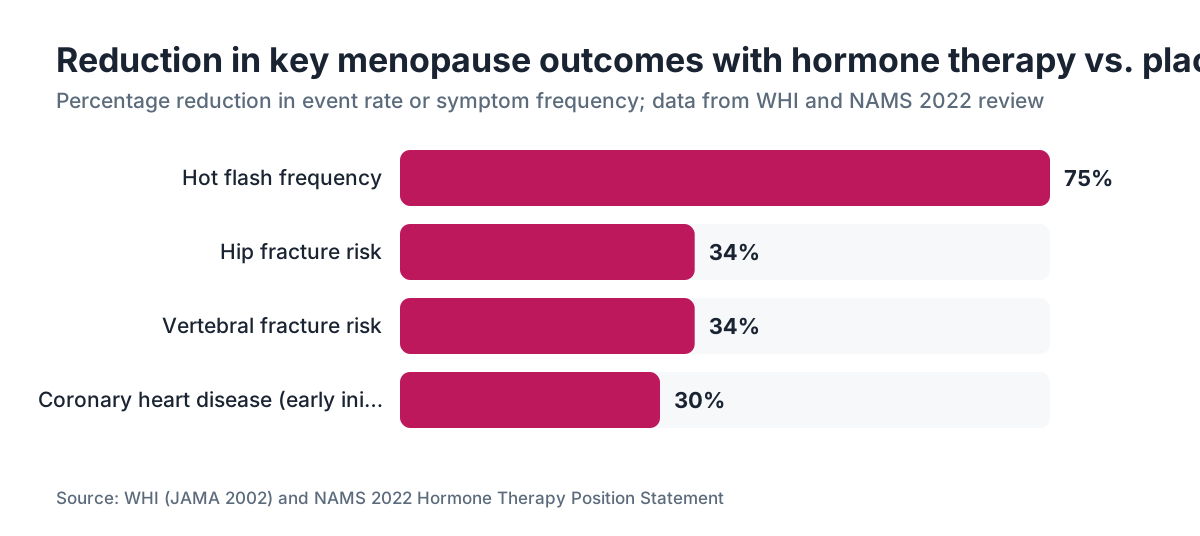
TL;DR: Bio-identical hormone therapy uses hormones chemically identical to the ones your body made before menopause. The best-studied forms, FDA-approved estradiol and micronized progesterone, cut hot flashes by about 75%, reduce fracture risk by roughly a third, and improve sleep and mood. Benefits hinge on when you start, which hormones you use, and how you take them. Compounded custom blends have far thinner safety data.
What is bio-identical hormone replacement therapy?
Bio-identical hormones have the same molecular structure as the hormones your ovaries made before menopause. Estradiol, progesterone, and testosterone are the three that matter most. The word sounds fringe, but plenty of FDA-approved drugs are bio-identical. The estradiol in a patch, gel, or spray is bio-identical. The oral micronized progesterone in Prometrium is bio-identical [1]. What makes a hormone "bio-identical" is its shape, not who mixed it.
The confusion is a marketing story. Compounding pharmacies pushed the term in the early 2000s to sell custom-mixed creams, troches, and pellets, often paired with saliva hormone panels. The label stuck, so "bio-identical" now gets used two ways: for FDA-approved products that happen to use these molecules, and for compounded blends that never went through FDA review. That gap matters when you weigh benefits against risks.
In perimenopause and menopause, the symptoms come mostly from estradiol falling toward zero after the final period. Progesterone drops too, usually earlier in the transition. Those two losses drive the complaints that send women to the doctor: hot flashes, night sweats, broken sleep, vaginal dryness, mood swings, joint pain, and faster bone loss [2].
So when someone asks what bio-identical hormone replacement therapy actually does, the honest answer starts by separating what the FDA-approved products proved in trials from what compounded products claim without matching data.
What are the proven benefits of bio-identical hormone replacement therapy?
The benefit data on FDA-approved estradiol and progesterone is large and consistent. Here's what the trials show, minus the hype.
Hot flashes and night sweats. Estrogen cuts the frequency and severity of vasomotor symptoms by about 75% versus placebo, across many randomized trials reviewed by the North American Menopause Society (NAMS) [2]. Nothing else approved comes close. Night sweats fall the same way, which is why sleep improves so reliably.
Bone and fractures. Estrogen sets the pace of bone turnover in women. The Women's Health Initiative (WHI), despite its badly misread reputation, found that combined estrogen-progestogen therapy cut hip fractures by 34% and vertebral fractures by 34% versus placebo over an average 5.6 years [3]. That is one of the strongest signals in the entire menopause literature. If you're already weighing a bone density test, your hormone status feeds straight into that call.
Vaginal and urinary symptoms. Genitourinary syndrome of menopause (GSM) responds well to both systemic and local estrogen. Low-dose vaginal estradiol rings, tablets, and creams rebuild tissue, ease painful sex, and cut recurrent urinary tract infections, with no meaningful systemic absorption at the doses used [2].
Mood, cognition, and sleep. Here the picture is more layered. Several good trials show estradiol lifts mood and eases depressive symptoms, and the effect is bigger in the perimenopause window than in late postmenopause [4]. Sleep gets better mostly because hot flashes stop wrecking it. Direct cognitive effects are harder to pin down, though observational data keeps linking earlier hormone therapy to better cognitive aging. The timing hypothesis (more below) shapes all of this.
Heart benefit in younger postmenopausal women. The WHI looked frightening at first because it pooled women averaging 63, many already sick. Age-stratified re-analyses tell a different story. Women who started within 10 years of menopause or before 60 had a 30% drop in coronary heart disease events and lower all-cause mortality [5]. That's now the shared position of NAMS and the Endocrine Society [1][2].
How do bio-identical hormones compare with synthetic hormones?
The comparison that matters most is bio-identical progesterone (micronized progesterone, Prometrium) versus synthetic progestins like medroxyprogesterone acetate (MPA), the progestogen used in the WHI's combined arm.
That combined arm (estrogen plus MPA) showed a small but real jump in breast cancer risk after about five years [3]. The estrogen-only arm, in women without a uterus, showed no increase and actually trended lower. That split pushed researchers to ask whether the synthetic progestin, not the estrogen, was the trouble.
The French E3N cohort followed more than 80,000 women. Those using estrogen with micronized progesterone had no statistically significant rise in breast cancer over eight years, while those on synthetic progestins did [6]. This is observational data, not a randomized trial, so it can't prove cause and effect. But the biology is plausible: bio-identical progesterone binds receptors and signals inside cells differently than MPA.
Estrogen itself is simpler. Oral conjugated equine estrogens (CEE, from horse urine) are not bio-identical, but their risk profile is well mapped. Transdermal estradiol, which is bio-identical, likely has a better clot and stroke profile than oral CEE because it skips first-pass liver metabolism, where the clotting-factor changes start [2]. NAMS calls transdermal estradiol the preferred route for women with higher clot or stroke risk.
So the bio-identical label earns its keep mainly on the progesterone side, and secondarily on the estrogen delivery route (transdermal versus oral).
| Hormone | Bio-identical? | FDA-approved? | Key clinical data | |---|---|---|---| | Estradiol patch/gel/spray | Yes | Yes | WHI re-analyses, E3N cohort | | Oral micronized progesterone (Prometrium) | Yes | Yes | E3N cohort, lower VTE vs. MPA | | Conjugated equine estrogens (Premarin) | No | Yes | WHI primary trial | | Medroxyprogesterone acetate (Provera) | No | Yes | WHI combined arm | | Compounded estradiol/estriol/progesterone | Varies | No | No large RCT data |
When should you start bio-identical HRT to get the most benefit?
Timing is probably the single biggest factor in the benefit-risk math, and it's the part most doctors failed to explain after the 2002 WHI press release scared everyone off hormones.
The timing hypothesis, or window of opportunity, describes a steady finding: women who start within 10 years of menopause, or before age 60, get heart, brain, and bone benefits that later starters don't. A 2017 re-analysis in JAMA Internal Medicine found early starters had lower all-cause mortality and lower cardiovascular risk, while women starting more than 20 years past menopause saw no heart benefit and possibly some harm [5].
For bone, timing still counts but the window runs longer. Estrogen keeps the bone you have; it doesn't fully rebuild what's gone. Starting during the perimenopause years, when bone loss speeds up before periods stop, gives the best protective payoff.
For mood and cognition, the brain's estrogen receptors seem most responsive in early postmenopause. The Women's Health Initiative Memory Study (WHIMS) found older women who started hormones had worse cognitive outcomes, while younger starters landed neutral to positive. The lesson isn't "hormones hurt the brain." It's "don't start at 72 expecting a cognitive boost."
Not sure when menopause starts for you, or what menopause age to expect? Those answers feed straight into the timing conversation with your clinician.
What are the risks and who should not use bio-identical HRT?
The benefits are real. So are the contraindications. Being straight about both is what separates a useful article from an ad.
Absolute contraindications to systemic hormone therapy: active or recent breast cancer (especially hormone receptor-positive), an active or recent blood clot (VTE), active cardiovascular disease or recent heart attack or stroke, undiagnosed abnormal vaginal bleeding, and known or suspected pregnancy. Many guidelines also flag known BRCA1/2 mutations for careful individual review [1][2].
Relative contraindications, where the choice needs careful weighing: a personal or strong family history of hormone-receptor-positive breast cancer, active liver disease (oral hormones only, not transdermal), uncontrolled high blood pressure, and active gallbladder disease.
The breast cancer number deserves precision. The WHI combined arm (estrogen plus MPA) showed about 8 extra cases per 10,000 women per year after five years of use [3]. Small in absolute terms, but real. The data with bio-identical progesterone instead of MPA looks more reassuring, but there's no large randomized trial using bio-identical progesterone, so the uncertainty stays. The Endocrine Society puts it plainly: "Bioidentical hormone therapy carries risks that include possible increased risk of blood clots, stroke, and breast cancer" [1].
The 2022 NAMS Hormone Therapy Position Statement sums it up: for healthy women under 60 or within 10 years of menopause, benefits generally outweigh risks for most women with bothersome symptoms [2]. That "most women" is doing real work. It isn't everyone.
Are compounded bio-identical hormones better than FDA-approved ones?
This is the most contested question in the field, and the honest answer is: almost certainly not, and possibly worse.
Compounded hormones are mixed by a pharmacy to a prescriber's spec. They aren't FDA-approved, so they never went through trials for safety, effectiveness, or batch-to-batch consistency [7]. The FDA has flagged specific problems with compounded hormone products: uneven potency (some tested samples ran 67% to 268% of the labeled dose), sterility failures, and no bioavailability data for oddball forms like troches and pellets [7].
Saliva hormone testing, often used to steer compounded dosing, tracks poorly with blood or tissue hormone levels. NAMS does not recommend it for monitoring systemic therapy [2]. Serum testing, timed correctly relative to your dose, is the validated method.
There are real reasons someone might still use a compounded product: a dose that isn't sold commercially, an allergy to a filler in a branded product, or testosterone (which has no FDA-approved female product in the U.S., so compounded is sometimes the only route). Those gaps are legitimate. But "compounded" and "natural" don't mean "better studied" or "safer."
WomenRx works with clinicians who default to FDA-approved bio-identical hormones and will tell you honestly whether compounding is actually warranted for your case.
Does bio-identical HRT help with weight gain during menopause?
Menopause weight gain is real, and estrogen loss is part of the engine. Fat shifts from hips and thighs to the belly partly because visceral fat piles on faster once estrogen drops. Many women also see metabolic rate slow and insulin sensitivity slip during the transition.
Estrogen therapy softens that fat redistribution, modestly. The evidence isn't dramatic. A meta-analysis found hormone therapy users had less trunk fat than non-users, but the gap showed up as centimeters of waist, not dress sizes [4]. HRT is not a weight loss drug. Say that part out loud.
For women who need real weight loss support, GLP-1 receptor agonists like semaglutide and tirzepatide are increasingly paired with hormone therapy. The two work through separate mechanisms and don't cancel each other out. You can read more on semaglutide for weight loss or compare semaglutide vs tirzepatide. Whether to run both is an individual call.
One practical note. The belly fat of menopause is itself an independent heart risk. So treating hormone loss, even without moving the scale, may cut cardiometabolic risk through better body composition.
How does bio-identical HRT affect sexual health and vaginal symptoms?
This benefit gets skipped, partly because it feels awkward to raise in a 10-minute appointment.
Genitourinary syndrome of menopause hits roughly 50% of postmenopausal women, causing vaginal dryness, burning, painful sex, and urinary urgency [8]. Unlike hot flashes, which often fade on their own, GSM tends to get worse. Vaginal tissue needs estrogen to keep its thickness, lubrication, and the acidic pH that fends off infection.
Low-dose local vaginal estrogen, which is bio-identical (estradiol ring, tablet, or cream), treats GSM well with barely any systemic absorption. Serum estradiol in women using the vaginal ring at the approved dose stays within postmenopausal range, which is why the FDA hasn't required an added progestogen for uterine protection alongside it [2]. That's a big deal, because many women who can't or won't use systemic hormones can still safely use local vaginal estrogen.
Systemic bio-identical HRT does more than fix dryness. Estrogen affects clitoral and vulvar blood flow, and there's evidence it lifts desire and arousal indirectly by cutting pain and improving mood. Testosterone, though not FDA-approved for women, is used off-label in compounded form and has the strongest direct data for low sexual desire in postmenopausal women [9].
The progesterone side is messier. Oral micronized progesterone has mild sedative effects (it converts to allopregnanolone, a GABA-A modulator), and some women report better sleep and less anxiety with it, which indirectly helps interest. Others find it flattens libido. Response varies person to person.
What does bio-identical HRT do for mental health and brain fog?
The menopause-cognition link is one of the busiest research areas in women's health right now. Brain fog, word-finding trouble, and memory slips rank among the most distressing symptoms, and they still get brushed off too often.
Estrogen receptors sit dense in brain regions tied to memory, mood, and executive function, including the hippocampus and prefrontal cortex. When estradiol drops in perimenopause, those circuits stumble. Most women find the fog lifts as the brain adjusts to lower estrogen over the first few postmenopausal years, but the adjustment isn't complete for everyone.
A 2022 randomized trial in PLOS ONE found perimenopausal and recently postmenopausal women on hormone therapy scored better on verbal memory tests than those on placebo, with the biggest gains in women who had the worst baseline symptoms [10]. Effects were smaller past five years postmenopause, matching the timing hypothesis.
For depression, the evidence is strong enough that some guidelines now suggest estradiol as a first-line option for new depressive symptoms in perimenopause, especially in women with no prior depression [4]. The mechanism seems to run through estradiol's effect on serotonin and dopamine, which helps explain why SSRIs sometimes flop for perimenopausal depression while estrogen works.
Nobody has good long-term randomized data on whether hormone therapy prevents Alzheimer's. Observational studies look encouraging, especially for early starters, but the WHIMS substudy showed no cognitive protection (though those women were mostly 65 and up). The honest answer: we don't know yet. The ELITE and KEEPS trials are the closest thing to real answers so far.
What forms of bio-identical HRT are available and how do they differ?
Delivery method changes more than convenience. It shapes metabolic pathways, risk profiles, and which symptoms get handled best.
Transdermal estradiol (patches, gels, sprays, creams) sends estradiol straight into the blood through the skin, skipping the liver. No first-pass hepatic effect means clotting factors, triglycerides, and blood pressure don't rise the way they can with oral estrogen. For women with a clot history, migraine with aura, or hypertension, transdermal is generally preferred [2]. The estrogen patch is the most studied transdermal form.
Oral estradiol is also bio-identical and effective. It does go through first-pass metabolism, which drives some of the clotting concerns, though the absolute risk rise in otherwise healthy younger women is small.
Oral micronized progesterone (Prometrium) is the bio-identical progestogen of choice for women with a uterus on systemic estrogen. It shields the uterine lining from estrogen-driven overgrowth. At 100 mg/day (a lower dose sometimes used for sleep) or 200 mg/day (standard uterine protection), it calms many women down at night.
Progesterone IUD (Mirena) protects the uterus locally with almost no systemic progestogen. Some clinicians pair it with systemic estradiol so women get the estrogen benefit without systemic progestogen exposure. That's an accepted but off-label use for menopause management.
Vaginal estradiol for local GSM comes as a ring (Estring), tablet (Vagifem/Yuvafem), or cream. Low-dose local products barely register in the bloodstream.
Testosterone has no FDA-approved female formulation in the U.S. Compounded testosterone cream or gel at low doses (typically 0.5 to 2 mg/day) is used off-label for low libido. Some providers use subcutaneous pellets, but pellets have the worst dose-control record of any form [7].
| Form | Bio-identical? | FDA-approved? | Best for | |---|---|---|---| | Estradiol patch (Vivelle-Dot, Climara) | Yes | Yes | Systemic symptoms, bone, cardiovascular safety | | Estradiol gel (Divigel, EstroGel) | Yes | Yes | Flexible dosing, clot-risk patients | | Oral estradiol (Estrace) | Yes | Yes | Systemic symptoms | | Oral micronized progesterone (Prometrium) | Yes | Yes | Uterine protection, sleep | | Vaginal estradiol ring (Estring) | Yes | Yes | GSM, local symptoms only | | Compounded estradiol/estriol creams | Yes | No | No validated large-trial data | | Testosterone cream (compounded) | Yes | No | Low libido, off-label |
How long can you stay on bio-identical HRT safely?
The old rule was "lowest dose, shortest time." Most major menopause societies now call that too restrictive, and it left millions of women undertreated.
The NAMS 2022 position statement says there's no evidence-based limit on how long healthy, appropriate candidates can use hormone therapy, and that stopping automatically at 60 or 65 isn't supported by the data [2]. Some benefits, especially bone and cardiovascular, only last while you keep taking it. Stop estrogen and bone loss picks right back up at the rate you'd have had without therapy.
The Endocrine Society agrees that duration should be individualized and revisited every year, weighing ongoing benefits against any new health changes [1].
For women with higher breast cancer risk, the math is different and needs ongoing individual review. For low-risk women using HRT for quality of life, there's no magic expiration date.
An annual review with a clinician who knows this material is the standard of care. That means reassessing symptoms, current contraindications, and updated family and personal history. Continuing should be an active decision, not an auto-refill.
How to get bio-identical HRT and what to expect from the process
Bio-identical HRT needs a prescription. The path depends on where you start.
Primary care doctors and OB/GYNs prescribe hormone therapy routinely, but comfort levels swing wildly. Many trained during the post-2002 WHI panic and stayed more conservative than current evidence supports. If your provider won't discuss hormones or says a 45-year-old with real perimenopausal symptoms is "too young," a second opinion from a menopause specialist is fair game. NAMS keeps a certified menopause practitioner directory on its website.
Telehealth widened access a lot. Platforms like WomenRx let women consult clinicians experienced in hormone management without the year-long wait for a menopause specialist. A visit usually includes a health history, a symptom check, and baseline labs (FSH, estradiol, thyroid, lipids, sometimes testosterone and SHBG). From there the plan gets built around you.
Expect a titration period. The first prescription is rarely the final dose. Most women need 2 to 3 tweaks over the first 3 to 6 months before things click. A simple symptom journal between visits helps your clinician dose faster.
Cost varies. FDA-approved bio-identical patches and gels usually run $30 to $80 a month with insurance, more without. Oral micronized progesterone is cheap with a GoodRx coupon. Compounded preparations tend to cost more (often $80 to $200 a month or higher) and rarely get insurance coverage.
Frequently asked questions
Is bio-identical hormone therapy safer than conventional HRT?
FDA-approved bio-identical hormones (estradiol, micronized progesterone) have a strong safety record in appropriate candidates. Evidence suggests bio-identical progesterone carries a more favorable breast risk profile than synthetic progestins like MPA. Compounded bio-identical products, though, lack FDA review and have inconsistent dosing data. 'Bio-identical' is not a blanket safety guarantee. Your delivery method and personal health history matter more than the label.
How long does it take for bio-identical HRT to start working?
Hot flash frequency usually drops noticeably within 4 to 6 weeks of starting estrogen. Sleep often improves around the same time because night sweats ease. Vaginal symptoms take 8 to 12 weeks to fully respond. Mood and energy can lift within weeks but sometimes take 2 to 3 months. Bone protection builds over months to years. Give any new regimen at least 3 months before deciding it isn't working.
Can I use bio-identical HRT if I still have my uterus?
Yes, but you must pair systemic estrogen with a progestogen if you have a uterus. Estrogen alone stimulates the uterine lining and can eventually cause endometrial hyperplasia or cancer. Oral micronized progesterone (Prometrium) at 200 mg/day, or 100 mg/day if taken daily rather than cyclically, is the standard bio-identical option. A progesterone IUD is an alternative. Never take systemic estrogen alone with an intact uterus.
What are the benefits of bio-identical HRT for perimenopause specifically?
Perimenopause, the transition years before the final period, is when symptoms swing hardest. Estradiol fluctuates wildly rather than just declining. Low-dose support can smooth those swings, easing hot flashes, sleep disruption, and mood instability. Evidence also shows estrogen works best as an antidepressant during this window, before the brain adapts to lower levels. Starting early in the transition gives the best quality-of-life return.
Does bio-identical HRT prevent osteoporosis?
Yes, this is one of its best-documented benefits. The Women's Health Initiative found combined estrogen-progestogen therapy cut hip and vertebral fractures by 34% versus placebo. Estrogen slows bone-resorbing osteoclast activity. The protection needs ongoing use; bone loss resumes when estrogen stops. Women who start during perimenopause preserve the most bone. It doesn't replace other bone-health steps but ranks among the most effective interventions available.
Can bio-identical HRT help with anxiety and depression?
Evidence supports estradiol as an effective treatment for perimenopausal depression and anxiety, especially in women with no prior psychiatric history. Multiple trials show estradiol beats placebo for mood symptoms in this group, and some studies show it matches antidepressants for new-onset perimenopausal depression. Oral micronized progesterone has calming, mildly anti-anxiety effects for many women through its conversion to allopregnanolone. Effects are strongest in the perimenopause window.
What labs should I get before starting bio-identical HRT?
Standard pre-treatment labs usually include serum FSH and estradiol to confirm menopausal status, a lipid panel, thyroid-stimulating hormone (TSH), fasting glucose, and a metabolic panel to check liver function. Baseline mammography is standard for women 40 and older. Some providers also test SHBG, testosterone, and DHEAS. Saliva hormone testing is not validated for this. Serum tests, timed correctly relative to your last dose if you're already on hormones, are the accepted approach.
Is bio-identical HRT the same as bioidentical hormone therapy (BHRT)?
They mean the same thing. 'BHRT' and 'bio-identical HRT' both refer to hormone therapy using molecules structurally identical to human hormones. The abbreviation BHRT gets used more by compounding pharmacies and integrative practitioners, while 'bio-identical HRT' is also used by conventional clinicians prescribing FDA-approved products. The molecules can be identical; what differs is whether the product went through FDA review.
Can bio-identical hormones affect weight or metabolism?
Estrogen therapy modestly reduces the menopausal shift of fat from hips to belly, showing less trunk fat than non-users in meta-analyses. It also helps hold onto insulin sensitivity. These effects are real but small. HRT is not a primary weight loss treatment. Women needing significant weight loss alongside hormone therapy may consider a GLP-1 medication; the two work through different mechanisms and can be used together.
What happens when you stop bio-identical HRT?
Stopping estrogen, even after years, usually brings back vasomotor symptoms for many women, though often milder than before treatment. Bone loss resumes at normal postmenopausal rates. Cardiovascular protection ends. Vaginal atrophy can return. Tapering over weeks rather than quitting cold turkey cuts the rebound for most women. Whether to stop is an individual decision based on ongoing risk-benefit review, not an automatic result of hitting a certain age.
Is there a breast cancer risk with bio-identical HRT?
The risk depends heavily on which hormones you use and for how long. The WHI combined arm (estrogen plus synthetic MPA) showed about 8 extra breast cancer cases per 10,000 women per year after 5 years. Estrogen alone showed no increase and possibly a small drop. The French E3N cohort found no significant increase in women using estradiol plus bio-identical progesterone. Reassuring, but still observational. Individual risk assessment with your clinician is essential.
Can younger women in their late 30s or early 40s use bio-identical HRT for premature menopause or early perimenopause?
Yes, and it's especially important in this group. Women with premature ovarian insufficiency (POI) or menopause before 40 face higher risks of heart disease, osteoporosis, and cognitive decline from prolonged estrogen deficiency. Most guidelines recommend hormone therapy at least until the average age of natural menopause (around 51) in women with POI, even given concerns about standard postmenopausal HRT risks. The risk-benefit math clearly favors treatment here.
How is bio-identical HRT different from birth control pills?
Birth control pills use synthetic estrogens (ethinyl estradiol) and synthetic progestins at doses far higher than menopause hormone therapy. They suppress ovulation. Menopause hormone therapy uses much lower doses, in bio-identical form for the products discussed here, to replace what the ovaries no longer make, not to override ovarian function. The two aren't interchangeable. Standard low-dose HRT doesn't reliably suppress ovulation in perimenopausal women who still cycle occasionally.
Sources
- Endocrine Society, Bioidentical Hormones position statement
- North American Menopause Society (NAMS), 2022 Hormone Therapy Position Statement
- Rossouw JE et al., JAMA 2002, Women's Health Initiative randomized controlled trial
- Soares CN, Frey BN, Haber E et al., Menopause 2014, meta-analysis of estrogen and depression in perimenopause
- Manson JE et al., JAMA Internal Medicine 2017, WHI age-stratified re-analysis
- Fournier A et al., Breast Cancer Research and Treatment 2008, E3N cohort study
- U.S. Food and Drug Administration, Compounded Bioidentical Hormones guidance page
- Portman DJ, Gass ML; Vulvovaginal Atrophy Terminology Consensus Conference Panel, Menopause 2014
- Davis SR et al., Lancet Diabetes and Endocrinology 2019, Global Consensus Position Statement on testosterone in women
- Epperson CN et al., PLOS ONE 2022, randomized trial of hormone therapy and verbal memory