Best online semaglutide programs in 2025: how to choose one safely
TL;DR: The best online semaglutide programs prescribe FDA-approved branded medication or clearly disclosed compounded semaglutide, require a real clinician visit, monitor you over time, and charge $200-$1,300 per month depending on the drug and source. Platforms differ most on prescriber access, lab requirements, and whether they handle the hormone issues that complicate weight loss in women over 40.
What should a good online semaglutide program actually include?
A legitimate online semaglutide program is more than a website that ships you a vial. At minimum it needs a licensed prescriber who reviews your medical history, a mechanism for ongoing follow-up, clear disclosure of what drug you're getting (branded vs. compounded), and a way to reach someone when side effects hit at 11 p.m. on a Saturday.
The FDA approved semaglutide under two brand names: Ozempic (for type 2 diabetes) and Wegovy (for chronic weight management in adults with a BMI of 30 or higher, or 27 with a weight-related condition) [1]. A program prescribing 'semaglutide' without telling you which formulation, from which manufacturer, is a red flag.
Good programs also do metabolic labs before starting. Fasting glucose, HbA1c, a lipid panel, and thyroid function matter because semaglutide carries a contraindication for personal or family history of medullary thyroid carcinoma or MEN2 syndrome [1]. Skipping labs to speed up onboarding is cutting a corner that can hurt you.
For women in perimenopause or menopause, a program that ignores hormones is missing a big piece of the picture. Estrogen loss changes how fat is stored, slows metabolic rate, and makes the plateau on GLP-1 therapy happen faster. Programs that can also evaluate hormone replacement therapy or menopause symptoms are meaningfully more useful than programs that only hand out a prescription.
What are the main types of online semaglutide programs?
Online programs fall into roughly four categories, and the differences matter a lot.
Branded-only programs prescribe Wegovy or Ozempic and work with your insurance or a savings card. Costs without insurance run $1,300-$1,350 per month for Wegovy at full retail [2]. With Novo Nordisk's savings card, commercially insured patients can pay as little as $0-$25 per month if they qualify, but eligibility is narrow and Medicare/Medicaid patients are excluded [2]. These programs tend to have the most clinical structure.
Compounded semaglutide programs grew enormously during the 2023-2024 shortage. FDA-registered 503A and 503B pharmacies could legally compound semaglutide while it remained on the shortage list. The FDA declared the shortage resolved in February 2025 and set a deadline for most compounders to stop, though litigation and regulatory timelines have shifted that picture repeatedly [3]. If a program is still offering compounded semaglutide, it needs to show you it has a current legal basis for doing so. Read more in our full guide to compounded semaglutide.
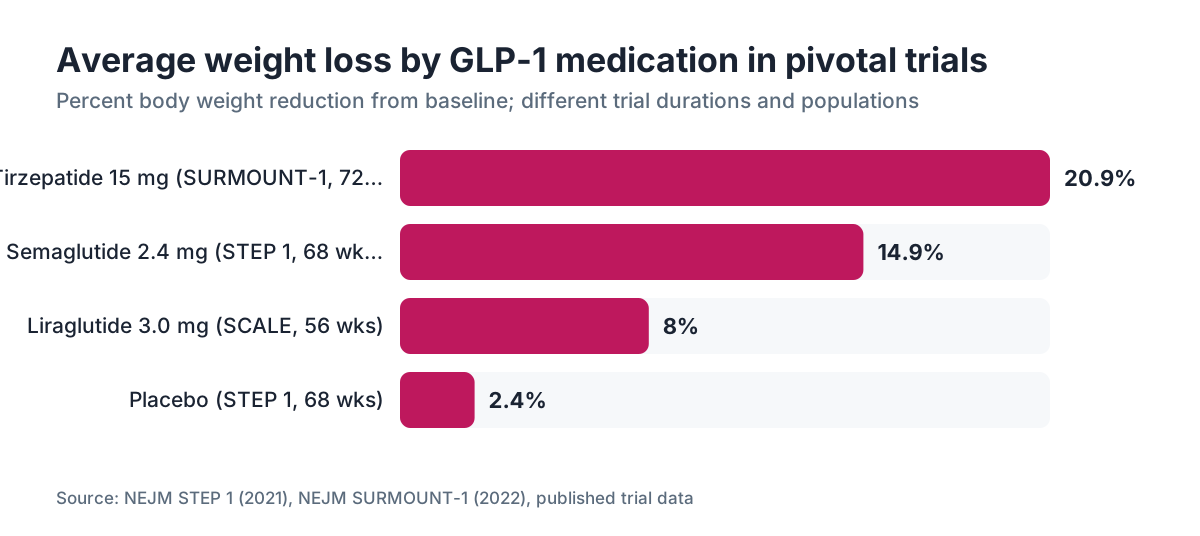
Tirzepatide programs are worth knowing about too. Tirzepatide (Zepbound for weight management) showed greater average weight loss in the SURMOUNT-1 trial (20.9% at 72 weeks on the highest dose vs. 14.9% for semaglutide in STEP 1 at 68 weeks), though head-to-head data is limited [4][5]. See the full breakdown in semaglutide vs tirzepatide.
Hybrid hormone-plus-GLP-1 programs combine a GLP-1 prescription with evaluation for hormone replacement therapy or other hormonal support. These are particularly relevant for women 40 and older whose weight gain is driven partly by the estrogen decline of perimenopause. WomenRx is one example of a telehealth platform built around this combination, but it's not the only one.
How much does an online semaglutide program cost per month?
Cost is the number one question, and the answer is genuinely wide.
| Program type | Monthly drug cost | Monthly membership/visit fee | Total range | |---|---|---|---| | Wegovy, full retail, no insurance | ~$1,350 | $0-$99 | ~$1,350-$1,450 | | Wegovy, Novo savings card (eligible patients) | $0-$25 | $0-$99 | $25-$124 | | Compounded semaglutide (while legal) | $150-$350 | $99-$199 | $250-$550 | | Ozempic off-label (branded, no ins.) | ~$900-$1,000 | $0-$99 | ~$900-$1,099 | | Tirzepatide (Zepbound, full retail) | ~$1,060 | $0-$99 | ~$1,060-$1,159 |
These ranges come from Novo Nordisk's published savings program, Eli Lilly's published Zepbound pricing, and widely reported pharmacy cash prices as of early 2025 [2][6]. Individual pharmacy pricing varies; GoodRx or Cost Plus Drugs often shows lower cash prices for Ozempic than retail.
Membership fees are pure margin for most platforms. Some charge $99-$199 per month just to access their prescribers, on top of drug cost. Others roll the prescriber fee into the drug price. Read the fine print before you sign up.
Insurance coverage for Wegovy is improving but still inconsistent. The STEP 1 trial (68 weeks, n=1,961) found 14.9% average body weight reduction with 2.4 mg weekly semaglutide vs. 2.4% with placebo, which is the outcome data most insurers are now using to justify coverage decisions [4]. Some large employers added Wegovy coverage in 2024; many still exclude it.
Is it safe to get semaglutide prescribed online?
Yes, with the right program. Telehealth prescribing is legal in all 50 states under federal and state frameworks, though the Ryan Haight Online Pharmacy Consumer Protection Act requires a valid prescriber-patient relationship before controlled substances can be prescribed [7]. Semaglutide is not a controlled substance, so that specific statute doesn't apply, but state medical board rules on telehealth prescribing still govern what a physician or NP can do.
The safety concern isn't really the prescribing channel. It's what the prescriber actually checks. The FDA label for Wegovy lists the following contraindications: personal or family history of medullary thyroid carcinoma, MEN2, known hypersensitivity to semaglutide, and pregnancy [1]. A program that skips those questions is negligent regardless of whether it's online or in-person.
Pancreatitis is a labeled warning. Gallbladder disease (cholelithiasis) is common enough in GLP-1 users that the Wegovy label flags it specifically [1]. Patients who've had pancreatitis should be carefully evaluated before starting. A program that doesn't take a GI history is a program you should skip.
The counterfeit and gray-market product risk is real. The FDA issued multiple warnings in 2023 and 2024 about counterfeit semaglutide pens circulating in the supply chain [3]. Branded product from a licensed US pharmacy with a valid prescription is the safest source. If a program ships you a vial with no lot number, no prescriber name, and no pharmacy label, stop.
What criteria should you use to compare online semaglutide programs?
Here's how to evaluate any program you're considering, in order of importance.
Prescriber access. Can you actually talk to a licensed clinician (MD, DO, NP, PA) before and during treatment? Asynchronous questionnaire-only programs where no one ever speaks with you are the lowest bar. Synchronous video visits are better. Programs that give you a direct line to your prescriber when symptoms change are best.
Pharmacy transparency. Does the program tell you exactly which pharmacy fulfills your prescription, whether it's 503A or 503B compounded or branded, and the lot number? This is a minimum safety standard.
Monitoring protocol. Does the program check labs at baseline and periodically? Does it track your weight, heart rate, and symptoms systematically? Does it escalate doses on a schedule that matches the FDA-approved titration (starting at 0.25 mg weekly for Wegovy, titrating over 16-20 weeks to 2.4 mg) [1]?
Side effect support. Nausea affects 44% of patients in STEP trials; vomiting, diarrhea, and constipation are also common [4]. A program with zero support infrastructure for managing these is a problem.
Hormonal context for women. Weight loss in women over 40 is more complicated than calories in, calories out. Menopause and perimenopause change insulin sensitivity, cortisol patterns, and where fat deposits. A program run by clinicians who understand this will get you further than one that treats you like a 28-year-old man in a clinical trial.
Cancellation and refund policy. Some platforms auto-renew and make cancellation deliberately hard. Read it before you pay.
Which online semaglutide programs are most commonly recommended?
There's no independent ranking body for telehealth GLP-1 programs the way there is for hospitals, so any 'best of' list you read, including this one, reflects criteria applied by the writer. What follows is an honest breakdown of the major players by category, not an endorsement.
Hims/Hers has been one of the largest volume prescribers of compounded semaglutide. They offer a low monthly price (often $199-$299 for compounded product) but have faced scrutiny over prescribing volume vs. clinical depth. They operate at scale, which means your prescriber may be handling hundreds of patients.
Ro (Roman/Rory) has offered both branded and compounded options. Their Body program was built around GLP-1s and includes ongoing check-ins. Pricing is competitive for compounded product.
Calibrate built a model around metabolic health with physician-led care, lifestyle coaching, and lab work. It has historically required insurance or a higher out-of-pocket commitment but offered more clinical structure.
Found combines medication management with behavioral coaching and is designed for longer-term use. It's been willing to work with insurance more aggressively than some competitors.
Noom Med added prescriber-led medication to its existing behavioral program. The integration with behavioral coaching is a genuine differentiator.
For women whose weight concerns intersect with hormonal changes, programs that can prescribe both GLP-1s and evaluate hormone replacement therapy are worth seeking out. WomenRx is built specifically for this combination, and it's one of the few platforms where a single clinician can manage both semaglutide for weight loss and hormone support in the same visit.
None of these programs is right for everyone. The best one is the one that will actually monitor you, answer your questions, and adjust your care when something changes.
How do online semaglutide programs handle the compounded semaglutide situation in 2025?
This is genuinely complicated, and any program that tells you it's simple is oversimplifying.
The FDA declared the semaglutide shortage resolved in February 2025 [3]. Under federal law, once a drug is off the shortage list, the legal basis for compounding it at scale (503B outsourcing facilities) largely disappears. 503A pharmacies serving individual patients with a documented clinical need may have more latitude, but the rules are contested.
Several compounders and telehealth platforms filed suit to block the FDA's enforcement actions. As of mid-2025, litigation was ongoing, and the timeline for enforcement had shifted multiple times. If you're reading this after July 2025, check the FDA's current shortage database and any recent court rulings before assuming compounded semaglutide is available legally from your program [3].
The practical risk for patients: if your program's compounded supply gets cut off, you may face an abrupt gap in treatment. Stopping semaglutide without a plan leads to weight regain, often rapid. Programs that also have a path to branded product or that maintain relationships with 503A pharmacies for documented shortage cases are safer bets right now.
Some programs are also offering semaglutide oral tablets (Rybelsus), which are FDA-approved for type 2 diabetes but not for weight management. That's an off-label use, and the weight loss data is thinner than for the injectable form. Worth knowing about, but not a substitute for Wegovy.
Does insurance cover online semaglutide programs?
Coverage depends entirely on which drug, which plan, and what diagnosis is on your claim.
Ozempic (indicated for type 2 diabetes) has much broader insurance coverage than Wegovy. If you have a diabetes diagnosis, your plan is more likely to cover it. Wegovy is approved for weight management, and many plans have historically excluded weight loss drugs, though that's changing.
The Inflation Reduction Act did not add Wegovy to Medicare Part D coverage. As of 2025, Medicare does not cover Wegovy for weight management alone, though patients with cardiovascular disease gained access through the SELECT trial data and subsequent FDA labeling update in 2024, which expanded Wegovy's indication to include reducing cardiovascular events in adults with obesity or overweight plus established cardiovascular disease [1][8].
Novo Nordisk's savings program for Wegovy can reduce out-of-pocket costs to $0 for a limited period for commercially insured patients who qualify. The program excludes government insurance programs [2].
If your online program submits claims to insurance, confirm they're using the correct diagnosis codes and billing for the actual drug dispensed. Some programs that use compounded semaglutide submit claims in ways that create confusion; that's your liability if a claim is disputed.
For most uninsured or underinsured patients, compounded semaglutide (while legally available) or tirzepatide through Lilly's savings program have been the affordable paths. Lilly's Zepbound savings program has offered commercially insured patients prices starting at $25 per month [6].
What happens to weight if you stop semaglutide?
The weight comes back. That's not a scare tactic, it's what the data shows.
The STEP 4 trial followed patients who reached the 2.4 mg maintenance dose and then either continued or switched to placebo. Those who stopped regained about two-thirds of their lost weight within 12 months [9]. The trial authors concluded that semaglutide requires ongoing use to maintain its effects.
This has real implications for how you evaluate an online program. A program that's easy to start and hard to continue, or one that relies on compounded supply that could evaporate, is a worse long-term investment than one with a clear path for ongoing access.
The lifestyle piece matters too. Semaglutide reduces appetite and slows gastric emptying, which makes it easier to eat less. But if the program doesn't also help you build habits that stick during treatment, stopping the drug leaves you with the same environment that drove weight gain originally. Programs with behavioral coaching (Calibrate, Found, Noom Med) try to address this explicitly.
For women in menopause, the interaction between GLP-1 therapy and bone density is also worth watching. Rapid weight loss of any kind, including on semaglutide, can accelerate bone loss in postmenopausal women. The STEP trials weren't powered to detect fracture risk, and long-term bone data remains limited [4]. If you're postmenopausal, this is a reason to get a bone density test before and during treatment.
Are online semaglutide programs appropriate for women in perimenopause or menopause?
Yes, but the programs that understand this population are better for you than generic platforms.
Weight gain in perimenopause and menopause isn't purely behavioral. Estrogen loss shifts fat storage toward the abdomen, reduces insulin sensitivity, and alters leptin and ghrelin signaling, the same hormones semaglutide targets. The result is that many perimenopausal women find weight loss harder than it was at 30, even on semaglutide, because they're fighting two overlapping hormonal shifts at once.
Hormone replacement therapy can complement GLP-1 treatment. Observational data and mechanistic studies suggest that estrogen therapy reduces visceral adiposity and improves insulin sensitivity, which may make GLP-1 therapy more effective [10]. The Endocrine Society's clinical practice guidelines on obesity note the importance of addressing underlying hormonal contributors to weight gain [11]. The Menopause Society (formerly NAMS) has also addressed the intersection of menopause and metabolic health in its position statements [10].
A program that can prescribe an estrogen patch, evaluate progesterone needs, and manage a GLP-1 in a single clinical relationship is offering something qualitatively different from a pure GLP-1 platform. It's not that you can't use both; it's that fragmented care means no one is looking at the whole picture.
Women who are unsure where they are in the hormonal transition can read more about perimenopause age and when menopause starts to orient themselves before their first telehealth visit. Going in with that context makes the conversation more productive.
What questions should you ask an online semaglutide program before signing up?
These seven questions will tell you almost everything you need to know.
-
Who prescribes, and what are their credentials? Ask for the specific license type (MD, DO, NP, PA) and the state in which they're licensed.
-
What drug will I actually receive? Branded (Wegovy, Ozempic) or compounded? From which pharmacy? Is that pharmacy 503A or 503B?
-
What labs do you require before starting? A program that skips this is not practicing medicine carefully.
-
How do I reach a clinician if I have a side effect outside business hours? If the answer is 'email us and we'll respond within 72 hours,' that's not adequate for a drug that can cause severe nausea, vomiting, or, rarely, pancreatitis.
-
What is your dose titration protocol? It should start at 0.25 mg weekly and titrate slowly to 2.4 mg over 16-20 weeks for Wegovy, following the approved label [1]. Programs that rush to maximum dose to show faster results are not acting in your interest.
-
What happens to my prescription if your compounded supply is disrupted? You need a plan.
-
What is your cancellation policy? Read it in writing, more than what the sales representative says.
If a program is reluctant to answer any of these, that reluctance is your answer.
How is semaglutide different from other GLP-1 weight loss options available online?
Semaglutide is a GLP-1 receptor agonist. Tirzepatide (Zepbound, Mounjaro) is a dual GLP-1/GIP agonist, which means it hits two receptors rather than one. In clinical trials, tirzepatide produced greater average weight loss: 20.9% at 72 weeks in SURMOUNT-1 vs. semaglutide's 14.9% at 68 weeks in STEP 1, though these weren't the same populations or study designs [4][5].
Liraglutide (Saxenda) is an older once-daily injectable GLP-1 that produces about 8-9% average weight loss. It's largely been replaced by semaglutide in clinical practice because weekly injections are easier to stick with than daily ones.
Oral semaglutide (Rybelsus) is approved for type 2 diabetes, not weight management. Absorption is variable and requires taking it on an empty stomach with a small amount of water and waiting 30 minutes before eating. Some online programs offer it off-label for weight loss; the evidence base is thinner than for injectable semaglutide.
The full comparison is in semaglutide vs tirzepatide, and our overview of semaglutide for weight loss covers the mechanism and trial data in more depth. The short version: semaglutide is proven, widely available, and for many women the right starting point. Tirzepatide may be worth considering if you've plateaued on semaglutide or if cost is similar in your situation.
Frequently asked questions
Can I get semaglutide prescribed online without going to a doctor's office?
Yes. Telehealth prescribing of semaglutide is legal in all 50 states. You'll complete a medical intake, often via video visit or detailed questionnaire reviewed by a licensed clinician, and the prescription is sent to a pharmacy that ships to your door. The quality of that clinical interaction varies widely by platform, which is why the prescriber access question matters so much.
What is the cheapest way to get semaglutide online legally?
Compounded semaglutide from an FDA-registered pharmacy, when legally available, typically runs $150-$350 per month, compared to $1,350 for branded Wegovy at full retail. Novo Nordisk's savings card can reduce Wegovy to $0-$25 per month for eligible commercially insured patients. The legal availability of compounded semaglutide depends on FDA shortage status, which changed in early 2025 and remains in flux due to ongoing litigation.
How long does it take to see weight loss results on semaglutide from an online program?
Most people start to notice appetite reduction within the first 4 weeks at the 0.5 mg dose. Meaningful weight loss (4-5% of body weight) typically appears by weeks 8-12. The STEP 1 trial found 14.9% average weight loss at 68 weeks on the 2.4 mg maintenance dose. Individual results vary considerably depending on starting weight, diet, hormonal status, and other factors.
Is compounded semaglutide still legal to prescribe online in 2025?
The FDA declared the semaglutide shortage resolved in February 2025, which ended the clearest legal basis for large-scale compounding. Some compounders and telehealth platforms are fighting this in court, and enforcement timelines have shifted repeatedly. The safest approach is to ask your specific program for its current legal basis for compounding, in writing, and to check the FDA's shortage database for the current status.
Do online semaglutide programs work for women in menopause?
Semaglutide works for postmenopausal women, but the hormonal environment of menopause makes weight loss harder. Estrogen loss reduces insulin sensitivity and shifts fat toward the abdomen. Programs that can also evaluate and prescribe hormone replacement therapy address both drivers at once. Standard GLP-1 platforms that don't account for hormonal context often produce slower results or higher plateau rates in this population.
What labs does an online semaglutide program need before prescribing?
At minimum: fasting glucose, HbA1c, lipid panel, thyroid function (TSH), and a personal and family history screen for medullary thyroid carcinoma and MEN2, which are absolute contraindications per the FDA label. Some programs also check a full metabolic panel and kidney function. Programs that skip labs to speed up onboarding are accepting safety risk you shouldn't be comfortable with.
What are the most common side effects I should expect from semaglutide?
Nausea is the most common, affecting 44% of participants in STEP trials. Vomiting, diarrhea, constipation, and abdominal pain are also frequently reported. These are most intense during dose escalation and usually improve with time. Gallstones are a less common but real risk, flagged in the Wegovy label. Pancreatitis is rare but serious; patients with a history of pancreatitis need careful evaluation before starting.
Will I gain the weight back when I stop semaglutide?
Most people do. The STEP 4 trial found patients who stopped semaglutide after reaching maintenance dose regained about two-thirds of their lost weight within 12 months. Semaglutide is a long-term medication for a chronic condition, not a short-term fix. Programs that help you build lasting behavioral habits during treatment offer some protection, but the biology strongly favors regain after stopping.
How do online semaglutide programs handle dose increases?
The FDA-approved Wegovy titration starts at 0.25 mg weekly for 4 weeks, increases to 0.5 mg for 4 weeks, then 1.0, 1.7, and finally 2.4 mg, with each step taking 4 weeks. The full titration takes 16-20 weeks. Programs that rush this schedule to show faster results increase side effect risk. Confirm your program follows this schedule or has a documented clinical reason to deviate.
Can semaglutide affect bone density in postmenopausal women?
Rapid weight loss from any cause can accelerate bone loss in postmenopausal women. The STEP trials were not powered to detect fracture risk, so long-term data is limited. If you're postmenopausal and starting semaglutide, getting a baseline bone density test and discussing calcium, vitamin D, and hormone status with your prescriber is reasonable and clinically supported.
What is the difference between Ozempic and Wegovy for online prescribing?
Same molecule, different doses and indications. Ozempic is FDA-approved for type 2 diabetes and goes up to 2.0 mg weekly. Wegovy is FDA-approved for chronic weight management and goes up to 2.4 mg weekly. Online programs prescribing Ozempic off-label for weight loss are common; it's not illegal but it is off-label. Insurance coverage and prior authorization requirements differ significantly between the two.
How do I know if an online semaglutide program is using a legitimate pharmacy?
Ask for the pharmacy name and look it up in the NABP (National Association of Boards of Pharmacy) database at nabp.pharmacy. Verify it holds state licensure and, if it's a compounder, confirm its FDA registration status. Your prescription and any shipped product should carry the pharmacy's name, address, lot number, and your prescriber's name. Missing any of these is a warning sign.
Does semaglutide interact with hormones or hormone therapy?
No major pharmacokinetic interactions between semaglutide and common hormone therapy formulations (estradiol, progesterone) are currently documented in the FDA label. The physiological effects do overlap: both estrogen therapy and semaglutide affect insulin sensitivity and fat distribution. Women on both should have those effects monitored together. This is another reason to use a program where one clinician sees the full picture.
What happens if my online semaglutide program stops offering compounded medication?
You may face an abrupt gap in treatment. Stopping semaglutide suddenly leads to rapid weight regain in most patients. If your program relies on compounded supply, ask before signing up what their plan is if that supply is disrupted. Programs with relationships to multiple pharmacies or a pathway to branded product are safer. Having a backup relationship with a local prescriber who can bridge you to Wegovy is worth arranging.
Sources
- FDA, Wegovy (semaglutide) Prescribing Information
- Novo Nordisk, Wegovy Savings Card Program
- FDA, Drug Shortages Database and semaglutide shortage resolution announcement
- Wilding JPH et al., STEP 1 Trial, New England Journal of Medicine, 2021
- Jastreboff AM et al., SURMOUNT-1 Trial, New England Journal of Medicine, 2022
- Eli Lilly, Zepbound Savings Program
- DEA, Ryan Haight Online Pharmacy Consumer Protection Act (21 U.S.C. 829)
- FDA, Wegovy label update for cardiovascular indication, 2024
- Rubino DM et al., STEP 4 Trial, JAMA, 2021
- The Menopause Society (formerly NAMS), Menopause and Metabolic Health Position Statement
- Endocrine Society, Clinical Practice Guideline: Pharmacological Management of Obesity
- NABP, National Association of Boards of Pharmacy, Pharmacy Verification