Best compounding pharmacy for semaglutide: how to evaluate your options safely
TL;DR: No single compounding pharmacy is universally "best" for semaglutide. The right one holds 503A or 503B FDA registration, uses USP-grade API with a Certificate of Analysis, ships to your state, and works with a real prescriber. The FDA removed semaglutide from its shortage list in February 2025, which tightened the rules hard. Vetting beats brand name.
Why is compounded semaglutide even an option?
A years-long shortage of Ozempic and Wegovy opened a legal door for compounding pharmacies. That's the whole story in one sentence.
Under federal law (21 U.S.C. § 503A and § 503B), compounding pharmacies can legally prepare copies of FDA-approved drugs when those drugs sit on the FDA's drug shortage list. Semaglutide, the active ingredient in Ozempic, Wegovy, and Rybelsus, landed on that list in 2022 and stayed there long enough that hundreds of compounders across the country started filling prescriptions for it. [10]
The FDA declared the semaglutide shortage resolved in February 2025, then gave a grace period: 503A pharmacies had until April 22, 2025, and 503B outsourcing facilities until May 22, 2025. [2] The window for routine compounding has mostly closed. There's a catch worth understanding. Compounders can still prepare semaglutide when a patient has a documented clinical reason the commercial product doesn't work, like a dose the pens don't offer or a verified allergy to an excipient.
If you're in perimenopause or menopause and you were leaning on compounded semaglutide for weight management next to hormone therapy, this regulatory shift is real. Your options didn't vanish. They narrowed. You now want a pharmacy that has thought hard about how it operates inside the new rules, not one that appeared during the shortage and is hoping nobody checks.
See semaglutide for weight loss and compounded semaglutide for how these medications actually work.
What does the FDA actually require from a compounding pharmacy for semaglutide?
Most consumer articles get vague right here. Let's be specific instead.
The FDA recognizes two categories. A 503A pharmacy compounds for individual patients based on a valid prescription from a licensed practitioner. A 503B outsourcing facility compounds in larger batches, sometimes without patient-specific prescriptions, and operates under tighter oversight that looks more like pharmaceutical manufacturing: FDA registration, cGMP standards, and regular federal inspections. [3]
For semaglutide, the FDA's 2025 guidance set two dates. 503B facilities had until May 22, 2025 to stop routinely compounding it. 503A pharmacies had until April 22, 2025. After those dates, compounding is allowed only in narrow situations, most commonly:
- A patient has a documented allergy or sensitivity to an ingredient in the commercial product. (Ozempic contains disodium phosphate dihydrate and propylene glycol, for example.)
- A prescriber documents a medical need for a specific dose or concentration that isn't commercially available.
- The patient needs a titration schedule the commercial pen can't accommodate. [2]
The FDA also said plainly that stirring in vitamin B12, NAD+, or other add-ins does not create a meaningfully different product that would justify continued compounding under the shortage exemption. That matters, because "semaglutide plus B12" was marketed hard during the shortage.
Here's the practical read. If a pharmacy is still selling you compounded semaglutide with no documented clinical rationale after mid-2025, it may be operating outside FDA guidance. That's a legal and safety risk that lands on you, not the pharmacy. [1]
What are the key criteria for evaluating a compounding pharmacy for semaglutide?
Treat this as your checklist. No pharmacy checks every box perfectly, but a missing box is a real warning.
1. State licensure and NABP accreditation The National Association of Boards of Pharmacy (NABP) runs a Verified Websites Program for online pharmacies and a separate accreditation for compounders called PCAB (Pharmacy Compounding Accreditation Board). PCAB accreditation means an outside body audited the pharmacy's processes, rather than the pharmacy just telling you it follows good practices. [4]
2. 503A vs. 503B status For larger-scale dispensing, a 503B outsourcing facility is the higher bar. You can search the FDA's registered outsourcing facilities list at FDA.gov. [3] If a pharmacy claims 503B status but doesn't appear there, that's a problem.
3. Certificate of Analysis (CoA) for the API The active pharmaceutical ingredient (API) should come with a third-party Certificate of Analysis confirming identity, purity, and potency. A real pharmacy shares this with you or your prescriber without a fight. If they won't, walk.
4. A real prescriber relationship Legitimate compounding pharmacies don't prescribe. They fill prescriptions from licensed practitioners who reviewed your history. A website offering semaglutide through a five-minute quiz with automatic approval has an inadequate prescriber relationship, almost every time. [5]
5. Documented clinical rationale after the shortage After April and May 2025, any prescription for compounded semaglutide needs a documented reason in your chart. If nobody ever asks why you can't use Wegovy or Ozempic, they're not compounding compliantly.
6. A US address and a pharmacist you can reach Basic, but it matters. You should be able to call and talk to a pharmacist. Offshore operations shipping semaglutide to US addresses are illegal no matter how polished the website looks.
How much does compounded semaglutide cost compared to brand-name?
Cost is usually the reason people ask about compounding at all. So here are real numbers.
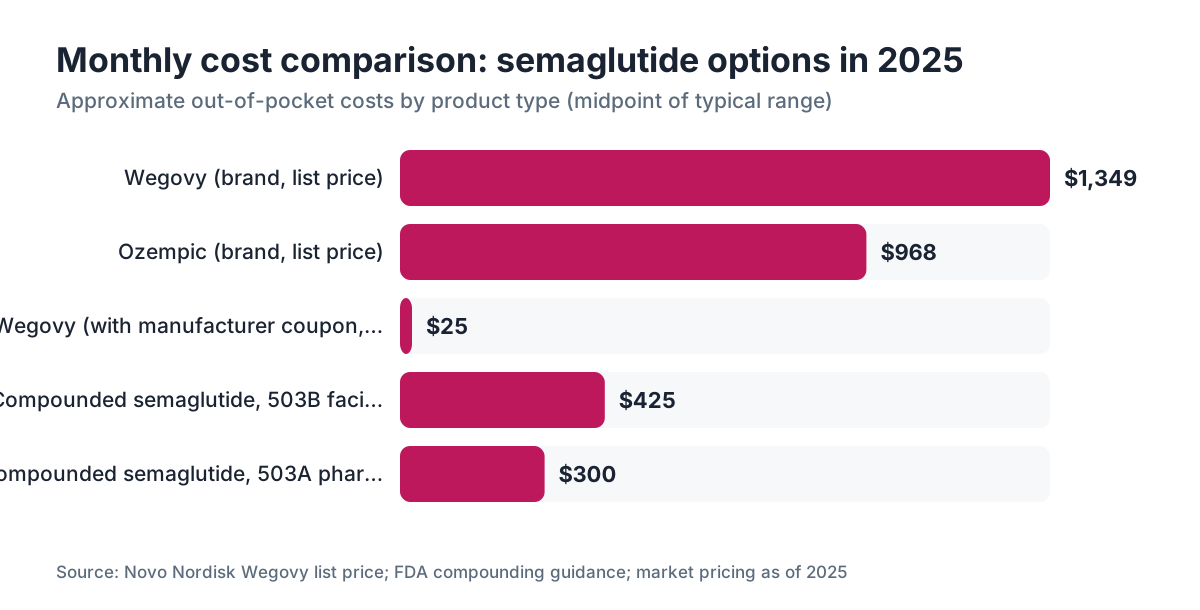
Brand-name Wegovy carries a list price around $1,349 per month without insurance. Ozempic's list price runs roughly $935 to $1,000 per month. [6] Insured patients with coverage often pay far less, but coverage for weight management (as opposed to type 2 diabetes) is still uneven.
During the shortage, compounded semaglutide sold through telehealth-affiliated pharmacies for $150 to $500 a month, depending on dose, overhead, and add-ins. After the shortage resolved, compliant compounders with documented rationale generally charge $200 to $600 per month. Pricing swings a lot, and the market moved fast in 2025. Nobody has clean current data, because this changed month to month.
The gap is real. The tradeoff: compounded semaglutide never goes through FDA's drug approval process. You're trusting one pharmacy's quality controls instead of manufacturing standards the FDA independently verified. During the shortage, the FDA got adverse event reports tied to compounded semaglutide, including dosing errors from products that required patients to reconstitute a powder themselves. [2]
If cost is what's driving you, run the honest comparison: brand-name with a manufacturer coupon or patient assistance program versus compounded from a PCAB-accredited 503B facility with a CoA. The distance shrinks. And for women already paying for hormone replacement therapy, the combined monthly total is the number that counts. See hormone replacement therapy for typical HRT costs.
| Option | Typical Monthly Cost (2025) | FDA-Approved Manufacturing? | Requires Prescription? | |---|---|---|---| | Wegovy (brand) | $1,349 list / ~$0-200 with coupon | Yes | Yes | | Ozempic (brand, off-label for weight) | $935 list | Yes | Yes | | Compounded semaglutide, 503B facility | $250-$600 | No (inspected) | Yes | | Compounded semaglutide, 503A pharmacy | $150-$450 | No | Yes | | Unvetted online seller | $100-$300 | No | Often fake or inadequate |
What red flags should rule out a compounding pharmacy immediately?
This is the section I'd hand to my own family.
No valid prescription required. The moment a site offers semaglutide with no prescription, or a token quiz and guaranteed approval, it is operating illegally. That's the end of the conversation.
"FDA-approved compounded semaglutide." Compounded drugs are not FDA-approved. A pharmacy using this phrase either doesn't understand the difference or is lying to you. [3]
Powder for reconstitution with murky instructions. Several compounding adverse events reported to the FDA during the shortage involved injectable powders where patients got inadequate mixing instructions. If a product requires you to mix anything yourself, you need specific training, and the pharmacy should provide it. Many don't. [2]
Semaglutide "for research" or "not for human use." Peptide suppliers labeling semaglutide this way aren't pharmacies. They're selling a chemical with zero quality assurance for human use. Dangerous and illegal.
No pharmacist you can call. A striking number of operations that grew during the shortage ran entirely through chat bots and text, with no licensed pharmacist reachable by phone.
Claims their semaglutide is "better" or "enhanced." Some pharmacies added L-carnitine, B12, or NAD+ and sold the mix as superior. The FDA addressed this directly: adding an ingredient to semaglutide does not create a different active ingredient for the shortage exemption. [2] It can also create pharmacological interactions nobody studied.
No Certificate of Analysis. Ask for it. If they stall or call it proprietary, you have your answer.
How do 503A and 503B pharmacies differ in practice?
The difference matters more than most patients think.
A 503A pharmacy is a traditional compounding pharmacy. It prepares medications for specific patients from individual prescriptions. It has to be licensed in the state where the patient receives the medication. State boards of pharmacy do the primary regulating, with federal oversight covering certain safety requirements. The FDA can inspect 503A pharmacies but doesn't register them the way it registers outsourcing facilities. [1]
A 503B outsourcing facility is a different animal. It registers with the FDA, takes regular federal inspections, follows current good manufacturing practice (cGMP) standards close to those for drug manufacturers, and can ship larger quantities across state lines. [3] There are roughly 80 registered 503B facilities in the US as of 2025, against tens of thousands of 503A pharmacies.
For compounded semaglutide, a 503B facility gives you a higher level of quality oversight. It doesn't make the drug FDA-approved. It does mean federal regulators physically inspected the facility, and the facility keeps documented quality controls. The FDA's registered outsourcing facility list is public and searchable.
Here's the plain version. Ordering from a telehealth platform that sources from a registered 503B facility gives you more assurance than ordering from a local 503A pharmacy that has never seen a federal inspector. Both can be legitimate. The 503B bar is simply higher. [3]
Which compounding pharmacies have been flagged or warned by the FDA?
I'm not naming specific pharmacies as "good" or "bad," because that status changes and any list I write goes stale within months. What I'll give you is how to pull real enforcement information yourself.
The FDA keeps a public database of warning letters issued to compounding pharmacies, searchable at FDA.gov by company name or date. During 2023 through 2025, the FDA sent warning letters to multiple compounders over semaglutide specifically, citing failure to operate under applicable conditions, false or misleading claims, and quality control failures. [7]
The FDA also published its determination that semaglutide should not be compounded under the shortage exemption after the shortage resolved.
For real-time checks:
- FDA Warning Letters database: fda.gov
- FDA Registered Outsourcing Facilities: fda.gov
- NABP PCAB-accredited compounders: nabp.pharmacy
- Your state board of pharmacy site (licenses are public and verifiable)
The FDA's stated conclusion in its February 2025 shortage notice was blunt: "FDA has determined that the shortage of semaglutide products is resolved." [2] That one sentence changed the legal picture for compounders. Worth knowing the exact language instead of trusting a summary.
What should a legitimate prescription for compounded semaglutide include?
If you're getting your prescription through a telehealth platform, the prescription and your chart should carry specific elements that protect both you and the prescriber.
A valid prescription for compounded semaglutide (post-shortage) should document your diagnosis or condition, why a commercially available product doesn't work for you (the clinical rationale), the specific compound, strength, dosage form, route of administration, directions for use, and the prescriber's DEA number or NPI. [5]
The prescriber should have reviewed your full health history, more than a weight or a BMI. Semaglutide is a GLP-1 receptor agonist with real contraindications, including a personal or family history of medullary thyroid carcinoma and multiple endocrine neoplasia syndrome type 2. The FDA's Wegovy prescribing information lists these. [8]
For women in perimenopause or menopause, a good prescriber also weighs how GLP-1 therapy meets your hormonal picture. Rapid weight loss in women with low estrogen can speed bone density loss, and the STEP trials didn't study this population in depth. [9] That's one reason WomenRx prescribes GLP-1s alongside hormone evaluation rather than in isolation.
If your telehealth platform never asked about your thyroid history, personal cancer history, or current medications before approving compounded semaglutide, that isn't a small oversight. It's a hole in safe prescribing.
How does the STEP trial evidence apply to compounded semaglutide?
Every efficacy number for semaglutide comes from trials using the FDA-approved, Novo Nordisk product. Not compounded versions. That's the fact under everything here.
The STEP 1 trial, published in the New England Journal of Medicine in 2021, found participants taking 2.4mg semaglutide weekly lost a mean of 14.9% of body weight over 68 weeks, against 2.4% for placebo. [9] That's the number everyone quotes. It's a real result from a real trial.
But that result came from Novo Nordisk's formulation, their process, their excipients, their delivery device. Compounded semaglutide uses API from third-party suppliers, formulated by individual pharmacies. Assuming the compounded version performs identically is reasonable, but unproven. Potency variation in compounded medications is documented in the pharmaceutical literature, which is one reason the FDA's oversight framework exists at all.
This is not an argument against compounding. It's an argument for choosing a pharmacy whose quality controls give you reasonable confidence that what's in the vial matches the label. A CoA from a reputable third-party lab is the closest assurance you get with a compounded product.
To compare semaglutide with tirzepatide (Mounjaro/Zepbound), which has its own compounding market, see semaglutide vs tirzepatide.
What questions should you ask a compounding pharmacy before ordering semaglutide?
Here's a practical list. A good pharmacy answers all of these without getting prickly.
- Are you a 503A pharmacy or a 503B registered outsourcing facility? (Ask for the FDA registration number if 503B.)
- Are you PCAB-accredited through NABP?
- Where do you source your semaglutide API, and can I see the Certificate of Analysis for the current lot?
- What's the documented clinical rationale for my prescription, now that the FDA shortage has resolved?
- What concentration and volume is the product, and how do I store and administer it?
- Who is the prescribing physician, and can I talk with them or a pharmacist about drug interactions?
- What's your policy if I have an adverse reaction?
- Are you licensed in my state?
- Does your product require reconstitution? If so, what are the full instructions?
- Will you send a tracking number and insulated packaging for a temperature-sensitive product?
If the pharmacy stumbles on the CoA question, the FDA registration question, or the clinical rationale question, that's your answer. A pharmacy that can't explain its own compliance is not one you want compounding an injectable for you.
For women managing GLP-1 therapy and hormones at the same time, WomenRx coordinates both through one clinical team instead of separate prescribers who don't know what the other ordered. That matters practically. GLP-1s slow gastric motility, which can change how oral medications absorb, including some forms of hormone therapy. See progesterone for notes on oral versus other delivery routes.
What are the specific safety risks of compounded injectable semaglutide?
Injectables carry risks oral drugs don't. Sterility is the one that can hurt you fastest.
The FDA received adverse event reports tied to compounded semaglutide during the shortage. Documented issues in the FDA's public statements included dosing errors (units versus milliliters confusion with insulin-style syringes), contamination concerns, products lacking adequate sterility testing, and formulations arriving outside the required 36-46°F (2-8°C) cold chain. [2]
The reconstitution problem deserves emphasis. Some compounders shipped semaglutide as a lyophilized (freeze-dried) powder that patients had to reconstitute themselves with bacteriostatic water. An error in that step, too much diluent or too little, produces a wildly different concentration than intended. A patient who thinks she's drawing up 0.25mg but has actually made a 2.5mg solution is in real danger.
Pre-filled, ready-to-inject compounded semaglutide from a reputable 503B facility with sterility testing removes the reconstitution risk entirely. If anyone ever hands you a powder and tells you to mix it yourself without detailed training and a precise protocol, that's a setup for error.
Storage matters too. Semaglutide degrades outside the cold chain. A vial that shipped without adequate insulation in July may have lost potency, and you can't tell by looking.
Bone density is the underappreciated downstream concern. Rapid weight loss, especially in women with lower estrogen, can accelerate bone loss. A bone density test before you start a GLP-1 gives you a baseline. The STEP trials noted lean mass loss alongside fat loss, which is a real concern for perimenopausal women.
Can you still get compounded semaglutide legally in 2025 and beyond?
Yes, in limited circumstances. The word doing all the work is "documented."
After the shortage resolution and the grace period expirations in April and May 2025, compounding semaglutide stays legal under 503A when a licensed prescriber documents a specific patient need the commercial product can't meet. Under 503B, the same idea applies: compounding has to be patient-specific and clinically justified, not batched in anticipation of prescriptions.
In practice, that means a prescriber writes something specific in your chart. For example: you tried Wegovy and reacted to a specific excipient, or you need a dose or concentration the commercial pens don't offer. Some state Medicaid programs and legal frameworks recognize access-related rationale, but the FDA's shortage exemption language doesn't make cost an automatic qualifier.
The FDA has said it intends to act against compounders that keep producing semaglutide outside these parameters. Whether enforcement moves fast and evenly is a separate question. Historically, FDA action against individual 503A pharmacies has been slow. That doesn't make non-compliant compounding safe or legal. It just means you may run into pharmacies that haven't been caught yet.
For women in the perimenopause or early menopause window (typically ages 40 to 55, see perimenopause age), weight management is a legitimate medical concern with real hormonal drivers. The right path in 2025 is a prescriber who understands both the GLP-1 landscape and the post-shortage rules, and who documents your individual need properly.
Frequently asked questions
Is compounded semaglutide still legal to buy in 2025?
Yes, but only under specific conditions. After the FDA resolved the semaglutide shortage in February 2025 and grace periods expired in April and May 2025, compounding is legal only when a licensed prescriber documents a clinical reason the commercial product doesn't meet your need. Routine compounding without that rationale is no longer within FDA guidance. Pharmacies that continue without documentation are operating outside federal rules.
How can I verify that a compounding pharmacy is legitimate?
Check the FDA's registered outsourcing facilities list (for 503B status), your state board of pharmacy's license lookup, and NABP's PCAB accreditation directory at nabp.pharmacy. Ask the pharmacy directly for their FDA registration number, their API supplier's Certificate of Analysis, and whether they are licensed in your state. A real pharmacy answers all of these without hesitation.
What is the difference between 503A and 503B compounding pharmacies?
503A pharmacies compound for individual patients based on a specific prescription and are primarily state-regulated. 503B outsourcing facilities register with the FDA, undergo regular federal inspections, and follow cGMP standards similar to pharmaceutical manufacturers. For compounded semaglutide, a 503B facility represents a higher level of manufacturing oversight, though neither produces an FDA-approved product.
Why did so many compounding pharmacies start selling semaglutide?
A federal drug shortage of Ozempic and Wegovy, documented on the FDA's shortage list starting in 2022, created a legal window under 21 U.S.C. § 503A and 503B for compounders to fill the gap. Demand was enormous. When the FDA declared the shortage resolved in February 2025, the legal basis for routine compounding largely ended, though clinical-rationale exceptions remain.
Is compounded semaglutide as effective as Wegovy or Ozempic?
The STEP 1 trial, published in the New England Journal of Medicine in 2021, showed 14.9% mean weight loss with brand-name semaglutide 2.4mg over 68 weeks. All efficacy data comes from Novo Nordisk's formulation. Compounded semaglutide hasn't been studied in controlled trials. If the compounded product matches the branded product's dose and purity, the biology should be similar, but that equivalence isn't proven.
What makes a semaglutide compounding pharmacy unsafe?
The biggest risks are sterility failures, dosing errors from reconstitution instructions, degraded product from poor cold-chain shipping, and API of unknown purity. The FDA received multiple adverse event reports tied to compounded semaglutide during the shortage. Pharmacies that won't share a Certificate of Analysis, don't have NABP accreditation, or sell without a real prescription are the ones to avoid.
Can a telehealth platform legally prescribe compounded semaglutide?
Yes, if a licensed physician or nurse practitioner in your state conducts a real clinical evaluation, documents your medical history and the clinical rationale for compounding over the commercial product, and writes a valid prescription. The platform itself doesn't prescribe; the licensed practitioner does. Telehealth platforms that auto-approve prescriptions through a quick quiz without a real clinician review don't meet that standard.
How much does compounded semaglutide cost per month?
Prices range from roughly $150 to $600 per month depending on dose, pharmacy type, and whether any additives are included. Brand-name Wegovy has a list price around $1,349 per month without insurance. Many manufacturers offer coupons that drop out-of-pocket costs significantly for eligible patients. The cost gap with compounded versions is real but narrows when you factor in coupons and patient assistance programs.
Should I be worried about semaglutide powder that needs to be mixed?
Yes, pay attention here. Lyophilized (powder) semaglutide that patients reconstitute themselves has been associated with dosing errors reported to the FDA. Errors in the dilution step produce a completely different concentration than intended. If you're given powder and water and told to mix it yourself, make sure you receive precise written instructions, and ideally choose a pharmacy that supplies a ready-to-inject solution instead.
Does compounded semaglutide with B12 or other additives work better?
There's no clinical evidence that adding B12, NAD+, or other compounds to semaglutide improves its weight-loss efficacy. The FDA specifically noted during the shortage resolution that adding another ingredient doesn't create a meaningfully different product for purposes of the shortage exemption. These formulations were largely a marketing choice, not a clinical one. Scrutinize any pharmacy leading with these combinations.
What should perimenopausal women specifically know about compounded semaglutide?
Perimenopause changes how women store and lose fat, and low estrogen can accelerate bone loss during rapid weight loss from GLP-1 therapy. The STEP trials didn't study this population in depth. Women in their 40s and 50s using semaglutide should have a baseline bone density test and ideally work with a clinician who also understands their hormonal picture rather than treating weight in isolation from the rest of their health.
Can I get compounded semaglutide if I can't afford Wegovy?
Cost alone doesn't automatically qualify you for compounded semaglutide under current FDA guidance post-shortage, though some prescribers document access barriers as part of clinical rationale. Before pursuing compounding purely for cost, check Novo Nordisk's savings programs (the Wegovy savings card can bring costs to near zero for commercially insured patients) and whether your insurance covers it for a weight-related diagnosis rather than just type 2 diabetes.
How do I store compounded semaglutide?
Like brand-name semaglutide, compounded versions should be refrigerated at 36-46°F (2-8°C). Do not freeze. If the product arrived warm or was left unrefrigerated for an extended period, its potency may be compromised. A legitimate compounding pharmacy ships with insulated packaging and cold packs. If yours arrived without cold packaging in warm weather, contact the pharmacy before using it.
What's the difference between compounded semaglutide and semaglutide peptides sold online?
Significant and important. Compounded semaglutide from a licensed pharmacy requires a prescription and is prepared for human use under state and federal oversight. "Semaglutide peptides" sold by research chemical suppliers are labeled "not for human use" and carry no quality guarantees, no clinical oversight, and no legal protection if something goes wrong. They are not the same product and should not be used interchangeably.
Sources
- U.S. FDA, Compounding and the FDA (agency overview page)
- U.S. FDA, GLP-1 and semaglutide compounding guidance and shortage resolution statements (2025)
- U.S. FDA, Registered Outsourcing Facilities (503B) and compounding categories
- National Association of Boards of Pharmacy (NABP), PCAB Compounding Accreditation
- U.S. FDA, Human Drug Compounding (prescription requirements)
- Novo Nordisk, Wegovy Prescribing Information and U.S. List Price
- U.S. FDA, Warning Letters Database
- U.S. FDA, Wegovy (semaglutide) Full Prescribing Information
- Wilding JPH et al., New England Journal of Medicine, STEP 1 Trial 2021
- U.S. FDA, Drug Shortages Database
- Endocrine Society, Clinical Practice Guidelines on Obesity Pharmacotherapy
- North American Menopause Society (NAMS), Menopause and Weight Management Position Statement