Average cost of an HRT consult at a cash-pay practice in 2025
TL;DR: A first hormone replacement therapy consult at a cash-pay or direct-care practice typically costs $150 to $400 in 2025, depending on visit length, provider type, and whether labs are bundled. Follow-up visits run $75 to $200. Telehealth practices sit at the lower end. Lab work, if ordered separately, adds $100 to $400 more.
What is the average cost of an HRT consult at a cash-pay practice in 2025?
Most cash-pay and direct-primary-care practices charge $150 to $400 for an initial hormone consult in 2025 [1]. That range buys a 45- to 90-minute visit with a physician, nurse practitioner, or PA who reviews your symptoms, medical history, and any existing lab work. Follow-up visits run 20 to 30 minutes and land between $75 and $200.
Telehealth-only practices cluster at the low end, often $150 to $250 for a first consult, because they carry less overhead than a physical office. In-person practices in high cost-of-living metros (New York, Los Angeles, San Francisco) push past $400 for a first visit, especially when the provider is an MD gynecologist or reproductive endocrinologist rather than an NP.
The cash-pay model exists for one reason. Most commercial plans reimburse hormone visits at rates that don't cover the time a real consult takes. When a practice opts out of insurance, it charges a flat fee and spends 60 minutes with you instead of 12. That's the trade: no co-pay billing, but no claim filing on your behalf either.
One number worth keeping in mind. The Menopause Society (formerly NAMS) reports that fewer than one in five ob-gyn residency programs include dedicated menopause medicine training [2]. That gap is why specialized cash-pay menopause practices have grown, and why their fees reflect a narrow expertise.
What does a cash-pay HRT consult fee actually include?
This varies more than the sticker price suggests, and it's the first thing to ask before you book.
At a minimum, the fee should cover the provider's time for the visit, a symptom review (often a validated tool like the Menopause Rating Scale or the Greene Climacteric Scale), a discussion of your personal and family cardiovascular and breast cancer history, and a treatment recommendation with a written plan.
Many practices bundle a follow-up call or message within 30 days. Some fold a basic hormone panel into the flat fee. Others don't, so you leave with a lab requisition and pay the lab separately.
Here's what the consult fee almost never covers: the hormone medications themselves, lab draws or processing fees, and any imaging such as a DEXA bone density test if the provider wants baseline bone data. Compounded medications, if prescribed, cost extra (more on that below).
A good practice posts its fee schedule on its website. If you can't find it, ask before you schedule. Any practice worth paying cash for can tell you three things flat out: what you owe at the visit, what labs they order and what those cost, and how ongoing membership or follow-up is structured.
How does cash-pay HRT pricing compare across practice types?
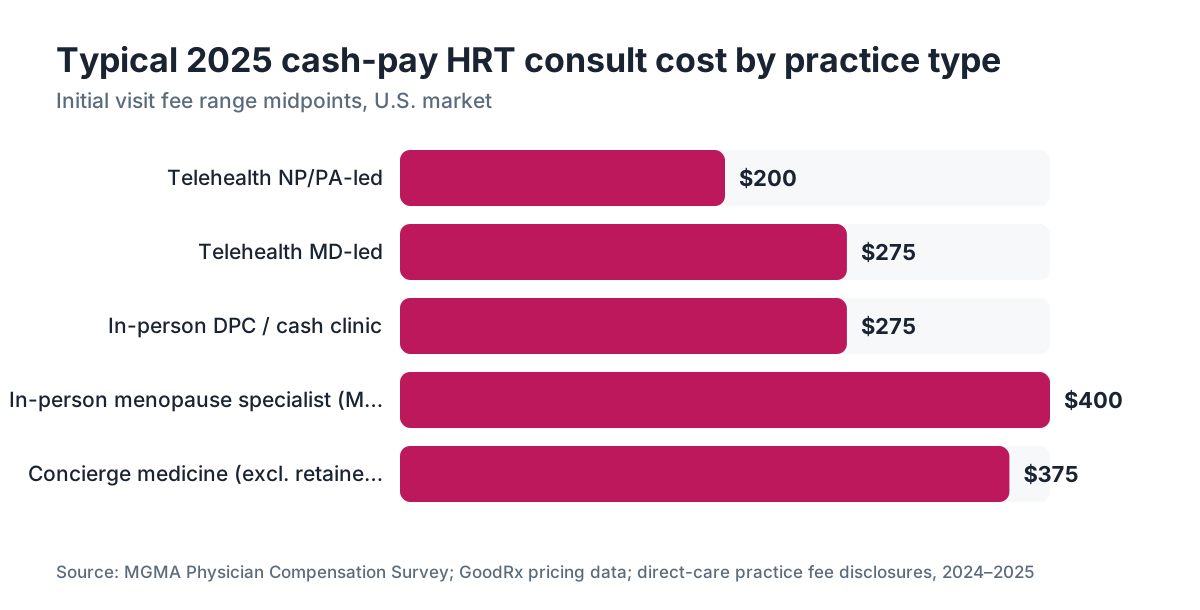
The table below reflects realistic 2025 market ranges based on published direct-care pricing, telehealth platform disclosures, and practitioner surveys [1][3].
| Practice type | Initial consult | Follow-up visit | Notes | |---|---|---|---| | Telehealth (NP/PA-led) | $150, $250 | $75, $125 | Lowest overhead; async messaging often included | | Telehealth (MD-led) | $200, $350 | $100, $175 | Board-certified gynecologists or internists | | In-person DPC / cash-only clinic | $200, $350 | $100, $200 | May charge a membership fee separately | | In-person menopause specialist (MD) | $300, $500+ | $150, $250 | Subspecialty pricing in high-cost cities | | Concierge medicine with HRT focus | $250, $500+ | Included in retainer | Annual retainer typically $3,000, $10,000 |
Direct primary care (DPC) deserves its own note. A DPC practice charges a monthly membership, typically $75 to $150 for a woman in her 40s or 50s, and then either includes the HRT consult or charges a reduced fee for it. If you're a member, your consult cost is spread across the membership. That math works in your favor if you use the practice for more than hormones.
Concierge medicine is a different animal. Concierge practices charge a retainer on top of insurance (or cash), and the retainer buys access and time, not a discount on procedures. The initial HRT consult may be framed as included, but the annual fee is real money.
For most women, a telehealth or in-person cash-pay clinic in the $150 to $300 range for a first visit is the sweet spot of cost and quality, assuming the provider has documented menopause training.
What lab work will I need, and what does it cost on top of the consult?
Most HRT providers want baseline labs before or at your first prescription. The exact panel depends on your age, symptoms, and history, but a typical first-visit hormone panel includes estradiol, FSH, LH, total and free testosterone, SHBG, DHEA-S, thyroid (TSH, sometimes free T3/T4), and a complete metabolic panel [4].
Order these through a cash-pay lab service (Ulta Lab Tests, Walk-In Lab, or Quest's direct-to-consumer arm) and a full female hormone panel runs roughly $100 to $250 depending on which markers are included. At retail lab rates through your practice, the same panel can run $300 to $500 with no negotiated discount. Ask which labs your provider uses and whether they've negotiated cash pricing.
Some practices run in-house labs or hold a standing agreement with a regional lab. That's usually the cheapest path when it's available.
One lab you may not expect: a lipid panel, and sometimes a fasting glucose or HbA1c, because cardiovascular risk shapes which formulation and route of estrogen fits you [5]. The Endocrine Society's 2022 clinical practice guideline on menopausal hormone therapy recommends assessing cardiovascular and VTE risk before prescribing [4].
Thyroid earns a separate mention. Hypothyroidism mimics menopause almost point for point (fatigue, weight gain, brain fog, mood changes), and ruling it out or catching it early changes the whole treatment picture. A standalone TSH costs about $30 to $50 as a cash-pay test.
How much do the actual HRT medications cost after the consult?
The consult is just the door. Ongoing medication cost is what you live with month to month.
FDA-approved branded hormone therapies vary widely. Generic estradiol patches run about $30 to $60 for a month's supply at retail pharmacies with GoodRx or a similar discount card [6]. Oral micronized progesterone (generic Prometrium) is typically $25 to $60 per month. A generic estradiol gel or spray falls in the same range. Branded products like Vivelle-Dot, Divigel, or Bijuva cost more, sometimes $100 to $300 per month before any coupon.
Compounded bioidentical hormones are a different story. A compounded estradiol-plus-progesterone cream or troche from a 503A compounding pharmacy typically runs $60 to $150 per month depending on the formulation and pharmacy. Some practices add a prescription management fee on top. The FDA has said plainly that compounded hormones are not FDA-approved for safety and efficacy the way manufactured products are [7]. That doesn't make them dangerous, but it puts the burden on you and your provider to ask hard questions about the pharmacy's quality standards.
Testosterone for women, when prescribed off-label, is almost always compounded, because no FDA-approved testosterone product is currently indicated for women in the U.S. A compounded testosterone cream or gel runs $40 to $100 per month [6].
Put it together. A woman on a basic estrogen patch plus oral progesterone, paying cash, spends roughly $50 to $120 a month on medications. Add compounded testosterone and you're at $100 to $200 a month. Those numbers assume generic or discounted pricing and no insurance in the mix.
Why does cash-pay HRT cost less than going through a specialist billed to insurance?
This is the counterintuitive part of the system that trips people up. Going through insurance for a hormone consult with a specialist often costs more out of pocket than paying cash, especially on a high-deductible plan.
Here's the mechanism. A specialist visit billed to insurance carries a chargemaster rate that can be $400 to $800 before adjustments. In a deductible phase, you pay that billed rate (or close to it) until you hit your deductible. A cash-pay practice charging $200 flat is simply cheaper, and you skip six weeks of EOBs and surprise bills.
Insurance-billed hormone therapy also runs into coverage walls. Many plans cover medically necessary HRT for documented surgical menopause or specific diagnoses, but they deny or limit coverage for perimenopausal symptom management, particularly when a visit is coded preventive rather than diagnostic. The ICD-10 coding on your chart decides what gets paid.
That coding also lives in your permanent medical record. Some women choose cash-pay specifically to keep sensitive health information out of insurance databases. That's a personal decision, not a medical recommendation, but it's a real reason people go this route.
Cash-pay practices also spend more time with patients. A 60-minute hormone replacement therapy consult is rare in an insurance-billed practice because the reimbursement doesn't support it.
Are there membership or subscription models that lower the per-visit cost?
Yes. For women who expect ongoing HRT management (which is most women, since hormone therapy isn't a one-and-done), a membership model often makes financial sense.
Some telehealth HRT practices charge a monthly subscription of $30 to $75 that covers provider messaging, prescription renewals, and quarterly check-ins, plus an upfront initial consult fee. Stay on HRT for two or more years and you spend less per interaction than paying à la carte for each follow-up.
Direct primary care memberships run $75 to $150 per month for most women in midlife, and they include effectively unlimited visits plus care coordination. The break-even against à la carte cash pricing is roughly three to four standard follow-up visits per year.
WomenRx structures its hormone and menopause care around an ongoing care model rather than one-time consults, which mirrors how HRT actually works. You don't get a prescription once and vanish. You adjust doses, change delivery methods, add or modify therapy as your hormonal picture shifts through perimenopause and into postmenopause.
Concierge retainers are a separate product. They cost real money ($3,000 to $10,000 per year is common) and the value is access and time, not savings. For a woman who wants a primary physician who truly knows her and manages HRT inside whole-person care, concierge earns its price. For someone who just wants good hormone management at a fair price, a DPC or telehealth subscription wins on value.
Can I use HSA or FSA funds to pay for a cash-pay HRT consult?
Yes. Medical consults with licensed providers are qualified medical expenses under IRS rules, so you can pay for a cash-pay HRT consult with your Health Savings Account (HSA) or Flexible Spending Account (FSA) [8].
Prescription medications, including HRT and compounded hormones when accompanied by a valid prescription, also qualify. Lab work ordered by a provider qualifies too.
The governing document is IRS Publication 502, Medical and Dental Expenses, which lists qualified expenses for HSA and FSA purposes [8]. The rule is simple: if a licensed medical provider is involved and the service treats, diagnoses, or prevents disease, it qualifies.
What doesn't qualify: supplements marketed as hormone support, over-the-counter products without a prescription (with exceptions for OTC items allowed after the 2020 CARES Act changes), and direct primary care membership fees structured as a flat retainer not tied to specific services (this one is debated, so confirm with your plan administrator).
If you have an HSA from a high-deductible plan, using it for cash-pay HRT is one of the most tax-efficient ways to manage the cost. Money goes in pre-tax, grows tax-free, and comes out tax-free for qualified expenses. That effective discount is 22 to 32 percent for most women in this income range.
What should I ask before booking a cash-pay HRT consultation?
Seven questions tell you everything you need to know before you spend a dollar.
-
What is the exact fee for an initial visit, and what does it include? Ask if the 30-day follow-up message or call is part of it.
-
What labs do you order at a first visit, and how do I pay for them? Get a real dollar estimate.
-
Do you prescribe FDA-approved hormone therapies, compounded hormones, or both? Ask what guides that choice.
-
What is your training in menopause medicine? You want a provider who has completed a menopause medicine fellowship, holds the NCMP (Menopause Society Certified Practitioner) credential, or has documented clinical focus on menopausal hormone therapy [2].
-
How are follow-up visits priced, and how often will I need one?
-
Do you offer a membership or subscription option, and does it save money over à la carte?
-
What happens if my medication needs adjustment? Is there an async option, or do I have to book a full visit?
A provider who answers these clearly, in writing if you ask, is worth paying for. One who is vague about pricing or can't explain their menopause training is a red flag no matter what the fee is.
How do 2025 cash-pay HRT consult costs compare to what insurance reimburses?
Medicare rates are public, and they give a clean benchmark. A level-4 new patient visit (CPT 99204, roughly what a thorough 45-to-60-minute HRT consult represents) reimburses at Medicare rates in 2025 around $170 to $190 depending on geographic adjustment [9]. A level-5 new patient visit (99205, 60 to 74 minutes of high complexity) reimburses around $220 to $240.
So a specialist charging $300 to $400 cash is charging roughly 1.5 to 2 times Medicare rate. That's normal and legal for cash-pay practices. It's also why insurance-contracted physicians can't profitably run 60-minute consults at insurance rates. They're paid $190, and overhead and malpractice eat a big chunk of it.
Commercial insurance pays more than Medicare in most markets, but what you actually owe depends entirely on your plan. A Blue Cross PPO contracted rate for a 99204 might be $250 to $300, but in a deductible you pay the full contracted rate, not a co-pay.
The honest read: for a woman in the deductible phase of a high-deductible plan, cash-pay HRT consults are often cheaper or cost-equivalent to using insurance, and she avoids referrals, prior authorizations, and billing corrections. For a woman with a low deductible or one who has met it, insurance for specialist visits usually wins. Run your own numbers.
Will HRT consult costs change in 2026?
The honest answer: modestly upward, in line with general medical inflation.
Telehealth HRT pricing has been fairly stable since 2022 because competition among platforms keeps fees in check. But overhead (licensing, malpractice, electronic health records, lab partnerships) climbs year over year, and practices with genuinely experienced providers won't race to the bottom on price.
Based on current trends, a reasonable 2026 projection is initial consult fees of $175 to $275 at cash-pay telehealth practices and $250 to $450 at in-person specialists. Those are extrapolations from 2023 to 2025 market data, not published forecasts, and they could shift with changes to telehealth prescribing rules.
One regulatory factor to watch: the DEA's rules on telehealth prescribing of controlled substances. Testosterone prescribed for women is a Schedule III controlled substance, and telehealth prescribing of Schedule III drugs has operated under pandemic-era flexibilities that are still being renegotiated [10]. If stricter rules take effect, some telehealth practices may require an in-person visit before prescribing testosterone, which adds cost.
Estrogen and progesterone are not controlled substances, so the telehealth path to those medications is untouched by the DEA scheduling debate.
Where can I find a cash-pay HRT provider and how do I compare options?
The Menopause Society (formerly NAMS) runs a find-a-provider directory at menopause.org that lets you search by location and filter for members [2]. Membership doesn't guarantee a cash-pay option, but it signals menopause-focused training. The NCMP credential is the strongest quality signal available in the U.S. for menopause practitioners.
The Institute for Functional Medicine and the American Academy of Anti-Aging Medicine (A4M) also keep directories, though the standard of care varies more widely there. Do extra vetting if you go that route.
For telehealth specifically, a handful of platforms built their whole model around women's hormones. WomenRx focuses on menopause, perimenopause, and related care for women. When comparing platforms, look at four things: who actually prescribes (MD, NP, PA, and their specific training), whether the initial consult fee is transparent, what the lab arrangement is, and what happens if you need to adjust your prescription between scheduled visits.
Reddit communities like r/Menopause and r/HormoneTherapy carry real-world pricing reports from women across the country, which is genuinely useful crowd-sourced market data. Treat individual numbers as anecdotes, not averages, but the threads show what women in different cities actually pay.
Avoid any practice that promises to prescribe HRT with no thorough history, no lab work, or a symptom questionnaire alone. That's not a bargain. That's a liability.
Frequently asked questions
What is the average cost of a first HRT consultation at a cash-pay clinic in 2025?
Most cash-pay HRT consults run $150 to $400 for an initial visit in 2025. Telehealth practices charge $150 to $250. In-person menopause specialists in major cities often charge $300 to $500. Follow-up visits typically run $75 to $200. Lab work, ordered separately, adds $100 to $400 depending on the panel and the lab.
Does health insurance cover HRT consultations?
Some plans cover HRT consults when billed under appropriate diagnosis codes, but coverage is inconsistent. Women with high-deductible plans often pay as much out of pocket through insurance as they would at a cash-pay practice. The medications themselves may require prior authorization. Cash-pay practices skip authorization delays but don't file claims for you.
Can I use my HSA or FSA to pay for a cash-pay HRT consult?
Yes. Medical consults with licensed providers are qualified medical expenses under IRS Publication 502, so HSA and FSA funds can cover a cash-pay HRT consult, lab work, and prescription hormone medications. Membership retainer fees for direct primary care may or may not qualify depending on structure; confirm with your plan administrator.
What labs are typically ordered at a first HRT visit and what do they cost?
A standard first-visit hormone panel includes estradiol, FSH, LH, testosterone (total and free), SHBG, DHEA-S, TSH, and a metabolic panel. Through a cash-pay lab service, this runs roughly $100 to $250. At retail lab rates without negotiated pricing, the same panel can cost $300 to $500. Always ask your provider which lab they use and whether they have cash pricing.
How much do HRT medications cost per month on top of the consult fee?
Generic estradiol patches run $30 to $60 per month with a discount card. Generic oral micronized progesterone is $25 to $60 per month. Compounded hormone creams or troches run $60 to $150 per month. Compounded testosterone for women costs $40 to $100 per month. A basic estrogen plus progesterone regimen in generic form typically costs $50 to $120 monthly.
Is a telehealth HRT consult as thorough as an in-person visit?
For most hormone consults, telehealth is clinically equivalent. Estrogen, progesterone, and testosterone decisions rest on history, symptoms, and lab values, none of which require a physical exam in most cases. A pelvic or breast exam, if indicated, cannot be done via telehealth. If you're overdue for a gynecologic exam, schedule one separately alongside your HRT consult.
What credentials should I look for in a cash-pay HRT provider?
The NCMP (Menopause Society Certified Practitioner) is the strongest single credential. Board certification in obstetrics and gynecology or internal medicine with documented menopause focus also matters. The Menopause Society's provider directory lists members. Be cautious of practices that can't describe their specific menopause training or that promise prescriptions without reviewing labs.
Are compounded bioidentical hormones cheaper than FDA-approved HRT?
Sometimes, but not always. Compounded hormones run $60 to $150 per month, which overlaps with branded FDA-approved products but is generally more than generics. Generic estradiol patches and oral progesterone are the cheapest option at $50 to $120 combined per month. The FDA notes that compounded hormones lack the same approval for safety and efficacy as manufactured products, which is separate from cost.
How often do I need follow-up visits after starting HRT, and what do those cost?
Most providers schedule a follow-up 6 to 12 weeks after starting HRT to assess symptoms and adjust dosing, then every 6 to 12 months once you're stable. Follow-up visits at cash-pay practices typically cost $75 to $200. Some telehealth practices include follow-up messaging in a monthly subscription, which cuts per-interaction cost over time.
Is a DPC membership worth it for HRT management?
For women who plan to stay on HRT long-term, a direct primary care membership at $75 to $150 per month can make sense financially, especially if you use the practice for other care too. The break-even against à la carte cash pricing is roughly three to four follow-up visits per year. DPC also offers better access and longer visits, which matters for dosing adjustments.
What is the cost difference between a telehealth and in-person HRT consult?
Telehealth HRT consults typically run $150 to $250 for an initial visit, while in-person cash-pay clinics charge $200 to $350 and in-person menopause specialists charge $300 to $500 or more. The clinical outcome is similar for most women, since prescribing rests on labs and history rather than physical findings. Location and provider type drive the difference more than anything else.
Will cash-pay HRT consult prices go up in 2026?
Modestly, yes. Based on 2023 to 2025 market trends, telehealth initial consults are likely to reach $175 to $275 by 2026, and in-person specialist visits $250 to $450. Competition among telehealth platforms has kept prices relatively stable, but overhead and licensing costs climb annually. DEA telehealth prescribing rules for testosterone (Schedule III) could also add cost if in-person visits become required.
Can I negotiate the price of a cash-pay HRT consult?
At a fixed-fee telehealth platform, generally no. At an independent in-person practice, it's worth asking whether they have a self-pay discount or can bundle the consult with labs. Some practices offer a reduced fee if you pay in full at booking. Asking is not rude in a cash-pay setting, since the whole model is built on transparent pricing.
Does the Affordable Care Act require insurers to cover HRT?
The ACA requires coverage of certain preventive services without cost sharing, but HRT for menopause symptoms is not on the USPSTF A or B recommendation list for that purpose. The USPSTF recommends against using HRT to prevent chronic conditions in postmenopausal women, which shapes how plans cover it. Symptomatic treatment may be covered as a standard benefit, but it varies by plan and diagnosis coding.
Sources
- Medical Group Management Association (MGMA), Physician Compensation and Production Survey
- The Menopause Society (NAMS), Provider Training and Certification page
- Health Affairs, Direct Primary Care: Evaluating A New Model Of Delivery And Financing
- Endocrine Society, Clinical Practice Guideline: Treatment of Symptoms of the Menopause (2022)
- American Heart Association, Cardiovascular Risk and Menopause Hormone Therapy
- GoodRx, Hormone Therapy Drug Pricing Data
- FDA, Compounded Hormone Products and Menopause
- IRS, Publication 502: Medical and Dental Expenses
- CMS, Medicare Physician Fee Schedule 2025
- DEA, Telemedicine Prescribing of Controlled Substances Proposed Rules
- USPSTF, Hormone Therapy for the Primary Prevention of Chronic Conditions in Postmenopausal Persons (2022)
- The Menopause Society, 2022 Hormone Therapy Position Statement