Average age of perimenopause: what the research actually says
TL;DR: Most women begin perimenopause between ages 45 and 55, with the average onset around age 47. The transition typically lasts 4 to 8 years before the final menstrual period marks menopause, which occurs at a median age of 51 to 52 in the United States. Genetics, smoking, and certain medical histories can shift timing earlier or later by several years.
What is the average age perimenopause starts?
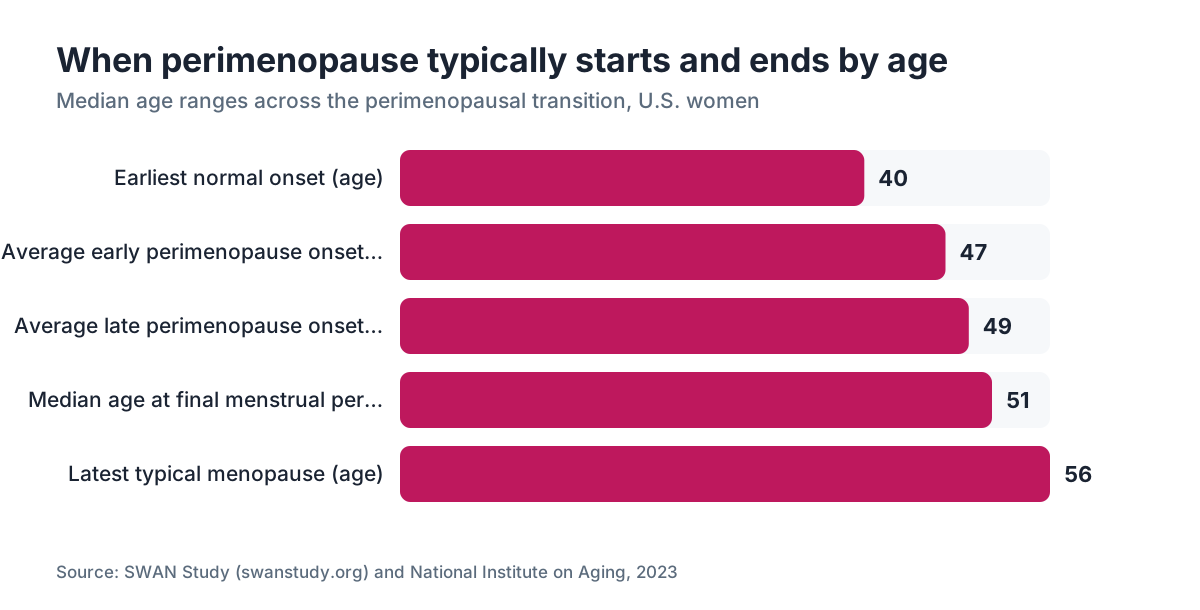
The average age for perimenopause onset is about 47, though the normal range stretches from the early 40s to the mid-50s. The Study of Women's Health Across the Nation (SWAN), one of the largest and most cited longitudinal studies on this transition, tracked over 3,300 women across multiple ethnic groups and found that the median age at which women began showing menstrual irregularity and early perimenopausal symptoms was 47.5 years [1].
That number is a median, not a ceiling. Roughly 10 percent of women notice changes in their late 30s, and a smaller fraction won't experience anything until their early 50s. Both are biologically normal.
Perimenopause is not a single event. It is a gradual hormonal transition that the Menopause Society (formerly NAMS) defines as starting when a woman's menstrual cycles become irregular or she experiences other symptoms attributable to changing ovarian function, and ending 12 months after her final menstrual period [2]. That 12-month mark is, by definition, menopause itself.
Here's the part that trips women up. There is no blood test that announces perimenopause has started. FSH levels swing wildly during the transition, which is why a single high FSH reading tells you almost nothing. Diagnosis is clinical: you and your clinician read your cycle history and symptoms together.
How long does perimenopause last on average?
The average duration is 4 to 8 years. But about 10 percent of women move through in under a year, and another 10 percent spend more than a decade in transition [1]. The range is real, and it surprises women who assumed this would be a short chapter.
SWAN data splits perimenopause into two stages. Early perimenopause is defined by cycles that still occur but vary by 7 or more days in length. Late perimenopause begins when a woman has had at least two cycles more than 60 days apart. That late stage usually lasts 1 to 3 years and is when hot flashes, sleep disruption, and vaginal dryness tend to intensify [1].
The total clock starts, for most women, somewhere in their mid-to-late 40s and ends at the final menstrual period, which in the United States comes at a median age of 51 to 52 [3]. So a woman who enters perimenopause at 46 and reaches menopause at 52 has spent six years in transition. That's ordinary. It just rarely gets said plainly.
What factors shift the average age of perimenopause earlier or later?
Genetics is the single strongest predictor. If your mother or older sisters entered perimenopause early, your odds of doing the same go up substantially. Research published in Human Reproduction found that the heritability of age at natural menopause is about 50 percent, meaning roughly half of the variation between women is explained by genes [4].
Smoking is the most modifiable risk factor. Current smokers reach menopause 1 to 2 years earlier than nonsmokers on average, and earlier perimenopause onset follows the same pattern [1]. The mechanism is direct: cigarette toxins speed up follicular atresia, draining the ovarian reserve faster.
Other factors that tend to push onset earlier:
- Surgical menopause (bilateral oophorectomy) causes immediate menopause, skipping perimenopause entirely. Women who have had one ovary removed may notice earlier onset.
- Chemotherapy and pelvic radiation can damage ovarian tissue and trigger premature ovarian insufficiency (POI), which is menopause before age 40.
- Low body weight and a history of eating disorders are linked to earlier transitions.
- Nulliparity (never having been pregnant) is tied to modestly earlier onset in some studies.
Factors linked to later onset include higher body weight (adipose tissue produces estrone), higher parity, and never having smoked. Oral contraceptive use does not meaningfully delay the underlying ovarian aging process, though the pill can mask the irregular cycles that would otherwise flag perimenopause [2].
Ethnicity matters too, and the SWAN data are the best evidence we have. Black women in the study entered perimenopause earlier and spent more years in transition than white women. Hispanic and Chinese women had broadly similar timing to white women, and Japanese American women tended toward slightly later onset [1]. These are group averages, not individual predictions.
Can perimenopause start in your 30s?
Yes, though it's uncommon. Perimenopause before 40 falls under the clinical definition of premature ovarian insufficiency when it comes with elevated FSH levels on two occasions 4 weeks apart [5]. The Endocrine Society estimates POI affects roughly 1 in 100 women under 40 and about 1 in 1,000 women under 30 [5].
POI is different from natural perimenopause in ways that matter. It can be intermittent: the ovaries may still release an egg now and then, and spontaneous pregnancy happens in about 5 to 10 percent of cases even after diagnosis. It also carries heavier health consequences, because decades of estrogen deficiency raise cardiovascular and bone-fracture risk sharply.
Women in their late 30s who notice irregular cycles, hot flashes, or night sweats but don't meet formal POI criteria are sometimes labeled as having "early perimenopause." That phrase isn't in the standard diagnostic criteria, but clinically it reflects the same underlying process: declining ovarian reserve driving hormonal fluctuation. If you're 37, your cycles have gone unpredictable, and you're waking up drenched, get evaluated instead of writing it off as stress.
A bone density test (bone density test) is worth discussing with your clinician at the time of any early perimenopause or POI diagnosis, because estrogen's protective effect on bone starts eroding the moment ovarian function declines.
What are the first signs that perimenopause has started?
Cycle changes come first for most women. Periods that were once predictable start arriving earlier, later, or with heavier or lighter flow. A cycle varying by more than 7 days from your usual pattern, on two or more consecutive cycles, is the clinical marker SWAN used to define early perimenopause [1].
Vasomotor symptoms, the medical term for hot flashes and night sweats, are what most women associate with menopause. They can start years before the final period. About 40 percent of women report hot flashes during early perimenopause, rising to roughly 80 percent in late perimenopause [2].
Other early signs that often get blamed on stress or aging:
- Sleep disruption, sometimes from night sweats and sometimes independent of them
- Mood changes, including more anxiety or irritability, linked to estrogen's effect on serotonin and GABA pathways
- Brain fog and trouble with word retrieval (this improves for most women after menopause)
- Vaginal dryness and shifts in libido
- Joint aches, underrecognized but documented in SWAN data
No single symptom confirms perimenopause. They overlap with thyroid disorders, depression, anemia, and other conditions that need ruling out. That's not a reason to dismiss your symptoms. It's a reason to get a workup.
How is perimenopause diagnosed and when should you see a doctor?
Diagnosis is mostly clinical. A clinician takes a detailed menstrual history, asks about symptoms, and may order labs to rule out other causes. The Menopause Society's position is that FSH levels alone are not reliable for diagnosing perimenopause because FSH swings dramatically from cycle to cycle during the transition [2].
Labs still earn their place. A full thyroid panel (TSH, free T3, free T4) is worth getting because hypothyroidism mimics perimenopause almost symptom for symptom. A complete blood count can catch anemia as a cause of fatigue. Some clinicians order AMH (anti-Mullerian hormone) as a rough marker of ovarian reserve, though it has more use in fertility contexts than in perimenopause diagnosis.
See a clinician sooner rather than later if:
- You are under 45 and having irregular cycles or hot flashes
- Bleeding is extremely heavy, prolonged, or happening more often than every 21 days
- You have gone more than 60 days without a period before age 40
- Symptoms are significantly disrupting your sleep, work, or quality of life
When symptoms run moderate to severe, the conversation about hormone therapy becomes relevant early in perimenopause. Timing matters: evidence from the Women's Health Initiative and later analyses suggests that starting hormone replacement therapy within 10 years of menopause onset or before age 60 is linked to cardiovascular benefit rather than risk, what researchers now call the "timing hypothesis" [6].
Does perimenopause affect weight, and what can you do about it?
Yes, and it's one of the most common complaints clinicians hear. The average woman gains about 1.5 pounds per year during the perimenopause transition, and fat redistributes toward the abdomen even without total weight gain [1]. Falling estrogen shifts the body's fat storage preference from hips and thighs to visceral (belly) fat, which carries higher metabolic risk.
The mechanisms stack up. Lower estrogen cuts insulin sensitivity. Sleep disruption raises cortisol and ghrelin, driving appetite. Muscle mass falls partly because estrogen is anabolic for muscle. And resting metabolic rate drops as lean mass declines.
Lifestyle work still helps: strength training, enough protein (most evidence now points to at least 1.2 grams per kilogram of body weight per day for perimenopausal and menopausal women), and steady sleep habits all make a measurable difference. But they often work less well than they did at 35, and that is not a willpower problem.
GLP-1 receptor agonists have become a real option for women whose perimenopausal weight gain isn't budging with lifestyle changes. The SURMOUNT-1 trial of tirzepatide found an average weight loss of 20.9 percent of body weight at the highest dose over 72 weeks [7], and the STEP 1 trial of semaglutide found 14.9 percent average weight loss over 68 weeks [8]. Neither trial enrolled perimenopausal women as a defined subgroup, so we don't have clean subgroup data. If you're weighing this route, semaglutide for weight loss is one of the options worth understanding in detail.
At WomenRx, clinicians work with perimenopausal women on both the hormonal and metabolic sides of this transition, which often makes more sense than treating them apart. Hormone therapy can improve insulin sensitivity and body composition, and some women find they need less aggressive metabolic intervention once estrogen is steady.
If you want to understand the medication landscape first, semaglutide vs tirzepatide is a useful comparison to have before any clinical conversation.
How does perimenopause differ from menopause?
Perimenopause is the transition. Menopause is the finish line. Menopause is defined as exactly 12 consecutive months without a menstrual period, not caused by pregnancy, breastfeeding, or a medical condition [2]. You can only confirm you've reached menopause by looking backward.
The distinction has practical teeth. During perimenopause, ovulation still happens, just irregularly. That means pregnancy is still possible until 12 months after the final period. Women in perimenopause who do not want to conceive need contraception. This gets missed more often than you'd think.
Symptoms are often at their worst during late perimenopause, not after menopause. Hot flash frequency typically peaks in the year or two around the final menstrual period and then, for most women, eases. The median duration of hot flashes from first onset to resolution is about 7.4 years, according to the SWAN study [1]. For roughly a quarter of women, vasomotor symptoms hang on for 10 or more years.
For more on what happens after the 12-month mark, menopause covers the post-transition landscape, including bone loss timelines and cardiovascular risk shifts.
What is the average age of menopause, and how does that relate to perimenopause timing?
The median age at natural menopause in the United States is 51 to 52 years [3]. That number has held steady across decades of research. About 95 percent of women reach menopause between ages 44 and 56 [3].
Because perimenopause usually lasts 4 to 8 years, the math is simple. If menopause lands at 51, perimenopause often started somewhere around 44 to 47. If menopause comes earlier, at 47, perimenopause may have started in the early 40s. The two timelines are linked, but neither predicts the other perfectly.
For more context on menopause age and what drives the variation, that's a topic on its own. The short version: your mother's menopause age is your single best predictor.
When does menopause start is a related question worth separating, because the answer depends on whether you mean symptoms (which start during perimenopause) or the formal definition (12 months of no periods).
What treatments are available during perimenopause?
Treatment depends on which symptoms are most disruptive. Hot flashes and night sweats are the most common target, and menopausal hormone therapy (MHT, also called HRT) is the most effective treatment for vasomotor symptoms, full stop. The Menopause Society describes MHT as the most effective therapy for bothersome vasomotor symptoms and genitourinary symptoms of menopause in appropriate candidates [2].
For women with a uterus, systemic estrogen must be paired with a progestogen to protect the uterine lining. Progesterone options include synthetic progestins and micronized progesterone (Prometrium), which some clinicians and patients prefer for its side-effect and sleep profile.
Estrogen delivery matters. Transdermal estrogen (patches, gels, sprays) skips first-pass liver metabolism and is linked to lower risk of blood clots and stroke compared to oral estrogen. The estrogen patch route is often preferred for women with any cardiovascular risk factors.
For women who can't or choose not to use hormones, non-hormonal options with real evidence include:
- Fezolinetant (Veozah), an FDA-approved neurokinin 3 receptor antagonist, approved in 2023 specifically for moderate to severe vasomotor symptoms [9]
- SSRIs and SNRIs (low-dose paroxetine is the only FDA-approved non-hormonal option for hot flashes)
- Gabapentin, modestly effective for hot flashes, especially nighttime ones
- Cognitive behavioral therapy (CBT) for hot flash perception, which has solid trial evidence
Genitourinary symptoms (dryness, pain with sex, recurrent UTIs) often need local vaginal estrogen even in women using systemic therapy, because systemic doses don't always fully reach vaginal tissue.
If you're managing both perimenopausal hormonal symptoms and real weight concerns, coordinating both at once through a service like WomenRx can simplify the clinical picture.
Does perimenopause affect bone density and cardiovascular risk?
Yes to both, and the pace of change during the transition is faster than most women realize.
Bone loss accelerates sharply in late perimenopause and the first 2 to 3 years after the final period. The Bone Health and Osteoporosis Foundation (formerly the National Osteoporosis Foundation) estimates women can lose up to 20 percent of their bone density in the 5 to 7 years around menopause [10]. Much of that loss begins during perimenopause, not after.
Cardiovascular risk climbs too. Estrogen protects blood vessel walls, improves lipid profiles (it raises HDL and lowers LDL), and tempers inflammatory markers. As estrogen falls during perimenopause, LDL rises and arteries stiffen. By 10 years post-menopause, women's cardiovascular disease rates catch up to and then pass men's of the same age.
A bone density test (bone density test) is recommended by the U.S. Preventive Services Task Force for all women 65 and older, and earlier for women with risk factors including early menopause, low body weight, or a family history of osteoporosis [10]. If you had early perimenopause or POI, don't wait until 65.
The cardiovascular picture is one reason the timing hypothesis for hormone therapy carries so much weight. Starting estrogen during perimenopause or within 10 years of menopause appears to reduce cardiovascular events, while starting it more than 10 years after the final period in older women does not show the same benefit and may carry more risk [6].
Frequently asked questions
What is the earliest age perimenopause can start?
Perimenopause can begin as early as the late 30s in some women, though this is uncommon. Menopause before age 40 is classified as premature ovarian insufficiency (POI), which affects roughly 1 in 100 women under 40. Women who have irregular cycles or hot flashes before 40 should be evaluated by a clinician rather than assuming the cause is stress or something else benign.
Is 40 too young for perimenopause?
Not necessarily. While the average onset is around 47, some women begin perimenopause in their early 40s, which still falls within normal biological range. Onset at exactly 40 sits at the lower edge of normal. Onset before 40 with confirmed hormonal changes meets the criteria for premature ovarian insufficiency and warrants earlier screening for bone loss and cardiovascular risk.
Can you get pregnant during perimenopause?
Yes. Ovulation still occurs during perimenopause, just irregularly. Pregnancy remains possible until 12 consecutive months have passed without a period, which is the clinical definition of menopause. Women in perimenopause who don't want to become pregnant should use contraception. This is one of the most commonly missed points about this life stage.
What blood tests confirm perimenopause?
No single blood test confirms perimenopause. FSH levels swing too much during the transition to be reliable on a single draw. Clinicians may check TSH (to rule out thyroid disease), FSH and estradiol together, and sometimes AMH as a marker of ovarian reserve. Diagnosis is primarily clinical, based on menstrual history and symptoms. A high FSH on one test does not confirm perimenopause.
How do I know if I'm in perimenopause or just stressed?
Stress and perimenopause share many symptoms: fatigue, sleep problems, mood changes, irregular periods. The features that point to perimenopause are vasomotor symptoms (hot flashes, night sweats) and menstrual cycle irregularity that doesn't resolve with rest or reduced stress. A clinician can sort this out with a history and targeted labs. Thyroid dysfunction is another common mimicker worth ruling out.
Does perimenopause affect mental health?
Yes. Estrogen influences serotonin, dopamine, and GABA pathways, so declining and fluctuating levels during perimenopause can increase anxiety, irritability, and depressive symptoms. The risk of a first-ever episode of major depression roughly doubles during the perimenopause transition compared to premenopause, according to SWAN data. Women with a prior history of depression or PMS are at higher risk. This is neurobiological, not a character flaw.
What is the average age of perimenopause for Black women?
SWAN data found that Black women enter perimenopause earlier and have a longer transition than white women on average. Black women also report more frequent and more severe hot flashes. These are group-level patterns from a large study, not individual predictions. The reasons likely involve a mix of genetic, environmental, and socioeconomic factors that the study continues to investigate.
Can hormone therapy start during perimenopause, before menopause?
Yes, and this is often the right time. The Menopause Society notes that starting hormone therapy during perimenopause, when symptoms are active, is appropriate for women without contraindications. Beginning estrogen during or shortly after the transition takes advantage of the 'timing hypothesis' window, linked to cardiovascular and bone benefits rather than the risks seen when therapy starts decades later.
How does perimenopause affect sleep?
Sleep disruption is one of the most common and least-discussed perimenopausal symptoms. Night sweats are the obvious cause, but estrogen and progesterone both affect sleep architecture on their own. Declining progesterone reduces slow-wave and REM sleep quality. SWAN data found that women in late perimenopause were significantly more likely to report trouble sleeping than premenopausal women of the same age, independent of hot flash frequency.
Will my perimenopause symptoms tell me when I'm close to menopause?
Somewhat. The shift from irregular cycles to cycles more than 60 days apart (late perimenopause) usually means you are within 1 to 3 years of your final period. Worsening hot flashes and night sweats often peak around the time of the final period. But individual variation is wide, and no reliable symptom or test pinpoints exactly when your last period will happen.
Does perimenopause cause hair loss?
It can. Falling estrogen and the resulting shift in the estrogen-to-androgen ratio during perimenopause can trigger female-pattern hair thinning, officially called female androgenetic alopecia. Some women also have telogen effluvium, a diffuse shedding triggered by the hormonal stress of the transition. Thyroid dysfunction, which should always be ruled out, is another common cause of hair loss in this age group.
Is perimenopause different if you've had a hysterectomy?
It depends on whether your ovaries were removed. If the uterus was removed but ovaries were kept (hysterectomy without oophorectomy), your ovaries keep working and you still go through perimenopause on roughly the same timeline, but you won't have periods to track. Menopause can then only be confirmed by hormone levels. If ovaries were removed (oophorectomy), you experience surgical menopause immediately, with no perimenopause transition.
What lifestyle changes help the most during perimenopause?
Strength training is probably the highest-yield single change: it preserves muscle mass, supports bone density, and improves insulin sensitivity during a window when all three decline. Adequate protein (at least 1.2 grams per kilogram of body weight), consistent sleep timing, limiting alcohol (which worsens hot flashes and disrupts sleep), and not smoking all have evidence behind them. These work better combined than any single change alone.
What is perimenopause age range considered normal?
The normal range for perimenopause onset is broadly 40 to 55, with the average around 47. Onset in the early 40s sits on the earlier end of normal. Onset before 40 with hormonal confirmation meets criteria for premature ovarian insufficiency and is treated differently. Onset in the early 50s is also common, especially in women with a family history of later natural menopause.
Sources
- NIH / Study of Women's Health Across the Nation (SWAN) - main findings summary
- The Menopause Society (formerly NAMS) - Position Statement on Menopause
- National Institute on Aging - Menopause overview
- Human Reproduction - Heritability of age at natural menopause (Murabito et al.)
- Endocrine Society - Premature Ovarian Insufficiency Clinical Practice Guideline
- NIH National Heart, Lung, and Blood Institute - Women's Health Initiative
- New England Journal of Medicine - SURMOUNT-1 trial (Jastreboff et al., 2022)
- New England Journal of Medicine - STEP 1 trial (Wilding et al., 2021)
- FDA - Veozah (fezolinetant) approval announcement
- Bone Health and Osteoporosis Foundation - Osteoporosis fast facts