Zinc and Colds: What the Evidence Really Applies To
Zinc lozenges may shorten a cold that’s already started, but they haven’t been shown to reliably prevent one.
The strongest evidence is about zinc lozenges used after cold symptoms begin, not daily zinc as general immune protection. Reviews suggest early treatment may shorten a cold by about two days on average, but the evidence is uncertain and effects on symptom severity are unclear. Prevention results are different: zinc appears to make little to no difference in whether you catch a cold. 1
Prevention and treatment are different questions
Taking zinc regularly in hopes of avoiding a cold is not the same as trying a zinc product after symptoms start. In a 2024 review summarized by the NIH Office of Dietary Supplements, zinc appeared to make little to no difference in preventing colds. The same review found it may shorten symptoms by about two days in people who already had a cold. The reviewers rated the evidence for these conclusions as low to very low certainty. 1
That distinction matters: evidence that a treatment might shorten an illness does not show that it prevents infection. One systematic review of trials in healthy adults also found no clear prevention benefit, while estimating that zinc could shorten cold duration by about 2.25 days. Its definition of a cold included a range of respiratory infections, not only laboratory-confirmed common colds. 2
Why the product and timing matter
The treatment findings mainly concern zinc taken by mouth as lozenges, often zinc acetate or zinc gluconate, after symptoms begin. Lozenges dissolve in the mouth and throat, where they temporarily expose those tissues to zinc. They are not interchangeable with a routine multivitamin, a swallowed zinc tablet, or a promise of broad immune protection. 1
Timing was part of the studies, too. For example, one trial described by the NIH Office of Dietary Supplements enrolled 50 adults who began zinc acetate lozenges within 24 hours of developing a cold. That is an example from a specific lozenge trial, not a general timing recommendation for zinc supplements. 1
The trials don’t point to one settled formula or schedule. For example, one review of three randomized trials found shorter colds with zinc acetate lozenges, but its authors said the best lozenge composition and frequency still needed study. 4 Another review pooled three trials of zinc acetate lozenges providing 80-92 mg of zinc per day and found reductions in the duration of some, but not all, individual cold symptoms. That narrow result does not establish that every zinc product works the same way. 5
The broader trial record is mixed. The NIH review notes that some lozenge trials found shorter colds while others found no benefit, and that effects on symptom severity are unclear. A review of older trials also found high variation between studies, including differences in dose and formulation. 13
Read the outcome, not just the headline
“Shortens a cold” usually means the time until symptoms resolve. It does not necessarily mean the illness feels milder day to day, prevents complications, or stops you from catching another cold. In the NIH summary of a 2024 review, zinc’s effect on symptom severity remained uncertain. 1
It’s also worth asking who was studied. Many cold trials included adults, but that doesn’t make the results proof of a special immune benefit for women. One analysis of three zinc acetate trials included 199 people, most of them women, and found no evidence that the estimated effect differed by gender. That subgroup finding is reassuring but small, and it doesn’t show that zinc works better in women. 4
Dose is a safety question, too
Cold-study products and doses vary. The NIH review reports that most trials used zinc acetate or gluconate lozenges, often at total daily amounts above the adult tolerable upper intake level of 40 mg, for up to two weeks. Those study regimens are evidence about what researchers tested, not a dosing recommendation or a reason to exceed the limit on your own. The upper limit applies to zinc from food and supplements combined for healthy adults. 1
More zinc can cause nausea, stomach upset, vomiting, headache, or a bad taste. Taking 50 mg or more daily for weeks can interfere with copper absorption and reduce immune function. Check the label for the amount of elemental zinc, and count zinc in all supplements rather than looking only at the cold product. 13
Pregnancy and breastfeeding call for a separate check
Cold-trial results don’t establish an effective or appropriate cold-treatment dose during pregnancy or breastfeeding. The recommended daily intake is 11 mg during pregnancy and 12 mg while breastfeeding for adults; the adult upper limit is 40 mg daily in both life stages. These are nutrient-intake reference amounts, not cold-treatment instructions. 1
If you’re pregnant or breastfeeding and considering a zinc product for a cold, check the elemental zinc amount against everything else you take, including any prenatal supplement, and get individualized advice before using a high-dose cold product. The general adult cold-trial findings shouldn’t be treated as pregnancy-specific evidence. 1
For most readers, the practical takeaway is simple: prevention claims are not supported in the same way as possible early treatment, and any possible shortening of a cold is tied mainly to particular lozenge trials. A standard zinc supplement for “immunity” is not an evidence-based substitute for that narrower question.
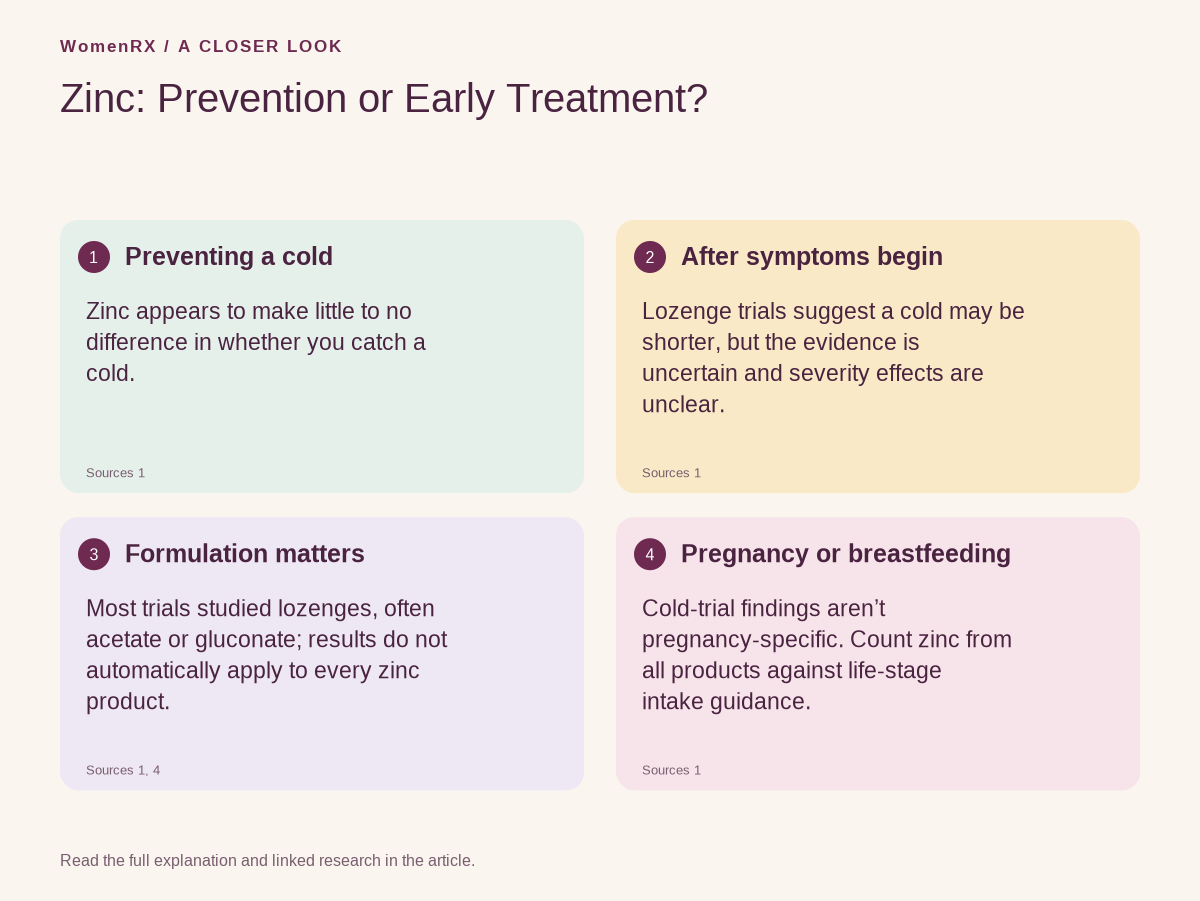
Zinc: Prevention or Early Treatment?
Preventing a cold: Zinc appears to make little to no difference in whether you catch a cold.1
After symptoms begin: Lozenge trials suggest a cold may be shorter, but the evidence is uncertain and severity effects are unclear.1
Formulation matters: Most trials studied lozenges, often acetate or gluconate; results do not automatically apply to every zinc product.14
Pregnancy or breastfeeding: Cold-trial findings aren’t pregnancy-specific. Count zinc from all products against life-stage intake guidance.1
Read the figure as text
The same word, “zinc,” covers different questions. This comparison shows why a prevention claim, a lozenge trial, and a pregnancy intake reference should not be treated as interchangeable.- Preventing a cold: Zinc appears to make little to no difference in whether you catch a cold.1
- After symptoms begin: Lozenge trials suggest a cold may be shorter, but the evidence is uncertain and severity effects are unclear.1
- Formulation matters: Most trials studied lozenges, often acetate or gluconate; results do not automatically apply to every zinc product.14
- Pregnancy or breastfeeding: Cold-trial findings aren’t pregnancy-specific. Count zinc from all products against life-stage intake guidance.1
More questions, answered
Does zinc help make cold symptoms less severe?
It’s unclear. Reviews suggest zinc may shorten the duration of a cold, but the NIH summary of the 2024 review found little clarity about whether it reduces overall symptom severity. 1
Are zinc lozenges the same as a zinc nasal spray?
No. Cold trials have used different forms, including lozenges and some nasal products, but results from one formulation or route don’t establish that another works. The most commonly studied products were lozenges. 1
Sources you can check
- Zinc - Health Professional Fact SheetAccessed 2026-09-25Return to first citation
- Zinc Supplementation Reduces Common Cold Duration among Healthy Adults: A Systematic Review of Randomized Controlled Trials with Micronutrients Supplementation.Wang MX, Win SS, Pang J. · The American journal of tropical medicine and hygiene · 2020Return to first citation
- Zinc for the treatment of the common cold: a systematic review and meta-analysis of randomized controlled trials.Science M, Johnstone J, Roth DE, Guyatt G, Loeb M. · CMAJ : Canadian Medical Association journal = journal de l'Association medicale canadienne · 2012Return to first citation
- Zinc acetate lozenges for treating the common cold: an individual patient data meta-analysis.Hemilä H, Petrus EJ, Fitzgerald JT, Prasad A. · British journal of clinical pharmacology · 2016Return to first citation
- The effectiveness of high dose zinc acetate lozenges on various common cold symptoms: a meta-analysis.Hemilä H, Chalker E. · BMC family practice · 2015Return to first citation