When Melatonin Might Help You Sleep
Melatonin is most useful to consider when your sleep clock is out of step with the hours you need to keep, not as a fix for every restless night.
Melatonin may help with jet lag or a delayed sleep schedule, where when you take it matters to the goal. It’s less clear that it will solve ongoing insomnia, especially if stress, night waking, or another condition is driving it. Standard and slow-release products raise different questions, but there isn’t one timing or formulation that fits everyone. 148
First, is your sleep clock late or is sleep itself difficult?
Picture two evenings. In one, you’re wide awake at the bedtime you need for work, but you fall asleep easily and sleep well when you’re free to keep a later schedule. In the other, you’re sleepy at bedtime but lie awake worrying, or you wake repeatedly during the night. Both can feel like “I can’t sleep.” They don’t point to the same solution. Circadian rhythm disorders involve difficulty sleeping or waking at the right times; insomnia can mean trouble falling asleep, staying asleep, or both. 12
Melatonin is a hormone whose levels normally rise at night and help regulate sleep timing. A synthetic version can help with some short-term sleep problems and may ease jet lag. That makes a clock-related problem a more promising reason to consider it than an assumption that it will switch off worry or keep you asleep through every disruption. 84
What timing is meant to change?
If your schedule has shifted after travel, or you consistently become sleepy much later than you want to, the question is whether melatonin could help move sleep toward the hours you need. Timing is part of that question, not a minor detail on the bottle. Guidance on melatonin says how it’s taken depends on why it’s being used; research on delayed sleep timing likewise considers strategically timed use rather than a universal bedtime rule. 510
There’s also a limit to what a shifted body-clock marker tells us. In an exploratory analysis of a randomized trial involving 49 adults with ADHD and delayed sleep phase, melatonin shifted a measured circadian marker, but sleep times and overall sleep did not improve. The finding doesn’t settle how melatonin works for everyone with a late schedule. It does show why “it shifted the clock” and “I’m sleeping better” aren’t interchangeable outcomes. 9
If your main problem is months of broken sleep, look beyond the clock. Stress, medicines, caffeine, other health conditions, and sleep disorders can contribute to insomnia. For example, menopause can be one context for sleep difficulty, but that alone doesn’t establish a melatonin-timing problem or show that melatonin treats the cause of the waking. Cognitive behavioral therapy for insomnia (CBT-I) is a first-line approach for chronic insomnia; addressing an underlying problem matters when insomnia is a symptom of something else. 234
Standard or slow-release: ask what you want to change
Melatonin comes in standard and slow-release forms. That distinction is worth noticing if you’re deciding whether your concern is when you become sleepy or waking during the night. But the existence of two formulations doesn’t establish that slow-release melatonin will fix your particular night waking, or that a standard product will correct a delayed schedule. Evidence on circadian timing still leaves questions about the best parameters and who benefits. 84
Age and the reason for poor sleep also affect how relevant a claim may be. Some clinical guidance discusses short-term melatonin use particularly in older adults, while a trial in adults with ADHD and delayed sleep phase tested a different, specific sleep-timing question. Neither is a reason to borrow a dose or schedule from a study for your own situation. 89 If you’re comparing products, check which form the label describes and avoid treating products as interchangeable: a review of circadian approaches flags product variability as a concern. That observation doesn’t tell you the quality of any particular US product. 4
Safety belongs in the decision, too
Melatonin can leave some people with a headache or feeling tired, sick, or irritable the next day. It can also interact with medicines. Before adding it, check specifically if you take fluvoxamine or amitriptyline, a sedating medicine such as diazepam or zolpidem, an estrogen-containing contraceptive or hormone therapy, or warfarin. Guidance identifies these among medicines that may interact with melatonin; it does not mean every interaction works the same way. 86
If you’re pregnant, melatonin is not usually recommended because little is known about its effects on babies. Breastfeeding is a different decision, not an automatic extension of the pregnancy advice: it isn’t known how much manufactured melatonin passes into breast milk, and longer use might make a baby sleepy. If you’re considering it while breastfeeding, discuss your situation with a clinician or pharmacist. If your baby seems unusually sleepy or feeds less well than usual, seek advice promptly. Guidance also advises against sharing a bed with your baby while taking melatonin. 7
The useful next question is specific: Am I trying to move my sleep schedule, cope with a temporary disruption, or treat sleep that stays difficult even when the timing is right? Your answer changes what melatonin could reasonably do, and what deserves attention instead. 124
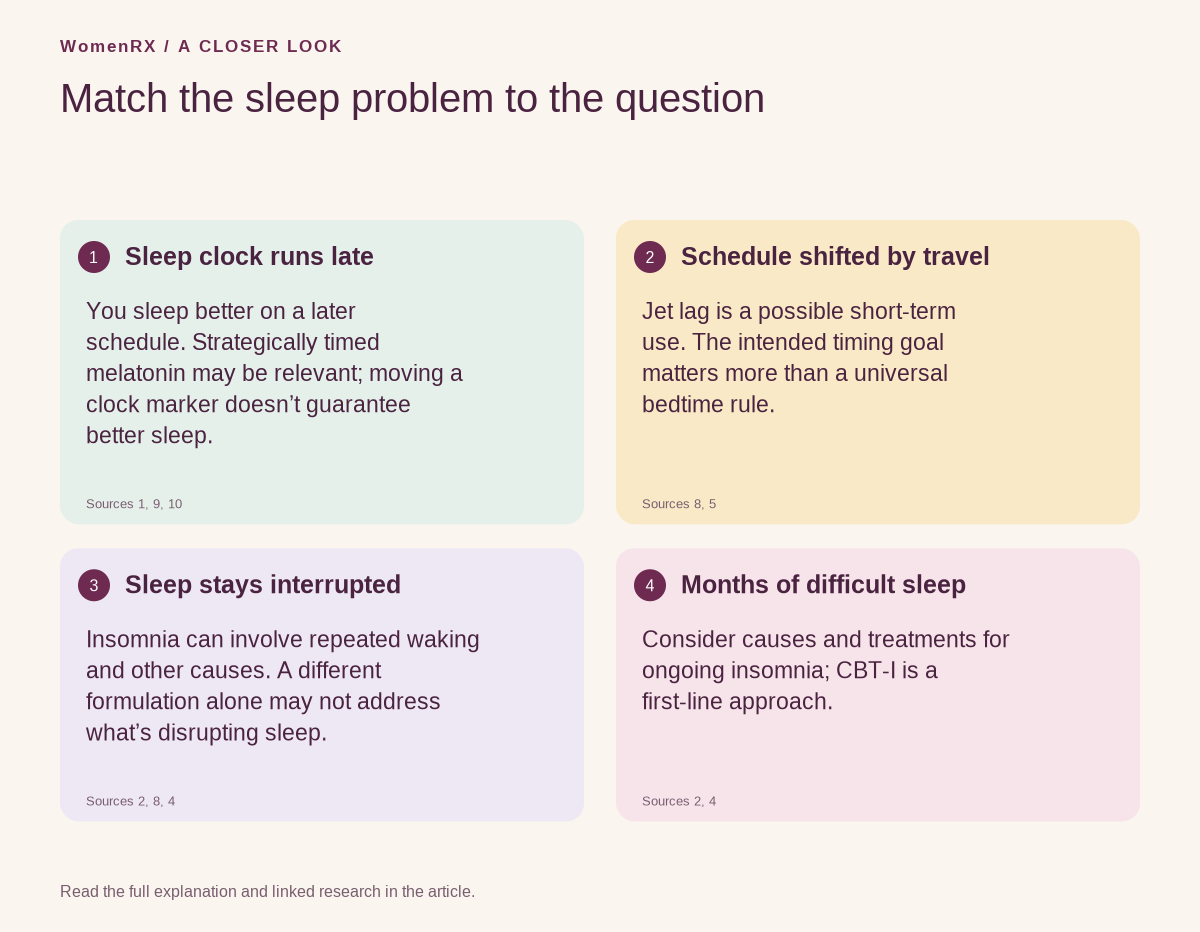
Match the sleep problem to the question
Sleep clock runs late: You sleep better on a later schedule. Strategically timed melatonin may be relevant; moving a clock marker doesn’t guarantee better sleep.1910
Schedule shifted by travel: Jet lag is a possible short-term use. The intended timing goal matters more than a universal bedtime rule.85
Sleep stays interrupted: Insomnia can involve repeated waking and other causes. A different formulation alone may not address what’s disrupting sleep.284
Months of difficult sleep: Consider causes and treatments for ongoing insomnia; CBT-I is a first-line approach.24
Read the figure as text
These situations can all feel like poor sleep, but they call for different questions about melatonin.- Sleep clock runs late: You sleep better on a later schedule. Strategically timed melatonin may be relevant; moving a clock marker doesn’t guarantee better sleep.1910
- Schedule shifted by travel: Jet lag is a possible short-term use. The intended timing goal matters more than a universal bedtime rule.85
- Sleep stays interrupted: Insomnia can involve repeated waking and other causes. A different formulation alone may not address what’s disrupting sleep.284
- Months of difficult sleep: Consider causes and treatments for ongoing insomnia; CBT-I is a first-line approach.24
More questions, answered
Can melatonin help with stress or mood?
Stress and emotional upset can contribute to insomnia, but that doesn’t make melatonin a treatment for the stress itself. If those concerns are keeping you awake, an approach that addresses the insomnia and its cause may be more useful than focusing only on sleep timing. 24
Sources you can check
- Sleep Disorders | MedlinePlusAccessed 2026-09-25Return to first citation
- Insomnia | MedlinePlusAccessed 2026-09-25Return to first citation
- Insomnia - NHSAccessed 2026-09-25Return to first citation
- Circadian dimensions in insomnia disorder: mechanistic evidence, candidate phenotypes, and a phenotype-stratified research framework.Zhang S, Liu Y, Tan J, Si W, Liu H, Huang Y, Li Y, Xiao J. · Frontiers in psychiatry · 2026Return to first citation
- How and when to take melatonin - NHSAccessed 2026-09-25Return to first citation
- Taking melatonin with other medicines and herbal supplements - NHSAccessed 2026-09-25Return to first citation
- Pregnancy, breastfeeding and fertility while taking melatonin - NHSAccessed 2026-09-25Return to first citation
- About melatonin - NHSAccessed 2026-09-25Return to first citation
- Attention-Deficit/Hyperactivity Disorder and Delayed Sleep Phase Syndrome in Adults: A Randomized Clinical Trial on the Effects of Chronotherapy on Sleep.van Andel E, Bijlenga D, Vogel SWN, Beekman ATF, Kooij JJS. · Journal of biological rhythms · 2022Return to first citation
- Group bright light therapy compared to treatment as usual for delayed sleep-wake phase disorder among patients in psychiatric care (the SIP trials): a protocol for a pragmatic, randomised controlled trial.Wilhelmsen-Langeland A, Osnes B, Gradisar M, Vågenes VA, Sørensen L, Bjorvatn B, Fasmer OB, Koenig J, Pallesen S, Saxvig IW. · BMJ open · 2025Return to first citation