What Zinc Supplements Can and Can’t Do
Zinc may matter when intake or zinc status is low, but results in specific illnesses don’t prove a general benefit for women.
Zinc supplements have shown possible benefits in some specific settings, especially studies of childhood infections and people with certain health conditions. That’s different from showing that extra zinc helps a woman whose zinc status is already adequate. Pregnancy has its own evidence: routine supplementation hasn’t clearly reduced several poor birth outcomes, though it may lower preterm birth risk. 1 4
Zinc is essential, but that doesn’t mean taking extra improves health when you already get enough. The key distinction is between meeting a nutrient need or addressing inadequate zinc and using a supplement to treat a condition in someone whose zinc status is adequate. Findings in people with a particular illness, age group, or setting don’t automatically apply to other women.
Some groups have a higher risk of inadequate zinc, including people who are pregnant or lactating, people with gastrointestinal disorders or bariatric surgery, and people who follow vegetarian or vegan diets. That makes individual context relevant, but it doesn’t establish that supplements improve every health outcome in those groups. 1
Infection findings are mainly from children
A review of 51 randomized trials on bacterial infections found more consistent benefits in children than adults. In children, some trials reported shorter or less severe diarrhea, and some found improved resolution of respiratory infections. Evidence in adults was limited and mixed, with possible benefits reported in selected groups such as people with zinc deficiency or burns. Differences in population, treatment, and outcome make it hard to generalize these results to healthy adult women. 4
One trial shows how specific a positive result can be. In Uganda, 100 children younger than five with sickle cell anemia were assigned to zinc or placebo and followed for six months. The zinc group had 305.7 infections per 100 person-years, compared with 480.7 in the placebo group. That supports a possible benefit in this particular group; it doesn’t show that zinc prevents infections in adult women. 5
Pregnancy is a distinct case
Zinc requirements are higher during pregnancy and lactation. For adults age 19 and older, the recommended intake is 8 mg a day for women, 11 mg during pregnancy, and 12 mg during lactation. These are recommended total daily intakes, not supplement instructions. 1
Trials of routine zinc supplementation during pregnancy have not shown clear reductions in low birthweight, stillbirth, or neonatal death, though supplementation might reduce preterm birth risk. So pregnancy-related need and a possible outcome benefit are separate questions: meeting increased nutrient needs matters, but the evidence doesn’t show that routine supplements prevent all pregnancy complications. 1
Findings in chronic illness don’t travel far
A review of randomized trials in adults with chronic kidney disease reported increases in some measures, including body weight, albumin, and dietary energy intake. The authors rated the overall evidence as low quality. These findings concern people with CKD; they don’t establish that zinc improves those measures in women without kidney disease. The summary also doesn’t report whether results differed for women. 6
A meta-analysis of seven trials involving 338 people with cirrhosis found modest changes in some measures, including blood tests. The authors noted that some changes had limited clinical significance and that results were inconsistent. This is evidence about a specific illness, not a general liver-health benefit. 2
Weight claims need a reality check
A meta-analysis of 41 randomized trials in adults found no significant overall effect on body mass index, fat mass, fat-free mass, or the measured adipokines. It found a small average increase in body weight and decrease in waist circumference, which the authors judged not clinically significant. The abstract doesn’t report a women-specific analysis. These results don’t support using zinc as a weight-loss supplement. 3
Yeast infection: lower zinc levels don’t prove treatment works
A review found that women with vulvovaginal candidiasis (VVC) had lower measured zinc levels than comparison groups. The difference was larger in pregnant women. These were observational comparisons, so they can’t show that low zinc caused VVC; lower levels might reflect changes associated with the condition. 7
Treatment findings are limited. In one randomized trial, the 90-day reinfection rate was numerically lower with zinc, 28.6% versus 48.5%, but the difference wasn’t statistically significant. Another trial reported less itching with an add-on treatment containing zinc, which doesn’t establish an effect from zinc alone. The review concluded that evidence isn’t sufficient to support routine zinc-based prevention or treatment for VVC. 7
A quick way to assess a zinc claim
Ask who was studied, what outcome changed, and whether the result applies to people with adequate zinc status. A change in a blood test or other measure isn’t automatically a meaningful improvement in health. A benefit in children or people with a specific illness also doesn’t answer whether zinc helps a woman who is otherwise well.
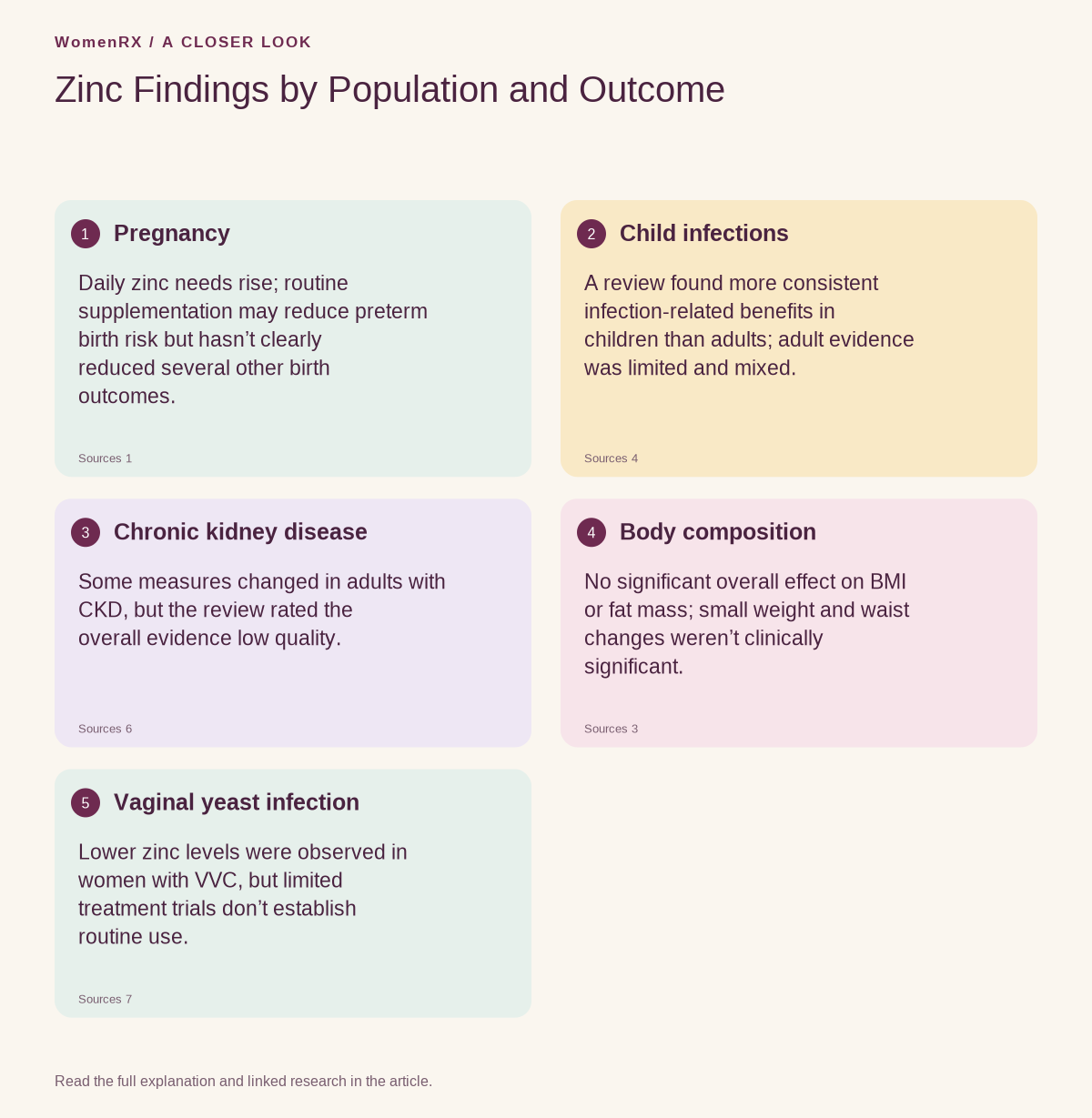
Zinc Findings by Population and Outcome
Pregnancy: Daily zinc needs rise; routine supplementation may reduce preterm birth risk but hasn’t clearly reduced several other birth outcomes.1
Child infections: A review found more consistent infection-related benefits in children than adults; adult evidence was limited and mixed.4
Chronic kidney disease: Some measures changed in adults with CKD, but the review rated the overall evidence low quality.6
Body composition: No significant overall effect on BMI or fat mass; small weight and waist changes weren’t clinically significant.3
Vaginal yeast infection: Lower zinc levels were observed in women with VVC, but limited treatment trials don’t establish routine use.7
Read the figure as text
These examples show why a result in one group or on one measure may not apply to another.- Pregnancy: Daily zinc needs rise; routine supplementation may reduce preterm birth risk but hasn’t clearly reduced several other birth outcomes.1
- Child infections: A review found more consistent infection-related benefits in children than adults; adult evidence was limited and mixed.4
- Chronic kidney disease: Some measures changed in adults with CKD, but the review rated the overall evidence low quality.6
- Body composition: No significant overall effect on BMI or fat mass; small weight and waist changes weren’t clinically significant.3
- Vaginal yeast infection: Lower zinc levels were observed in women with VVC, but limited treatment trials don’t establish routine use.7
More questions, answered
Does zinc research show a special benefit for women?
The VVC review directly concerns women and found an association between lower measured zinc and VVC, especially in pregnant women, but it doesn’t establish that supplements prevent or treat the infection. The summaries of kidney disease and body-composition studies don’t report women-specific results. 3 6 7
Does lower zinc measured during an illness mean a supplement will help?
Not by itself. A lower zinc level observed alongside an illness doesn’t establish that low zinc came first or that supplementation improves the illness. For VVC, the review notes that lower levels might reflect changes associated with the condition. 7
Sources you can check
- Zinc - Health Professional Fact SheetAccessed 2026-09-25Return to first citation
- Zinc supplementation in liver cirrhosis: meta-analysis of its effect on biochemical and clinical outcomes.Gong Y, Yang Z, Sun G, Xue X, Zhang X. · BMC nutrition · 2026Return to first citation
- Effects of Zinc Supplementation on Anthropometric Indices and Adipokines in Adults: A Systematic Review and Meta-Analysis of Randomized Controlled Trials.Salmani M, Karimi M, Asbaghi O, Bagheri R, Nikbaf-Shandiz M, Bakhtiary F, Goudarzi K, Kazemi K, Shouhani Z, Setayesh L, Haghighat N, Ashtary-Larky D. · Biological trace element research · 2026Return to first citation
- The Role of Zinc Against Bacterial Infections in Neonates, Children, and Adults: A Scoping Review from the Available Evidence of Randomized Controlled Trials About Zinc Supplementation to New Research Opportunities.De Rose DU, Mirotta N, Dotta A, Salvatori G, Ronchetti MP, Campogiani L, Ceccherini-Silberstein F, Iannetta M. · Antibiotics (Basel, Switzerland) · 2026Return to first citation
- Daily Zinc Supplementation for Infection Prevention in Children With Sickle Cell Anemia: The ZIPS-2 Randomized Clinical Trial.Namazzi R, Mellencamp KA, Bagala I, Conroy AL, Kato C, Birungi I, Kasembo P, Kyarisiima G, Tenywa E, Ren J, Goings MJ, Cusick SE, John CC. · JAMA · 2026Return to first citation
- Impact of Zinc Supplementation in Adults With Chronic Kidney Disease: A Systematic Review and Meta-Analysis of Randomized Controlled Trials.Tan NLX, Young M, Lambert K, Dawson J. · Nutrition reviews · 2026Return to first citation
- Zinc-based therapies for prevention and treatment of vulvovaginal candidiasis: a systematic review and meta-analysis.Bwambale J, Nakawuka B, Mboowa G, Bongomin F, Kwizera R. · BMC infectious diseases · 2026Return to first citation