Can Zinc Supplements Change Your Body Weight?
Zinc studies report different weight outcomes in people with specific health conditions, not a predictable effect for everyone.
Zinc supplements aren’t an established way to lose weight, and the studies don’t show that they predictably cause weight gain. Results differ in trials involving people with chronic kidney disease, diabetes, fatty liver disease, or zinc deficiency. Those findings don’t establish what zinc does to weight in otherwise healthy adults, or whether effects differ by sex or life stage. 2 3 4 5
The result depends on the group studied
The available studies don’t point to one predictable weight effect from zinc. They tested people with specific health conditions, and their results shouldn’t be treated as a forecast for otherwise healthy adults.
A systematic review of randomized trials in adults with chronic kidney disease found an average body-weight increase of 2.52 kg with zinc supplementation compared with control groups. The review found no significant difference in body mass index (BMI) and rated the overall evidence as low quality. That result applies to adults with chronic kidney disease, not everyone taking zinc. 5
In a 12-week randomized trial involving people with type 2 diabetes, weight and BMI increased within the zinc group. But the increases weren’t significantly different from changes in the placebo group. A change within one group, by itself, doesn’t show that zinc caused it. 3
A small trial in overweight or obese participants with fatty liver disease reported lower weight, BMI, and waist circumference in the zinc group than in the placebo group. Both groups were also advised to follow a balanced, energy-restricted diet and be physically active, so the result doesn’t show that zinc alone produces weight loss. 4
Why weight gain and weight loss can both appear
The populations and outcomes weren’t the same. For example, a randomized trial in 48 people with zinc deficiency who were receiving hemodialysis found that body-fat weight increased in the group given zinc over one year. This is a finding in a specific group with a particular medical condition and deficiency, not proof that zinc makes other people gain body fat. 2
The kidney-disease review measured body weight across randomized trials, while the hemodialysis study reported body-fat weight. Those measures aren’t interchangeable. Body weight includes fat, muscle, bone, and water, so a scale change alone can’t tell you what changed. 1 2 5
A supplement combination adds another wrinkle. One trial in people with type 2 diabetes tested zinc alongside inositols, alpha-lactalbumin, and Gymnema sylvestre. A subgroup had greater weight reduction with the combination, but the study can’t identify zinc as the ingredient responsible. 6
What to take from the findings
If you’re considering zinc for weight loss, these studies don’t establish it as a weight-loss treatment. They also don’t show that taking zinc will predictably make you gain weight. The positive and negative results come from different groups and study setups, and some are limited by small or condition-specific samples. 2 3 4 5
The reported studies don’t provide sex-specific weight results or a clear answer for pregnancy, perimenopause, or postmenopause. That leaves a real gap: it isn’t possible to infer a women-specific effect from these findings.
If your weight is changing without trying, zinc is only one possible consideration. Weight includes several kinds of tissue and fluid, and unexpected gain or loss can have other causes. MedlinePlus recommends discussing unintentional weight changes with a healthcare provider. 1
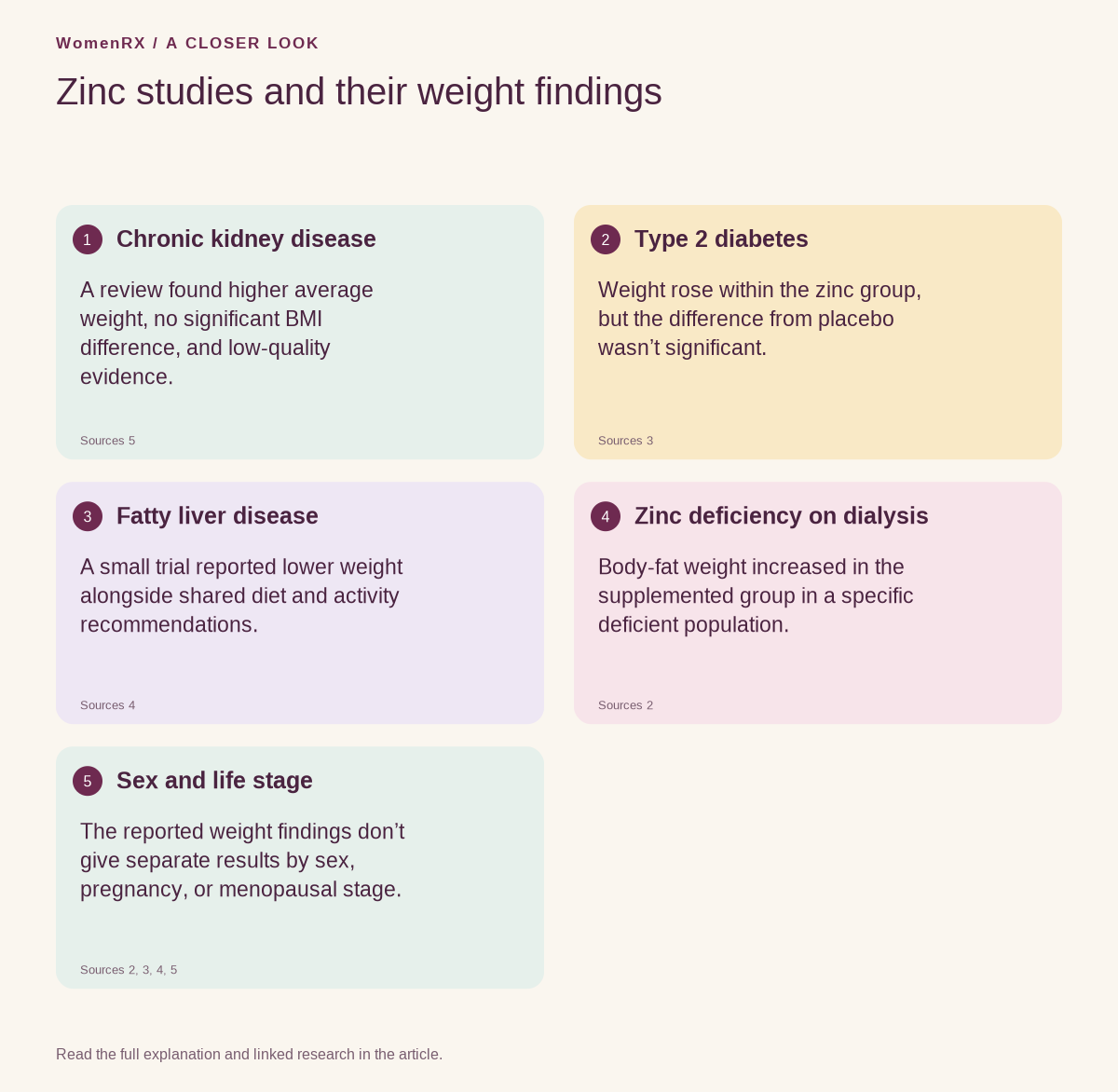
Zinc studies and their weight findings
Chronic kidney disease: A review found higher average weight, no significant BMI difference, and low-quality evidence.5
Type 2 diabetes: Weight rose within the zinc group, but the difference from placebo wasn’t significant.3
Fatty liver disease: A small trial reported lower weight alongside shared diet and activity recommendations.4
Zinc deficiency on dialysis: Body-fat weight increased in the supplemented group in a specific deficient population.2
Sex and life stage: The reported weight findings don’t give separate results by sex, pregnancy, or menopausal stage.2345
Read the figure as text
These studies tested different groups and outcomes, so their results don’t combine into one prediction for everyone.- Chronic kidney disease: A review found higher average weight, no significant BMI difference, and low-quality evidence.5
- Type 2 diabetes: Weight rose within the zinc group, but the difference from placebo wasn’t significant.3
- Fatty liver disease: A small trial reported lower weight alongside shared diet and activity recommendations.4
- Zinc deficiency on dialysis: Body-fat weight increased in the supplemented group in a specific deficient population.2
- Sex and life stage: The reported weight findings don’t give separate results by sex, pregnancy, or menopausal stage.2345
More questions, answered
Does a change on the scale mean zinc changed body fat?
Not necessarily. Body weight includes fat, muscle, bone, and water. A scale reading alone can’t show which of these changed. 1
Sources you can check
- Body Weight: MedlinePlusAccessed 2026-09-25Return to first citation
- The effects of zinc supplementation on body fat mass in hemodialysis patients: An open-label randomized controlled trial.Fukasawa H, Yamawaki M, Furuya J, Omata K, Kaneko M, Matsuyama T, Yasuda H, Furuya R. · Therapeutic apheresis and dialysis : official peer-reviewed journal of the International Society for Apheresis, the Japanese Society for Apheresis, the Japanese Society for Dialysis Therapy · 2025Return to first citation
- The Effect of Zinc Supplementation on Glycemic, Weight, and Blood Pressure Control in Patients With Type 2 Diabetes Mellitus: A Double-Blind Randomized Controlled Trial.Sayadi M, Nowbandegani SJ, Inalou FB, Nazemzadegan B, Javidi Alsaadi S, Eskandari M, Sepehrinia M. · Health science reports · 2025Return to first citation
- The effects of zinc supplementation on the metabolic factors in patients with non-alcoholic fatty liver disease: a randomized, double-blinded, placebo-controlled clinical trial.Rezaei SMA, Mohammadi F, Eftekhari MH, Ejtehadi F, Ghaem H, Mohammadipoor N. · BMC nutrition · 2023Return to first citation
- Impact of Zinc Supplementation in Adults With Chronic Kidney Disease: A Systematic Review and Meta-Analysis of Randomized Controlled Trials.Tan NLX, Young M, Lambert K, Dawson J. · Nutrition reviews · 2026Return to first citation
- Combined Inositols, α-Lactalbumin, Gymnema Sylvestre and Zinc Improve the Lipid Metabolic Profile of Patients with Type 2 Diabetes Mellitus: A Randomized Clinical Trial.Nani A, Bertuzzi F, Meneghini E, Mion E, Pintaudi B. · Journal of clinical medicine · 2023Return to first citation