What Changes After Both Ovaries Are Removed?
Removing both ovaries before natural menopause causes an abrupt loss of ovarian hormones, unlike a hysterectomy that leaves the ovaries in place.
If both ovaries are removed before natural menopause, hormone levels change abruptly and menopause symptoms may follow. Removing the uterus alone stops periods but does not, by itself, end ovarian hormone production. What you experience and whether hormone therapy is suitable depend on your age, symptoms, health history, and why surgery is happening. Ask how your care plan will address symptoms and longer-term bone health. 4 2
The key difference is whether your ovaries remain
A hysterectomy removes the uterus, so you no longer have periods or can carry a pregnancy. If your ovaries are left in place, they can continue producing hormones. Removing both ovaries before natural menopause is different: it causes an abrupt loss of ovarian hormones and brings on surgical menopause. The change can happen whether or not the uterus is removed at the same time. 4
That difference matters when you’re planning surgery. Ask your surgeon to spell out exactly which organs are expected to be removed or preserved. The reason for surgery matters too: the discussion may differ for an operation to treat disease and one intended to reduce inherited cancer risk. 5 6
What you may notice after surgery
There are two kinds of changes to keep in mind. First is recovery from the operation itself. Pain, swelling, and soreness around an incision can occur after surgery; your surgeon can explain what to expect from your specific procedure. 1
The second change is the hormone shift. Some people experience hot flashes or other vasomotor symptoms, changes in sleep or mood, and changes in sexual function. These experiences aren’t identical for everyone. In a prospective controlled study of premenopausal women with BRCA1/2 variants who had risk-reducing removal of their ovaries and fallopian tubes, sexual function, sleep, and mood were adversely affected compared with women who retained their ovaries. In that study, vasomotor symptoms were generally mild, peaked at three months, and did not worsen through 24 months. Those findings describe that particular group, not a guaranteed timeline for every person having ovarian surgery. 5
The study also found loss of bone density at 24 months, partially mitigated among participants using menopausal hormone therapy. Cardiometabolic health and cognition were largely maintained over those two years. These results offer a useful view of what happened in this study, but they do not settle longer-term outcomes for every age or surgical indication. 5
Make hormone treatment a personal discussion
Menopausal hormone therapy can reduce vasomotor symptoms and help prevent bone loss, but it isn’t automatically right for everyone. Its risks vary with factors including treatment type, route, timing, duration, and whether a progestogen is used. A menopause position statement says the benefit-risk balance is generally favorable for treating bothersome vasomotor symptoms in people younger than 60 or within 10 years of menopause onset who have no contraindications. Your own history and reason for surgery still matter. 2
If hormone therapy isn’t a suitable choice, or you prefer not to use it, evidence-supported nonhormonal options exist for vasomotor symptoms. The North American Menopause Society’s position statement includes cognitive behavioral therapy, clinical hypnosis, several prescription medicines, and weight loss among options supported at different evidence levels. Which option fits depends on your symptoms and circumstances. 3
Bring these questions into the conversation before surgery if you can, or afterward if the plan is still unclear:
- Exactly which organs are being removed, and why?
- What symptoms might reflect the hormone change, and what symptoms might be part of surgical recovery?
- Given my age, health history, and reason for surgery, is hormone therapy an option for me? If so, what benefits, risks, and alternatives should we weigh?
- How will we follow bone health and other longer-term concerns?
- If symptoms affect sleep, mood, or sexual function, what support or treatments could help?
There isn’t one standard experience after both ovaries are removed. Knowing whether ovarian function will end, what to watch for, and how your treatment choices will be revisited can make the next steps clearer.
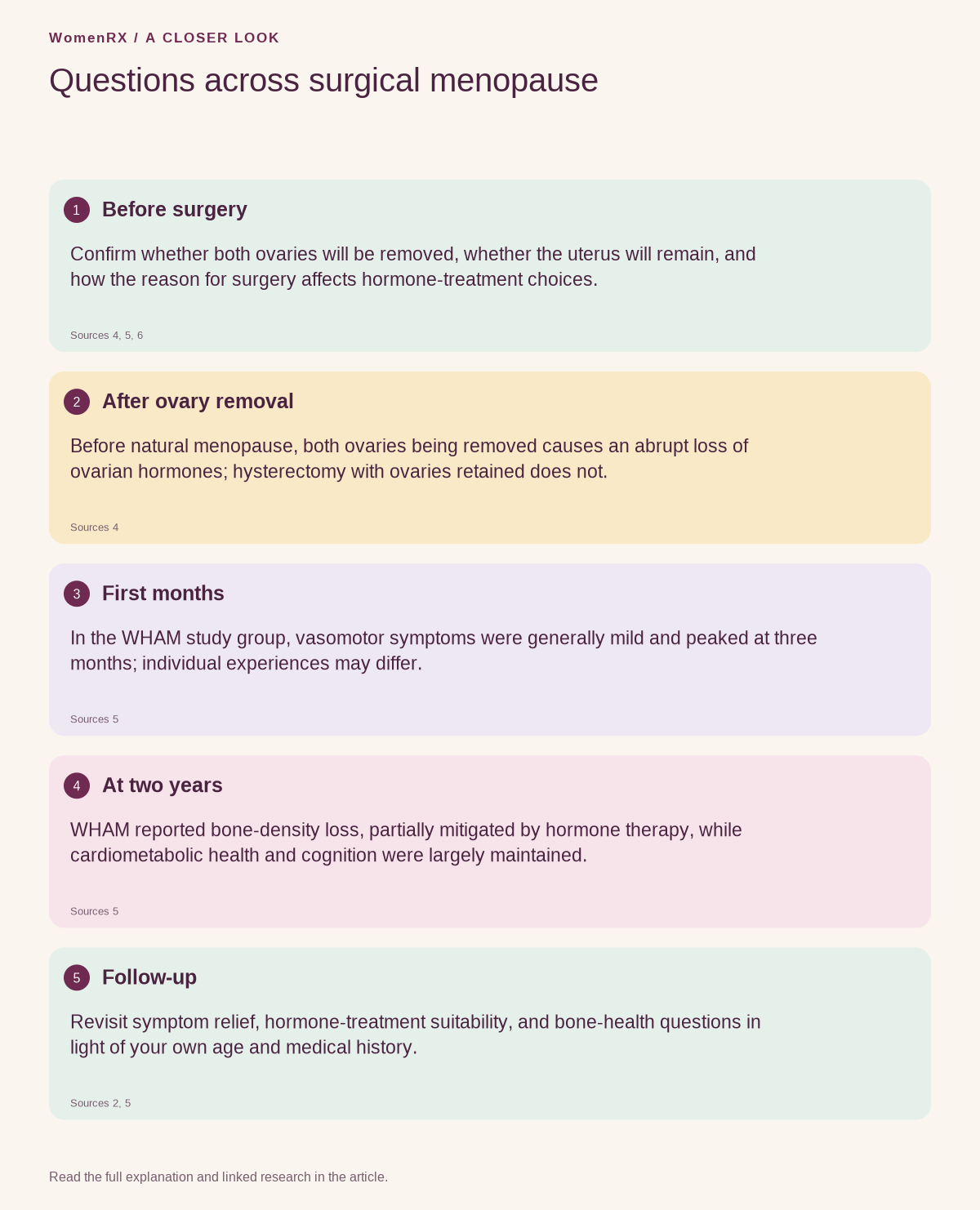
Questions across surgical menopause
Before surgery: Confirm whether both ovaries will be removed, whether the uterus will remain, and how the reason for surgery affects hormone-treatment choices.456
After ovary removal: Before natural menopause, both ovaries being removed causes an abrupt loss of ovarian hormones; hysterectomy with ovaries retained does not.4
First months: In the WHAM study group, vasomotor symptoms were generally mild and peaked at three months; individual experiences may differ.5
At two years: WHAM reported bone-density loss, partially mitigated by hormone therapy, while cardiometabolic health and cognition were largely maintained.5
Follow-up: Revisit symptom relief, hormone-treatment suitability, and bone-health questions in light of your own age and medical history.25
Read the figure as text
A simple sequence separates the immediate hormone change from study findings over time and the treatment questions to revisit.- Before surgery: Confirm whether both ovaries will be removed, whether the uterus will remain, and how the reason for surgery affects hormone-treatment choices.456
- After ovary removal: Before natural menopause, both ovaries being removed causes an abrupt loss of ovarian hormones; hysterectomy with ovaries retained does not.4
- First months: In the WHAM study group, vasomotor symptoms were generally mild and peaked at three months; individual experiences may differ.5
- At two years: WHAM reported bone-density loss, partially mitigated by hormone therapy, while cardiometabolic health and cognition were largely maintained.5
- Follow-up: Revisit symptom relief, hormone-treatment suitability, and bone-health questions in light of your own age and medical history.25
More questions, answered
Does removing my uterus alone cause surgical menopause?
Not by itself. A hysterectomy stops menstruation, but when the ovaries remain, ovarian hormone production is preserved. 4
Does hormone therapy prevent every effect of ovary removal?
No. In one prospective study of premenopausal women who had risk-reducing surgery, hormone therapy reduced but did not resolve vasomotor symptoms, and it partially mitigated bone-density loss at 24 months. Those findings are from that study group and don’t predict an individual result. 5
Sources you can check
- After Surgery: MedlinePlusAccessed 2026-09-25Return to first citation
- The 2022 hormone therapy position statement of The North American Menopause Society.“The 2022 Hormone Therapy Position Statement of The North American Menopause Society” Advisory Panel. · Menopause (New York, N.Y.) · 2022Return to first citation
- The 2023 nonhormone therapy position statement of The North American Menopause Society.Menopause (New York, N.Y.) · 2023Return to first citation
- Premature and early menopause and neuroimaging biomarkers of neurodegenerative diseases: a systematic review.Gallmetzer E, Mak E, Kara F, Zeydan B, Kapoor E, Shufelt CL, Rocca WA, Kantarci K. · Frontiers in dementia · 2026Return to first citation
- What Happens After Menopause (WHAM)? A Progress Report of a Prospective Controlled Study of Women After Pre-Menopausal Risk-Reducing Bilateral Salpingo-Oophorectomy.Price SAL, Maki PM, El Khoudary SR, Brand A, Islam RM, Domchek SM, Joffe H, Mishra GD, Moss KM, Baker FC, Braat S, Wark JD, Hickey M. · BJOG : an international journal of obstetrics and gynaecology · 2025Return to first citation
- Management of surgical menopause in female patients with bladder cancer undergoing radical cystectomy.Day E, Bizzarri FP, Mackenzie C, Szabados B, Nelson AW, Colquhoun AJ, Perry MJ, Kelly JD, Lobo N. · Nature reviews. Urology · 2026Return to first citation