Menopause After Hysterectomy: What Your Surgery Changed
Whether your ovaries were removed is the key clue, because bleeding can no longer mark the transition once your uterus is gone.
A hysterectomy removes the uterus, but it doesn’t necessarily remove the ovaries. If both ovaries were removed before menopause, menopause begins abruptly through surgery. If one or both remain, the surgery alone doesn’t establish that you’re menopausal, and you can’t use missed periods to tell. Your operative record, symptoms, age, and ovarian history help put the change in context. 1 2
Start with what was removed
A hysterectomy means your uterus was removed. The ovaries may have been left in place, one may have been removed, or both may have been removed. Removal of the fallopian tubes is a separate detail: some people have their tubes removed while keeping their ovaries. 5
If both ovaries were removed before natural menopause, this is surgical menopause. The ovaries are no longer there to produce their hormones, so the change happens with surgery rather than gradually being identified by a year without periods. 1
If one or both ovaries remain, hysterectomy alone doesn’t tell you that menopause has begun. Ovarian function can change over time, and a small prospective study found changes in hormone markers six months after hysterectomy in 81 patients whose ovaries were retained. Those changes are not, by themselves, proof that the participants had reached menopause. 4
Why your periods can’t answer the question
After the uterus is removed, there’s no menstrual bleeding to track. That takes away the usual sign used to identify natural menopause: a full year without periods. In a large pooled analysis, researchers defined natural menopause by 12 months without menstruation in people without hysterectomy or oophorectomy, and defined surgical menopause as removal of both ovaries. Those definitions show why the same period-based rule can’t be applied after a hysterectomy. 1
Instead, the picture depends on the operation and your symptoms. Vasomotor symptoms and genitourinary symptoms are among the issues addressed in menopause guidance, but symptoms alone don’t tell you exactly when ovarian function changed or establish the cause. 3
Check the operative record, especially if the details are fuzzy
Look for the operative report or discharge summary and check whether it says that one or both ovaries were removed, or that the ovaries were preserved. If the paperwork is unclear, ask the surgical office or your current care team to confirm. This detail matters: in a medical-record validation study, self-reports of ovary removal were less accurate than self-reports of hysterectomy, and some people who reported removal of one ovary had actually had both removed. 2
Tell your clinician when the surgery happened, your age at the time, which ovaries remain, and what has changed since. If you have symptoms such as hot flashes or vaginal or urinary changes, describe when they started and how much they affect you. These details can help distinguish a possible menopausal change from other explanations, though they don’t independently confirm menopause. 3
A clinician may consider ovarian-function blood tests in context. FSH and estradiol were measured in a small prospective study after hysterectomy, but that study was not a diagnostic guideline and did not establish a test result that confirms menopause after surgery. 4
Age matters when both ovaries were removed
The timing of ovary removal is relevant beyond the immediate symptoms. In a pooled analysis of 203,767 postmenopausal women from 10 observational studies, surgical menopause was associated with higher cardiovascular risk than natural menopause overall; the analysis also found that younger age at surgical menopause mattered. Because this was observational research, it shows an association, not proof that surgery alone caused each outcome. 1
If both ovaries were removed before natural menopause, ask how your age and health history affect follow-up and whether hormone therapy is appropriate for you. Menopause guidance says hormone-therapy benefits and risks vary by factors including age, timing, and treatment characteristics, so the decision is individualized. 3
The practical distinction is simple: hysterectomy removes the bleeding signal; removal of both ovaries causes surgical menopause if it happens before natural menopause. When ovaries remain, use the surgical record and the broader clinical picture rather than assuming that hysterectomy itself marked the start of menopause.
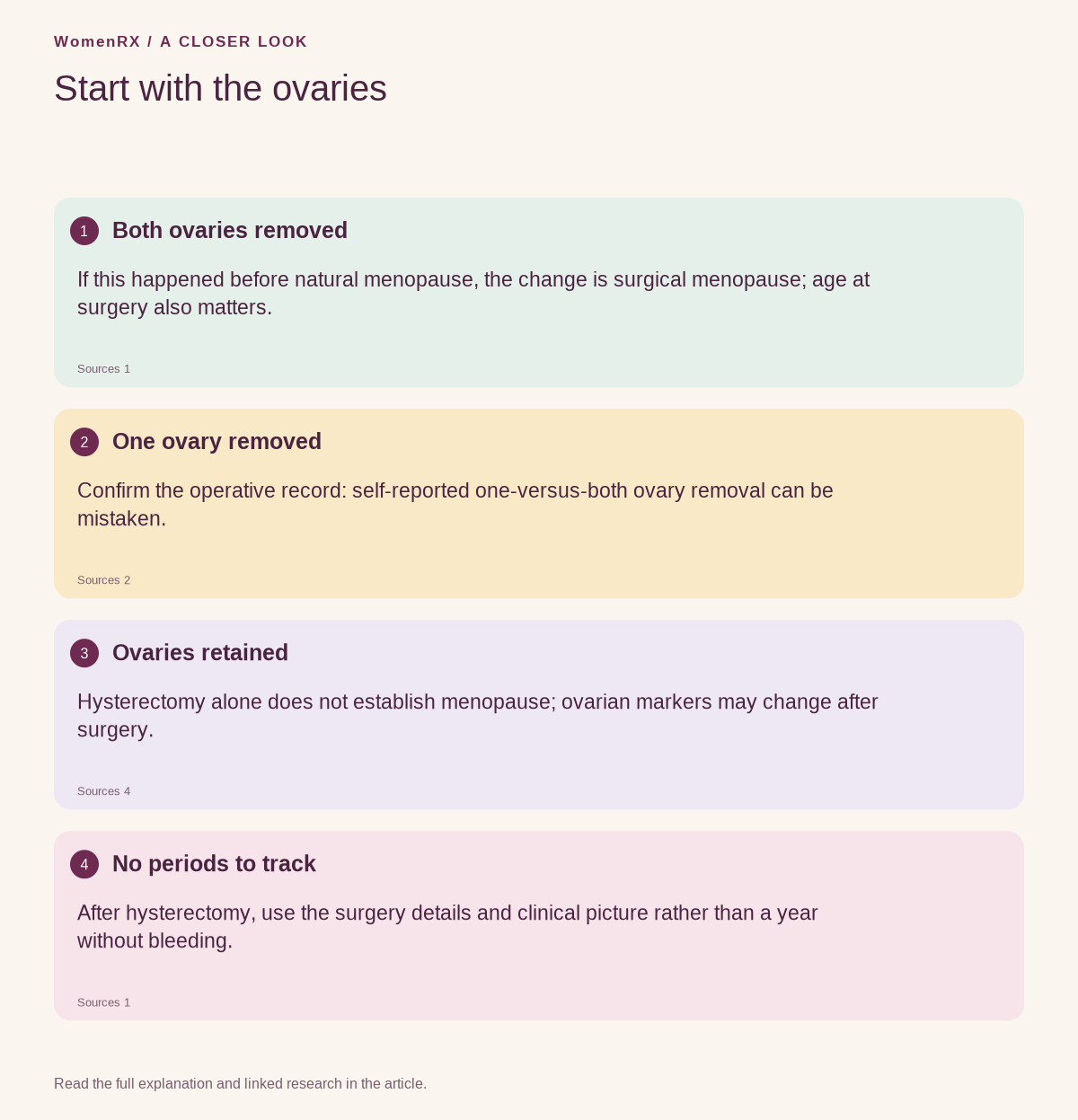
Start with the ovaries
Both ovaries removed: If this happened before natural menopause, the change is surgical menopause; age at surgery also matters.1
One ovary removed: Confirm the operative record: self-reported one-versus-both ovary removal can be mistaken.2
Ovaries retained: Hysterectomy alone does not establish menopause; ovarian markers may change after surgery.4
No periods to track: After hysterectomy, use the surgery details and clinical picture rather than a year without bleeding.1
Read the figure as text
Follow the surgery detail first, then use symptoms and age as context. Bleeding cannot mark menopause after the uterus is removed.- Both ovaries removed: If this happened before natural menopause, the change is surgical menopause; age at surgery also matters.1
- One ovary removed: Confirm the operative record: self-reported one-versus-both ovary removal can be mistaken.2
- Ovaries retained: Hysterectomy alone does not establish menopause; ovarian markers may change after surgery.4
- No periods to track: After hysterectomy, use the surgery details and clinical picture rather than a year without bleeding.1
More questions, answered
Can removing my fallopian tubes cause menopause?
Tube removal is not the same operation as removing the ovaries. A pilot study followed people who had hysterectomy with ovarian preservation, including many who also had their tubes removed; it found no worsening in median menopausal-symptom scores in that group at six months. The study was small, so it can’t settle every question about longer-term ovarian function. 5
What if I’m not sure whether one or both ovaries were removed?
Check the operative report or ask the surgical office to confirm. Self-reported ovary-removal history was less accurate than hysterectomy history in one validation study, including cases where someone reporting removal of one ovary had actually had both removed. 2
Sources you can check
- Type of menopause, age of menopause and variations in the risk of incident cardiovascular disease: pooled analysis of individual data from 10 international studies.Zhu D, Chung HF, Dobson AJ, Pandeya N, Brunner EJ, Kuh D, Greenwood DC, Hardy R, Cade JE, Giles GG, Bruinsma F, Demakakos P, Simonsen MK, Sandin S, Weiderpass E, Mishra GD. · Human reproduction (Oxford, England) · 2020Return to first citation
- Validation of self-reported history of hysterectomy and oophorectomy among women in an integrated group practice setting.Phipps AI, Buist DS. · Menopause (New York, N.Y.) · 2009Return to first citation
- The 2022 hormone therapy position statement of The North American Menopause Society.“The 2022 Hormone Therapy Position Statement of The North American Menopause Society” Advisory Panel. · Menopause (New York, N.Y.) · 2022Return to first citation
- Comparison of the effects of total laparoscopic hysterectomy and total abdominal hysterectomy on ovarian reserve and sexual function: a non-randomised prospective study.Gnanarathne S, Kandauda C, Isurindi UA, Kariyawasam A. · BMC women's health · 2026Return to first citation
- Menopausal symptoms after hysterectomy with opportunistic salpingectomy: a pilot study.Maryns AS, Hamerlynck T, De Vree B, Verboven AS, Makar AP, Tummers P, Tjalma W. · Facts, views & vision in ObGyn · 2025Return to first citation