What Are Nonprescription Progesterone Supplements, and Do They Contain Progesterone?
A label can tell you what a product declares as an ingredient, but a hormone-related claim doesn’t show that the product contains progesterone or changes your hormone levels.
A product’s name or “hormone support” claim doesn’t establish that it contains progesterone. Look at the ingredient list: “progesterone” means the label declares that ingredient; a plant extract or other named ingredient does not, by itself, establish that progesterone is present. Neither wording proves the product’s hormone effects. Prescription micronized progesterone is a hormone medicine, not simply a supplement with a hormone-related claim. 1
Start with the ingredient list, not the front label
A label can make three different things sound alike: progesterone as an ingredient, a plant ingredient, or a claim about supporting progesterone. They are not interchangeable.
For example, imagine a label that says “Supplement Facts: progesterone.” That tells you the label declares progesterone as an ingredient. It does not, by itself, establish the product’s actual contents or show that it works as intended.
Now imagine the ingredient list says “wild yam extract,” while the front says “supports healthy progesterone.” The label declares a plant extract and makes a hormone-related claim. It does not declare progesterone as an ingredient, and the claim alone does not establish that the product raises progesterone or improves menopause symptoms.
These are examples of how to read wording, not verified product labels. If progesterone appears only in the product name or an advertising claim, check the ingredient list before treating it as an ingredient.
Progesterone medicine is a different category
Prometrium is a prescription capsule whose active ingredient is micronized progesterone. Its prescribing information says the progesterone is made from a plant-source starting material but is chemically identical to progesterone of human ovarian origin. That description applies to this medicine; a plant-derived ingredient in a supplement is not automatically progesterone. 1
Prometrium has specified medical uses, including preventing endometrial hyperplasia in certain postmenopausal women receiving conjugated estrogens. That is different from taking a product because its marketing suggests it supports hormones. 1
What the evidence says about progesterone cream
If the product you’re considering is a topical progesterone cream marketed for hot flashes, the evidence in the cited menopause position statement is limited: it describes few data supporting efficacy and says safety concerns should be the same as for other progestogen preparations. The statement is from 2004, so it should not be mistaken for a current, comprehensive review of every product or use. It does not establish that a cream reliably relieves menopause symptoms or changes hormone levels. 3
More broadly, the North American Menopause Society’s 2022 position statement describes hormone therapy as the most effective treatment for vasomotor symptoms, while emphasizing that benefits and risks vary with factors such as hormone type, route, timing, and whether a progestogen is used. That guidance concerns hormone therapy, not evidence that a supplement claim works. 2
A quick way to classify a label
- Find the ingredient panel. Don’t rely on “progesterone support,” “hormone balance,” or a product name.
- Look for the exact word “progesterone.” If it’s listed, the label declares progesterone as an ingredient. If it lists a plant or another compound instead, the label does not thereby declare progesterone.
- Separate the ingredient from the promise. A claim about hormone support is not evidence that the product contains progesterone, changes hormone levels, or treats a menopause symptom.
- Check whether it’s a medicine or a supplement. Prescription progesterone products have identified active ingredients and medical uses; a similar-sounding claim on a supplement label doesn’t make the products equivalent. 1
If the label is unclear, the useful question is specific: “Which listed ingredient is progesterone itself, and what evidence shows this product changes the outcome I’m taking it for?” The wording on the package can help classify what is being declared, but it cannot answer whether the product will help you.
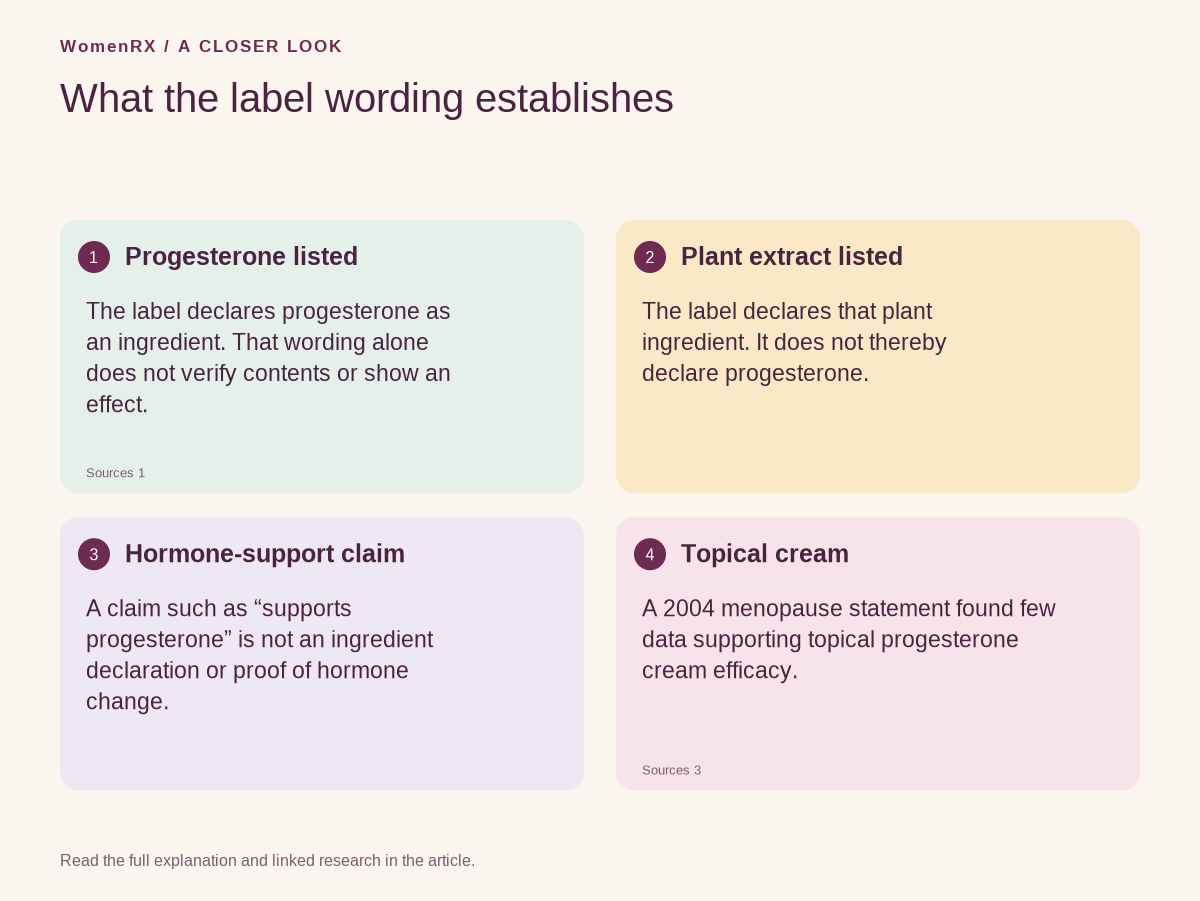
What the label wording establishes
Progesterone listed: The label declares progesterone as an ingredient. That wording alone does not verify contents or show an effect.1
Plant extract listed: The label declares that plant ingredient. It does not thereby declare progesterone.
Hormone-support claim: A claim such as “supports progesterone” is not an ingredient declaration or proof of hormone change.
Topical cream: A 2004 menopause statement found few data supporting topical progesterone cream efficacy.3
Read the figure as text
Compare the ingredient declaration with the claim: each tells you something different, and none alone proves a menopause benefit.- Progesterone listed: The label declares progesterone as an ingredient. That wording alone does not verify contents or show an effect.1
- Plant extract listed: The label declares that plant ingredient. It does not thereby declare progesterone.
- Hormone-support claim: A claim such as “supports progesterone” is not an ingredient declaration or proof of hormone change.
- Topical cream: A 2004 menopause statement found few data supporting topical progesterone cream efficacy.3
Sources you can check
- PROMETRIUM (PROGESTERONE) CAPSULE [ACERTIS PHARMACEUTICALS, LLC] | US prescribing information and patient instructionsAccessed 2026-09-25Return to first citation
- The 2022 hormone therapy position statement of The North American Menopause Society.“The 2022 Hormone Therapy Position Statement of The North American Menopause Society” Advisory Panel. · Menopause (New York, N.Y.) · 2022Return to first citation
- Treatment of menopause-associated vasomotor symptoms: position statement of The North American Menopause Society.North American Menopause Society. · Menopause (New York, N.Y.) · 2004Return to first citation