Is progesterone a supplement, and how is it different from hormone therapy?
The phrase “progesterone supplement” doesn’t tell you what’s inside a product or whether it can play the role of a prescribed hormone medicine.
Progesterone is a hormone and an ingredient in prescription medicines, but the phrase “progesterone supplement” doesn’t establish that a product contains it. Check the product’s listed ingredients, then distinguish progesterone from a different ingredient or hormone precursor. A menopause claim on a supplement isn’t evidence that it can replace a prescribed hormone therapy plan. 1 2 3
Start with what the product contains
If a package says “progesterone support” or “hormone balance,” look past that phrase to its listed ingredients. Does it list progesterone itself? If it lists DHEA instead, that’s a different substance. If it lists an herb or other compound, don’t read a hormone-related claim as proof that the product contains progesterone. Check the particular product’s packaging for its ingredients and product category, rather than trying to identify it by the wording on the front.
Progesterone is a hormone, not another name for a vitamin or herb. It can also be an ingredient in a prescription medicine. For example, the US prescribing information for Prometrium identifies micronized progesterone as its active ingredient. Dietary supplements can contain vitamins, minerals, herbs, and other ingredients, and they do not have to go through the testing that drugs do. 1 2
“Plant-derived” describes an origin, not a product category
A plant connection can make this especially confusing. Prometrium’s prescribing information says its progesterone is made from a plant-source starting material and is chemically identical to progesterone of human ovarian origin. It’s still a progesterone medicine. The starting material alone doesn’t make the finished product a dietary supplement. 2
The reverse matters too: a botanical ingredient isn’t necessarily progesterone just because its marketing mentions progesterone. In laboratory work and ovariectomized rats, the plant compound kaempferol showed activity involving progesterone receptors. That doesn’t establish that a kaempferol product contains progesterone or treats menopause symptoms in women. 4
A precursor isn’t the finished hormone
DHEA is another name you may encounter in hormone-related claims. It isn’t progesterone. A review describes DHEA as a prohormone that can be converted in the body into more potent androgens and estrogens. That pathway does not make DHEA an interchangeable form of progesterone. 3
This is why ingredient identity is more useful than a broad promise to “support hormones.” A claim about one hormone cannot tell you what a different ingredient will do in your body, or whether it will help the menopause symptom you want to address.
Why the distinction matters for hormone therapy
A prescribed hormone therapy plan is more than a hormone-related claim. It involves specific medicines used for a specific purpose. In a clinical trial described in Prometrium’s prescribing information, postmenopausal women with intact uteri received conjugated estrogen with progesterone, estrogen alone, or placebo. During treatment lasting up to 36 months, endometrial hyperplasia, a change in the uterine lining, was less common in the estrogen-plus-progesterone group than in the estrogen-only group. That result concerns those medicines and that study population. It does not show that a supplement can fill progesterone’s role in a prescribed plan. 2
When you’re comparing products, keep three questions separate: What ingredient is listed? Is the product a supplement or a medicine? What evidence supports its specific menopause claim? Getting the first answer doesn’t automatically answer the other two. If you already use prescribed hormone therapy, bring the package or ingredient list to the clinician managing it before treating a similarly named product as a substitute. MedlinePlus advises telling your healthcare provider about supplements you use. 1 2
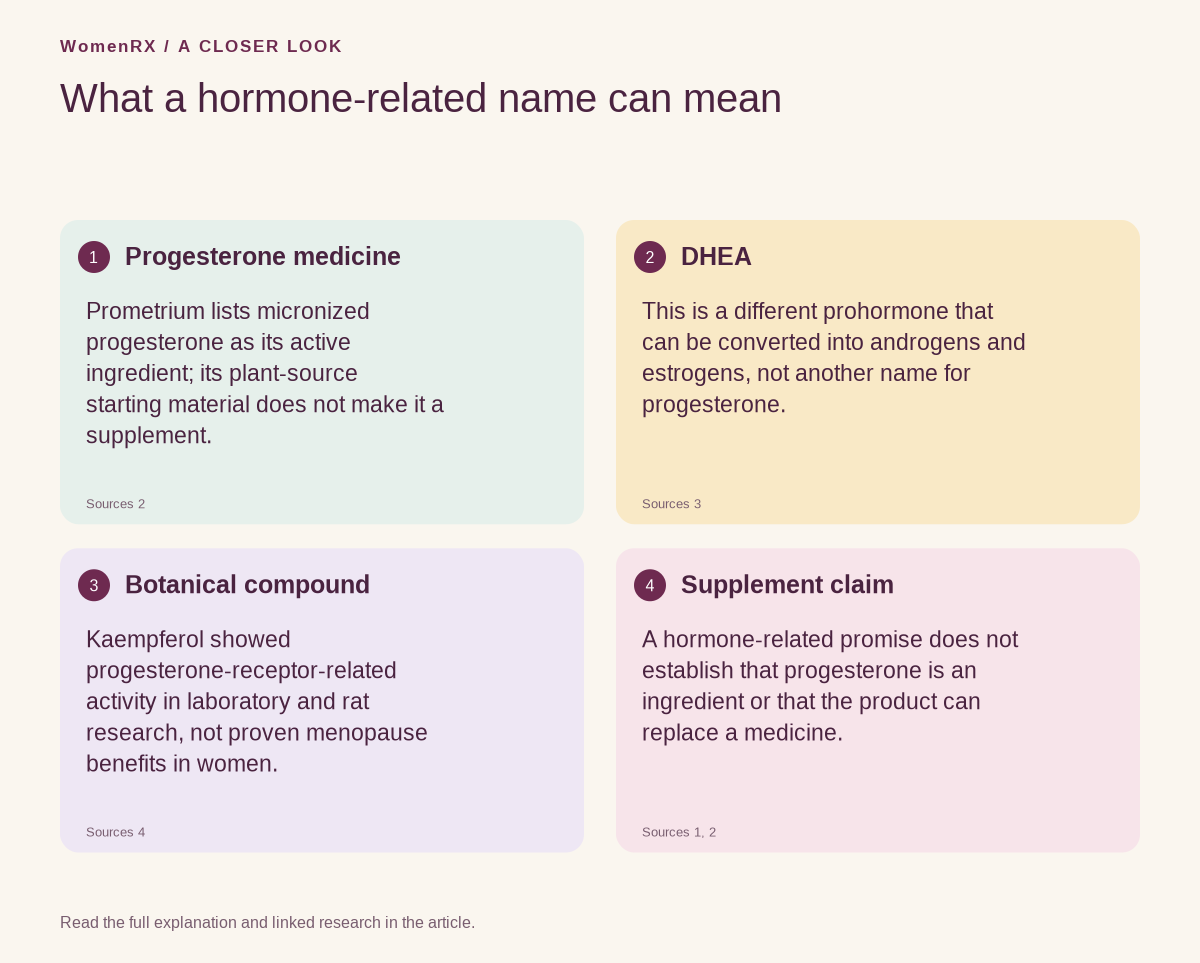
What a hormone-related name can mean
Progesterone medicine: Prometrium lists micronized progesterone as its active ingredient; its plant-source starting material does not make it a supplement.2
DHEA: This is a different prohormone that can be converted into androgens and estrogens, not another name for progesterone.3
Botanical compound: Kaempferol showed progesterone-receptor-related activity in laboratory and rat research, not proven menopause benefits in women.4
Supplement claim: A hormone-related promise does not establish that progesterone is an ingredient or that the product can replace a medicine.12
Read the figure as text
Compare the ingredient and evidence before deciding whether a product resembles a prescribed progesterone medicine.- Progesterone medicine: Prometrium lists micronized progesterone as its active ingredient; its plant-source starting material does not make it a supplement.2
- DHEA: This is a different prohormone that can be converted into androgens and estrogens, not another name for progesterone.3
- Botanical compound: Kaempferol showed progesterone-receptor-related activity in laboratory and rat research, not proven menopause benefits in women.4
- Supplement claim: A hormone-related promise does not establish that progesterone is an ingredient or that the product can replace a medicine.12
More questions, answered
Does plant-derived progesterone mean a product is a supplement?
No. Prometrium’s progesterone is made from a plant-source starting material, but Prometrium is a prescription medicine containing micronized progesterone. The ingredient’s origin doesn’t determine the finished product’s category. 2
Is DHEA another name for progesterone?
No. DHEA is a different substance. It’s described as a prohormone that can be converted into androgens and estrogens, not as another name for progesterone. 3
Sources you can check
- Dietary Supplements: MedlinePlusAccessed 2026-09-25Return to first citation
- PROMETRIUM (PROGESTERONE) CAPSULE [ACERTIS PHARMACEUTICALS, LLC] | US prescribing information and patient instructionsAccessed 2026-09-25Return to first citation
- Therapeutic effects of progestins, androgens, and tibolone for menopausal symptoms.Liu JH. · The American journal of medicine · 2005Return to first citation
- Kaempferol Exhibits Progestogenic Effects in Ovariectomized Rats.Toh MF, Mendonca E, Eddie SL, Endsley MP, Lantvit DD, Petukhov PA, Burdette JE. · Journal of steroids & hormonal science · 2014Return to first citation