Wegovy and Food: Find Your Tolerable Routine
If meals feel uncomfortable on Wegovy, test a manageable change in how you eat without turning it into a list of forbidden foods.
Nausea and early fullness can occur with semaglutide, but these studies don’t test individual food triggers or establish a food avoid list. 24 If a large meal seems to leave you uncomfortable, try dividing the same food into smaller eating occasions and notice whether that helps without reducing what you eat overall. If symptoms make it hard to eat or drink enough, tell your prescriber. 13
Start with what your symptoms actually do
If you’re taking Wegovy and feeling nauseated, overly full, or otherwise uncomfortable after eating, it’s natural to look for a food to blame. Semaglutide studies report digestive side effects, but they don’t test individual food triggers or establish a food list that everyone taking Wegovy needs to avoid. So they can’t show that eliminating a particular food will help. Cutting out foods without a clear reason can also make it harder to eat a varied, nourishing diet. 241
Semaglutide may affect how the stomach functions. In a small pilot study, eight people without gastrointestinal symptoms were assessed before and while taking semaglutide; researchers observed changes in gastric electrical measures, and early fullness increased. That study offers one possible clue about why meals may feel different, but it was too small to tell us which foods will trigger symptoms or whether a particular eating plan will relieve them. 4
Test the size of a meal, not your willpower
Suppose a large dinner often leaves you feeling overly full. You could try eating part of that dinner first and having the rest at another eating occasion, rather than leaving it uneaten. Notice whether the uncomfortable fullness changes when you do this more than once. This is a way to learn what feels manageable for you, not a proven treatment or a reason to eat less overall.
Keep the comparison simple: did you eat roughly the same foods, did the symptom ease, and were you still able to eat and drink enough over the day? A brief note may help you remember, but you don’t need to track every bite or count calories. If the change doesn’t help, you haven’t failed a diet. You’ve learned that meal size alone may not explain what you’re feeling.
If a change helps, check that your overall eating still offers a range of foods and the nutrients and fluids you need. Healthy eating doesn’t require a very strict diet or avoiding favorite foods altogether. 1
When symptoms start crowding out nutrition
A smaller appetite or ongoing nausea can make it difficult to eat enough. Persistent gastrointestinal symptoms and marked weight loss deserve attention: a review identified six published cases of Wernicke’s encephalopathy after semaglutide treatment for obesity, and all six involved prolonged gastrointestinal symptoms and substantial weight loss before neurological deterioration. These case reports can’t tell us how common the complication is, but they underline why continuing difficulty eating shouldn’t be dismissed as something you simply have to tolerate. 3
Let your prescriber know if nausea, vomiting, or appetite loss is stopping you from eating or drinking enough. Bring a few concrete observations: what symptoms you notice, when they tend to occur, and whether any one change seems to help. A prescriber or dietitian can help you protect nutrition while considering what to do about symptoms; you don’t have to solve the problem by narrowing your diet further.
If pregnancy or breastfeeding is part of the picture
If you’re planning a pregnancy, pregnant, or breastfeeding, bring questions about nutrition and digestive symptoms to your clinician or dietitian so advice can account for your situation.
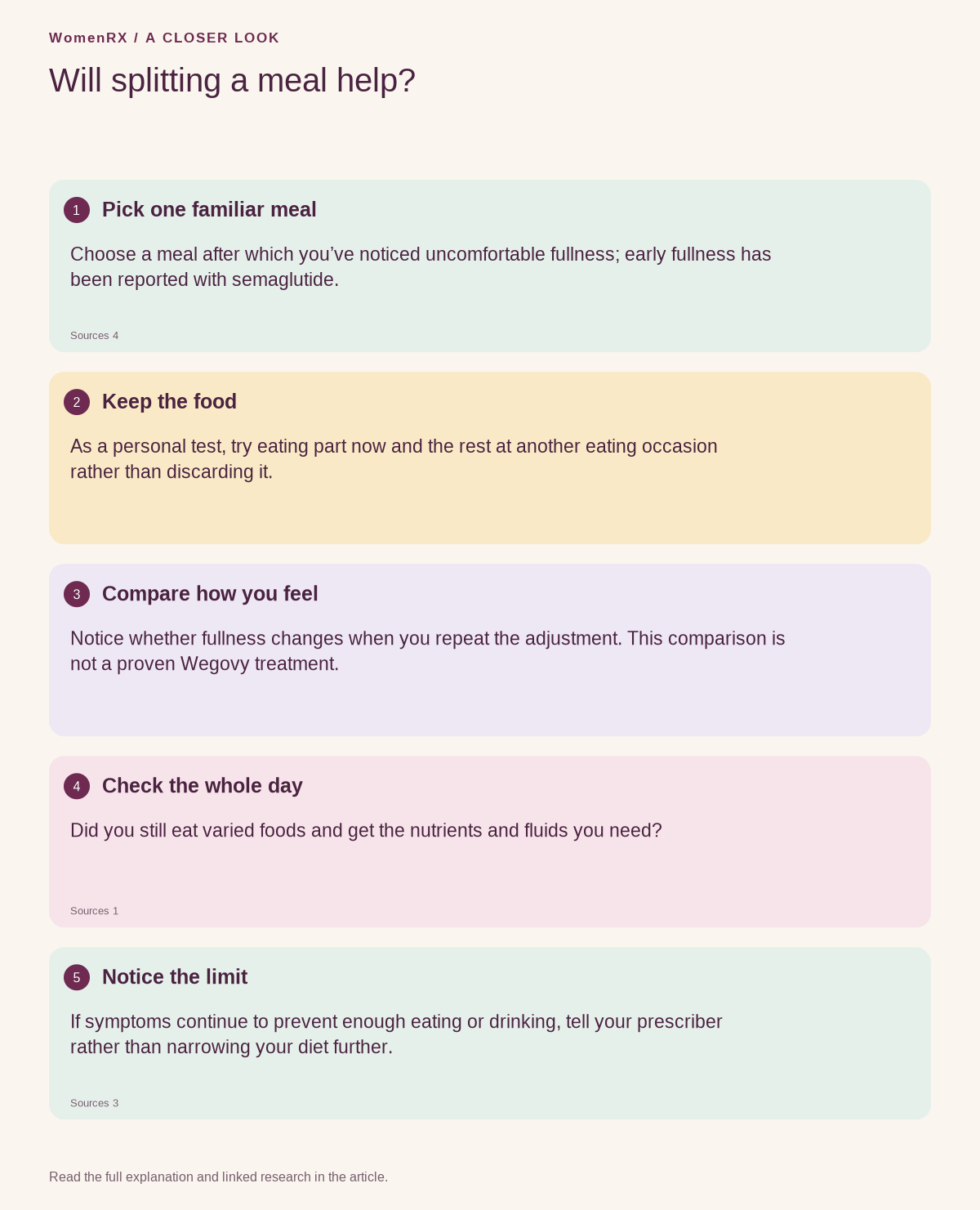
Will splitting a meal help?
Pick one familiar meal: Choose a meal after which you’ve noticed uncomfortable fullness; early fullness has been reported with semaglutide.4
Keep the food: As a personal test, try eating part now and the rest at another eating occasion rather than discarding it.
Compare how you feel: Notice whether fullness changes when you repeat the adjustment. This comparison is not a proven Wegovy treatment.
Check the whole day: Did you still eat varied foods and get the nutrients and fluids you need?1
Notice the limit: If symptoms continue to prevent enough eating or drinking, tell your prescriber rather than narrowing your diet further.3
Read the figure as text
An optional way to assess a large-meal pattern without automatically cutting food from your day.- Pick one familiar meal: Choose a meal after which you’ve noticed uncomfortable fullness; early fullness has been reported with semaglutide.4
- Keep the food: As a personal test, try eating part now and the rest at another eating occasion rather than discarding it.
- Compare how you feel: Notice whether fullness changes when you repeat the adjustment. This comparison is not a proven Wegovy treatment.
- Check the whole day: Did you still eat varied foods and get the nutrients and fluids you need?1
- Notice the limit: If symptoms continue to prevent enough eating or drinking, tell your prescriber rather than narrowing your diet further.3
More questions, answered
Should I stop eating a food that seems to trigger symptoms?
Not necessarily. First consider whether the amount you ate, rather than the food itself, might be part of the pattern. If you try a change, check whether it helps while you still eat a varied diet. The semaglutide studies described here don’t test individual food triggers or establish specific foods to eliminate. 241
What if I can’t eat or drink enough?
Tell your prescriber if ongoing symptoms are getting in the way of eating or drinking enough. A review of six published Wernicke’s encephalopathy cases after semaglutide treatment for obesity reported prolonged gastrointestinal symptoms and substantial weight loss in all six before neurological deterioration. Case reports can’t estimate how likely this complication is. 3
Sources you can check
- Nutrition: MedlinePlusAccessed 2026-09-25Return to first citation
- Real-World Comparison of Short-Term Adverse Events, Treatment Persistence, and Efficacy of Semaglutide and Tirzepatide: A Nationwide Multicenter Study.Hepşen S, Haymana C, Ertepe Küçükgöde G, Özcan B, Özbaş B, Or Koca A, Aydoğan Bİ, Tura Bahadır Ç, Durcan E, Yumuk V, Toros B, Alphan Üç Z, Önder ÇE, Karaca Karagöz Z, Aşık M, Öztür... · Obesity facts · 2026Return to first citation
- Wernicke's Encephalopathy Following Semaglutide Treatment for Obesity: A Systematic PRISMA Review of Case-Based Evidence.Bidesie J, Oudman E. · Obesity (Silver Spring, Md.) · 2026Return to first citation
- Semaglutide Induces Changes in Gastric Electrical Activity in Patients With Overweight and Obesity: A Pilot Study.Abraham R, Foong D, Piya M, Grudzinskas K, Ho V. · Journal of neurogastroenterology and motility · 2026Return to first citation