Zepbound and Food: A Gentler Way to Find What Works
Zepbound doesn’t make a whole food group off-limits, but smaller meals and noticing patterns may help when eating feels uncomfortable.
There isn’t a universal list of foods everyone needs to avoid on Zepbound. If nausea, diarrhea, constipation, or vomiting is affecting meals, try smaller, more frequent meals, stay hydrated, and notice whether richer or very sugary foods seem to make your symptoms worse. If symptoms persist, contact your prescriber rather than narrowing your diet on your own. 2 3
Start with meal patterns, not a forbidden-food list
If eating on Zepbound feels different, it’s understandable to wonder what you should cut out. Current guidance does not establish a universal list of foods that are unsafe for everyone taking tirzepatide. A review of gastrointestinal effects from incretin medicines, including tirzepatide, describes smaller, more frequent meals, adequate hydration, and avoiding high-fat or high-sugar foods as possible symptom-management strategies. Think of the food suggestions as a cautious trial, not a rule that every person needs to follow. 2
Tirzepatide can be associated with gastrointestinal symptoms such as nausea, diarrhea, vomiting, and constipation. These are common treatment side effects in the clinical evidence, and a review reports that they often occur during dose escalation and may ease as treatment continues. That doesn’t mean you have to push through symptoms that are interfering with eating or drinking. 3
Try one change at a time
A practical way to learn what suits you is to adjust meal patterns first, then observe. For example, if a large meal leaves you uncomfortable, try a smaller portion and see whether that feels better. If a rich or very sugary meal seems to precede symptoms, note that and try a different meal next time. The review’s advice to avoid high-fat or high-sugar foods is a starting point for symptom management, not proof that those foods cause symptoms for everyone. 2
Changing one thing at a time can make your notes more useful. You might jot down what and roughly how much you ate, when symptoms began, what they felt like, and whether the discomfort affected your ability to eat or drink. You can also note whether your treatment was recently adjusted. This isn’t a diagnostic test or a validated tracking tool; it’s a way to see whether a pattern is clear enough to discuss with your care team.
Try not to respond to discomfort by cutting out several food groups at once. If symptoms keep returning, you’re struggling to get enough food or fluids, or your eating is becoming stressful, ask your prescriber about next steps. A registered dietitian can help you adapt meals without making the list of foods you can eat smaller than it needs to be. For ongoing symptoms, the clinical review recommends considering symptom-relief options with a clinician. 2
Know when food experiments aren’t the answer
Severe stomach-area pain that won’t go away needs prompt medical attention, whether or not you also feel nauseated or vomit. The Zepbound Medication Guide says to stop using the medicine and call your healthcare provider right away for this symptom because it can be a sign of pancreatitis. Don’t try to manage severe, persistent pain by changing what you eat. 1
If treatment intersects with pregnancy planning, breastfeeding, or a history of disordered eating, ask your prescriber for an individualized plan before making food restrictions. Those circumstances deserve a conversation that accounts for your health and eating needs, not a one-size-fits-all food list.
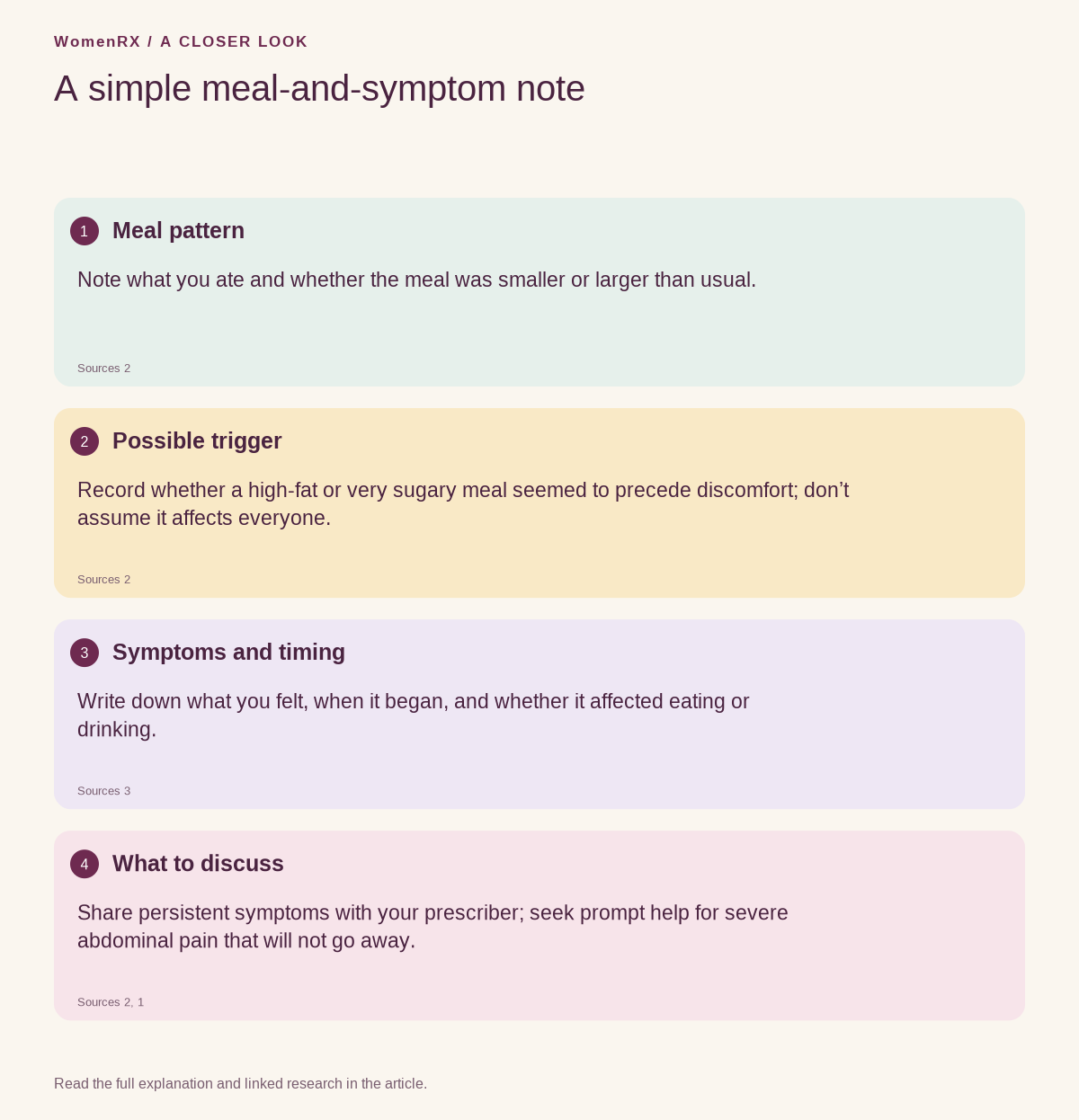
A simple meal-and-symptom note
Meal pattern: Note what you ate and whether the meal was smaller or larger than usual.2
Possible trigger: Record whether a high-fat or very sugary meal seemed to precede discomfort; don’t assume it affects everyone.2
Symptoms and timing: Write down what you felt, when it began, and whether it affected eating or drinking.3
What to discuss: Share persistent symptoms with your prescriber; seek prompt help for severe abdominal pain that will not go away.21
Read the figure as text
Use these prompts to notice personal patterns and share useful context with your care team. This is a conversation aid, not a diagnostic checklist.- Meal pattern: Note what you ate and whether the meal was smaller or larger than usual.2
- Possible trigger: Record whether a high-fat or very sugary meal seemed to precede discomfort; don’t assume it affects everyone.2
- Symptoms and timing: Write down what you felt, when it began, and whether it affected eating or drinking.3
- What to discuss: Share persistent symptoms with your prescriber; seek prompt help for severe abdominal pain that will not go away.21
More questions, answered
Should I stop eating high-fat foods on Zepbound?
Not necessarily. A review of incretin medicines suggests avoiding high-fat foods as one possible way to manage gastrointestinal symptoms, but it doesn’t establish that everyone taking Zepbound needs to eliminate them. If you suspect a connection, try observing your own pattern and discuss persistent symptoms with your prescriber. 2
What if nausea or other symptoms keep affecting meals?
Contact your prescriber if symptoms persist or make it hard to eat or drink. A clinical review recommends clinician-guided symptom relief when dietary changes aren’t enough. Severe stomach-area pain that won’t go away needs prompt medical attention. 2 1
Sources you can check
- ZEPBOUND (TIRZEPATIDE) INJECTION, SOLUTION ZEPBOUND (TIRZEPATIDE) INJECTION, SOLUTION ZEPBOUND KWIKPEN (TIRZEPATIDE) INJECTION, SOLUTION [ELI LILLY AND COMPANY] | US prescribing information and patient instructionsAccessed 2026-09-25Return to first citation
- GLP1 and GIP Receptor Agonists: Effects on the Gastrointestinal Tract and Management Strategies for Primary Care Physicians.Saha B, Kamalumpundi V, Codipilly DC. · Mayo Clinic proceedings · 2025Return to first citation
- Tirzepatide for obesity without diabetes: mechanistic insights, clinical evidence, and future directions.He WT, Song YD, Wang XY, He SY, Tao X, Yuan SX, Zhou L, Long EW. · Frontiers in pharmacology · 2026Return to first citation