Eating on Mounjaro: Foods That May Worsen Digestive Symptoms
There’s no universal Mounjaro food-ban list; smaller meals and noticing your own symptom patterns may be a more useful place to start.
No specific food is identified here as something everyone must avoid while taking Mounjaro. Digestive symptoms are common with tirzepatide, and a clinical review suggests trying smaller, more frequent meals, adequate hydration, and limiting high-fat or high-sugar foods if they seem to aggravate symptoms. Treat those as possible adjustments, not rules: notice what you ate and how you felt before cutting out whole food groups. 2 3
Start with symptoms, not a forbidden-food list
Nausea, vomiting, diarrhea, constipation, and abdominal discomfort can happen with tirzepatide. That doesn’t mean a particular food caused every episode, or that you need to avoid an entire category. A review of gastrointestinal effects from incretin medicines suggests trying smaller, more frequent meals, staying adequately hydrated, and avoiding high-fat or high-sugar foods as possible symptom-management steps. These are practical options to test against your own experience, not proof that those foods trigger symptoms for everyone. 2 3
Mounjaro also affects stomach emptying, which can be part of the digestive picture. A food-and-symptom note may help you see whether certain meals seem to coincide with discomfort, but it can’t establish the cause on its own. Symptoms may also relate to the medicine, changes in eating, or another health issue. 3
Make one gentle adjustment at a time
If symptoms tend to follow a particular meal, start with a modest change rather than a sweeping restriction. For example, you might try a smaller portion, split a large meal into smaller eating occasions, or choose a less rich option and see whether that feels better. If a very sugary meal seems to be a pattern for you, note that too. These are examples of ways to test the review’s general suggestions, not prescribed meal rules. 3
Keep fluids in view, especially when nausea, vomiting, or diarrhea makes eating and drinking harder. The review recommends adequate hydration, but the right approach can depend on your health and circumstances. If you’re struggling to keep fluids down or symptoms are continuing, don’t rely on food changes alone; contact the clinician managing your treatment. 3
Avoid responding to one uncomfortable day by removing multiple food groups. A short note can be enough: what and roughly when you ate, when symptoms began, what they felt like, and whether you could drink normally. Include the medicine timing or any recent treatment changes if you know them. This isn’t a validated diagnostic tool; it’s a way to bring a clearer pattern to a conversation about what to try next.
Keep the question focused on your own pattern
A useful question is not just “Which foods are bad on Mounjaro?” It’s “Do my symptoms repeatedly follow a certain kind of meal, and does a small change help?” If a pattern isn’t clear, that’s a reason to avoid making a long-term restriction based on guesswork. A clinician or registered dietitian can help you think through nutrition and symptom management, particularly if eating has become stressful or hard to maintain.
This advice does not establish different food triggers for women. If pregnancy or breastfeeding, menstrual symptoms, or a history of disordered eating affects what feels safe or manageable for you, seek individualized nutrition and medical support rather than using a restrictive avoid list.
Know when food adjustments aren’t enough
Severe abdominal pain that does not go away, with or without nausea or vomiting, needs prompt attention: Mounjaro’s medication guide says to stop using it and call your healthcare provider right away in that situation. Upper abdominal pain can also be a symptom of a gallbladder problem and should be reported promptly. 1
For milder digestive discomfort, a simple meal-and-symptom note can help you and your care team decide whether a small adjustment makes sense. The aim is to find what works for you, not to follow a universal list of foods to fear.
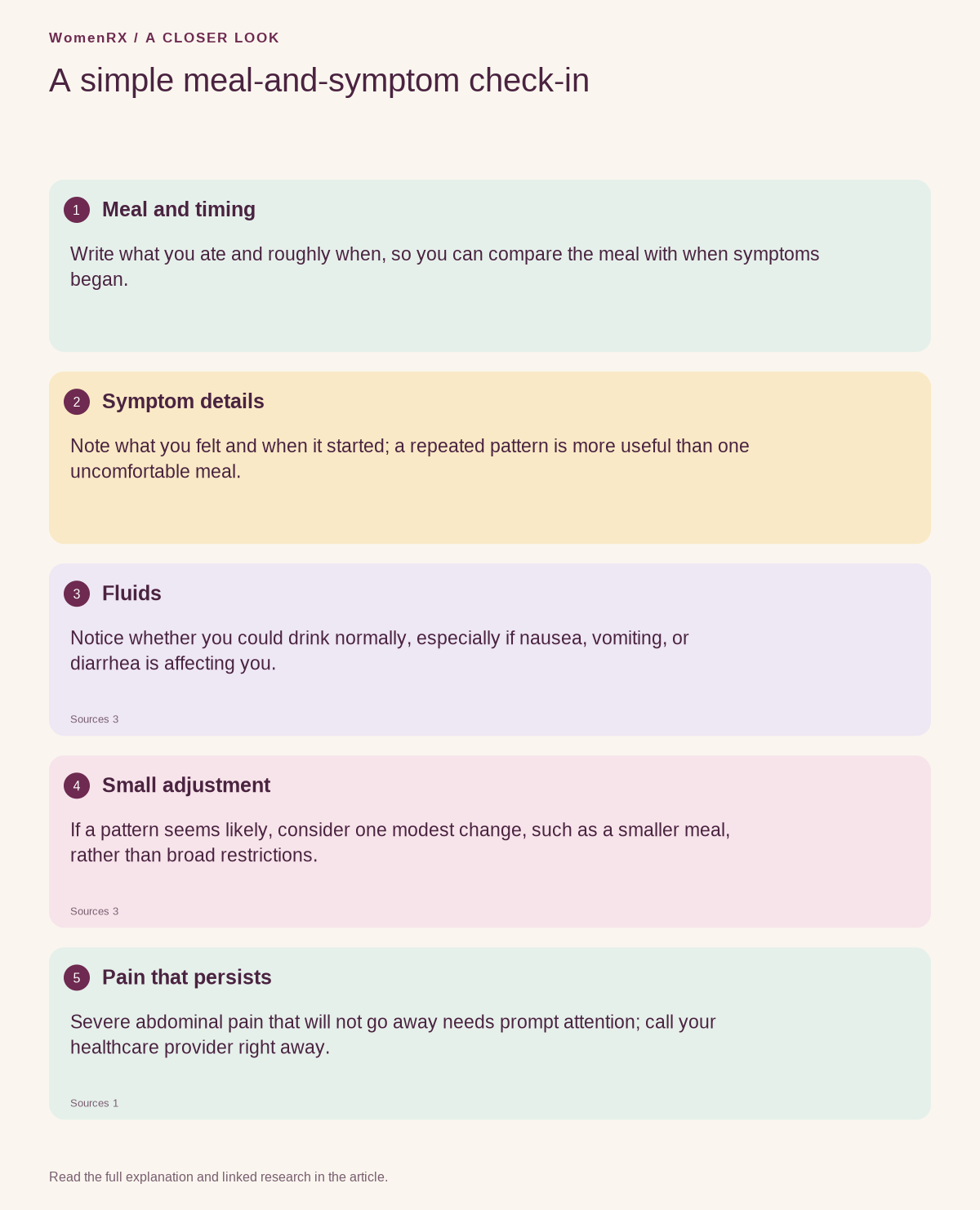
A simple meal-and-symptom check-in
Meal and timing: Write what you ate and roughly when, so you can compare the meal with when symptoms began.
Symptom details: Note what you felt and when it started; a repeated pattern is more useful than one uncomfortable meal.
Fluids: Notice whether you could drink normally, especially if nausea, vomiting, or diarrhea is affecting you.3
Small adjustment: If a pattern seems likely, consider one modest change, such as a smaller meal, rather than broad restrictions.3
Pain that persists: Severe abdominal pain that will not go away needs prompt attention; call your healthcare provider right away.1
Read the figure as text
Use these prompts to notice patterns and describe them clearly without treating the notes as a diagnosis or a reason to cut out whole food groups.- Meal and timing: Write what you ate and roughly when, so you can compare the meal with when symptoms began.
- Symptom details: Note what you felt and when it started; a repeated pattern is more useful than one uncomfortable meal.
- Fluids: Notice whether you could drink normally, especially if nausea, vomiting, or diarrhea is affecting you.3
- Small adjustment: If a pattern seems likely, consider one modest change, such as a smaller meal, rather than broad restrictions.3
- Pain that persists: Severe abdominal pain that will not go away needs prompt attention; call your healthcare provider right away.1
More questions, answered
Should I avoid high-fat or sugary foods completely?
Not necessarily. A clinical review suggests avoiding high-fat or high-sugar foods as a possible way to manage symptoms, but that does not make them universally prohibited. If you suspect a connection, try a modest change and note whether your symptoms shift. 3
What should I write down when I’m tracking symptoms?
Note what and roughly when you ate, when symptoms began, what they felt like, and whether you could drink normally. Include any treatment changes you know about. Use the notes to describe a pattern, not to diagnose the cause.
Sources you can check
- MOUNJARO (TIRZEPATIDE) INJECTION, SOLUTION MOUNJARO KWIKPEN (TIRZEPATIDE) INJECTION, SOLUTION [ELI LILLY AND COMPANY] | US prescribing information and patient instructionsAccessed 2026-09-25Return to first citation
- Efficacy and safety of tirzepatide for weight loss in patients with obesity or type 2 diabetes: a systematic review and meta-analysis.Tian Q, Song Y, Deng Y, Lin S. · Frontiers in endocrinology · 2025Return to first citation
- GLP1 and GIP Receptor Agonists: Effects on the Gastrointestinal Tract and Management Strategies for Primary Care Physicians.Saha B, Kamalumpundi V, Codipilly DC. · Mayo Clinic proceedings · 2025Return to first citation