Rhodiola After 40: What the Evidence Can Tell You
Research in older adults and on PMS doesn’t show that rhodiola treats perimenopause symptoms.
There’s no clear evidence here that rhodiola helps perimenopause or menopause symptoms. One 12-week study included adults ages 50-89, but tested rhodiola alongside vitamins and minerals without a placebo comparison, so it can’t show whether rhodiola caused the reported improvements. A small PMS trial tested a multi-ingredient product and found no significant difference between it and placebo. 1 2
Age 40 isn’t the dividing line
Being over 40 doesn’t, by itself, make rhodiola more likely to work. The useful question is whether the research tested people with your concern, at a life stage like yours, and whether it tested rhodiola on its own.
For perimenopause-related fatigue, stress, mood changes, or sleep problems, these studies don’t provide a direct answer. They don’t report results specifically for perimenopausal women or test rhodiola as a treatment for menopause symptoms. That means a benefit for those concerns hasn’t been established by this research, not that a benefit has been ruled out.
What the studies actually tested
A 12-week drug-monitoring study included 120 adults ages 50-89: 83 women and 37 men. Participants took an extract of Rhodiola rosea together with vitamins and minerals. The study reported improvements in physical and cognitive complaints, including exhaustion, concentration difficulties, and susceptibility to stress. But the abstract reports no placebo comparison, and the combination product means the changes can’t be attributed to rhodiola alone. It also doesn’t say whether participants were perimenopausal or postmenopausal. 1
The other study is about a different life-stage concern. It tested a supplement containing rhodiola, GABA, chasteberry, vitamin B6, and melatonin in 42 women with premenstrual syndrome over three months. Some measures improved within the supplement group, but the comparison between the supplement and placebo groups found no statistically significant differences. Because the product had several ingredients and studied PMS rather than perimenopause, it doesn’t establish that rhodiola alone helps midlife symptoms. 2
Match the evidence to your goal
- For menopause symptoms: These studies don’t show that rhodiola treats hot flashes, sleep disruption, mood changes, or other menopause-related concerns. Don’t treat the older-adult study as menopause evidence just because it included people over 50.
- For general energy or stress: The older-adult study offers a limited signal, but not a reliable estimate of rhodiola’s effect by itself. It tested a combination product without a placebo comparison. 1
- For premenstrual symptoms: The small placebo-controlled study tested a blend, not rhodiola alone, and didn’t find a significant between-group difference. 2
If you’re considering a product, check whether it contains rhodiola alone or a blend. With a blend, any effect or side effect could come from another ingredient, and results from one formula won’t necessarily apply to another. If you take medicines, have a pharmacist review the exact product and your medication list; these studies don’t establish which medicines may interact with rhodiola or combination products.
A practical bottom line
If your main reason for considering rhodiola is a perimenopause symptom, this evidence doesn’t give you a strong basis to expect it to help. If you’re considering it for general energy or stress, know that the encouraging older-adult findings came from a combination product and weren’t compared with placebo. The answer is not that rhodiola can’t work, but that these results don’t tell you whether it will help with your specific goal.
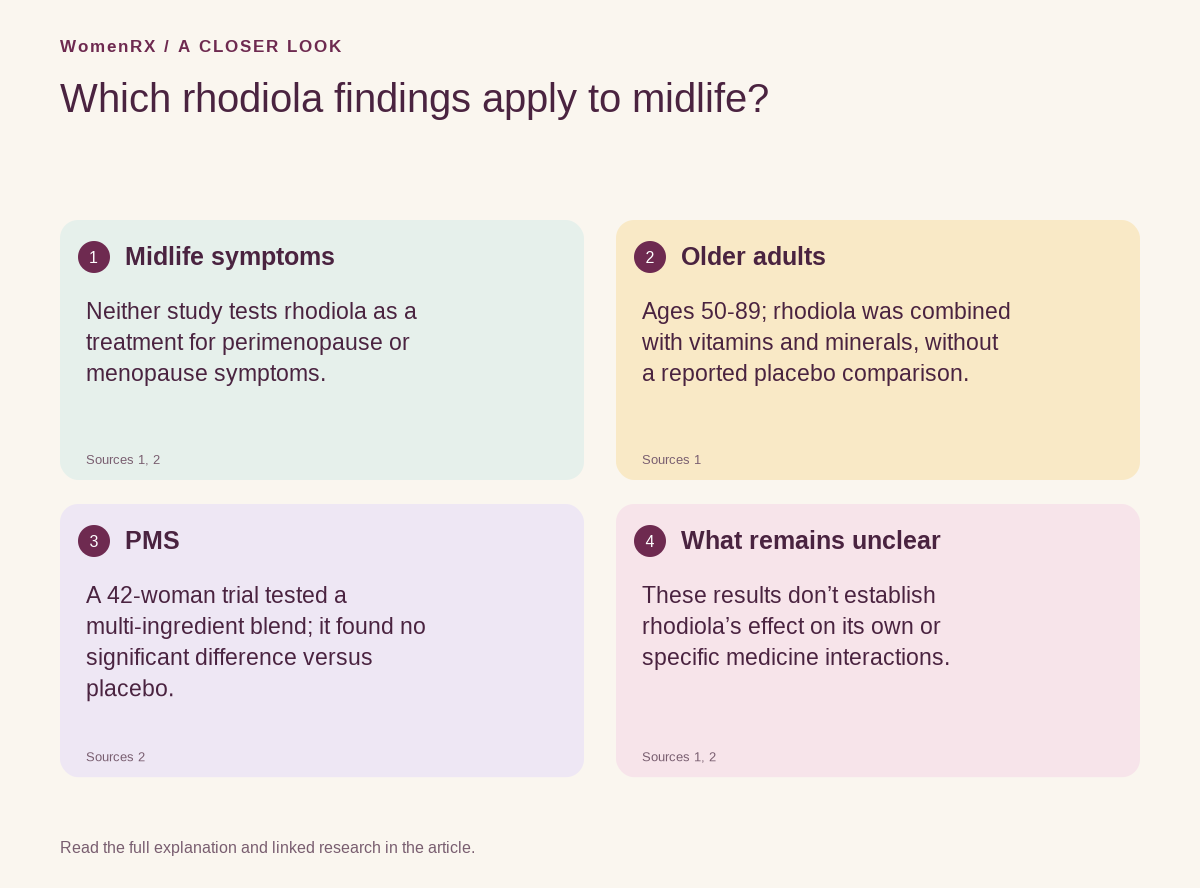
Which rhodiola findings apply to midlife?
Midlife symptoms: Neither study tests rhodiola as a treatment for perimenopause or menopause symptoms.12
Older adults: Ages 50-89; rhodiola was combined with vitamins and minerals, without a reported placebo comparison.1
PMS: A 42-woman trial tested a multi-ingredient blend; it found no significant difference versus placebo.2
What remains unclear: These results don’t establish rhodiola’s effect on its own or specific medicine interactions.12
Read the figure as text
The study populations and products show why older-adult or PMS findings don’t directly answer whether rhodiola helps perimenopause.- Midlife symptoms: Neither study tests rhodiola as a treatment for perimenopause or menopause symptoms.12
- Older adults: Ages 50-89; rhodiola was combined with vitamins and minerals, without a reported placebo comparison.1
- PMS: A 42-woman trial tested a multi-ingredient blend; it found no significant difference versus placebo.2
- What remains unclear: These results don’t establish rhodiola’s effect on its own or specific medicine interactions.12
Sources you can check
- Efficacy and tolerability of a Rhodiola rosea extract in adults with physical and cognitive deficiencies.Fintelmann V, Gruenwald J. · Advances in therapy · 2007Return to first citation
- Effects of the PREMEN-CALM® in the Management of the Premenstrual Syndrome: A Randomized, Double-Blind, Placebo-Controlled Pilot Study.Herrera A, Al Adib M, Rodríguez AB, Carrasco C. · Journal of dietary supplements · 2024Return to first citation