Perimenopause, GLP-1 Treatment, and Fatigue: What to Check
Treatment changes, eating, sleep, and menstrual symptoms offer different clues when fatigue starts during perimenopause.
If fatigue starts while you’re taking a GLP-1 medicine, compare its onset with when treatment began or changed, then look separately at eating, sleep, and menstrual changes. A semaglutide trial reported an adverse event called asthenia, not a direct fatigue measure for perimenopausal women. Poor sleep, anemia, thyroid disease, and other medicines are also possible contributors. 1 3 4
Start with the timing, not an assumption
Fatigue is a symptom, not a diagnosis. It may begin around the time a medicine is started or changed, but that timing alone doesn’t prove the medicine caused it. If you’re considering a GLP-1 medicine and already feel tired, make a brief note of your usual energy, sleep, and eating beforehand. If you’re already taking one, note when fatigue began and whether it changed around a treatment adjustment. That comparison can make the pattern easier to discuss without asking you to decide the cause on your own.
There is a medication-specific clue for semaglutide, but it has limits. In a 26-week randomized pilot study of 104 adults with type 2 diabetes, an adverse event reported as asthenia was more common in the label-titration group than in the flexible-titration group: 24.5% versus 9.8%. The abstract reports that adverse-event term, not a direct fatigue measure. The study compared titration approaches, not treatment with no treatment, and did not report results for perimenopausal women. It can’t tell you whether semaglutide is the reason you feel tired, or whether the finding applies to other medicines or populations. 4
For liraglutide, the US Saxenda prescribing information says weight loss occurs through reduced calorie intake. If your eating has changed alongside fatigue, that’s worth discussing, but the label does not show that reduced intake caused the fatigue. The same label says liraglutide delays stomach emptying and could affect absorption of oral medicines, although the oral medicines tested in its clinical pharmacology trials were not affected to a clinically relevant degree. Mention other oral medicines if their effects seem to have changed. These are product-specific points about liraglutide, not findings that apply automatically to every GLP-1 medicine. 2
One observational study offers another limited clue: among 183 people with type 2 diabetes in Pakistan taking a combination of liraglutide and insulin, 9 people (5%) reported fatigue at six months. Because the study was retrospective and involved both medicines, it can’t isolate liraglutide’s effect or predict what a person taking a GLP-1 medicine alone will experience. 5
Give perimenopause its own track
Periods can become irregular just before menopause, and the amount of bleeding can change. If fatigue comes with newly heavy bleeding, bring up the bleeding specifically: heavy periods can be investigated, and anemia is a separate possible cause of fatigue. Neither a changing cycle nor fatigue alone tells you that anemia is present. 1 3
Keep sleep and other symptoms distinct, too. If you’re having broken nights, ask whether fatigue is worse after them; inadequate sleep is a recognized contributor to fatigue. If you’re also having bothersome hot flashes, mention those separately rather than assuming they explain the sleep change or the fatigue. Hot flashes are a menopause symptom with treatment options, but their presence doesn’t settle what’s causing your tiredness. 1 6 7
These patterns can overlap. Fatigue that began after a treatment change, for example, could occur at the same time as disrupted sleep or heavier periods. Looking at both tracks helps keep a plausible clue from becoming an automatic answer.
What different patterns are worth checking?
If fatigue followed a treatment adjustment and eating has become harder, discuss both changes together. That’s a more useful medication review than timing alone, without assuming that eating less caused the fatigue. If tiredness follows broken sleep instead, the sleep pattern deserves attention even when treatment timing also seems suspicious. If bleeding has become heavy, raise that directly rather than filing it under ordinary perimenopause changes. 1 2 3
A review can also look beyond menopause and medication. MedlinePlus lists sleep disorders, anemia, thyroid disease, depression or anxiety, chronic illness, and some medicines among possible causes of fatigue. That doesn’t mean you have any one of them. It means fatigue without a clear pattern, or fatigue that persists, deserves a broader look. 1
If fatigue continues for several weeks or gets in the way of daily activities, arrange a medical review. Questions about sleep, appetite, and daily activities, along with an exam or lab tests, may help identify a cause. Bring the patterns that stand out: treatment timing, a change in eating, broken sleep, heavy bleeding, or a change in how another medicine seems to work. Don’t change your treatment based on a symptom pattern alone. 1 2 3
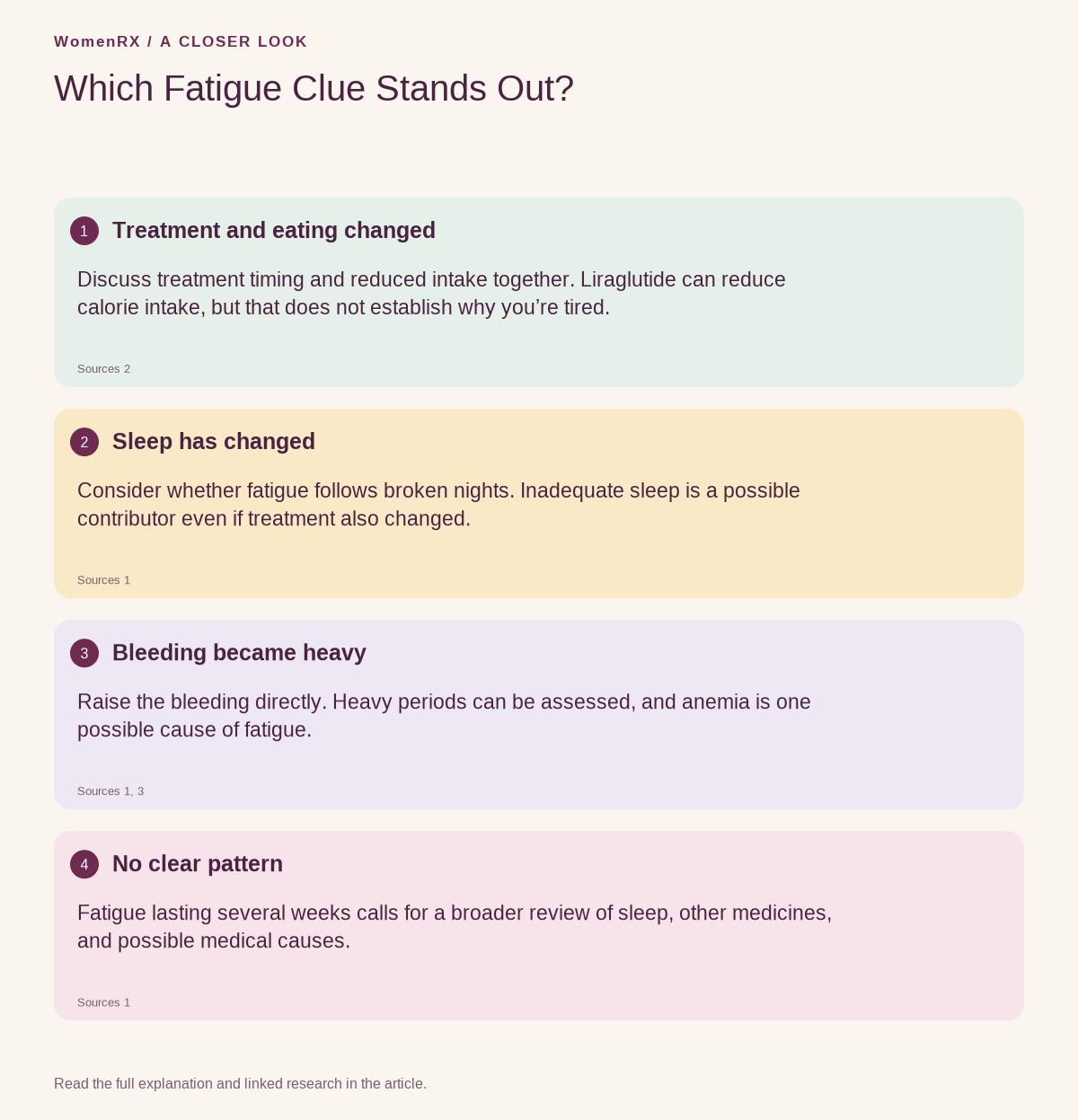
Which Fatigue Clue Stands Out?
Treatment and eating changed: Discuss treatment timing and reduced intake together. Liraglutide can reduce calorie intake, but that does not establish why you’re tired.2
Sleep has changed: Consider whether fatigue follows broken nights. Inadequate sleep is a possible contributor even if treatment also changed.1
Bleeding became heavy: Raise the bleeding directly. Heavy periods can be assessed, and anemia is one possible cause of fatigue.13
No clear pattern: Fatigue lasting several weeks calls for a broader review of sleep, other medicines, and possible medical causes.1
Read the figure as text
Start with what changed alongside fatigue. More than one branch may fit, and none is a diagnosis.- Treatment and eating changed: Discuss treatment timing and reduced intake together. Liraglutide can reduce calorie intake, but that does not establish why you’re tired.2
- Sleep has changed: Consider whether fatigue follows broken nights. Inadequate sleep is a possible contributor even if treatment also changed.1
- Bleeding became heavy: Raise the bleeding directly. Heavy periods can be assessed, and anemia is one possible cause of fatigue.13
- No clear pattern: Fatigue lasting several weeks calls for a broader review of sleep, other medicines, and possible medical causes.1
More questions, answered
Does the semaglutide study apply to tirzepatide?
No. The cited trial studied semaglutide in adults with type 2 diabetes and compared two titration approaches. It does not establish a fatigue effect for tirzepatide, liraglutide, or perimenopausal women. 4
What if I’m considering a GLP-1 medicine and already feel tired?
Note your current sleep, energy, and eating patterns before treatment, then share them when discussing whether the medicine is appropriate. That gives you a comparison point if fatigue changes later; it won’t predict whether fatigue will occur.
Sources you can check
- Fatigue: MedlinePlusAccessed 2026-09-25Return to first citation
- SAXENDA (LIRAGLUTIDE) INJECTION, SOLUTION [NOVO NORDISK PHARMACEUTICAL INDUSTRIES, LP] | US prescribing information and patient instructionsAccessed 2026-09-25Return to first citation
- Period problems - NHSAccessed 2026-09-25Return to first citation
- Gradual Titration of Semaglutide Results in Better Treatment Adherence and Fewer Adverse Events: A Randomized Controlled Open-Label Pilot Study Examining a 16-Week Flexible Titration Regimen Versus Label-Recommended 8-Week Semaglutide Titration Regimen.Eldor R, Avraham N, Rosenberg O, Shpigelman M, Golan-Cohen A, Cukierman-Yaffe T, Merzon E, Buch A. · Diabetes care · 2025Return to first citation
- Multicenter, Retrospective, observational study to evaluate the real-world use and effectiveness of a fixed-ratio combination of insulin degludec/liraglutide (IDegLira) in the Pakistani population with Type-2 diabetes (T2D).Raja UY, Wahab MU, Randhawa FA, Hussain A, Raza A, Mahar SA, Ishtiaq O, Rehman T, Qureshi FM, Ahmed I. · Pakistan journal of medical sciences · 2025Return to first citation
- The 2022 hormone therapy position statement of The North American Menopause Society.“The 2022 Hormone Therapy Position Statement of The North American Menopause Society” Advisory Panel. · Menopause (New York, N.Y.) · 2022Return to first citation
- The 2023 nonhormone therapy position statement of The North American Menopause Society.Menopause (New York, N.Y.) · 2023Return to first citation