Menopause Symptoms: Find Yours and Choose a Next Step
Find the symptom that brought you here, see how it may relate to menopause, and choose a next step that fits.
Hot flashes and night sweats are well-recognized menopause symptoms, but an ache, a racing heartbeat, or a change in mood doesn’t point to one cause on its own. Use the index to find your symptom and its next step. Period changes may signal perimenopause; any bleeding after 12 months without a period needs to be checked. 10
Find your symptom
Jump to anxiety or low mood, brain fog, fatigue, hair or skin changes, headaches, hot flashes, joint or other aches, low sex drive, night sweats, palpitations, period changes, period pain, sleep problems, urinary symptoms, vaginal discomfort, or weight changes. The NHS guide Symptoms of menopause and perimenopause also includes mouth and gum problems. 10
Clear connection means a symptom is well recognized in menopause. Possible connection means it’s reported during menopause but can have other explanations. Not specific means the symptom alone gives you little reason to assume menopause is the cause. These are reading cues, not a diagnostic checklist. Symptoms can begin during perimenopause and continue after the final period. Treatment-induced menopause also deserves its own conversation about relief options, particularly during or after cancer treatment. 410
Anxiety or low mood
Possible connection. Anxiety and depression are measured alongside other menopausal symptoms in treatment studies, and a review of randomized trials found that cognitive and behavioral therapies improved both compared with control groups. That result shows these approaches may help; it doesn’t establish that a new mood change was caused by menopause. If mood is the symptom disrupting your days, focus the conversation on the mood change itself rather than assuming it will settle when other symptoms do. 5
Brain fog or poor concentration
Possible connection. Memory and concentration problems are reported during perimenopause and menopause, and they may feel worse when sleep is poor. If you’re also waking with night sweats, start with the sleep problem as well as the concentration change. Neither symptom alone establishes that menopause is the cause. 10
Fatigue
Possible connection, not a diagnosis. Fatigue is included in menopause-symptom research, and one review found improvement with cognitive and behavioral therapies. It’s still a broad symptom. For example, if you’re awake repeatedly with night sweats, that sleep disruption is useful context when you describe your fatigue. If fatigue is your main concern, don’t use the menopause label as the entire explanation. 59
Hair or skin changes
Possible connection. Hair thinning and dry or itchy skin are reported among menopause and perimenopause symptoms, but the symptom list doesn’t establish the cause of a particular change. If one of these is your main concern, describe the hair loss or skin problem directly rather than treating it as proof of menopause. 10
Headaches or migraines
Possible connection. Headaches and migraines that are worse than usual can occur around perimenopause or menopause. A worsening headache deserves attention as a headache, not just a menopause label. MedlinePlus explains why pain patterns and possible causes matter. 210
Hot flashes
Clear connection. Hot flashes are vasomotor symptoms commonly discussed in both natural and treatment-induced menopause. If they bother you, a useful distinction is whether you want fewer episodes, less disruption from them, or both. A review of psychosocial interventions, particularly cognitive behavioral therapy (CBT), found more consistent improvements in how bothersome hot flashes and night sweats felt than in their frequency or severity. That makes CBT a potential relief option without promising that the flashes will stop. 68
Joint or other aches
Not specific. Joint pain and headaches appear in broad measures of menopausal symptom burden, but an ache has many possible causes. Pain may be related to injury, inflammation, nerve damage, or other processes, and its location and pattern matter. A new or worsening pain deserves attention on its own terms rather than being filed away as “just menopause.” MedlinePlus explains different pain patterns and causes. 26
Low sex drive
Possible connection. Reduced sex drive is reported during menopause, but it isn’t the same problem as vaginal dryness or pain with sex. If discomfort is part of what has changed, go to the vaginal discomfort entry rather than looking for one solution to every sexual symptom. Research on psychosocial interventions has not demonstrated an improvement in sexual functioning. 810
Night sweats
Clear connection, but check the pattern. Menopausal hot flashes are one common reason for night sweats. A warm bedroom can also make you sweat; drenching sweats soak nightclothes or bedding even when the room is cool. Anxiety, alcohol or drug use, and other causes are possible too. Arrange a medical assessment if sweats regularly wake you or worry you, or if they come with a fever, cough, diarrhea, or unexplained weight loss. NHS guidance on night sweats explains these other possibilities. 1
Palpitations
Possible connection, not a symptom to dismiss. A heartbeat that feels faster, slower, or more noticeable can accompany menopause symptoms, including hot flashes. If you’re having palpitations, get them assessed rather than deciding from the timing alone that they’re menopausal. 10
Period changes
Clear connection in perimenopause. Periods may come more or less often and become heavier or lighter before they stop. Bleeding more than before deserves assessment. Once you’ve had no period for 12 months, any vaginal bleeding, even a little spotting, needs to be checked. Hormonal contraception can change or stop bleeding, which makes periods a less reliable clue to your menopause stage. 10
Period pain
Not specific. If you’re still having periods, cramps can occur around the start of a period because the uterus contracts. They aren’t, by themselves, evidence of menopause. A warm bath or shower may help ordinary cramps. Seek prompt medical advice if pelvic or period pain is severe or worse than usual and usual pain relief hasn’t helped. Periods becoming more painful, heavier, or irregular also warrant assessment rather than an automatic menopause explanation. NHS guidance on period pain covers other possible causes. 3
Sleep problems
Possible connection. Hot flashes and night sweats can go along with poor sleep, but it helps to distinguish waking sweaty from difficulty sleeping without sweats. In trials of women with menopausal symptoms, psychosocial interventions improved sleep outcomes. Exercise may be worthwhile for other reasons, but a review of exercise trials in women experiencing vasomotor symptoms did not find a clear overall improvement in sleep quality or insomnia. Choose a next step that fits the sleep problem you actually have. 89
Urinary symptoms
Possible connection, with more than one explanation. Needing to pee more often, leaking urine, and symptoms that feel like a urinary tract infection are reported during menopause. Burning when you pee or needing to go more often may also be a UTI, so don’t assume a new urinary symptom is simply hormonal. Raise the specific symptom, not just “menopause,” when seeking care. 10
Vaginal discomfort or pain with sex
Clear menopause connection for vaginal discomfort; don’t assume every painful experience has one cause. Research on menopause includes vaginal dryness and discomfort as well as sexual symptoms. These need a different relief conversation from hot flashes: a review of psychosocial interventions did not demonstrate improvement in urogenital symptoms or sexual functioning. If cancer treatment is part of your history, treatment choices depend on the cancer and its hormone sensitivity, so bring up the discomfort directly with your cancer and menopause care teams. 468
Weight changes
Possible connection, not a verdict about the cause. Weight gain, often around the stomach and upper body, is common during perimenopause and menopause. It cannot tell you on its own whether you’re in menopause. If it’s the change that concerns you, address that concern specifically rather than relying on a symptom checklist to explain it. 10
When menopause happens early or after treatment
The same symptom can lead to a different care discussion depending on why menopause is happening. Early menopause means regular periods stop before 45; before 40, it’s considered premature menopause. Changes in your periods or menopause symptoms before 45 are worth discussing because bone and heart health, as well as symptom relief, may need attention. Premature ovarian insufficiency involves loss of ovarian function before 40, and evidence for lifestyle interventions specifically in this group remains limited. Cancer treatment can induce menopause, and symptom relief must be weighed against cancer-specific treatment considerations. Neither situation is well served by assuming that advice for typical midlife menopause applies unchanged. 4711
For the next step, let the symptom and its timing lead: a recurring drenching sweat calls for a different assessment than an ordinary hot flash; period pain while you’re still cycling is different from bleeding after menopause. If your concern is missing from this index, the NHS guide Symptoms of menopause and perimenopause can help you name it. A symptom that is new, worsening, or interfering with daily life deserves attention even if it appears on a menopause list. 1310
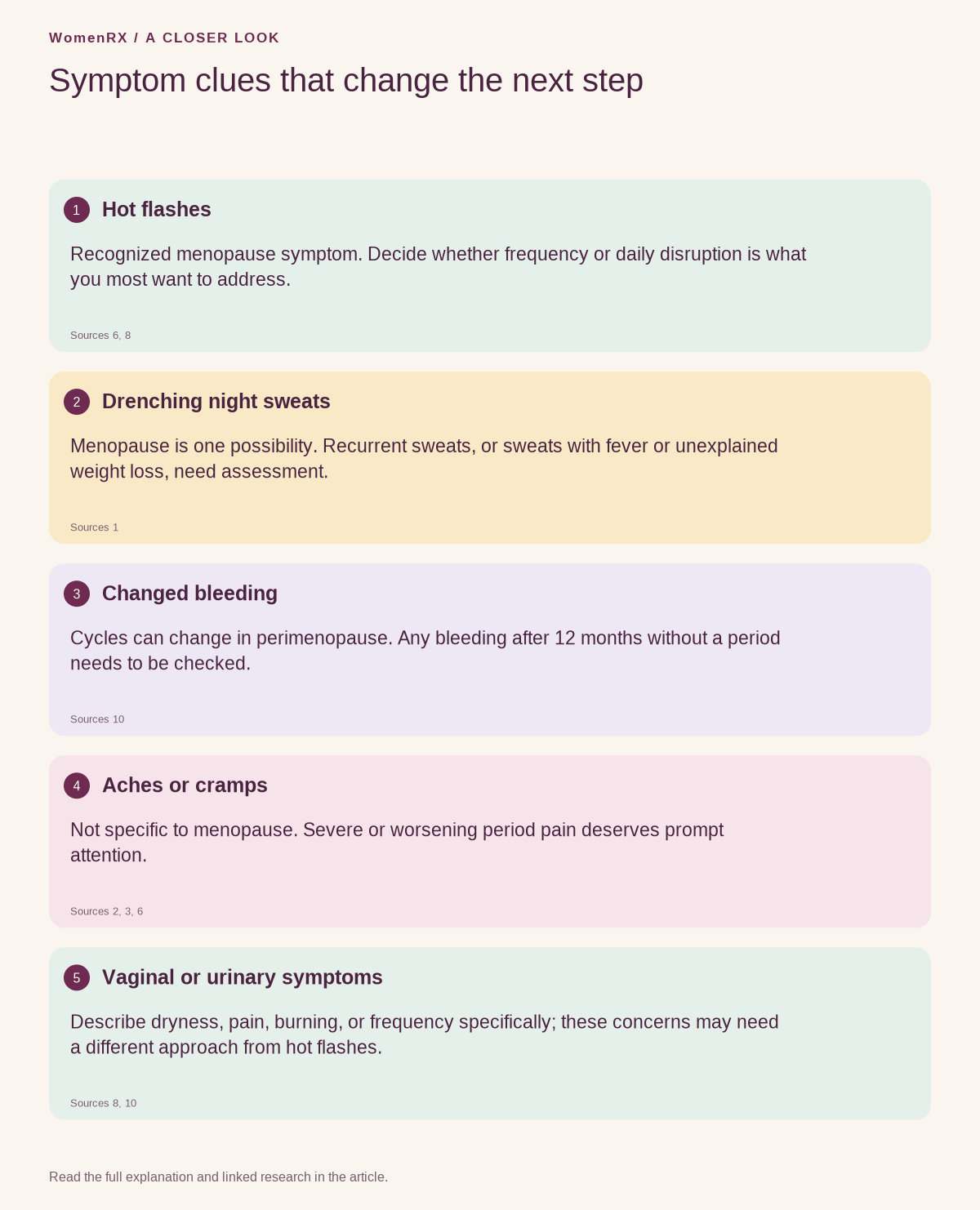
Symptom clues that change the next step
Hot flashes: Recognized menopause symptom. Decide whether frequency or daily disruption is what you most want to address.68
Drenching night sweats: Menopause is one possibility. Recurrent sweats, or sweats with fever or unexplained weight loss, need assessment.1
Changed bleeding: Cycles can change in perimenopause. Any bleeding after 12 months without a period needs to be checked.10
Aches or cramps: Not specific to menopause. Severe or worsening period pain deserves prompt attention.236
Vaginal or urinary symptoms: Describe dryness, pain, burning, or frequency specifically; these concerns may need a different approach from hot flashes.810
Read the figure as text
This quick reference highlights five different routes through the symptom index. It is not a diagnostic score.- Hot flashes: Recognized menopause symptom. Decide whether frequency or daily disruption is what you most want to address.68
- Drenching night sweats: Menopause is one possibility. Recurrent sweats, or sweats with fever or unexplained weight loss, need assessment.1
- Changed bleeding: Cycles can change in perimenopause. Any bleeding after 12 months without a period needs to be checked.10
- Aches or cramps: Not specific to menopause. Severe or worsening period pain deserves prompt attention.236
- Vaginal or urinary symptoms: Describe dryness, pain, burning, or frequency specifically; these concerns may need a different approach from hot flashes.810
More questions, answered
Can CBT help even if I still have hot flashes?
Yes. Research more consistently shows reduced bother from hot flashes and night sweats than a reduction in how often or how severely they occur. Feeling less disrupted is a meaningful outcome, even if the episodes don’t disappear. 8
Are drenching night sweats always menopause?
No. Menopause is one common cause, but night sweats can have other explanations. If they regularly wake you, or occur with a fever, cough, diarrhea, or unexplained weight loss, arrange a medical assessment. 1
Sources you can check
- Night sweats - NHSAccessed 2026-09-25Return to first citation
- Pain | MedlinePlusAccessed 2026-09-25Return to first citation
- Period pain - NHSAccessed 2026-09-25Return to first citation
- Menopause Management in Patients With Cancer.Ward KK, Mitchem S, Harichand-Herdt S. · Obstetrics and gynecology · 2026Return to first citation
- Efficacy of cognitive therapy and behavior therapy for menopausal symptoms: a systematic review and meta-analysis.Ye M, Shou M, Zhang J, Hu B, Liu C, Bi C, Lv T, Luo F, Zhang Z, Liang S, Feng H, Qian C, Cao S, Liu Z. · Psychological medicine · 2022Return to first citation
- Mindfulness, cognitive behavioural and behaviour-based therapy for natural and treatment-induced menopausal symptoms: a systematic review and meta-analysis.van Driel CM, Stuursma A, Schroevers MJ, Mourits MJ, de Bock GH. · BJOG : an international journal of obstetrics and gynaecology · 2019Return to first citation
- Lifestyle Management in Menopause: A Systematic Review of Women With Premature Ovarian Insufficiency.Yeganeh L, Vermeulen N, Ee C, Teede H, Vincent AJ. · Clinical endocrinology · 2025Return to first citation
- The effectiveness of psychosocial interventions on physiological symptoms of menopause: a systematic review and meta-analysis.Robinson K, Hardy R, Melville M, Saidel S, Desai R, Spector A. · BMC women's health · 2026Return to first citation
- Effect of physical activity on sleep in women experiencing vasomotor symptoms during menopause: a systematic review and meta-analysis.Corrêa AB, Bardella MDC, da Silva AP, Moreira MM, Leite LFPA, de Moraes C. · Maturitas · 2025Return to first citation
- Symptoms of menopause and perimenopause - NHSAccessed 2026-09-25Return to first citation
- Early or premature menopause - NHSAccessed 2026-09-25Return to first citation