Menopause Patches: Estrogen, Protection, and Your Options
An estrogen patch may ease hot flashes, but whether it needs a second hormone depends largely on whether you have a uterus.
A menopause patch usually delivers estradiol through the skin to treat symptoms such as hot flashes. Some patches contain estrogen alone; others combine estrogen with a progestogen. If you still have a uterus, estrogen generally needs progestogen protection for the uterine lining. A patch doesn’t prevent pregnancy, and your symptoms, health history, bleeding pattern, and contraception needs all matter. 1 2 3
What a patch delivers
Most estrogen patches contain estradiol, a form of estrogen used to treat menopause symptoms. The hormone passes through the skin into the body. Depending on the product, the patch may contain estradiol alone or estradiol plus a progestogen, a hormone that helps protect the lining of the uterus. 1 3
The goal is usually relief from bothersome symptoms, especially hot flashes. Hormone therapy is considered the most effective treatment for these symptoms, but it isn’t the only option. The benefits and risks depend on factors including the hormone combination, dose, route, timing, and duration of use. 4
The uterus question changes the regimen
Estrogen can thicken the uterine lining. If you have a uterus, using systemic estrogen without enough progestogen can leave that lining unprotected. A clinician may pair an estrogen-only patch with a separate progestogen, or consider a patch that combines both hormones. After a hysterectomy, estrogen can usually be used without progestogen, though your own medical history still matters. 1 2
Some combined patches use levonorgestrel as the progestogen; a US prescribing label for one such patch describes continuous delivery of estradiol and levonorgestrel. That is one product, not a description of every patch. If you’re still having periods, ask how the plan accounts for your bleeding pattern and whether the two hormones come in one product or separate medicines. 3 1
A patch isn’t birth control
Hormone therapy doesn’t reliably prevent pregnancy. Perimenopause can include irregular periods, but pregnancy may still be possible. If you don’t want to become pregnant, make contraception part of the treatment discussion rather than assuming the patch covers it. 2
How you use it depends on the product
Patch schedules and instructions vary. Some estrogen patches are changed once or twice a week; check the directions for the specific product you’re prescribed. A combined US patch is labeled for weekly application. Follow that product’s instructions, and ask about alternatives if the patch irritates your skin or doesn’t fit your routine. 1 3
Weighing benefits, risks, and alternatives
Your decision is personal, not a simple choice between “safe” and “unsafe.” Menopause guidance says hormone therapy’s benefit-risk balance varies with age, time since menopause, route, dose, duration, and whether a progestogen is used. For people under 60 or within 10 years of menopause onset, without contraindications, the balance is generally favorable for treating bothersome hot flashes and preventing bone loss. That is a broad guideline, not a guarantee for an individual. 4
Tell the prescriber about your health history, including any history of estrogen-dependent cancer or cardiovascular disease, which can affect whether systemic hormone therapy is appropriate. If you’re weighing a patch against pills, ask specifically how the route changes the risk discussion for you. Available evidence and recommendations distinguish among formulations and routes; “transdermal” alone doesn’t mean risk-free. 4 5 6
If you’d rather not use hormones, or they aren’t a good fit for your history, evidence-supported options for hot flashes include cognitive behavioral therapy, clinical hypnosis, certain prescription medicines such as SSRIs or SNRIs, gabapentin, and fezolinetant. These options have different tradeoffs; the right comparison depends on your symptoms and other health needs. 5
A focused conversation can start with three questions: Which symptoms are we treating? Do I need progestogen because I have a uterus? And what should I use for contraception while I’m still perimenopausal? Add your medical history and preferences, then compare hormone and nonhormone approaches on those terms.
What Changes the Patch Decision?
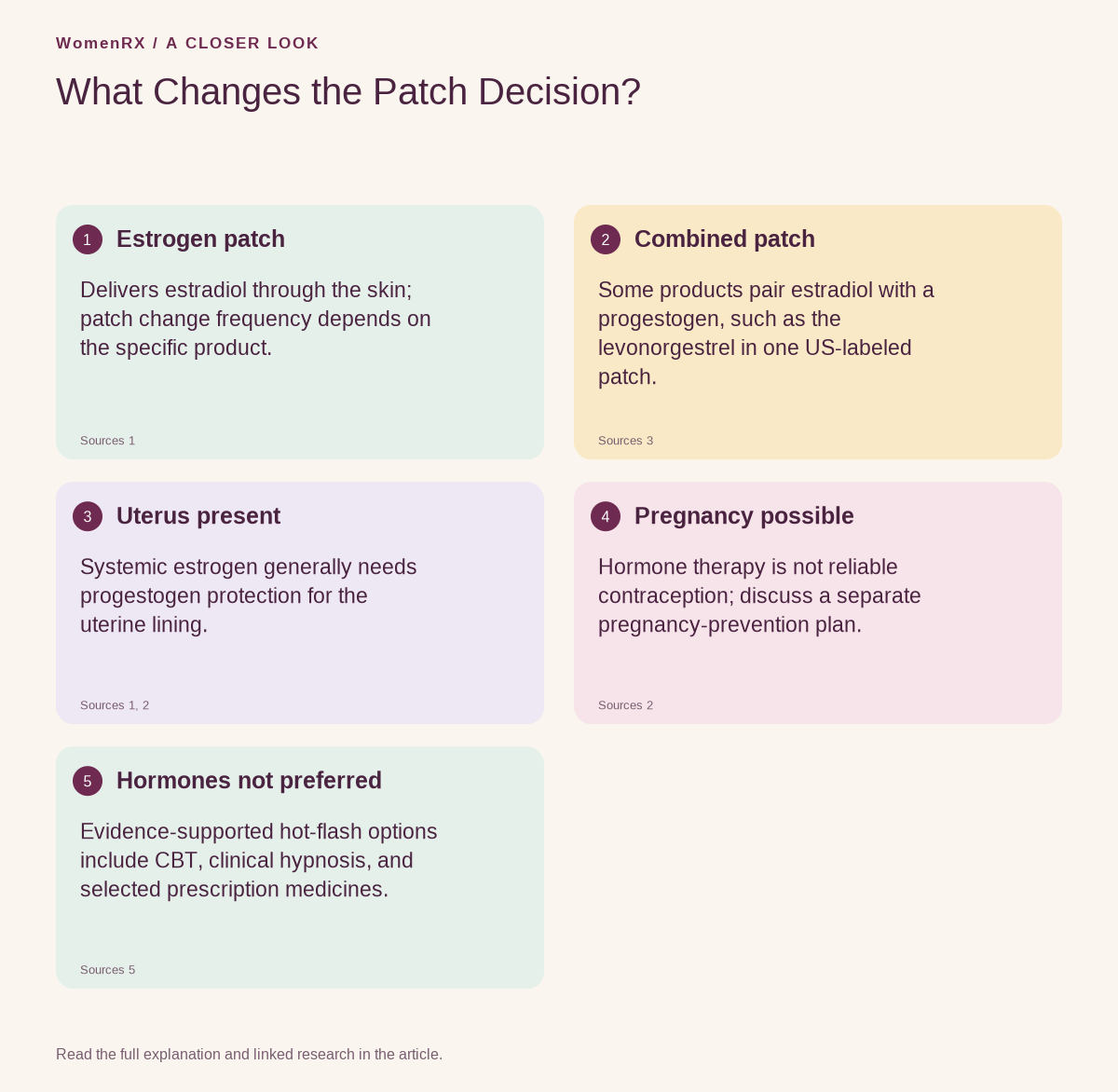
Estrogen patch: Delivers estradiol through the skin; patch change frequency depends on the specific product.1
Combined patch: Some products pair estradiol with a progestogen, such as the levonorgestrel in one US-labeled patch.3
Uterus present: Systemic estrogen generally needs progestogen protection for the uterine lining.12
Pregnancy possible: Hormone therapy is not reliable contraception; discuss a separate pregnancy-prevention plan.2
Hormones not preferred: Evidence-supported hot-flash options include CBT, clinical hypnosis, and selected prescription medicines.5
Read the figure as text
Compare the hormone combination, uterus status, contraception needs, and alternatives before focusing on a particular patch.- Estrogen patch: Delivers estradiol through the skin; patch change frequency depends on the specific product.1
- Combined patch: Some products pair estradiol with a progestogen, such as the levonorgestrel in one US-labeled patch.3
- Uterus present: Systemic estrogen generally needs progestogen protection for the uterine lining.12
- Pregnancy possible: Hormone therapy is not reliable contraception; discuss a separate pregnancy-prevention plan.2
- Hormones not preferred: Evidence-supported hot-flash options include CBT, clinical hypnosis, and selected prescription medicines.5
More questions, answered
Can I use an estrogen-only patch if I still have a uterus?
Systemic estrogen can thicken the uterine lining. If you have a uterus, treatment generally includes a progestogen for protection, either separately or in a combined product. 1 2
Will a menopause patch prevent pregnancy?
No. Menopause hormone therapy isn’t a reliable contraceptive, so you may still need a separate plan during perimenopause. 2
Sources you can check
- About oestrogen tablets, patches, gel and spray - NHSAccessed 2026-09-25Return to first citation
- Common questions about oestrogen tablets, patches, gel and spray - NHSAccessed 2026-09-25Return to first citation
- CLIMARA PRO (ESTRADIOL AND LEVONORGESTREL) PATCH [BAYER HEALTHCARE PHARMACEUTICALS INC.] | US prescribing information and patient instructionsAccessed 2026-09-25Return to first citation
- The 2022 hormone therapy position statement of The North American Menopause Society.“The 2022 Hormone Therapy Position Statement of The North American Menopause Society” Advisory Panel. · Menopause (New York, N.Y.) · 2022Return to first citation
- The 2023 nonhormone therapy position statement of The North American Menopause Society.Menopause (New York, N.Y.) · 2023Return to first citation
- Management of menopausal hormone therapy.Switzer J, Vignali L, Vignali J, Jackson R. · Current opinion in obstetrics & gynecology · 2026Return to first citation