Magnesium-Rich Foods That Fit Everyday Meals
Seeds, beans, leafy greens, nuts, and whole grains can add magnesium in practical portions, and you can combine them across meals.
For an easy start, add a serving of beans, leafy greens, nuts or seeds, or whole grains to meals you already enjoy. For example, ½ cup of cooked black beans has about 60 mg of magnesium, and ½ cup of boiled spinach has about 78 mg. Most adult women need 310-320 mg daily; needs are higher during pregnancy and vary with age. 1

Build meals around foods you already eat
Magnesium shows up in a range of familiar foods, especially leafy greens, beans and other legumes, nuts, seeds, and whole grains. Instead of treating any one food as a must-have, think about adding one or two of these options to meals that suit your routine. The amounts below are approximate magnesium per listed serving. 1
Breakfast: grains, nuts, and seeds
A single-serving portion of instant oatmeal provides about 36 mg. Two large shredded-wheat biscuits provide about 61 mg, and a cup of plain or vanilla soymilk provides about 61 mg. For a more concentrated addition, an ounce of dry-roasted almonds has about 80 mg; an ounce of chia seeds has about 111 mg. 1
For example, oatmeal with an ounce of almonds adds up to about 116 mg. That’s a useful contribution, not a requirement to eat a particular breakfast. Serving sizes matter: the figures are for an ounce of nuts or seeds, not a casual sprinkle. 1
Lunch or dinner: beans, greens, and whole grains
A half-cup of cooked black beans provides about 60 mg, while a half-cup of cooked edamame provides about 50 mg. Pair either with a half-cup of cooked brown rice, which adds about 42 mg, or add boiled spinach: a half-cup has about 78 mg. 1
As a meal-building example, black beans, brown rice, and spinach in those portions contribute about 180 mg altogether. The arithmetic can help you see how foods add up, but it isn’t a meal plan or a promise about how much your body absorbs. 1
Snacks and easy additions
If a full serving of beans or greens doesn’t fit your day, smaller additions still count. Two tablespoons of smooth peanut butter provide about 49 mg; a medium banana has about 32 mg; and a ½ cup of cubed avocado has about 22 mg. A baked potato with its skin, at the listed 3.5-ounce serving, has about 43 mg. 1
Magnesium amounts can vary among products and portions. Fortified breakfast cereals can contribute, too, but the amount depends on the product. Tap, mineral, and bottled water may also contain magnesium, with amounts that vary by source and brand. 1
How much do women need?
For women ages 19-30, the recommended dietary allowance (RDA) is 310 mg daily. It is 320 mg for women ages 31 and older. During pregnancy, the RDA is 350 mg for ages 19-30 and 360 mg for ages 31-50; for pregnant teens ages 14-18, it is 400 mg. During lactation, the RDA is 310 mg for ages 19-30 and 320 mg for ages 31-50; for lactating teens ages 14-18, it is 360 mg. 1
These are daily intake reference amounts, not targets that any single food needs to meet. Food labels may show a percentage of the Daily Value (DV), which is 420 mg for adults and children age four and older. That label reference is not the same as an individual woman’s age- or pregnancy-specific RDA. 1
A serving list is not an absorption ranking
A food’s magnesium amount tells you what it contributes to the diet, not exactly how much your body takes up. NIH notes that roughly 30% to 40% of magnesium from food and beverages is typically absorbed. Dietary factors can affect magnesium bioavailability, so a serving-based list shouldn’t be read as a ranking of what your body will absorb best. 1 2
A practical approach is to rotate foods that work for you: beans in a bowl or salad, greens alongside dinner, nuts or seeds with breakfast, or whole grains in place of more-refined grains. Refining grains in ways that remove the bran and germ can substantially lower their magnesium content, so choosing whole-grain versions can make a difference to the magnesium in that food. 1
For most healthy people, getting too much magnesium from food is not considered a health risk; the established upper limit applies to magnesium from supplements and medications, not magnesium naturally present in food and beverages. If you’re considering a supplement, remember that magnesium also appears in some antacids and laxatives, and certain medicines can interact with magnesium products or affect magnesium levels. Those are reasons to consider your full context rather than adding a supplement just because one day’s meals fall short. 1
Magnesium by meal-building serving
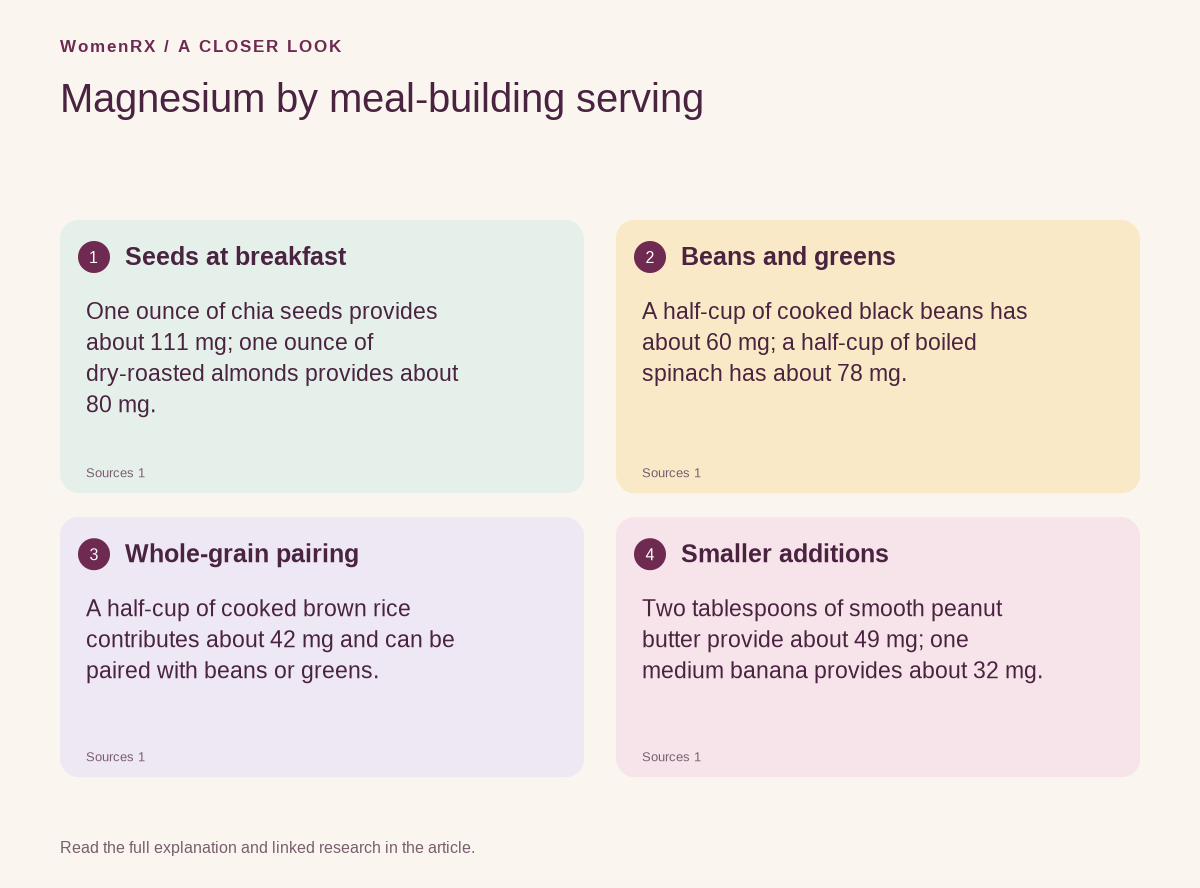
Seeds at breakfast: One ounce of chia seeds provides about 111 mg; one ounce of dry-roasted almonds provides about 80 mg.1
Beans and greens: A half-cup of cooked black beans has about 60 mg; a half-cup of boiled spinach has about 78 mg.1
Whole-grain pairing: A half-cup of cooked brown rice contributes about 42 mg and can be paired with beans or greens.1
Smaller additions: Two tablespoons of smooth peanut butter provide about 49 mg; one medium banana provides about 32 mg.1
Read the figure as text
Compare practical portions from breakfast, meals, and snacks. The values are approximate and show intake contributions, not how much an individual absorbs.- Seeds at breakfast: One ounce of chia seeds provides about 111 mg; one ounce of dry-roasted almonds provides about 80 mg.1
- Beans and greens: A half-cup of cooked black beans has about 60 mg; a half-cup of boiled spinach has about 78 mg.1
- Whole-grain pairing: A half-cup of cooked brown rice contributes about 42 mg and can be paired with beans or greens.1
- Smaller additions: Two tablespoons of smooth peanut butter provide about 49 mg; one medium banana provides about 32 mg.1
More questions, answered
Does the magnesium amount on a food label use my personal daily target?
Not necessarily. The FDA Daily Value for magnesium is 420 mg, while the RDA for women depends on age and life stage. A label’s percentage of DV is a comparison tool, not a personalized pregnancy or age-specific target. 1
Does magnesium in drinking water count?
Yes. Tap, mineral, and bottled water can contribute magnesium, but the amount varies by source and brand. 1
Sources you can check
- Magnesium - Health Professional Fact SheetAccessed 2026-09-25Return to first citation
- Nutritional Factors Affecting Magnesium Bioavailability: A Narrative Review.Rondón LJ. · Biological trace element research · 2026Return to first citation