Choosing Turkey for Everyday Meals
Skinless white-meat turkey is a lean protein choice, while added solution, prepared-product labels, and cooking method can change what ends up on your plate.
Skinless white-meat turkey is a lean protein choice. For a concrete meal example, 85 grams, about 3 ounces, of cooked roasted breast meat provides about 125 calories and 26 grams of protein. That’s an illustration, not a serving everyone needs. 67 Baking or grilling avoids the added fat of frying; check sodium labels when choosing prepared turkey. 36
Start with the turkey you’re actually buying
If you’re choosing turkey for an everyday meal, the most useful distinction isn’t simply turkey versus another meat. It’s what kind of turkey is in the package and how you plan to serve it. Skinless white-meat turkey is listed as a lean protein option in MedlinePlus guidance. That makes it a straightforward choice when you want protein in a meal without relying on frying. Long-term weight loss depends on the broader eating pattern and other lifestyle changes. 16
For a breast cut, removing the skin fits that lean-protein approach. If you prefer another cut or want to keep the skin, you can still build a balanced meal around it. What you can’t do reliably is treat every cut and preparation as nutritionally interchangeable. The guidance identifies skinless white meat as lean, but it doesn’t give a cut-by-cut comparison that would justify a precise ranking here. 6
Plain, enhanced, and deli turkey are different shopping decisions
A plain cut gives you more control over what you add when you cook it. Some whole turkeys, though, are sold with an added solution. In a food-composition study comparing whole turkeys with and without added solution, the turkeys with added solution had higher sodium. That finding is a reason to check the package if sodium matters to you, not a reason to assume that every enhanced turkey has the same amount. 4
Deli turkey calls for a separate label check. Don’t use the whole-turkey study as a stand-in for a package of sliced meat: it did not compare deli products. Instead, read the sodium information on the prepared products you’re deciding between. Food labels are a practical way to see how much sodium is in prepared foods, and the amount can differ from product to product. 3
For example, if you’re deciding between roasting a plain turkey breast for sandwiches and buying ready-to-eat slices, you can compare convenience alongside the sodium shown on the packages. The label tells you more about those particular choices than the word “turkey” on the front does. 34
Let the cooking method do some of the work
Baked, grilled, stewed, and broiled preparations are alternatives to frying that MedlinePlus identifies as lower in calories and saturated fat. Frying adds fat from cooking oil, so the finished dish can be quite different from a simply cooked piece of turkey. Sauces and other additions also become part of the meal, even when the starting cut is lean. 6
You don’t need a special turkey recipe to make that useful. A simply cooked cut can go into a grain bowl with vegetables, or become the protein in a sandwich with plenty of lettuce, tomato, and cucumber. Those are meal examples, not promises about how full you’ll feel. MedlinePlus suggests making fruits and vegetables half the plate as one way to shape a balanced meal. 6
Choose a portion in the context of the meal
There isn’t one turkey portion that works for every woman or every meal. Protein needs vary with factors including age, health, and activity, and most Americans already get enough protein. 2 For a concrete dinner example, you could put vegetables across half your plate, add a whole grain, and serve 85 grams, about 3 ounces, of cooked roasted turkey breast meat without skin. Historical USDA food-composition data estimate about 125 calories, 26 grams of protein, and 1.8 grams of fat for that amount of turkey. The numbers describe that specific cooked portion, not a recommendation or a prediction for every packaged product. Adjust the meal to your appetite and overall needs. 67
Protein helps the body build and maintain tissues, including muscle, and turkey can be one way to include it in a meal. Long-term weight loss depends on the broader eating pattern and other lifestyle changes. A short study of particular reformulated cooked turkey and ham products also assessed perceived satiety, but its findings don’t establish how ordinary turkey affects appetite, weight, or women specifically. 125
The practical choice is simpler: pick a cut you enjoy, decide whether you want the skin, check added-solution or prepared-product labels when relevant, and choose a cooking method that suits the meal you want to eat. 346
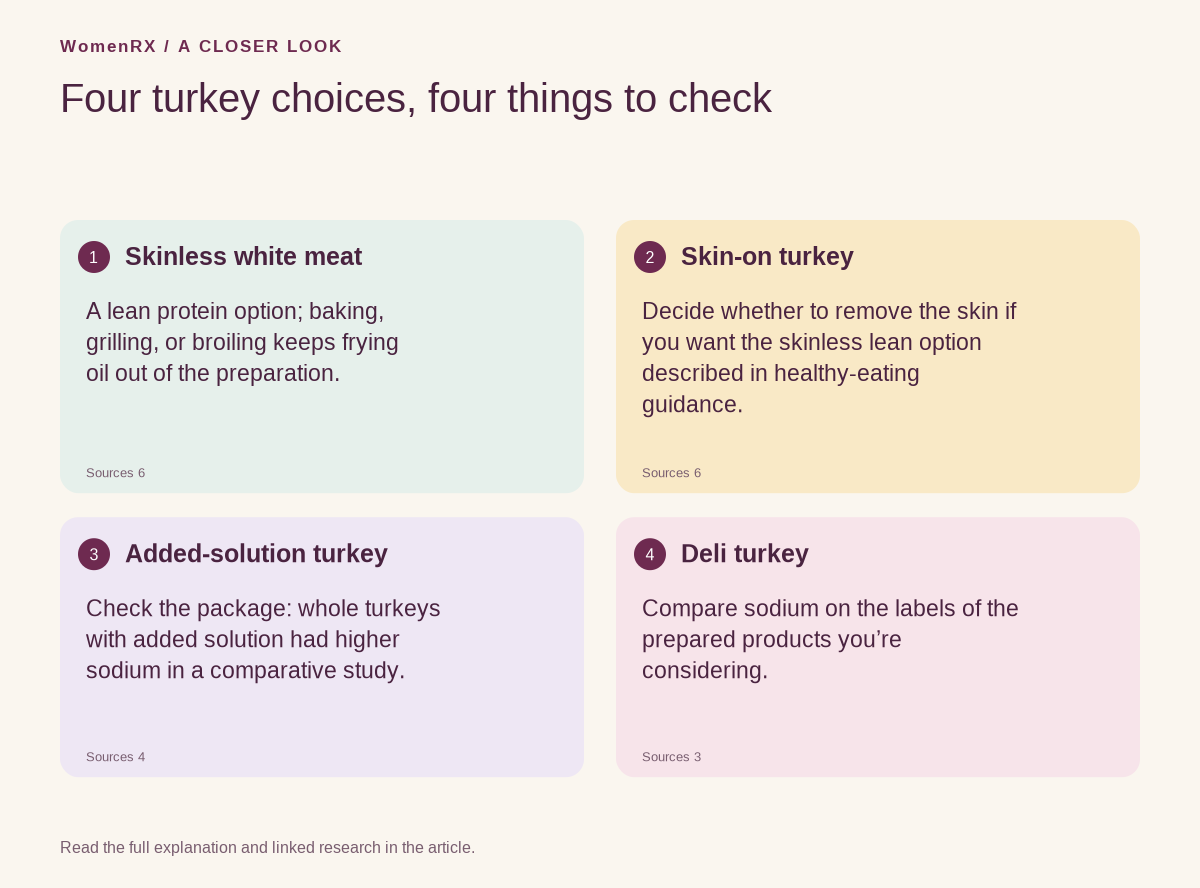
Four turkey choices, four things to check
Skinless white meat: A lean protein option; baking, grilling, or broiling keeps frying oil out of the preparation.6
Skin-on turkey: Decide whether to remove the skin if you want the skinless lean option described in healthy-eating guidance.6
Added-solution turkey: Check the package: whole turkeys with added solution had higher sodium in a comparative study.4
Deli turkey: Compare sodium on the labels of the prepared products you’re considering.3
Read the figure as text
The useful comparison depends on whether you’re choosing a cut, a cooking method, or a prepared product.- Skinless white meat: A lean protein option; baking, grilling, or broiling keeps frying oil out of the preparation.6
- Skin-on turkey: Decide whether to remove the skin if you want the skinless lean option described in healthy-eating guidance.6
- Added-solution turkey: Check the package: whole turkeys with added solution had higher sodium in a comparative study.4
- Deli turkey: Compare sodium on the labels of the prepared products you’re considering.3
More questions, answered
Is deli turkey the same choice as turkey I cook at home?
Not necessarily. Prepared products deserve their own label comparison, particularly for sodium. The study that found higher sodium in whole turkeys with added solution did not test deli turkey, so it can’t tell you how a particular pack of slices compares with a home-cooked cut. 34
Sources you can check
- Dietary Supplements for Weight Loss - Health Professional Fact SheetAccessed 2026-09-25Return to first citation
- Dietary Proteins: MedlinePlusAccessed 2026-09-25Return to first citation
- Sodium: MedlinePlusAccessed 2026-09-25Return to first citation
- Nutrient composition and retention in whole turkeys with and without added solution.Williams JR, Roseland JM, Nguyen QV, Howe JC, Patterson KY, Pehrsson PR, Thompson LD. · Poultry science · 2017Return to first citation
- Exploring the Health Effects of New Additive- and Allergen-Free Reformulated Cooked Meat Products: Consumer Survey, Clinical Trial, and Perceived Satiety.Quizhpe J, Ayuso P, Yepes F, Miranzo D, Avellaneda A, Nieto G, Ros G. · Nutrients · 2025Return to first citation
- MedlinePlus: Managing weight with healthy eatingAccessed 2026-09-25Return to first citation
- USDA SRLegacy: calculated illustrative turkey portionAccessed 2026-09-26Return to first citation