Low Estrogen Signs Across Different Life Stages: When to Seek Assessment
Hot flashes or genitourinary changes can be clues, but their meaning depends on your life stage, health, and treatments.
Low estrogen may be associated with hot flashes and genitourinary changes, but those symptoms don’t establish a hormone level or explain their cause. Menopause, earlier ovarian insufficiency, breastfeeding, and estrogen-suppressing treatment are different contexts. After birth, for example, dryness or urinary and sexual symptoms can also reflect pelvic-floor, scar, infection, or other causes, so the details around when symptoms began matter. 1 3 4 5
The same symptom can mean different things
Hot flashes and changes in genital or urinary comfort can occur when estrogen is low, but they’re clues, not a diagnosis. Their meaning depends on what else is happening: whether you’re approaching or past menopause, recently gave birth and are breastfeeding, have changes in ovarian function earlier in life, or are taking treatment that suppresses estrogen. A symptom by itself can’t establish an estrogen level or identify its cause.
The distinction matters because similar symptoms can have different explanations and implications. A menopause-related change, a postpartum pelvic-floor problem, and a medication effect shouldn’t be treated as though they were one condition.
Around menopause: hot flashes and genitourinary changes
During menopause, vasomotor symptoms such as hot flashes and genitourinary syndrome of menopause are recognized concerns. A menopause position statement identifies hormone therapy as the most effective treatment for bothersome vasomotor symptoms and recognizes treatment options for genitourinary symptoms. That guidance is about symptoms and their management; it doesn’t mean that any one symptom proves low estrogen. 3
If you’re in the menopause transition or postmenopause, note what you’re experiencing and how it affects daily life. Changes in genital or urinary comfort deserve attention too, even if hot flashes aren’t part of your experience. An assessment can consider the pattern and context rather than treating a symptom as a hormone test.
After pregnancy: breastfeeding is its own context
During lactation, prolactin related to suckling can suppress ovarian activity and may keep estradiol low, particularly when periods haven’t returned. A 2026 narrative review proposes the term genitourinary syndrome of lactation for possible vulvovaginal, urinary, and sexual symptoms in this setting. The term is newly proposed, and the review emphasizes that not every postpartum symptom should be attributed to low estrogen. 1
For example, dryness or discomfort with sex after birth could also relate to perineal scar pain, pelvic-floor dysfunction, infection, vulvar skin conditions, urinary problems, hormonal contraception, or psychosocial factors. A clinician may need to distinguish among these possibilities rather than assuming lactation is the whole explanation. 1
Pregnancy itself is a separate situation, not a reason to label a symptom as low estrogen. For instance, itching during pregnancy can be associated with intrahepatic cholestasis of pregnancy, a liver disorder related to pregnancy and described in relation to estrogen and progesterone effects. That is a different concern from hypoestrogenism and calls for its own assessment. 2
Earlier changes in ovarian function
Primary ovarian insufficiency involves reduced ovarian function earlier than expected. The cited guidance describes possible vasomotor symptoms and urogenital atrophy, as well as longer-term concerns including bone loss and fracture risk. Those health implications make it useful to assess a possible ovarian-function change rather than dismissing symptoms as ordinary menopause when they arise earlier in life. 4
The guidance also notes that hormone therapy and combined hormonal contraceptives differ in how reliably they prevent pregnancy. If pregnancy prevention matters to you, mention that when discussing possible ovarian insufficiency and treatment options. 4
Treatment can change the picture
Some treatments for endometriosis suppress estrogen and can cause hypoestrogenism. A review of endometriosis treatments describes GnRH agonists and antagonists as options associated with hypoestrogenism. If symptoms began after a treatment change, include the medicine and timing in your account; symptoms may need to be understood in relation to both the condition and its treatment. 5
What to include in an assessment
A useful description is specific, not just a list of symptoms. Share:
- Your life stage, including whether you’re pregnant, recently gave birth, breastfeeding, or around menopause.
- When symptoms began and how they have changed.
- Any changes in your periods, if relevant, and whether they have returned after birth.
- Any treatment or contraception changes, especially treatment intended to affect ovarian hormones.
- The effect on daily life, including sleep, comfort, sex, or urinary symptoms.
These details help put symptoms in context. They don’t confirm low estrogen on their own, and postpartum symptoms in particular can have several non-hormonal explanations. 1
The useful distinction
Think of low estrogen as one possible explanation, not a conclusion drawn from a single symptom. The most informative next step is an assessment that takes your life stage and treatment history seriously, and considers other causes where relevant. What calls for attention after birth may be different from what matters around menopause or with earlier ovarian changes.
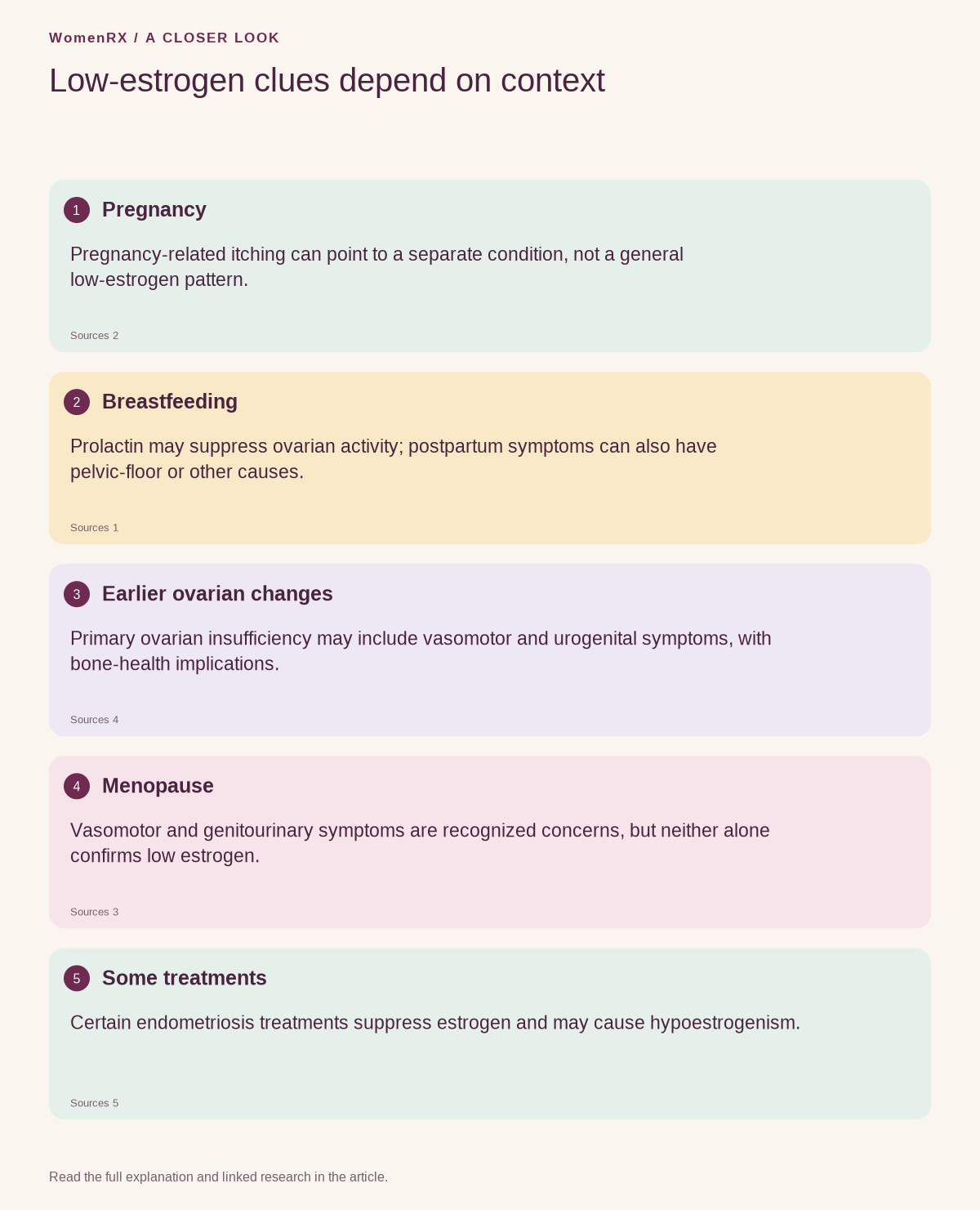
Low-estrogen clues depend on context
Pregnancy: Pregnancy-related itching can point to a separate condition, not a general low-estrogen pattern.2
Breastfeeding: Prolactin may suppress ovarian activity; postpartum symptoms can also have pelvic-floor or other causes.1
Earlier ovarian changes: Primary ovarian insufficiency may include vasomotor and urogenital symptoms, with bone-health implications.4
Menopause: Vasomotor and genitourinary symptoms are recognized concerns, but neither alone confirms low estrogen.3
Some treatments: Certain endometriosis treatments suppress estrogen and may cause hypoestrogenism.5
Read the figure as text
These life-stage and treatment contexts are not interchangeable, and symptoms alone do not identify their cause.- Pregnancy: Pregnancy-related itching can point to a separate condition, not a general low-estrogen pattern.2
- Breastfeeding: Prolactin may suppress ovarian activity; postpartum symptoms can also have pelvic-floor or other causes.1
- Earlier ovarian changes: Primary ovarian insufficiency may include vasomotor and urogenital symptoms, with bone-health implications.4
- Menopause: Vasomotor and genitourinary symptoms are recognized concerns, but neither alone confirms low estrogen.3
- Some treatments: Certain endometriosis treatments suppress estrogen and may cause hypoestrogenism.5
More questions, answered
Can breastfeeding be linked to vaginal or urinary symptoms?
It can be. Suckling-related prolactin may suppress ovarian activity and keep estradiol low, particularly when periods haven’t returned. But postpartum dryness, pain, or urinary symptoms can also have other causes, including pelvic-floor problems, scar pain, infection, or urinary conditions. 1
Does a hot flash confirm low estrogen?
No. Hot flashes are recognized menopause-associated vasomotor symptoms, but a symptom alone doesn’t establish an estrogen level or its cause. Its meaning depends on your life stage and other health or treatment factors. 3
Sources you can check
- Genitourinary syndrome of lactation: An underrecognized postpartum condition affecting women's vulvovaginal, urinary and sexual health.Orozco Fernández R, Gil-Antuñano SP. · Women's health (London, England) · 2026Return to first citation
- Intrahepatic Cholestasis of Pregnancy.Gandhi S, Barsanti-Innes B, Jolicoeur G, Nwokoro IN. · Clinics in liver disease · 2026Return to first citation
- The 2022 hormone therapy position statement of The North American Menopause Society.“The 2022 Hormone Therapy Position Statement of The North American Menopause Society” Advisory Panel. · Menopause (New York, N.Y.) · 2022Return to first citation
- Committee Opinion No. 698: Hormone Therapy in Primary Ovarian Insufficiency.Obstetrics and gynecology · 2017Return to first citation
- Hormonal Treatment of Endometriosis: A Narrative Review.Piriyev E, Schiermeier S, Römer T. · Pharmaceuticals (Basel, Switzerland) · 2025Return to first citation