Low Energy in Women: When Supplements May Help
Iron or another nutrient supplement is most relevant when testing and your circumstances point to a deficiency, not simply because you feel tired.
Low energy by itself doesn’t show that you need a supplement. Iron deficiency is more plausible if you have heavy or prolonged periods, are pregnant, or have a restrictive diet, but a blood test can help distinguish low iron from anemia and other possibilities. B12 or folate deficiency can also cause tiredness, and may bring other symptoms. Match supplementation to the cause rather than guessing. 1256
Start with the clue, not the supplement
Fatigue is a real reason to look for an explanation, but it isn’t a diagnosis of nutrient deficiency. Menstruation can itself come with fatigue, and low energy can have more than one cause. Taking iron “just in case” may add side effects without addressing the reason you feel run down. A more useful question is whether your history or other symptoms make a deficiency likely enough to check. 46
Iron deserves particular attention if your periods are heavy or prolonged. Regular menstrual blood loss raises the risk of iron deficiency, and pregnancy also increases iron needs. A vegetarian or vegan diet, restrictive eating, or high levels of athletic training can be relevant context too. These are clues to discuss, not proof that your iron is low. 56
What testing can clarify
A clinician may use blood tests to check for anemia and iron stores. Hemoglobin helps assess anemia; ferritin is used to assess iron stores. Iron deficiency can exist without anemia, so a normal hemoglobin result alone may not settle the question if the history still raises concern. A review of iron deficiency in otherwise healthy people describes checking blood measures and ferritin in symptomatic people or those with risk factors. 6
If you do have confirmed iron deficiency, supplementation may be considered as part of treatment. In a small, open-label study, 36 non-anemic premenopausal women with low ferritin received oral iron for eight weeks; ferritin and self-reported health status improved. Because the study had no comparison group, it can’t establish how much of the reported improvement came from the supplement rather than other factors. It also doesn’t show that iron will help someone whose iron stores are normal. 7
Iron isn’t a general energy booster. In people with normal or high iron stores, routine supplementation isn’t an appropriate substitute for finding the cause of fatigue, and the review warns against long-term iron when stores aren’t low. That’s why testing first can prevent an unnecessary supplement as well as identify a deficiency that needs attention. 6
When B12 or folate may be relevant
B12 and folate deficiencies can cause anemia and tiredness, but fatigue isn’t the only possible clue. Other symptoms can include a sore or red tongue, memory or thinking changes, and, with B12 deficiency, numbness. A restrictive diet or vegan diet without reliable B12 sources can raise the possibility of low B12; some medicines can also affect absorption. Symptoms and blood tests help establish whether deficiency is present. 12
This distinction matters because the right replacement depends on the vitamin and the cause. For example, B12 deficiency may be related to diet or to a problem absorbing B12. Folate treatment can also improve symptoms while masking an underlying B12 deficiency, so B12 levels should be checked before treating folate deficiency. Don’t use folate alone as a shortcut for unexplained fatigue. 13
A practical next move
If you have ongoing low energy, note whether your periods are heavy or prolonged, whether you’re pregnant, and whether your diet excludes major sources of iron or B12. Share those details when discussing whether blood tests are appropriate. A major change in your menstrual cycle, very heavy bleeding, or severe period pain is also worth raising, because those changes can signal a problem that needs attention beyond a supplement. 456
The useful distinction is simple: a risk factor makes a deficiency worth considering; a test helps determine whether a supplement fits. If testing doesn’t show a deficiency, keep looking for an explanation rather than escalating an “energy” stack.
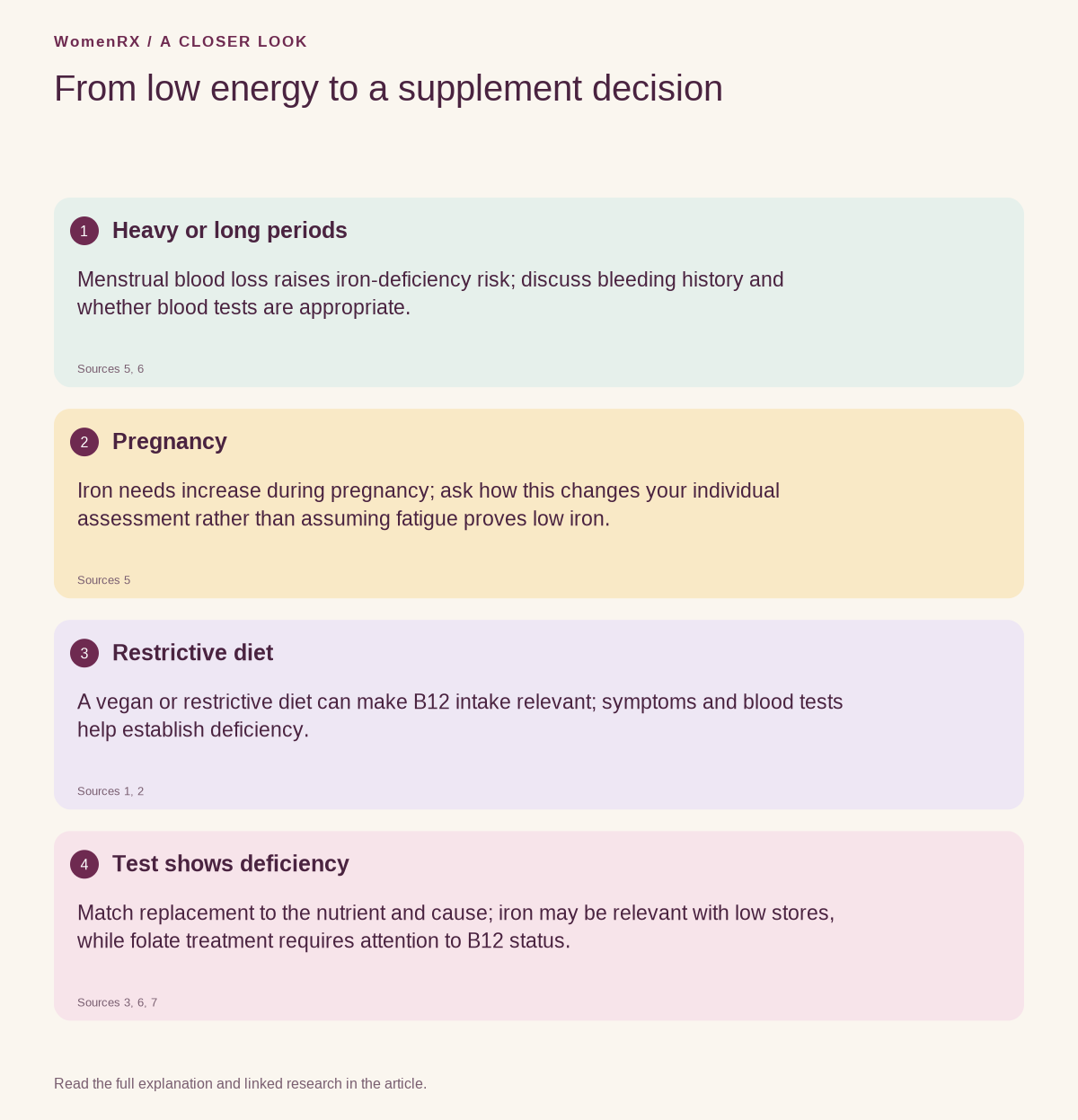
From low energy to a supplement decision
Heavy or long periods: Menstrual blood loss raises iron-deficiency risk; discuss bleeding history and whether blood tests are appropriate.56
Pregnancy: Iron needs increase during pregnancy; ask how this changes your individual assessment rather than assuming fatigue proves low iron.5
Restrictive diet: A vegan or restrictive diet can make B12 intake relevant; symptoms and blood tests help establish deficiency.12
Test shows deficiency: Match replacement to the nutrient and cause; iron may be relevant with low stores, while folate treatment requires attention to B12 status.367
Read the figure as text
Use the clues to decide what to raise and what testing may clarify; none of these clues alone confirms a deficiency.- Heavy or long periods: Menstrual blood loss raises iron-deficiency risk; discuss bleeding history and whether blood tests are appropriate.56
- Pregnancy: Iron needs increase during pregnancy; ask how this changes your individual assessment rather than assuming fatigue proves low iron.5
- Restrictive diet: A vegan or restrictive diet can make B12 intake relevant; symptoms and blood tests help establish deficiency.12
- Test shows deficiency: Match replacement to the nutrient and cause; iron may be relevant with low stores, while folate treatment requires attention to B12 status.367
More questions, answered
Can low iron cause fatigue even if I’m not anemic?
Iron deficiency can occur without anemia. A small open-label study in 36 non-anemic premenopausal women with low ferritin reported improved ferritin and self-reported health after iron treatment, but without a comparison group it can’t prove how much the supplement caused the change. 67
Does fatigue during my period mean I need iron?
No. Fatigue can occur as a menstrual symptom, while heavy or prolonged bleeding can raise the risk of iron deficiency. The symptom alone doesn’t tell you which applies; bleeding history and, when appropriate, blood tests help distinguish them. 456
Sources you can check
- Vitamin B12 or folate deficiency anaemia - NHSAccessed 2026-09-25Return to first citation
- Vitamin B12 or folate deficiency anaemia - Symptoms - NHSAccessed 2026-09-25Return to first citation
- Vitamin B12 or folate deficiency anaemia - Treatment - NHSAccessed 2026-09-25Return to first citation
- Menstruation | Period | MedlinePlusAccessed 2026-09-25Return to first citation
- Iron deficiency anemia among women: An issue of health equity.Tang GH, Sholzberg M. · Blood reviews · 2024Return to first citation
- The treatment of iron deficiency without anaemia (in otherwise healthy persons).Clénin GE. · Swiss medical weekly · 2017Return to first citation
- Effectiveness of low-dose iron treatment in non-anaemic iron-deficient women: a prospective open-label single-arm trial.Simic S, Karczewski M, Klapdor S, Nowak A, Schubert M, Moretti D, Swinkels DW, Beuschlein F, Saleh L, Suter P, Krayenbuehl PA. · Swiss medical weekly · 2023Return to first citation