Is Long-Term Resveratrol Use Well Studied?
A dose mentioned in human research isn’t necessarily a dose that’s been shown safe to take for years.
A review of metabolic and estrogen-related conditions calls for better long-term resveratrol safety and effectiveness research. 3 A separate stroke review says clinical dosing, safety, and value for stroke therapy remain uncertain. 2 A reported blood-sugar concern applies especially to people with type 2 diabetes taking oral diabetes medicines. Before continuing, compare your dose and duration with what was studied, and review your medicines and health circumstances. 3
What a study can, and can’t, tell you
If you’ve taken resveratrol for a while and feel fine, the question isn’t just whether anyone has studied it. It’s whether people taking a similar product, at a similar dose, for a similar length of time were studied for the outcome you care about.
Reviews describe possible biological effects but still call for more rigorous research on long-term safety and effectiveness. A review of resveratrol as a possible stroke therapy, for example, says clinical evidence is insufficient to define its dosing, safety, or clinical value for that use. Promising results in cells or animals don’t settle what happens when a person takes an oral supplement over years. 3 2
The evidence cited here doesn’t establish a dependable oral dose-and-duration benchmark that answers, “How long is it safe for me to keep taking this?” That makes your reason for taking resveratrol part of the decision: an uncertain long-term benefit is harder to weigh against an uncertain long-term risk.
The dose finding that matters if you take diabetes medicine
A review reports mild low-blood-sugar episodes associated with 500-1,000 mg of resveratrol per day in people with type 2 diabetes, particularly when it was combined with oral diabetes medicines. That’s a finding about a specific group, not a safety cutoff for everyone. The review passage does not give a duration that would establish those doses as safe for ongoing use. If you take medicine to lower blood sugar, ask whether resveratrol could complicate your glucose management before you continue it. 3
For other medicines, don’t turn a theoretical interaction into a confirmed one. A separate review identifies drug interactions as an area needing further research. 4 Include resveratrol in your medication review, and bring the product label so you can discuss the amount you take, how long you’ve taken it, and any other ingredients in the product.
Three useful questions are: Does evidence for my reason for taking it apply to this dose and product? Does my diabetes treatment or another health circumstance change the decision? What would make us reconsider continued use?
Menopause isn’t a shortcut to a safety answer
Resveratrol has been studied for effects on estrogen-related pathways, but a proposed effect on a pathway is not proof of menopause symptom relief. A review says most menopause studies it discusses were conducted in animals and calls for long-term randomized trials in postmenopausal women to better establish effectiveness and safety. 3
Pregnancy and breastfeeding also need their own answer. Findings from other adult groups cannot establish safety during either circumstance. If you’re pregnant, breastfeeding, or planning a pregnancy, raise that specifically when discussing whether to continue the supplement.
Check the route and species, not just the headline duration
A 12-week study found no clinical, biochemical, or tissue signs of toxicity in mice given an inhalable resveratrol formulation directly into the trachea three times a week. That was intratracheal administration, not a study of people taking an oral supplement. Its 12-week duration cannot establish long-term safety for a capsule. 1
When a study is described as reassuring, check four things before applying it to yourself: who was studied, how resveratrol was given, the dose and duration, and what researchers measured. For the decision in front of you, your exact supplement, medicines, reason for taking it, and current health circumstances matter more than a broad claim that resveratrol has been “studied.”
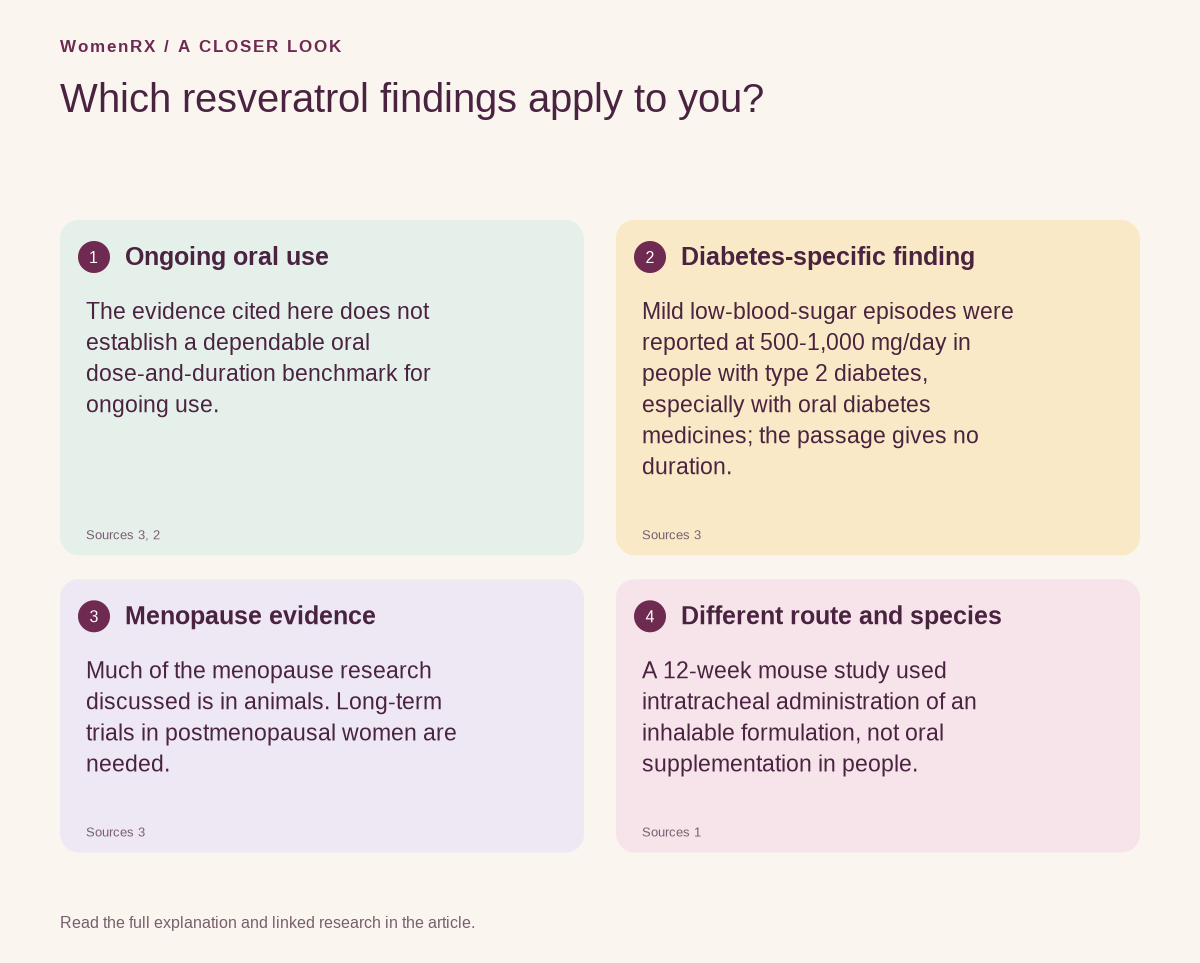
Which resveratrol findings apply to you?
Ongoing oral use: The evidence cited here does not establish a dependable oral dose-and-duration benchmark for ongoing use.32
Diabetes-specific finding: Mild low-blood-sugar episodes were reported at 500-1,000 mg/day in people with type 2 diabetes, especially with oral diabetes medicines; the passage gives no duration.3
Menopause evidence: Much of the menopause research discussed is in animals. Long-term trials in postmenopausal women are needed.3
Different route and species: A 12-week mouse study used intratracheal administration of an inhalable formulation, not oral supplementation in people.1
Read the figure as text
These findings answer different questions about dose, duration, population, and route.- Ongoing oral use: The evidence cited here does not establish a dependable oral dose-and-duration benchmark for ongoing use.32
- Diabetes-specific finding: Mild low-blood-sugar episodes were reported at 500-1,000 mg/day in people with type 2 diabetes, especially with oral diabetes medicines; the passage gives no duration.3
- Menopause evidence: Much of the menopause research discussed is in animals. Long-term trials in postmenopausal women are needed.3
- Different route and species: A 12-week mouse study used intratracheal administration of an inhalable formulation, not oral supplementation in people.1
Sources you can check
- Design and characterization of a resveratrol spray-dried inhalable formulation for pulmonary delivery with in vivo pharmacokinetic and toxicological evaluation.Sobocińska J, Wong CYJ, Gezer E, Ong HX, Daali Y, Serre-Beinier V, Traini D, Cuendet M. · Drug delivery · 2026Return to first citation
- Resveratrol and Curcumin in Stroke Therapy: From Experimental Evidence to Clinical Perspectives.Grabarczyk M, Szychowska A, Szczepańska W, Smolińska E, Glabinski A, Szpakowski P. · Nutrients · 2026Return to first citation
- New Perspectives on the Use of Resveratrol in the Treatment of Metabolic and Estrogen-Dependent Conditions Through Hormonal Modulation and Anti-Inflammatory Effects.Renke G, Fuschini AC, Clivati B, Teixeira LM, Cuyabano ML, Erel CT, Rosado EL. · Current issues in molecular biology · 2025Return to first citation
- Resveratrol: Harnessing Nature's Potential for Chronic Pain Relief.Wu H, Wu JY, Gao SJ, Liu L, Dai XY, Song WL, Zhang LQ, Liu DQ, Tang YX, Zhou YQ, Mei W. · Aging and disease · 2025Return to first citation