How to Read Tretinoin Reviews Without Mistaking Them for Predictions
Personal accounts can help you recognize possible benefits and irritation, but the product, treatment goal and timeframe determine what you can compare.
Read a tretinoin review as one person’s account, not a forecast for your skin. Check whether they were treating acne, which formulation and strength they used, how long they used it, what else was in their routine, and what they meant by “better.” Clinical studies can give you group-level evidence, but their results still depend on the product and outcome studied. 4 5 6

A review that says “my skin improved” can be encouraging. One that describes peeling can be unsettling. Both may be honest, yet neither tells you how likely you are to have the same experience. The useful question is: What details would make this account comparable to my situation?
First, find out what the person used and why
“Tretinoin” can refer to different topical products. Acne research here includes a 0.05% lotion and a microsphere gel studied at 0.04% or 0.1%; a US product label describes a 0.025% cream for acne. A review of one formulation and strength isn’t a direct test of another. 1 4 5
The treatment goal matters just as much. Was the person counting acne spots, looking at how they felt about their skin, or hoping for a different cosmetic change? The cited cream is indicated for acne; its label says long-term safety and effectiveness for other disorders haven’t been established for that product. An acne result doesn’t prove a different benefit. 1
If a review gives no timeframe, it’s hard to know what “worked” means. Acne treatment may take several months to show improvement, so a report after a brief period and one after months of use answer different questions. Look, too, for other acne treatments. Someone using more than one treatment may not be able to tell which contributed to a change. 3 5
Put online numbers and trial numbers in their own lanes
A crowdsourcing study compared online acne-treatment reports with published research. Its abstract reported improvement in approximately 80% of topical tretinoin users in clinical trials after 12 weeks, versus 46% of online users over an unspecified period. Those figures are not a head-to-head comparison of similar people followed for the same length of time. They can’t tell you which group was more likely to benefit. 6
Online posts also leave a question a percentage alone can’t answer: who chose to report, and who didn’t? A collection of reviews can reveal experiences worth asking about, but without consistent details about the people, products and outcomes, it can’t give you a reliable personal probability. The crowdsourcing researchers likewise identified limits in their data-collection methods and called for more standardized measures. 6
A trial can ask a narrower, clearer question. In a post-hoc analysis of two phase III trials involving 1,640 people with moderate-to-severe acne, researchers compared 0.05% tretinoin lotion with its vehicle lotion. At week 12, average scores improved more with tretinoin in all four areas of an acne-specific quality-of-life questionnaire: self-perception, emotional role, social role and acne symptoms. For the acne-symptoms area, the mean change was 6.5 points with tretinoin and 5.6 with vehicle. That describes an average difference for this product and study population, not the change any one person should expect. 4
Patient satisfaction is another outcome, but study design affects what it can tell you. In a 12-week, open-label community study, 544 people dissatisfied with their current acne treatments received tretinoin microsphere gel and could use up to two other non-retinoid acne therapies. Satisfaction and quality-of-life scores improved from baseline. Because participants could use other treatments and there was no comparison group described in the abstract, the study can’t isolate the gel’s effect. 5
Take irritation seriously without borrowing someone else’s timetable
Irritation isn’t just a vague complaint. The US cream label describes local redness and peeling that can be severe, and reports temporary changes in skin pigmentation. When someone writes that tretinoin made their skin “worse,” check whether they mean more acne, irritated skin, or both. Those descriptions call for different interpretations. 1
A useful account might name the product, other products used at the same time, what changed and when. Even a detailed account can’t establish what caused the change or promise that your skin will settle down on the same schedule. If your skin becomes excessively red, swollen, blistered or crusted, don’t use a reassuring review as a reason to push through it. The cream label calls for treatment to be stopped or adjusted when those effects occur; the prescriber can help you decide what to do with your particular product. 1
Check who the evidence actually represents
Acne can continue into adulthood, and hormonal changes during the menstrual cycle or pregnancy can contribute to episodes of acne. That makes age and life stage relevant when you’re comparing experiences. 2 But the published abstracts for the tretinoin outcome studies above, and the crowdsourcing abstract, don’t give enough demographic detail to judge representation by age, sex or skin tone, or to estimate whether outcomes differed across those groups. 4 5 6
Don’t treat comments from women online as evidence of a shared result for women. Instead, use a review for what it does well: noticing an outcome or irritation you want to understand. Then match its treatment goal, exact product, timeframe and other therapies against research that measured a similar outcome. If you’re pregnant, a review shouldn’t settle the treatment question: clinical guidance says topical retinoids are not suitable for use during pregnancy. 3
What a Tretinoin Account Can Tell You
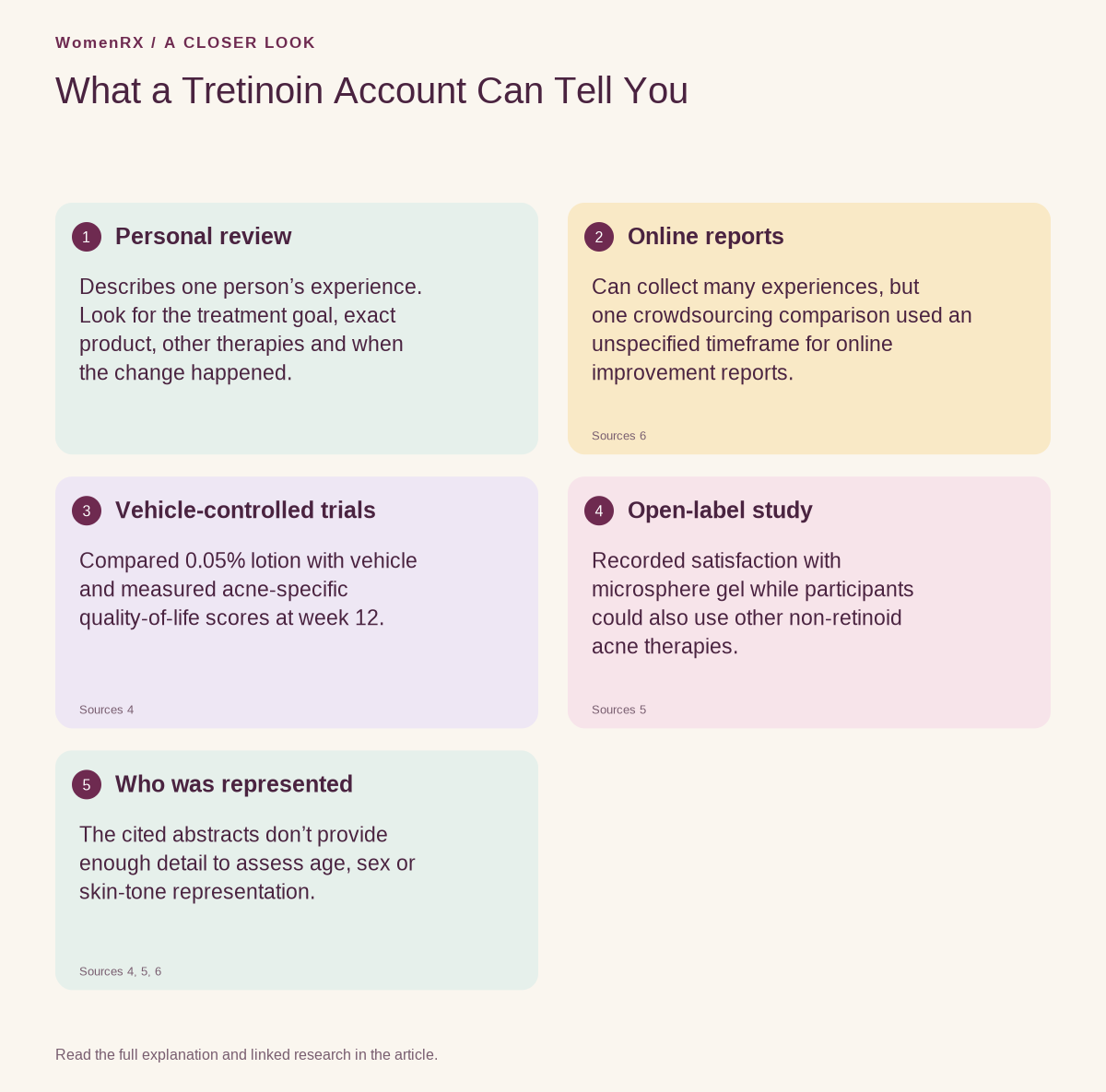
Personal review: Describes one person’s experience. Look for the treatment goal, exact product, other therapies and when the change happened.
Online reports: Can collect many experiences, but one crowdsourcing comparison used an unspecified timeframe for online improvement reports.6
Vehicle-controlled trials: Compared 0.05% lotion with vehicle and measured acne-specific quality-of-life scores at week 12.4
Open-label study: Recorded satisfaction with microsphere gel while participants could also use other non-retinoid acne therapies.5
Who was represented: The cited abstracts don’t provide enough detail to assess age, sex or skin-tone representation.456
Read the figure as text
Use the type of evidence to decide which question it can answer, then check the product and timeframe.- Personal review: Describes one person’s experience. Look for the treatment goal, exact product, other therapies and when the change happened.
- Online reports: Can collect many experiences, but one crowdsourcing comparison used an unspecified timeframe for online improvement reports.6
- Vehicle-controlled trials: Compared 0.05% lotion with vehicle and measured acne-specific quality-of-life scores at week 12.4
- Open-label study: Recorded satisfaction with microsphere gel while participants could also use other non-retinoid acne therapies.5
- Who was represented: The cited abstracts don’t provide enough detail to assess age, sex or skin-tone representation.456
More questions, answered
Can reviews tell me how long tretinoin takes to work?
A review can tell you when one person noticed a change, not set a timetable for you. In the crowdsourcing comparison, online users reported improvement over an unspecified period, while the clinical-trial figure referred to 12 weeks. 6
Sources you can check
- TRETINOIN CREAM [REDPHARM DRUG] | US prescribing information and patient instructionsAccessed 2026-09-25Return to first citation
- Acne - NHSAccessed 2026-09-25Return to first citation
- Acne - Treatment - NHSAccessed 2026-09-25Return to first citation
- The Effects of Once-Daily Tretinoin 0.05% Lotion on Quality of Life in Patients with Moderate-to-Severe Acne Vulgaris.Tyring SK, Kircik L, Pariser DM, Woolery-Lloyd HC, Harper JC, Bhatt V, Pillai R, Guenin E. · American journal of clinical dermatology · 2020Return to first citation
- Acne quality of life and patient satisfaction following treatment with tretinoin pump.Fried R, Nighland M. · Journal of drugs in dermatology : JDD · 2009Return to first citation
- Harnessing the power of crowds: crowdsourcing as a novel research method for evaluation of acne treatments.Armstrong AW, Cheeney S, Wu J, Harskamp CT, Schupp CW. · American journal of clinical dermatology · 2012Return to first citation