How to Compare Zinc Supplements Without Getting Lost in the Label
The zinc amount, serving size, and evidence behind quality claims tell you more than a form name or a “for women” label.
Start with the milligrams of zinc on the Supplement Facts panel. That number is elemental zinc, not the weight of zinc gluconate, sulfate, or another compound. 1 Check how many pills make one serving, then count zinc from any multivitamin or prenatal you also take. 1 Compare forms, but don’t assume one is best for women. For quality, look beyond marketing claims and ask for product-specific testing information.
Read the zinc amount before the form
A bottle may say “zinc gluconate” across the front, while another says “zinc sulfate.” Those names tell you what compound supplies the zinc. To compare amounts, turn to Supplement Facts: the listed milligrams of zinc are elemental zinc, not the weight of the whole compound. You don’t need to calculate how much zinc is in the gluconate or sulfate yourself. 1
Read the serving size at the same time. Check how many capsules or tablets the label counts as one serving before comparing bottles pill for pill. For example, a one-capsule serving and a two-capsule serving aren’t a pill-for-pill match just because both panels list the same zinc amount.
The % Daily Value is another comparison tool, not a personal dose recommendation; the adult Daily Value used on labels is 11 mg. 1
Put form in perspective
Zinc can come as gluconate, sulfate, citrate, oxide, and other forms. Form may affect absorption, but it doesn’t provide a reliable shortcut to the “best” bottle. A review describes a human trial in which zinc citrate and gluconate had similar absorption, while zinc oxide taken without food was less well absorbed than other formulations studied. Those findings don’t establish that one form produces better everyday health outcomes for women. 3
A small crossover study adds a reason to be cautious about sweeping rankings: eight healthy volunteers took zinc sulfate, gluconate, and aspartate with milk on separate occasions. The researchers estimated different fractions absorbed, but they didn’t report a women-specific result, and absorption under those conditions isn’t a test of which retail supplement works best for you. 4
Use the form name to identify what you’re comparing, then give more weight to the elemental amount, serving size, and reason you’re considering zinc. A “for women” claim doesn’t, by itself, establish a need for a different zinc compound.
Count what’s already in your routine
Zinc appears in stand-alone supplements, combination products, and many multivitamin/mineral supplements. Before adding a separate bottle, check each product’s Supplement Facts panel and add up the zinc in the servings you actually use. Think about food as part of total intake too. The adult tolerable upper intake level is 40 mg of zinc per day from food and supplements; it’s a ceiling intended to limit the risk of adverse effects, not a target. 2
How long you expect to take zinc matters alongside the amount. Regular high zinc intake can interfere with copper absorption, and excessive supplement use can cause copper deficiency. That’s a more useful reason to question a high-zinc daily product than a promise about hair, skin, or immunity is a reason to buy one. 2
If you’re pregnant or breastfeeding, include any prenatal supplement in that total and discuss the reason for adding more zinc with your pregnancy care team. Your needs and existing products matter more than a bottle’s “women’s” branding. If you take a quinolone or tetracycline antibiotic, zinc can interfere with absorption of both the zinc and the antibiotic when they’re taken at the same time; check with your pharmacist about how to separate them. 1
What a quality check can actually tell you
A clear Supplement Facts panel lets you compare the declared elemental zinc, serving size, and form. It doesn’t answer every question about how a particular bottle was made. Supplements aren’t FDA-approved before sale, and manufacturers are responsible for their products’ safety and labeling. 5
If a seller promotes a product as “tested” or “premium,” ask what finished-product testing it can document for that specific product and what the claim means. Don’t treat a front-label quality phrase as evidence that the zinc amount has been independently checked. Without product-specific evidence, there’s no sound basis for ranking brands on quality here. That leaves you with a practical order of decisions: compare the declared amount per serving, account for zinc you already take, decide whether the form matters to your purpose, and seek documentation for any quality claim you want to rely on.
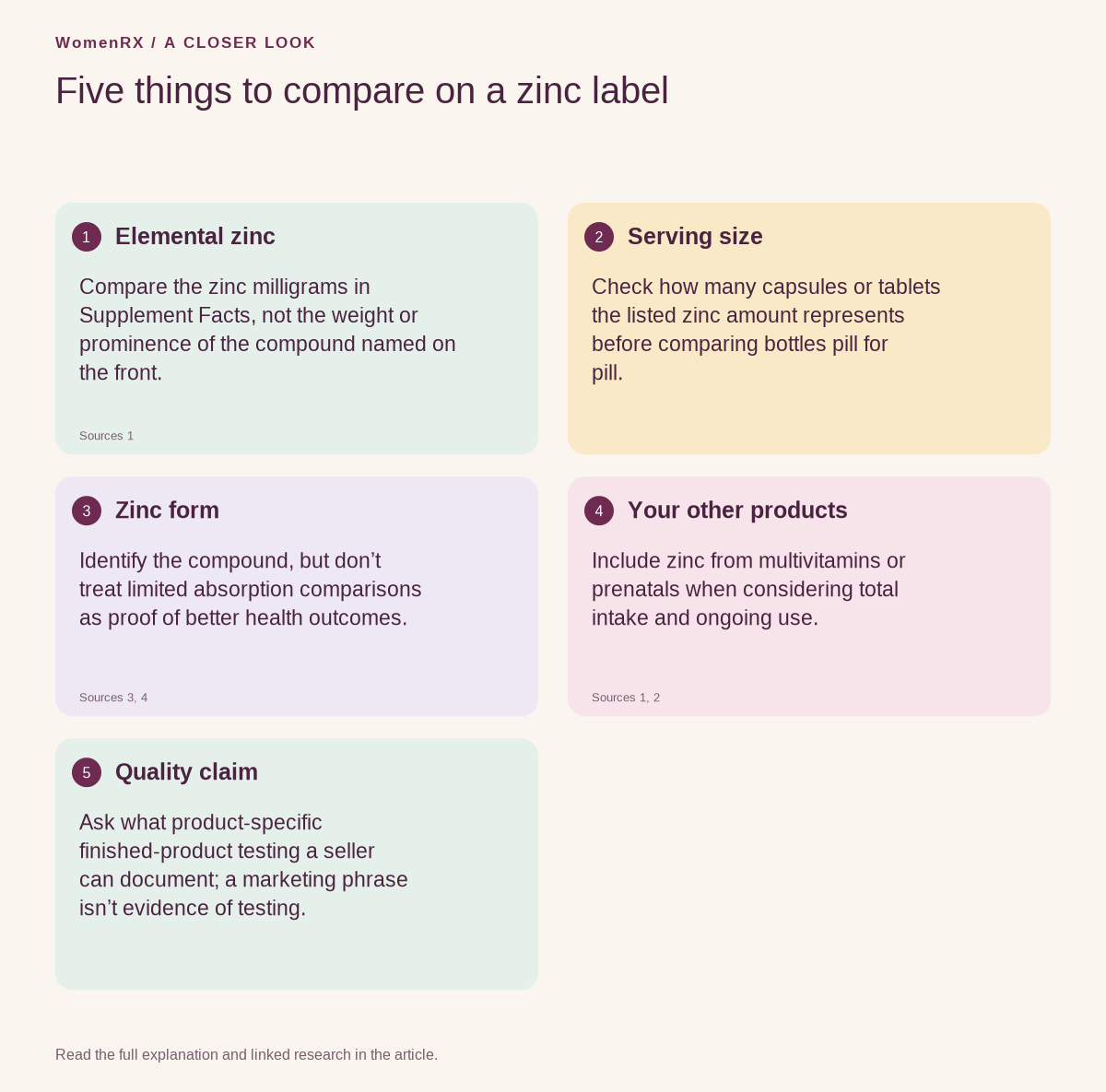
Five things to compare on a zinc label
Elemental zinc: Compare the zinc milligrams in Supplement Facts, not the weight or prominence of the compound named on the front.1
Serving size: Check how many capsules or tablets the listed zinc amount represents before comparing bottles pill for pill.
Zinc form: Identify the compound, but don’t treat limited absorption comparisons as proof of better health outcomes.34
Your other products: Include zinc from multivitamins or prenatals when considering total intake and ongoing use.12
Quality claim: Ask what product-specific finished-product testing a seller can document; a marketing phrase isn’t evidence of testing.
Read the figure as text
Use the same questions for each bottle rather than comparing front-label claims alone.- Elemental zinc: Compare the zinc milligrams in Supplement Facts, not the weight or prominence of the compound named on the front.1
- Serving size: Check how many capsules or tablets the listed zinc amount represents before comparing bottles pill for pill.
- Zinc form: Identify the compound, but don’t treat limited absorption comparisons as proof of better health outcomes.34
- Your other products: Include zinc from multivitamins or prenatals when considering total intake and ongoing use.12
- Quality claim: Ask what product-specific finished-product testing a seller can document; a marketing phrase isn’t evidence of testing.
Sources you can check
- Zinc - Health Professional Fact SheetAccessed 2026-09-25Return to first citation
- Copper - Health Professional Fact SheetAccessed 2026-09-25Return to first citation
- Role of zinc in health and disease.Stiles LI, Ferrao K, Mehta KJ. · Clinical and experimental medicine · 2024Return to first citation
- Preliminary Comparison of Fractional Absorption of Zinc Sulphate, Zinc Gluconate, and Zinc Aspartate after Oral Supple-Mentation in Healthy Human Volunteers.Piacenza F, Giacconi R, Costarelli L, Malavolta M. · Nutrients · 2023Return to first citation
- Acai: Usefulness and Safety | NCCIHAccessed 2026-09-25Return to first citation