How Breast Cancer Risk Varies With Menopause Hormone Therapy
Breast cancer evidence differs for estrogen-only and combined therapy, and the pattern depends on how long treatment is used.
There isn’t one breast cancer risk estimate that fits every type of menopause hormone therapy. Reviews describe a duration-related increase in risk with combined estrogen-progestogen therapy, while long-term findings for estrogen-only therapy after hysterectomy are different. A person’s breast cancer history and other risk factors also matter, so averages from one treatment group can’t predict an individual outcome. 4 5 6
The type of therapy changes the evidence
Menopause hormone therapy isn’t one treatment. Systemic therapy may contain estrogen alone or estrogen with a progestogen, and its effects can vary with formulation, duration, route, and when it is started. The North American Menopause Society advises weighing those features individually and revisiting the balance of benefits and risks over time. 2
The broad pattern in recent reviews is different for the two main regimens. Combined estrogen-progestogen therapy has been associated with a higher chance of breast cancer, with risk described as increasing with longer use. Estrogen-only therapy after hysterectomy has not shown the same pattern in long-term findings summarized by a recent review. These are group-level findings, not a forecast of what will happen to one person. 4 5
That difference doesn’t mean estrogen-only therapy is an interchangeable, lower-risk version of combined therapy. The evidence summarized for estrogen alone concerns people after hysterectomy; it doesn’t establish the same results for someone with a uterus or for every estrogen product and schedule. The treatment choice also has to fit the person’s medical situation, not just a breast cancer statistic.
Duration and progestogen deserve a closer look
For combined therapy, the evidence points to duration as one part of the risk picture. That’s a reason to revisit whether treatment is still meeting a meaningful need, not a reason to assume that a particular number of years is safe or unsafe for everyone. Menopause guidance recommends periodic reassessment and says longer treatment should be tied to a documented reason, with shared decision-making. 2 5
The type of progestogen may matter, too. A 2026 review describes observational evidence that micronized progesterone may have a more favorable breast cancer risk profile than some synthetic progestins. That comparison is not proof that one option eliminates risk: observational findings can identify a pattern, but they don’t establish that the progestogen alone caused it. 4
Personal history can change the conversation
A previous breast cancer diagnosis is a different situation from estimating risk for someone without that history. Menopause guidance lists estrogen-dependent cancer among reasons hormone therapy may not be a suitable choice, and a 2026 review describes evidence of harm from randomized trials of combined systemic hormone therapy and tibolone in breast cancer survivors. The same review says estrogen-only therapy has not been tested in randomized trials in this group. Those distinctions make a survivor’s treatment question different from the general-population evidence. 3 5
Other factors can shape a person’s starting risk, including a strong family history at a young age, an inherited risk-causing gene variant, atypical hyperplasia, or prior chest radiation at a young age. One review also identifies breast density as a risk factor. These factors don’t produce a precise personal forecast on their own, but they can change how the treatment tradeoff is considered. 1 6
What a useful comparison should include
When weighing systemic hormone therapy, ask which exact regimen the evidence applies to, how long it has been studied, and whether it resembles the proposed treatment. For example, evidence about estrogen alone after hysterectomy shouldn’t be used to estimate the risk of combined therapy. Likewise, an observational comparison between progestogens is less conclusive than a randomized comparison.
A practical discussion can connect the treatment’s purpose and expected benefit with the person’s breast cancer history and other risk factors. It can also make room to revisit the decision if symptoms, treatment needs, or health history change. This is more informative than applying one average risk estimate to every regimen and every person. 2 4 6
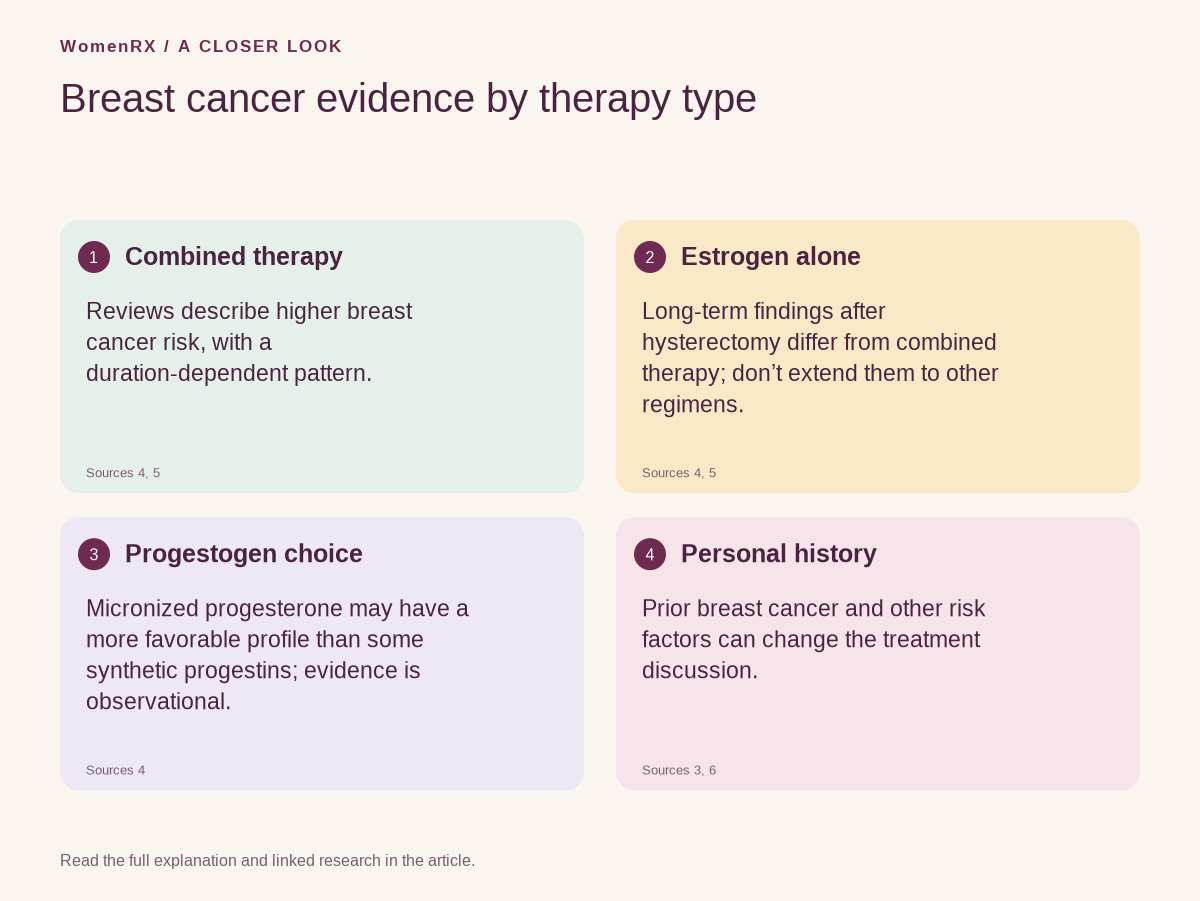
Breast cancer evidence by therapy type
Combined therapy: Reviews describe higher breast cancer risk, with a duration-dependent pattern.45
Estrogen alone: Long-term findings after hysterectomy differ from combined therapy; don’t extend them to other regimens.45
Progestogen choice: Micronized progesterone may have a more favorable profile than some synthetic progestins; evidence is observational.4
Personal history: Prior breast cancer and other risk factors can change the treatment discussion.36
Read the figure as text
These broad findings describe groups studied in reviews; they aren’t personal risk estimates.- Combined therapy: Reviews describe higher breast cancer risk, with a duration-dependent pattern.45
- Estrogen alone: Long-term findings after hysterectomy differ from combined therapy; don’t extend them to other regimens.45
- Progestogen choice: Micronized progesterone may have a more favorable profile than some synthetic progestins; evidence is observational.4
- Personal history: Prior breast cancer and other risk factors can change the treatment discussion.36
More questions, answered
Does estrogen-only evidence apply if I have a uterus?
The long-term estrogen-only findings summarized in recent reviews concern people after hysterectomy. They don’t establish the breast cancer risk of combined therapy or of estrogen-only treatment for someone with a uterus. The regimen and the person’s clinical circumstances need to match the evidence being discussed. 5
What if I’ve had breast cancer?
A personal breast cancer history calls for a different discussion from general-population risk estimates. One review reports harm signals from randomized trials of combined systemic hormone therapy and tibolone in survivors, while noting that estrogen-only therapy hasn’t been tested in randomized trials in that population. 3 5
Sources you can check
- Breast Cancer | Breast Cancer Symptoms | MedlinePlusAccessed 2026-09-25Return to first citation
- The 2022 hormone therapy position statement of The North American Menopause Society.“The 2022 Hormone Therapy Position Statement of The North American Menopause Society” Advisory Panel. · Menopause (New York, N.Y.) · 2022Return to first citation
- The 2023 nonhormone therapy position statement of The North American Menopause Society.Menopause (New York, N.Y.) · 2023Return to first citation
- Menopausal hormone therapy and breast cancer: Balancing risks and benefits.Bollam R, Karam J, Shufelt C, Faubion SS. · Maturitas · 2026Return to first citation
- Menopausal hormone therapy and breast cancer: risk and management.Sanserino K. · Current opinion in obstetrics & gynecology · 2026Return to first citation
- Evaluation of breast risk at menopause: what impact on the use of menopausal hormone therapy?Rodrigues MAH, Gompel A. · Maturitas · 2026Return to first citation