Headache, Hot Flashes, and Fatigue: What Might Connect Them?
The timing of your symptoms may reveal a possible connection, but it can’t show that menopause explains all three.
Hot flashes, headaches, and fatigue can overlap during perimenopause without having one cause. Night sweats that interrupt sleep may help explain next-day tiredness, while a headache or fatigue that follows a different pattern may need its own explanation. A sudden, severe headache should be reported to a health care provider; certain accompanying symptoms call for medical help right away. 1267
Start with the pattern, not the cluster
If headaches, hot flashes, and low energy arrive around the same time, it’s reasonable to wonder whether menopause connects them. Perimenopause can bring both menstrual-cycle-related symptoms and hot flashes. But headache and fatigue aren’t specific to menopause: in an analysis of women’s symptom logs, both were common across reproductive stages, and hot flashes did not predict other symptoms well apart from night sweats. The study describes patterns, not the cause of any one person’s symptoms. 7
Try comparing when the symptoms happen. For example, do you feel especially tired after a night when you woke up hot? Does the headache tend to arrive around menstrual changes, during a hot flash, or at an unrelated time? Timing gives you a clearer description of what’s happening. It isn’t a diagnosis.
When hot flashes may help explain low energy
Hot flashes and night sweats can occur alongside sleep trouble during the menopause transition. If you’re waking repeatedly and feel drained the next day, lost sleep is a plausible contributor: too little sleep is a recognized cause of fatigue. That connection is less convincing if the fatigue continues even after better nights. 16
Fatigue has other possible causes, including anemia, thyroid disease, infections, sleep disorders, depression, and anxiety. If you’ve felt tired for weeks without improvement, arrange an evaluation rather than assuming hot flashes account for it. 1
Give the headache its own attention
Headache has several possible explanations. Migraine is one type; tension headache is another. Stress, insufficient sleep, and missed meals can make tension headaches more likely. So a difficult night could be relevant to both tiredness and a headache, without proving that either was caused by a hot flash. 2
Notice whether headaches regularly coincide with menstrual changes, but don’t use that pattern alone to label them hormonal or migraine. If headaches keep recurring, get worse, or aren’t improving, seek care for the headache itself. 3
Some headache signs change the next step immediately. Tell a health care provider about a sudden, severe headache. Get medical help right away if a headache follows a blow to the head or comes with a stiff neck, fever, confusion, loss of consciousness, or pain in the eye or ear. Don’t wait to see whether those symptoms fit a menopause pattern. 2
Treating hot flashes addresses one part of the picture
If hot flashes are disrupting your sleep or daily life, you don’t have to wait for an explanation of every symptom before discussing relief. The North American Menopause Society identifies hormone therapy as the most effective treatment for menopausal hot flashes and recommends weighing its benefits and risks for the individual. Its evidence review also identifies nonhormonal options, including cognitive-behavioral therapy and certain prescription treatments. 45
Reducing hot flashes may help with the part of your experience tied to interrupted nights. It shouldn’t be treated as a test of what caused a separate headache or fatigue that persists.
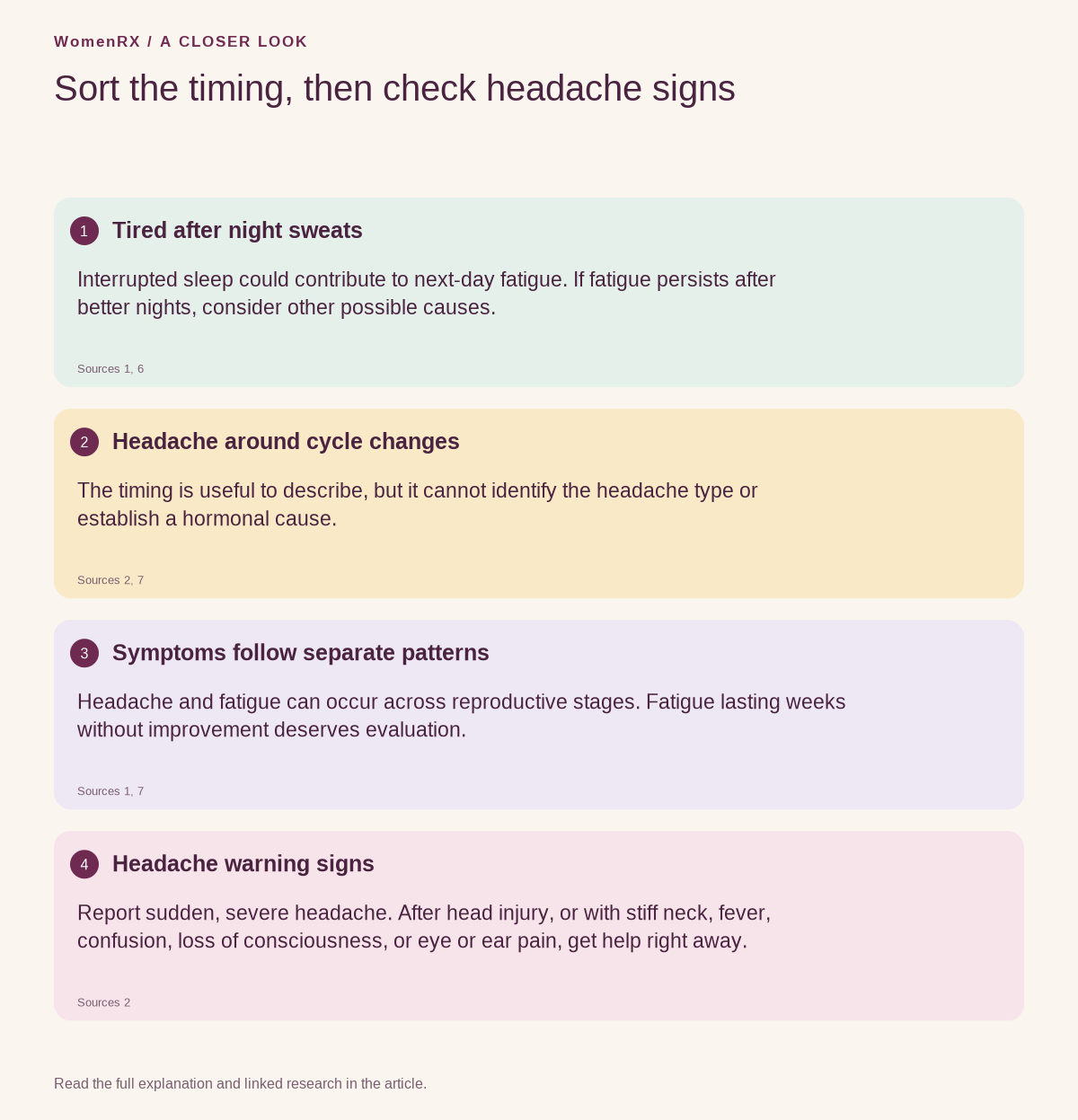
Sort the timing, then check headache signs
Tired after night sweats: Interrupted sleep could contribute to next-day fatigue. If fatigue persists after better nights, consider other possible causes.16
Headache around cycle changes: The timing is useful to describe, but it cannot identify the headache type or establish a hormonal cause.27
Symptoms follow separate patterns: Headache and fatigue can occur across reproductive stages. Fatigue lasting weeks without improvement deserves evaluation.17
Headache warning signs: Report sudden, severe headache. After head injury, or with stiff neck, fever, confusion, loss of consciousness, or eye or ear pain, get help right away.2
Read the figure as text
Use these distinctions to consider a possible connection without assuming the symptoms have one cause.- Tired after night sweats: Interrupted sleep could contribute to next-day fatigue. If fatigue persists after better nights, consider other possible causes.16
- Headache around cycle changes: The timing is useful to describe, but it cannot identify the headache type or establish a hormonal cause.27
- Symptoms follow separate patterns: Headache and fatigue can occur across reproductive stages. Fatigue lasting weeks without improvement deserves evaluation.17
- Headache warning signs: Report sudden, severe headache. After head injury, or with stiff neck, fever, confusion, loss of consciousness, or eye or ear pain, get help right away.2
More questions, answered
Do these three symptoms mean I have migraine?
No. Migraine is one possible type of headache, but hot flashes and fatigue alongside a headache don’t identify its type or cause. The headache’s own pattern and features matter. 27
Sources you can check
- Fatigue: MedlinePlusAccessed 2026-09-25Return to first citation
- Headache | MedlinePlusAccessed 2026-09-25Return to first citation
- Headaches - NHSAccessed 2026-09-25Return to first citation
- The 2022 hormone therapy position statement of The North American Menopause Society.“The 2022 Hormone Therapy Position Statement of The North American Menopause Society” Advisory Panel. · Menopause (New York, N.Y.) · 2022Return to first citation
- The 2023 nonhormone therapy position statement of The North American Menopause Society.Menopause (New York, N.Y.) · 2023Return to first citation
- Elinzanetant for the Treatment of Menopausal Hot Flashes: A Plain Language Review of the OASIS-1-4 Clinical Trial Results.Pinkerton JV, Nappi RE, Soares CN, Maki PM, Cardoso F, Donders G, Brennan D, Caetano C, Seitz C, Haseli-Mashhadi N, Haberland C, Brown G, Simon JA. · Women's health (London, England) · 2026Return to first citation
- Clustering of > 145,000 symptom logs reveals distinct pre, peri, and menopausal phenotypes.Aras SG, Grant AD, Konhilas JP. · Scientific reports · 2025Return to first citation