FDA Hormone Therapy Label Changes: Does Yours Apply?
The FDA approved changes to six menopause hormone therapy labels, so the first step is to check your exact product.
In November 2025, the FDA began a process to revise menopause hormone therapy warnings. It later approved changes to six product labels, removing statements about cardiovascular disease, breast cancer, and probable dementia from their boxed warnings. That doesn’t establish that your product was one of the six, erase other risk information, or settle whether treatment is right for you. 1
What changed, and when
You may have heard that the FDA “removed the hormone therapy warnings in 2025.” That skips a step. The FDA says it initiated removal of certain boxed-warning statements in November 2025. It subsequently approved revised labeling for six menopause hormone therapy products. Other companies had submitted proposed changes, but a proposed change is not an approved one. 1
For those six labels, statements about cardiovascular disease, breast cancer, and probable dementia were removed from the boxed warning, the label’s most prominent safety warning. The announcement does not say those risks have disappeared. Nor does its summary name the six products, so it cannot tell you on its own whether your tablet, patch, or other product has an approved revision. 1
How to check your specific medicine
Start with your prescription label or package, not just the word “estrogen.” Write down the product or generic name, active ingredients, manufacturer if shown, and form. If you have a package with an NDC number, keep that handy too. These details help distinguish products that share an ingredient but have different uses or labels.
Then look up the prescribing information for that exact product in the U.S. National Library of Medicine’s DailyMed drug-label database, or ask your pharmacist to pull up the current prescribing information. Match the manufacturer and form before reading it. Check the label’s revision date, approved uses, boxed warning, and Warnings and Precautions section. The date and wording tell you what the label you found says; they do not, by themselves, prove that this product was among the FDA’s six approved revisions. To establish that, ask your pharmacist or prescriber to match the product to an FDA product-specific approval record or confirmation of the approved label change. The FDA announcement confirms six approvals but does not identify all six in its summary. 1
A concrete example shows why reading beyond the headline matters. The April 2026 U.S. prescribing information for Prempro, an oral combination of conjugated estrogens and medroxyprogesterone acetate, says estrogen-plus-progestin therapy should not be used to prevent cardiovascular disease or dementia. It also reports that, in a Women’s Health Initiative study of postmenopausal women ages 50 to 79, the group taking a particular daily oral conjugated-estrogen and medroxyprogesterone-acetate combination had higher risks of deep vein thrombosis, pulmonary embolism, stroke, and heart attack than the placebo group over 5.6 years. Those findings concern that studied combination and population, not an identical risk estimate for every hormone product. This Prempro label illustrates why risk information still needs reading; it does not establish whether Prempro was one of the six products in the FDA announcement. 2
The ingredient alone can be especially misleading. Depo-Provera CI also contains medroxyprogesterone acetate, but its U.S. label says it is not indicated for postmenopausal women. A label update concerning menopause therapy should not be assumed to apply to a different product simply because the names of their ingredients overlap. 2 3
What the label cannot decide for you
A revised boxed warning changes where certain risk statements appear on particular products. Your treatment decision still depends on what you’re treating, which hormones and route you use, when you started relative to menopause, and your health history. The Menopause Society’s 2022 position statement says benefits and risks vary by type, dose, duration, route, timing, and whether a progestogen is used. It describes a generally favorable benefit-risk balance for treating bothersome hot flashes or preventing bone loss in women younger than 60 or within 10 years of menopause onset who have no contraindications. Starting later tends to have a less favorable balance. 4
The symptom you want to treat matters too. If your main concern is vaginal or urinary discomfort rather than hot flashes, say so. For bothersome genitourinary symptoms not relieved by over-the-counter therapies, when systemic hormone therapy isn’t otherwise indicated, the Menopause Society recommends considering low-dose vaginal estrogen or certain other treatments. That clinical distinction does not tell you whether a particular vaginal product received a revised FDA label. 4
If you’re considering a change because of the news, bring the exact product details and ask two separate questions: “Was a revised label approved for this product and form, and what wording changed?” and “Given my symptoms and health history, does any of this change our treatment plan?” That keeps a regulatory update from being mistaken for either an all-clear or a reason to stop a treatment that’s helping you. 1 4
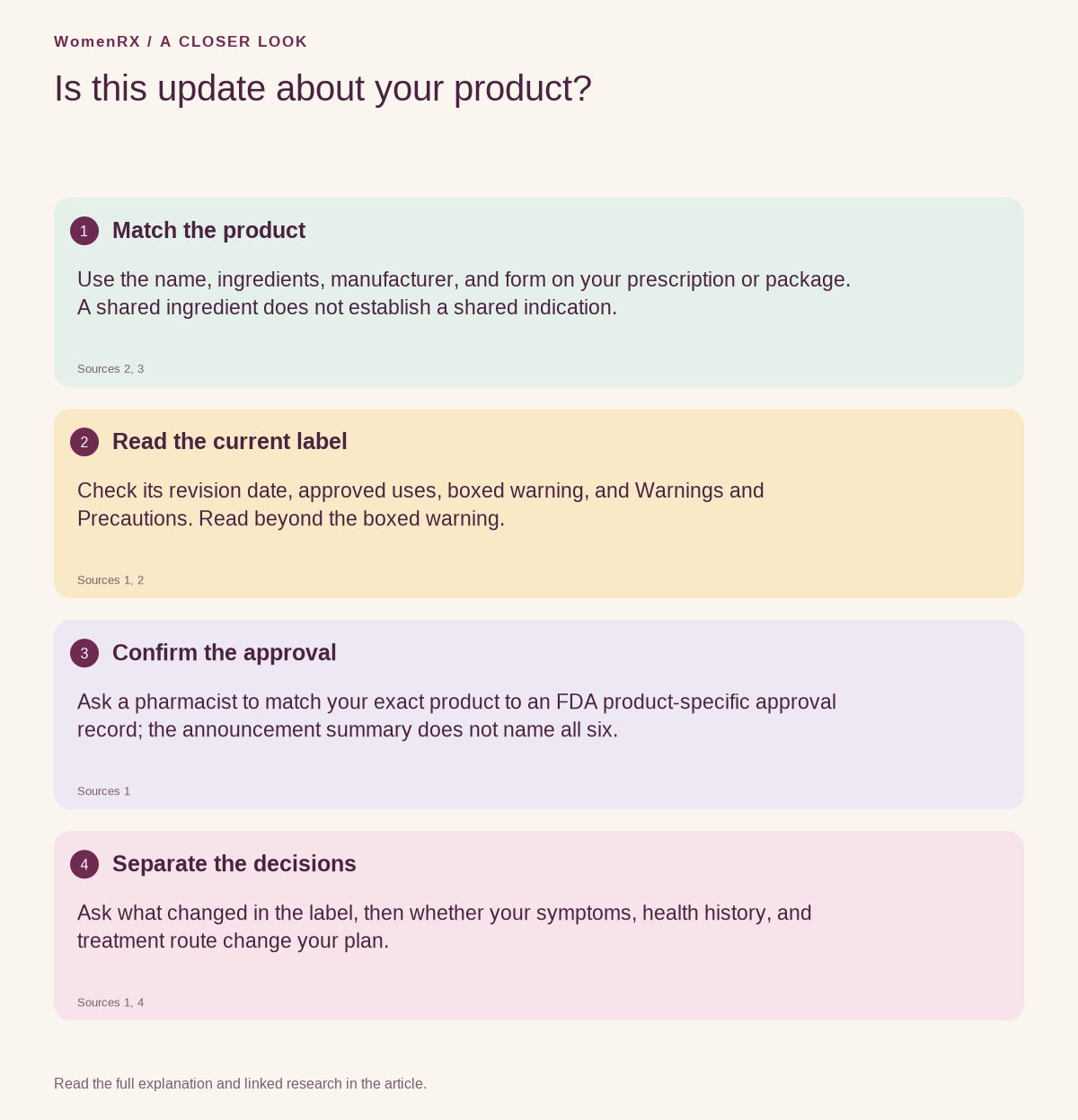
Is this update about your product?
Match the product: Use the name, ingredients, manufacturer, and form on your prescription or package. A shared ingredient does not establish a shared indication.23
Read the current label: Check its revision date, approved uses, boxed warning, and Warnings and Precautions. Read beyond the boxed warning.12
Confirm the approval: Ask a pharmacist to match your exact product to an FDA product-specific approval record; the announcement summary does not name all six.1
Separate the decisions: Ask what changed in the label, then whether your symptoms, health history, and treatment route change your plan.14
Read the figure as text
Use these checks to distinguish a current label from confirmation that your medicine received an approved revision.- Match the product: Use the name, ingredients, manufacturer, and form on your prescription or package. A shared ingredient does not establish a shared indication.23
- Read the current label: Check its revision date, approved uses, boxed warning, and Warnings and Precautions. Read beyond the boxed warning.12
- Confirm the approval: Ask a pharmacist to match your exact product to an FDA product-specific approval record; the announcement summary does not name all six.1
- Separate the decisions: Ask what changed in the label, then whether your symptoms, health history, and treatment route change your plan.14
More questions, answered
Does removing a boxed-warning statement mean the risk was removed from the full label?
Not necessarily. The FDA describes removal of specific statements from the boxed warning. Check the current full label, including Warnings and Precautions, for risk information that remains relevant to your product. 1 2
Sources you can check
- FDA Approves Labeling Changes to Menopausal Hormone Therapy Products | FDAAccessed 2026-09-25Return to first citation
- PREMPHASE (CONJUGATED ESTROGENS AND MEDROXYPROGESTERONE ACETATE) KIT PREMPRO (CONJUGATED ESTROGENS AND MEDROXYPROGESTERONE ACETATE) TABLET, SUGAR COATED [WYETH PHARMACEUTICALS LLC, A SUBSIDIARY OF PFIZER INC.] | US prescribing information and patient instructionsAccessed 2026-09-25Return to first citation
- DEPO-PROVERA (MEDROXYPROGESTERONE ACETATE) INJECTION, SUSPENSION [PHARMACIA & UPJOHN COMPANY LLC] | US prescribing information and patient instructionsAccessed 2026-09-25Return to first citation
- The 2022 hormone therapy position statement of The North American Menopause Society.“The 2022 Hormone Therapy Position Statement of The North American Menopause Society” Advisory Panel. · Menopause (New York, N.Y.) · 2022Return to first citation