EAAs or BCAAs: What’s Worth Adding to Your Training?
The useful question isn’t which amino-acid powder sounds more athletic, but whether it adds anything to the protein you already eat.
BCAAs provide three essential amino acids; an EAA blend provides a broader mix. In one small study after resistance exercise, a specific EAA formula and BCAAs produced similar short-term whole-body leucine retention, but the study didn’t test long-term strength or muscle growth. It also doesn’t establish a distinct benefit or need for women: four women took part, but their results weren’t reported separately. Start with your usual protein intake before deciding whether either supplement fills a gap. 1 2
What’s different inside the scoop?
BCAAs are leucine, isoleucine, and valine, three of the essential amino acids. An EAA product contains a broader essential-amino-acid mix. Leucine attracts attention because it helps signal muscle protein synthesis, while dietary amino acids also provide material for building proteins. Those are related roles, but a strong signal alone doesn’t tell you what a supplement will do for your strength or muscle growth over months of training. 2
So EAAs offer more types of essential amino acids than BCAAs. That’s a composition difference, not proof that an EAA drink will improve your training results more than a BCAA drink, or that either adds value when you’re already getting enough protein from your diet.
What happened when researchers compared them?
In a randomized crossover study, 12 young, recreationally active adults, eight men and four women, completed a resistance workout and then drank either a particular EAA formula with added dileucine, a BCAA formula, or collagen. Over the next six hours, whole-body leucine retention was similar after the EAA and BCAA drinks. The study did not establish a significant overall difference in its measured muscle protein synthesis response among the drinks. 2
That’s useful, but narrow. Whole-body leucine retention is a short-term measure, not a count of new muscle gained. The EAA drink also contained added dileucine, so this wasn’t a test of every EAA blend on the shelf. Researchers didn’t follow a training program to see whether either drink changed strength or muscle growth. And although four participants were women, their results weren’t reported separately. 2
A separate study helps put leucine marketing in perspective. Ten young healthy men consumed either β-lactoglobulin, a whey protein, or a whey protein isolate with the same amount of protein. Both increased muscle protein synthesis, with no significant difference between them. That doesn’t compare EAA and BCAA powders, but it does show why more leucine on a label needn’t translate into a greater measured response in every setting. 3
Put your eating pattern before the product category
Protein needs vary with age, sex, health, and physical activity. Meat, dairy, nuts, grains, and beans can all contribute protein. If you eat mostly plant foods, including different types of plant proteins across the day can help provide the amino acids your body needs. 1
Think about what’s already on your plate before comparing tubs. For example, if your usual meals regularly include protein-containing foods that work for you, these studies don’t show that adding EAAs or BCAAs will improve your long-term training results. If getting enough protein is the concern, look first at whether you can add protein-containing foods that fit your diet. An amino-acid blend’s ingredient list cannot tell you whether your overall protein intake meets your needs. 1 2
These studies don’t establish a distinct supplement benefit or need for women. The direct comparison included four women but didn’t report their outcomes separately; the whey-protein comparison enrolled men only. The studies also don’t answer whether needs differ during cycling years, pregnancy, postpartum, perimenopause, or postmenopause. Choose based on the gap you’re actually trying to fill, not a label aimed at women. 2 3
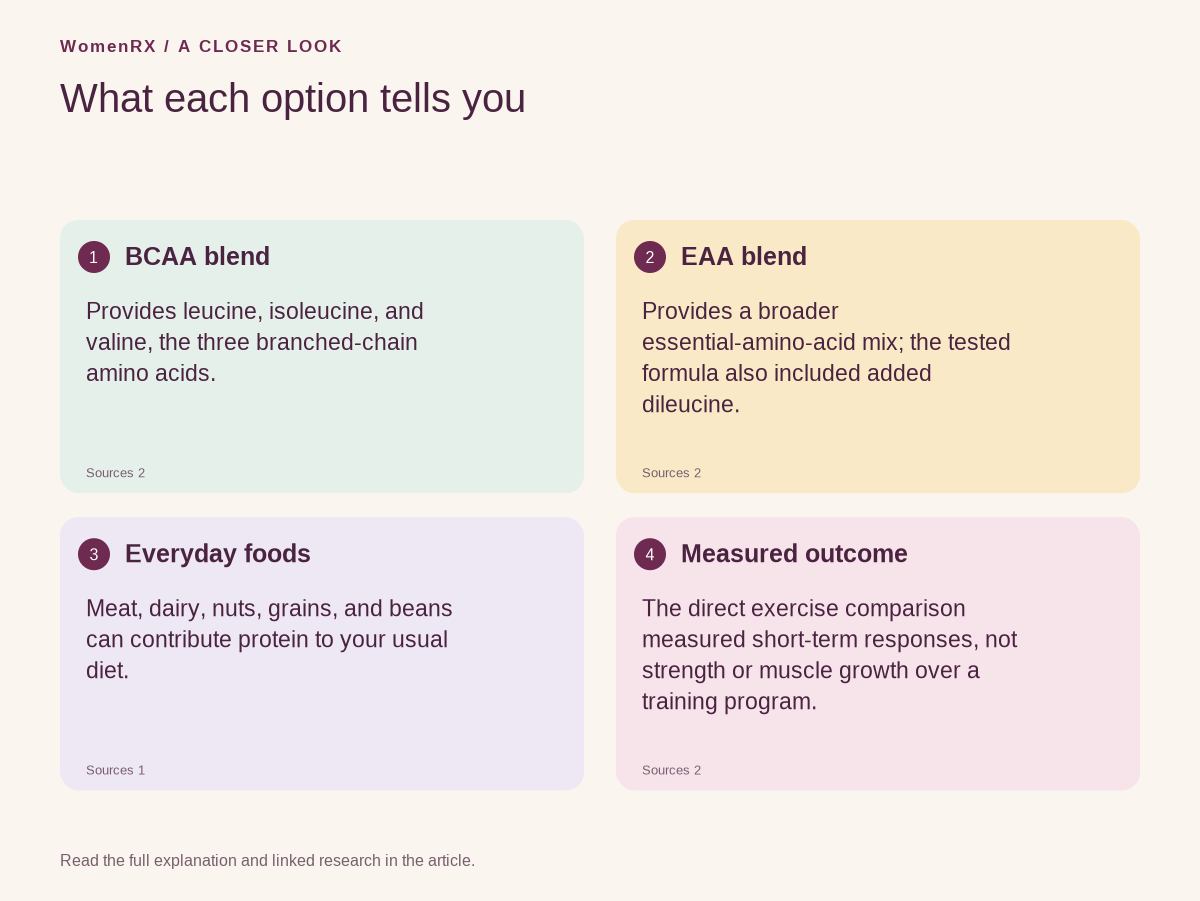
What each option tells you
BCAA blend: Provides leucine, isoleucine, and valine, the three branched-chain amino acids.2
EAA blend: Provides a broader essential-amino-acid mix; the tested formula also included added dileucine.2
Everyday foods: Meat, dairy, nuts, grains, and beans can contribute protein to your usual diet.1
Measured outcome: The direct exercise comparison measured short-term responses, not strength or muscle growth over a training program.2
Read the figure as text
Compare what the ingredients provide with what the exercise research can actually answer.- BCAA blend: Provides leucine, isoleucine, and valine, the three branched-chain amino acids.2
- EAA blend: Provides a broader essential-amino-acid mix; the tested formula also included added dileucine.2
- Everyday foods: Meat, dairy, nuts, grains, and beans can contribute protein to your usual diet.1
- Measured outcome: The direct exercise comparison measured short-term responses, not strength or muscle growth over a training program.2
Sources you can check
- Dietary Proteins: MedlinePlusAccessed 2026-09-25Return to first citation
- Dileucine-supplemented essential amino acids support whole-body anabolism after resistance exercise and serum-stimulated cell-based anabolism.Aguilera JA, Tinline-Goodfellow CT, Lees MJ, Kortebi I, West DWD, Abou Sawan S, Sharma M, Bashir R, Barnes TM, Ulanov AV, Burd NA, Moore DR. · Journal of the International Society of Sports Nutrition · 2025Return to first citation
- The Effect of Leucine-Enriched β-Lactoglobulin Versus an Isonitrogenous Whey Protein Isolate on Skeletal Muscle Protein Anabolism in Young Healthy Males.Ely IA, Paul M, Wall JJS, Cox J, Larsen MS, Scaife PJ, Lund JN, Breen L, Wilkinson DJ, Smith K, Phillips BE, Atherton PJ. · Nutrients · 2025Return to first citation