Collagen or Complete Protein: Which Fits Your Goal?
If you’re trying to meet protein needs or support muscle, a complete protein powder is the more fitting choice; collagen has a different amino-acid profile and a much narrower evidence base for muscle.
For meeting protein needs or supporting muscle, choose a powder that supplies all essential amino acids, such as a complete protein source. Collagen peptides are low in essential amino acids, including leucine, and a small short-term study in young adults found no increase in measured muscle protein synthesis after collagen. That doesn’t settle every possible collagen use, but it doesn’t make collagen a stand-in for complete protein. 1 2
Start with what you want the powder to do
If your goal is to add protein to a meal or support muscle alongside resistance exercise, look for a source that supplies all the essential amino acids your body can’t make. MedlinePlus describes animal proteins as complete proteins; plant proteins can also contribute through a varied diet. 1 A powder’s label may tell you how much protein it provides, but that number alone doesn’t tell you whether its amino-acid profile fits your goal.
Collagen peptides are protein, but they aren’t nutritionally interchangeable with complete protein powders. Collagen has low amounts of essential amino acids, especially leucine, an amino acid involved in the muscle-building response. 2 So if you’re choosing one powder specifically to help fill a protein gap or support muscle, a complete source is the more direct fit.
What the collagen muscle study actually found
In a randomized study, 45 healthy, recreationally active young adults, 21 men and 24 women, received collagen, a matching mixture of free amino acids, or a noncaloric placebo after resistance exercise. The researchers measured protein synthesis in muscle tissue over six hours. Neither collagen nor the amino-acid mixture significantly increased measured muscle protein synthesis in the exercised or rested leg compared with placebo. 2
That’s a short-term result, not proof about long-term muscle gain, strength, or every collagen product. The study didn’t compare collagen directly with whey or another complete protein powder. Although women were included, results weren’t reported separately for them. The participants were young, so the findings don’t establish how collagen affects muscle in older or postmenopausal women. 2
How to choose between them
Choose a complete protein source when you want the powder itself to contribute a balanced set of essential amino acids, or when muscle support is your main goal. Complete animal proteins provide all essential amino acids; combinations of plant proteins can also help meet amino-acid needs. 1 For older adults, a review emphasizes protein quality and essential amino acids, particularly leucine, in addition to protein quantity and physical activity. It is a review, not a collagen-versus-whey trial in postmenopausal women. 3
Consider collagen as a separate product, not a protein replacement. The study here doesn’t show that collagen increases muscle protein synthesis, and it doesn’t establish a benefit for other outcomes. If you use collagen, count it as distinct from the complete protein you rely on to support your overall protein intake.
You may not need a powder at all. Protein comes from foods including meat, dairy, nuts, grains, and beans. Your needs vary with factors such as age, health, and activity level. 1 A useful first step is to look at what you already eat and identify whether a convenient protein source would fill a real gap.
The practical bottom line
For protein adequacy or muscle support, prioritize a complete protein source from food or powder. Collagen’s different amino-acid profile is the key distinction, and current evidence here doesn’t show that a single collagen serving increases muscle protein synthesis. If your interest in collagen is unrelated to muscle, this comparison can’t tell you whether it helps that separate goal.
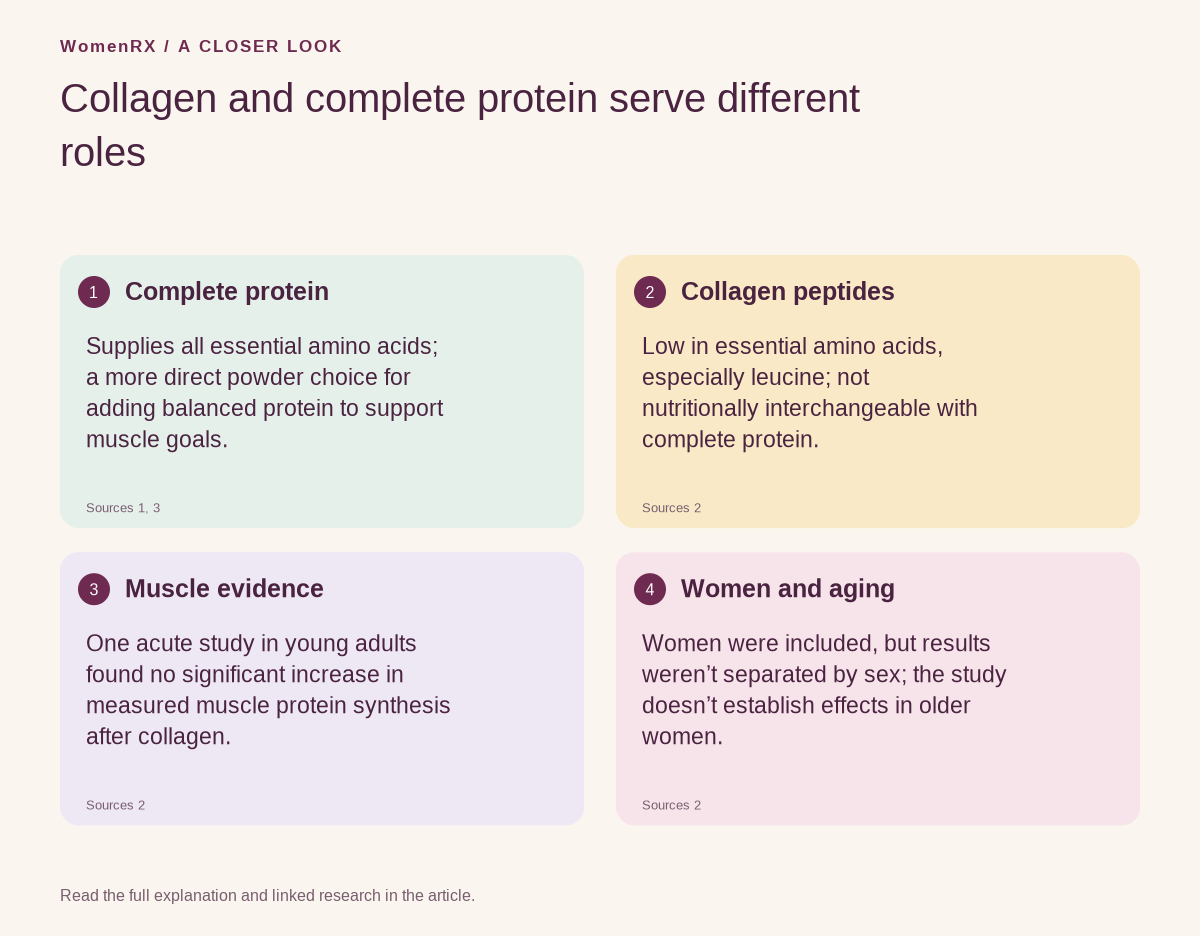
Collagen and complete protein serve different roles
Complete protein: Supplies all essential amino acids; a more direct powder choice for adding balanced protein to support muscle goals.13
Collagen peptides: Low in essential amino acids, especially leucine; not nutritionally interchangeable with complete protein.2
Muscle evidence: One acute study in young adults found no significant increase in measured muscle protein synthesis after collagen.2
Women and aging: Women were included, but results weren’t separated by sex; the study doesn’t establish effects in older women.2
Read the figure as text
Compare amino-acid profile, muscle evidence, and the goal each product can reasonably address.- Complete protein: Supplies all essential amino acids; a more direct powder choice for adding balanced protein to support muscle goals.13
- Collagen peptides: Low in essential amino acids, especially leucine; not nutritionally interchangeable with complete protein.2
- Muscle evidence: One acute study in young adults found no significant increase in measured muscle protein synthesis after collagen.2
- Women and aging: Women were included, but results weren’t separated by sex; the study doesn’t establish effects in older women.2
More questions, answered
Does collagen count as protein?
Yes, collagen is a protein. But because it is low in essential amino acids, including leucine, it isn’t nutritionally equivalent to a complete protein source for meeting amino-acid needs. 2
Does this research answer the question for postmenopausal women?
No. The collagen study included young men and women, but didn’t report results separately by sex or study older or postmenopausal women. 2
Sources you can check
- Dietary Proteins: MedlinePlusAccessed 2026-09-25Return to first citation
- The Effects of Ingesting a Single Bolus of Hydrolyzed Collagen versus Free Amino Acids on Muscle Connective Protein Synthesis Rates.Aussieker T, Kaiser J, Hendriks FK, Janssen TAH, Senden JM, VAN Kranenburg JMX, Goessens JPB, Zorenc A, Kornips E, Brinkhuizen T, Baar K, Snijders T, Holwerda AM, VAN Loon LJC. · Medicine and science in sports and exercise · 2025Return to first citation
- The role of protein quality and amino acid composition in preventing sarcopenia and functional decline in older adults.Calderón P, Jima Gavilanes D, Vivanco-Zárate AS, Sarango-González KP. · Frontiers in nutrition · 2026Return to first citation